
Reviewed · GOVERNMENT-LICENSED GUIDE TOURS
Nagasaki Half-Day Private Tour with Government-Licensed Guide
Nagasaki is a city best understood through its contrasts: a port shaped by Chinese and Dutch trade, a center of Christianity in Japan, and the site of the 1945 atomic bombing. This private, custom-built tour lets you choose which part of that story matters most, with a licensed local guide beside you instead of a fixed bus itinerary.
I like two things right away: the personal pace and the chance to hear Nagasaki through a local’s own experience. Guides such as Yoshi, Hiromi, Noriko, Hiro, and Norah have helped visitors connect museums and monuments with family memories, local food, festivals, and modern life. The main drawback is practical: the price does not include a private vehicle, transport fares, or entrance tickets, and four hours is enough for only two or three major stops.
Key points to know before booking
- Choose two or three sites: The long stop list is a menu, not a promise that you will see everything.
- Meet on foot: Hotel, station, port, and other meeting points may be arranged, but this is not a chauffeur service.
- Use public transport or taxis: Trams, buses, walking, and taxis can all shape the route, with fares paid separately.
- Expect serious history: Peace Park, the Hypocenter, Urakami Cathedral, and the Atomic Bomb Museum require quiet attention.
- Ask for local stories: Guides have shared family memories, festival traditions, champon recommendations, and practical advice for the rest of your stay.
- Good for a short visit: The tour works especially well if Nagasaki is a one-day stop or you want help finding your bearings before exploring alone.
A four-hour introduction to Nagasaki on your terms
The best feature here is not the number of places listed. It is the freedom to decide what kind of Nagasaki you want to meet.
You might spend the morning at Peace Park, the Atomic Bomb Museum, and the Hypocenter. That creates a focused visit built around the bombing and the city’s recovery. Or you might choose Dejima, Glover Garden, and Oura Church to examine Nagasaki as Japan’s doorway to foreign trade and Christianity.
A different plan could pair Sofukuji Temple, Kofukuji Temple, and Spectacles Bridge. That route brings together Chinese influence, Zen Buddhism, and the old center of town. Your guide should help you judge what fits into four hours, rather than encouraging an impossible checklist.
The tour is private, so only your own group takes part. That matters when the subject is emotional. You can pause at a museum, ask a difficult question, or change the pace without holding up a busload of people.
Other tours with a licensed guide in Japan:
- Tokyo 6hr Private Tour with Government-Licensed Guide
★ 5.0 · 3,902 reviews - Tokyo 4hr Private Tour with Government-Licensed Guide
★ 5.0 · 1,394 reviews - Kyoto 6hr Private Tour with Government-Licensed Guide
★ 5.0 · 1,369 reviews
Why the guide matters in Nagasaki
Nagasaki’s sights are spread across hills, riverfront streets, temple districts, and neighborhoods connected by public transport. A guide can save time, explain which stops belong together, and help you avoid spending the whole morning simply finding your way.
The strongest personal accounts come from guides who grew up in Nagasaki. Yoshi has shared family connections to the city and, in one tour, spoke about her father’s experience related to the bombing. Another guide, Tasaki Toru, was described as having a personal connection to the 1945 bombing as well. These stories can give the city a human scale, but they also call for sensitivity. Personal testimony is not a substitute for the museum’s records, and you should expect the subject to be handled with care.
Guides have also helped with much lighter parts of the visit. Yoshi introduced families to champon, Nagasaki’s well-known noodle dish, and taught children origami. Noriko helped a couple find vegan dining and offered suggestions for the rest of their stay. One guide arranged a traditional Japanese meal, while another pointed out a local festival rehearsal.
That mix is valuable. You can learn about wartime history in the morning, then ask where to eat or what to see next. The guide is not only there to recite dates.
Peace Park, the Hypocenter, and the Atomic Bomb Museum
For many people, this is the most important route.
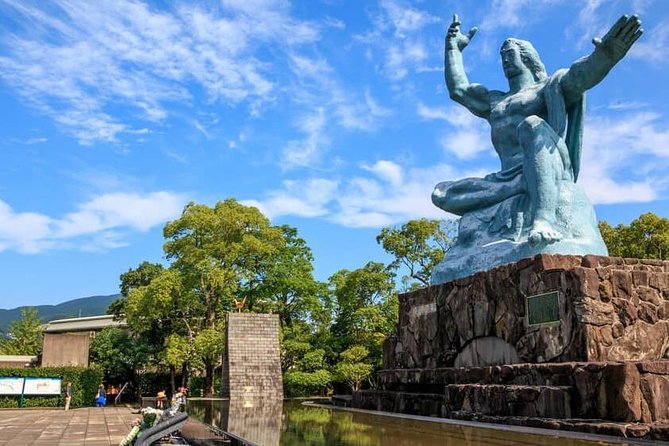
Peace Park is a quiet memorial space connected to the atomic bombing of August 9, 1945. The Hypocenter marks the place near the center of the explosion. Together, they give you a physical sense of the event that a textbook cannot provide.
The Atomic Bomb Museum adds documentation, objects, photographs, and accounts of destruction and recovery. It is a serious museum, not a quick photo stop. Fifteen minutes, as suggested in the stop descriptions, would be far too short for most people who want to read the displays properly. If you choose this route, tell your guide that you would rather spend more time here and drop another site.
A past family group visited the museum, Peace Park, and the Hypocenter with a guide who adjusted the route for children. Another group traveled by tram to the Peace Park and walked through the area with Hiro. This shows how useful the public transport format can be, but also why you need to discuss timing in advance.
Urakami Cathedral can add another layer. The church has a tragic connection to the bombing and remains a working Catholic cathedral in a large red brick building. It may suit you if you want to explore Nagasaki’s Christian history alongside the wartime story. It is not a replacement for the museum, and it should be approached respectfully as a religious site.
Dejima and the city’s international past
Dejima began as a man-made island built in 1636 to separate Portuguese residents from the Japanese population and control missionary activity. After the Portuguese were removed, it became associated with Dutch trade and Japan’s tightly managed contact with the outside world.
Today, Dejima helps you picture how limited, controlled foreign exchange once worked. The site is especially useful with a guide because its importance is not always obvious from the buildings alone. You may see reconstructed spaces and displays, but the larger point is how Nagasaki connected Japan with China, the Netherlands, and other foreign influences during a period of restricted contact.
The Nagasaki Museum of History and Culture is another strong choice for this theme. It presents Nagasaki as one of Japan’s major international ports and offers a broader setting for understanding trade, culture, and local government.
If you have only four hours, I would not choose both Dejima and the museum unless this is your main interest. They overlap in subject, though each approaches it differently. Dejima gives you place and atmosphere. The museum gives you context and objects.
Same base, a different sort of day:
- Mt Fuji and Hakone 1-Day Bus Tour Return by Bullet Train
★ 5.0 · 26,383 reviews - 1-Day Tokyo Bus Tour
★ 5.0 · 14,250 reviews - PERFECT KYOTO 1-Day Bus Tour
★ 5.0 · 13,518 reviews - Tokyo: TOKYO SKYTREE® Admission ticket
★ 4.5 · 11,192 reviews
Glover Garden, Oura Church, and the foreign settlement
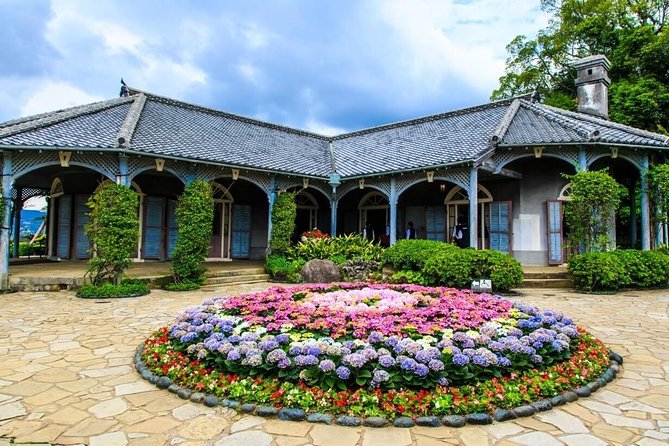
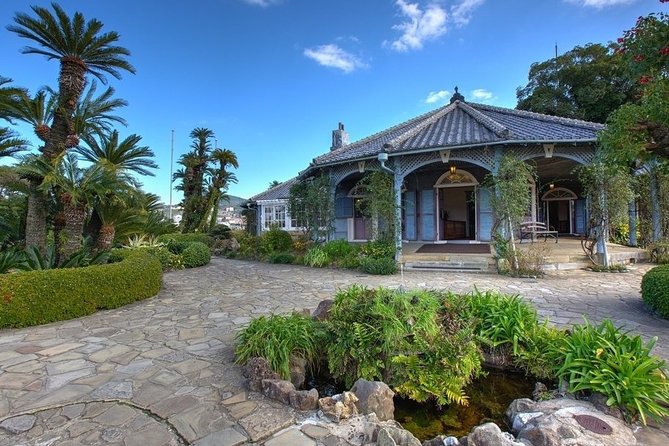
Glover Garden sits on a hillside and preserves mansions linked to former foreign residents. It is an open-air museum, so you get buildings, views, and a sense of the foreign settlement rather than a single indoor exhibit.
The hill is important to the experience. You should wear comfortable shoes and expect some walking. The setting can be rewarding, but anyone with limited mobility should ask about the exact route before booking. The tour does not include a private vehicle, and the guide meets you on foot.
Nearby Oura Church was built in 1864 by a French missionary for the foreign merchant community. It represents Nagasaki’s Christian history and the return of Christianity after a long period of suppression. The stop list names Oura Church twice, but it is the same attraction, not two separate churches.
Glover Garden and Oura Church make a natural pair. Add the Dutch Slope if you enjoy streets and architecture. This stone-paved hillside road once served an area where foreign traders lived after Nagasaki reopened its port to foreign trade in 1859.
The drawback is that this route can become hill-heavy. You may enjoy the views and old streets, but it is not the easiest choice if you want a flat, low-effort morning.
Sofukuji, Kofukuji, and the Chinese connection
Sofukuji Temple was built in 1629 for Nagasaki’s Chinese residents and follows a Chinese architectural style within the Obaku school of Zen Buddhism. Kofukuji is older and is described as the oldest important Chinese-founded temple in the city. Both belong on a route focused on the Chinese influence that shaped Nagasaki.
These temples offer a useful correction to the idea that Nagasaki’s foreign links were mainly European. Chinese merchants, religious communities, food, architecture, and trade were central to the city’s development.
Kofukuji lies in the Teramachi, or Temple Town, district. That setting helps you see the temple as part of an older urban quarter rather than an isolated monument. Sofukuji has its own appeal as a place of Chinese-influenced design and Zen tradition.
The guide can explain differences that may blur together if you visit alone. Still, two temple stops may feel repetitive if you are not especially interested in religious architecture. Pairing one temple with Spectacles Bridge or Dejima may give you a wider view of the city.
Spectacles Bridge and the old city center
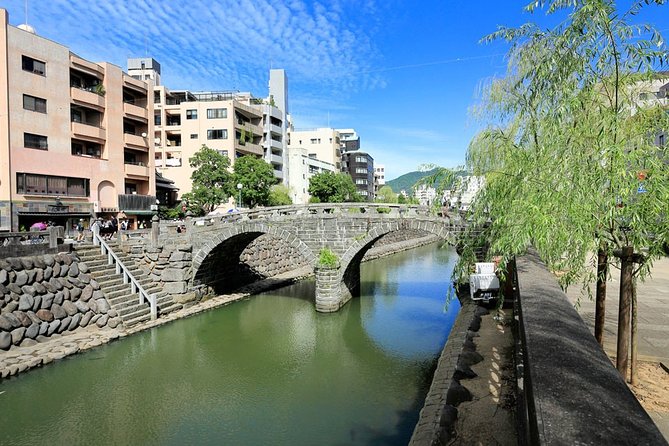
Meganebashi, or Spectacles Bridge, crosses the Nakashima River and gets its name from the twin arches reflected in the water. It is a short, easy stop and works well as part of a walking route through central Nagasaki.
Do not expect a major museum visit here. The value is visual and local. You can see one of the city’s best-known bridges, walk along the river, and connect the stop with nearby temple streets and shopping areas.
This is a good choice if you want a lighter morning after spending time at the Atomic Bomb Museum. It is also useful for families who need a change of pace. A guide can point out how the bridge fits into the city rather than treating it as a stand-alone photograph.
Mount Inasa for the broad city view
Mount Inasa rises 333 meters near the center of Nagasaki. The observation deck offers wide views over the city and port, with night views often considered a special attraction.
A short stop at the summit can help you understand Nagasaki’s shape. The city is not simply a flat port. Hills wrap around the built-up areas, and the view explains why some visits involve stairs, slopes, and careful route planning.
The summit can be reached by ropeway, bus, or car, but this tour does not include a private vehicle or transport fares. Ask your guide how the stop fits with the rest of your plan. A mountain visit can consume more time than a brief description suggests, especially if you are relying on public transport.
I would choose Mount Inasa if the view matters to you more than another museum or temple. It may be less useful in poor weather, though the supplied details do not promise any particular visibility.
The Christian Martyrs Monument and Confucius Shrine
The Twenty-Six Christian Martyrs Monument and adjacent museum honor 26 Christians executed in Nagasaki on February 5, 1597. The stop provides direct context for the city’s Christian story and is more focused than a general church visit.
The Nagasaki Confucius Shrine and Chinese Museum of Successive Generations offers another angle on the city’s international past. Built in 1893 by Nagasaki’s Chinese community, it is one of only a small number of Confucius shrines in Japan.
These two sites are useful if you want to compare the city’s Christian and Chinese legacies. They are not essential additions to a Peace Park route, and fitting both into four hours may leave too little time at the places you care about most.
What the price really buys you
At $122.20 per person, this is not the cheapest way to see Nagasaki. You still pay your own transport, admission tickets, lunch, and personal expenses. A private vehicle is not included.
The value comes from time saved and route control. If you are in Nagasaki for one day, arriving from a cruise ship, or traveling with family members who have different interests, a guide can prevent a wasted morning. You can also ask for a route built around your priorities instead of paying for several stops you do not want.
For three people, a private tour can compare favorably with a group excursion, especially when you value flexibility. One family chose it instead of a ship excursion and used a taxi to reach selected sights at their own pace. That does not mean the tour will always cost less than a group option. It means you should compare the total: tour fee, transport, admissions, and the value of having your own guide.
The group discount feature may improve the price for larger parties, but the exact discount is not provided. Ask before booking if the calculation matters to you.
Planning the meeting and transport
The guide meets you on foot within the designated Nagasaki area. Past arrangements have included hotels, Nagasaki Station, and the port terminal. Confirm the exact meeting place after booking, especially if you are arriving by ship or train.
This is a walking and public transport tour. Trams, buses, taxis, and walking may all be part of the morning. Fares are separate, and you should not assume a car will be waiting at your hotel.
One poor experience came from a misunderstanding about vehicle transport, along with concerns about a guide’s speaking volume and worn visual materials. That is a useful warning. Confirm three things in advance: where you will meet, how you will move between stops, and which sites you want to prioritize.
Guide quality can vary by individual. The strongest accounts describe clear English, good communication before arrival, personal stories, and careful attention to timing. Guides have also warned families about rain, suggested umbrellas, and adjusted routes for children. Contact before the tour gives you a chance to explain your walking pace, interests, and language needs.
Who should book this private Nagasaki tour
I would choose this tour if you have one day in Nagasaki and want help making sense of the city quickly. It also suits families, couples, cruise passengers, and small groups who do not want to follow a fixed route.
It is particularly good for you if you want to combine serious history with ordinary local life. A guide may take you from the Atomic Bomb Museum to champon noodles, from a temple district to a tram stop, or from a formal monument to advice about what to see next.
I would think twice if you want a fully escorted vehicle tour, dislike walking, or hope to visit most of the 16 listed places. The tour is built around two or three sites, not a grand sweep through the entire city. Entrance fees and transport costs can also make the final bill higher than the headline price.
The experience includes free cancellation up to 24 hours before the start time. Changes or cancellations made later are not accepted for a refund. Most people can participate, and service animals are allowed, but the walking and hillside routes deserve attention when planning.
Should you book it?
Book it if you want a flexible introduction with a real local connection, especially if Nagasaki is a short stop. Ask for a guide who matches your interests, then choose a tight route: Peace Park, the Hypocenter, and the Atomic Bomb Museum for wartime history; or Dejima, Glover Garden, and Oura Church for international Nagasaki.
I like this tour best when you treat it as a thoughtful four-hour orientation, not a race through every sight. Confirm transport, admissions, meeting point, and the two or three places you most want to see. Done that way, the price buys something useful: a morning shaped around your priorities, followed by the freedom to explore the rest of Nagasaki on your own.
FAQ
How long does the Nagasaki private tour last?
The tour lasts approximately four hours.
How many sites can I visit?
The tour includes a customizable plan for two or three sites from the available attractions. The full list is a selection menu, not an itinerary covering every stop.
Is hotel pickup included?
The guide can come to your hotel in the morning, but the meeting is on foot within the designated Nagasaki area. Meeting at Nagasaki Station or the port terminal has also been arranged.
Is transportation included?
No. This is a walking and public transport tour. Transportation fees, including any tram, bus, or taxi costs, are paid separately, and no private vehicle is included.
Are entrance tickets included?
No. Entrance fees are not included in the tour price. The guide’s entry fees are covered only for sights listed under the available attractions.
Is this a private tour?
Yes. Only your own group participates, and multiple separate tour groups cannot be combined.
What is the cancellation policy?
You can cancel up to 24 hours before the experience start time for a full refund. Cancellations or changes made less than 24 hours before the start time are not accepted for a refund.
Just added in Japan
- 1 Day Tour: Snow Monkeys & Snow Fun in Shiga Kogen★ 5.0 · 52 reviews
- Nagasaki: Private Walking Tour with a Local★ 4.7 · 79 reviews
- From Tokyo: Kamakura & Enoshima 1-Day Bus Tour★ 4.5 · 189 reviews
- Small-Group Wagyu Beef and 7 Japanese Dishes Tokyo Cooking Class★ 5.0 · 190 reviews
- Osaka Temple Cool Foot Bath & Matcha Experience〈45min〉★ 4.9 · 82 reviews
- Kobe 4hr Private Tour with Government-Licensed Guide★ 5.0 · 59 reviews
- Osaka: Mind & Spirit Balance Temple Reiki Healing★ 5.0 · 41 reviews
- Kobe Highlights & Hidden Gems: Private & Custom Tour with a Guide★ 4.5 · 70 reviews
Government-Licensed Guide Tours, compared.
Tokyo 6hr Private Tour with Government-Licensed Guide
Read our review →
Hiroshima / Miyajima Full-day Private Tour with Government Licensed Guide
Read our review →
Kyoto 4hr Private Tour with Government-Licensed Guide
Read our review →
Hiroshima City 4hr Private Walking Tour with Licensed Guide
Read our review →
Private Kyoto Tour with Licensed Guide & Vehicle (Max 15 persons)
Read our review →
Nikko Full-Day Private Tour with Government-Licensed Guide
Read our review →
Himeji Half-Day Private Tour with Government-Licensed Guide
Read our review →Browse the lists this tour appears in