
Reviewed · FOOD TOURS
Absolute Osaka Food Tour
Osaka’s food culture makes the most sense after dark, when the lights of Dotonbori come on and the smell of grilled batter and skewered meat drifts through the lanes. This three-hour walk moves beyond the obvious signs and takes you to four food stops, a quiet shrine, and some of the city’s best-known eating districts.
I like the small maximum group of 10, which gives you a better chance to ask questions and keep up in crowded streets. I also like the mix of foods and places: takoyaki, kushikatsu, a Japanese dessert, Hozenji Yokocho, and the market streets around Namba.
The main drawback is the $231 price, especially since transportation, extra food, and extra drinks are not included. You are paying for guidance, access to a planned tasting route, and the ease of trying several dishes in one evening, not simply for dinner.
Key points to know before you book
- Four food stops are included, with local dishes, one drink, and a traditional Japanese dessert.
- The 5 p.m. start works well for Osaka after dark, leading into the neon-lit Dotonbori evening.
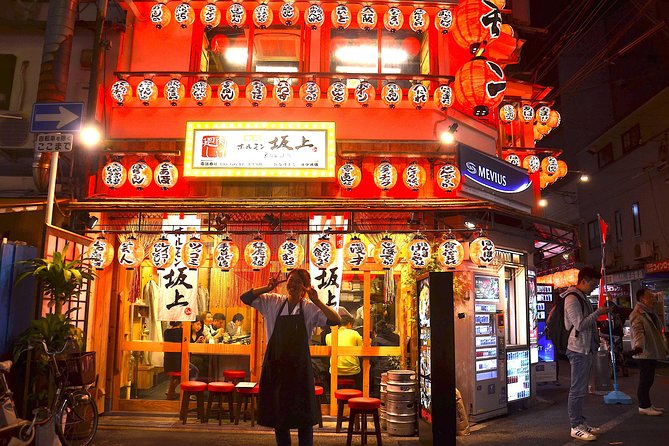
- The route covers several different areas, including Dotonbori, Hozenji Yokocho, Namba, Kuromon Market, and Sennichimae.
- The group is limited to 10 people, a useful size for narrow lanes and busy food districts.
- Guides such as Asli, Melissa, and Marie have led the tour, adding food knowledge and local stories.
- Vegetarian and pescetarian diets can be accommodated, but the tour is not recommended for gluten-free diners.
Starting beneath the Glico sign in Dotonbori
You meet at 5 p.m. near the famous Glico running man sign in Dotonbori. This is a sensible starting point because the sign is easy to recognize, and you begin in one of Osaka’s most theatrical public spaces.
The Glico figure shows a runner crossing a finish line. Your guide explains the story behind the image, including Fortunato Catalon, a Filipino sprinter whose success helped inspire the design and its connection to the Glico company. It is a small detail, but it gives the landmark more meaning than a quick photograph.
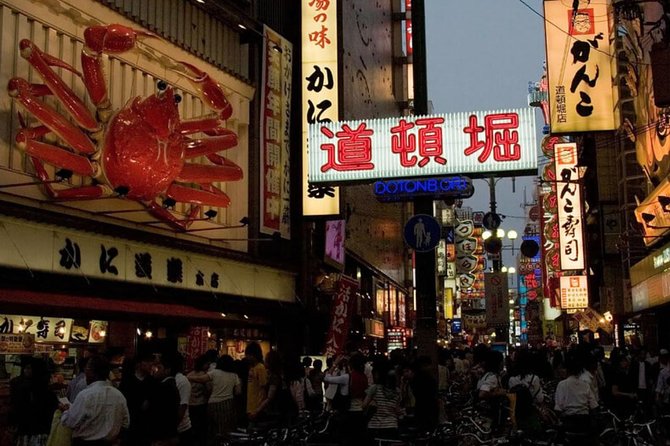
Dotonbori is loud, bright, and crowded. Giant restaurant signs compete for your attention, and some of the most famous places have long lines. That energy is part of the fun, but it can also make the district feel like a food-themed shopping center rather than a local neighborhood.
This is where a guide earns their keep. Instead of sending you toward the most obvious restaurant sign, the route turns toward less conspicuous places and explains what you are seeing along the way. You still get the famous Dotonbori atmosphere, but you are not left to judge Osaka’s food culture by the biggest billboard.
Other food tours in Osaka people book:
- Osaka: Shinsekai Food Tour with 13-15 Dishes at 5 Eateries
★ 4.8 · 2,204 reviews - Osaka Food Tour: 13 Dishes at 5 Local Eateries
★ 5.0 · 2,149 reviews - Hungry Osaka Street Food Tour:15 Tastings & 3 Drinks with a Local
★ 5.0 · 1,727 reviews
Takoyaki, kushikatsu, and four planned food stops
The food portion is built around four stops. The exact dishes can change with season, restaurant schedules, public holidays, weather, or availability, so you should not treat the published food list as a rigid menu.
Takoyaki is one of the essential Osaka tastes. These round wheat-flour snacks are cooked with fillings and served hot, often with sauce and other toppings. They look easy to eat, but the center can be extremely hot. Your guide can help you understand how the dish fits into Osaka’s casual street-food culture.
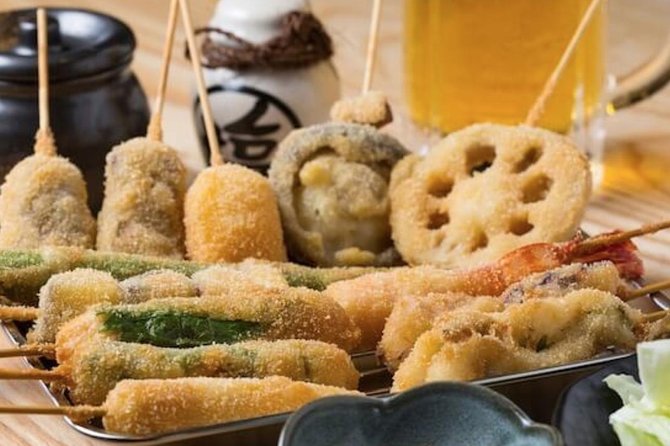
Kushikatsu gives you a different experience. These skewers are coated and fried, and they show how Osaka turns simple ingredients into quick, social food. The contrast between takoyaki and kushikatsu is useful: one is soft and piping hot inside, while the other offers crisp fried coating and a different way to sample several flavors.
You receive one drink with the tour. Any additional drinks or food are your responsibility, so budget for extras if you tend to eat more than a tasting portion. The included food is designed to introduce you to Osaka rather than replace a full evening meal for everyone.
A traditional Japanese dessert is also included. The specific dessert is not guaranteed in advance, which is another reason to expect seasonal substitutions. I prefer this kind of flexibility to a fixed menu that ignores what local shops can actually serve that day.
The best part of a guided tasting is the ability to try foods you might skip when ordering alone. A guide can explain what a dish is, point out local habits, and help you make sense of a menu even when the English descriptions are limited.
Hozenji Yokocho and the quiet side of Minami
The route includes Hozenji Yokocho, a narrow lane near Dotonbori with a much calmer mood than the main street. The change is quick. One moment you are surrounded by signs and music, and the next you are walking through a more intimate passage lined with traditional-looking restaurants.
Nearby Hozenji Temple adds a small cultural stop to the food route. The tour description presents this part as a chance to find a quieter shrine away from the main crowds. It gives you a pause between tastings and a glimpse of Osaka’s older religious traditions.
Do not expect a major temple visit or a long history lecture. This is a short walking tour, and the shrine functions as part of the evening route rather than as a separate sightseeing stop. Still, the contrast matters. Osaka is not only neon signs, giant crab displays, and restaurant queues.
The walk also passes through Minami, the broad area that includes Namba and Dotonbori. Your guide can connect the food to the neighborhood, explaining why Minami is such an important place for Osaka eating and nightlife.
Namba, Doguyasuji, and Kuromon Market
Sennichimae Doguyasuji Shotengai is known for shops connected to the restaurant trade. This kind of street helps explain the machinery behind Osaka’s food culture: cooking tools, restaurant supplies, and other practical goods are part of the city’s eating identity.
For you, the value is not just shopping. The street gives context to the restaurants you visit. Osaka’s food scene depends on equipment, preparation, presentation, and fast service, and Doguyasuji offers a look at that practical side.
The route also includes Kuromon Market. This is one of Osaka’s best-known market areas, with food stalls and shops serving both local customers and sightseers. It can be crowded, so stay close to your guide and keep an eye on the meeting point if the group spreads out.
Kuromon is a useful place to compare different kinds of Osaka eating. Restaurant tastings are more organized, while a market offers quick choices and visual appeal. The market may be busy and commercial, so do not expect a quiet local market stroll. Its value comes from seeing the range of food activity in one compact area.
The walking matters here. This is not a series of disconnected restaurant visits reached by taxi. You move through the districts on foot, seeing how Dotonbori, Namba, Sennichimae, and Kuromon relate to one another.
More eating your way round Osaka:
- Osaka Local Foodie Walking Tour in Dotonbori and Shinsekai
★ 5.0 · 985 reviews - Hungry Osaka Street Food Tour: 15 Dishes & 3 Drinks
★ 4.9 · 694 reviews - Osaka: Guided Food Tour with 12 Dishes at 4 Local Eateries
★ 5.0 · 533 reviews - Osaka After Dark: Small-Group Night Food Tour (Max 6)
★ 4.5 · 245 reviews
Misono Building and the changing evening route
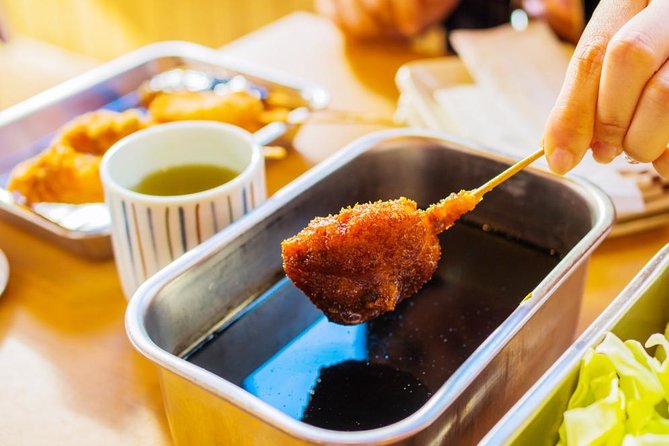
Misono Building is another named stop on the route. The exact length of time spent there and the specific venue used can vary, since restaurants and schedules sometimes require substitutions.
That flexibility is worth understanding before you book. Food tours depend on businesses that may close for a holiday, change opening hours, or run out of a seasonal item. A replacement stop may not be identical to the advertised one, but the operator states that substitutions will be made when needed.
The evening timing is one of the tour’s strengths. Starting at 5 p.m. allows you to see Dotonbori in the transition from late afternoon into its illuminated evening mood. It also places the tour around dinner time, when the food districts are at their most active.
The trade-off is that popular areas can be crowded and noisy. If you prefer slow meals in quiet restaurants, this is not the right format. If you want to see Osaka at its most energetic and learn how to move through the crowds, the timing makes sense.
What the guide adds to the experience
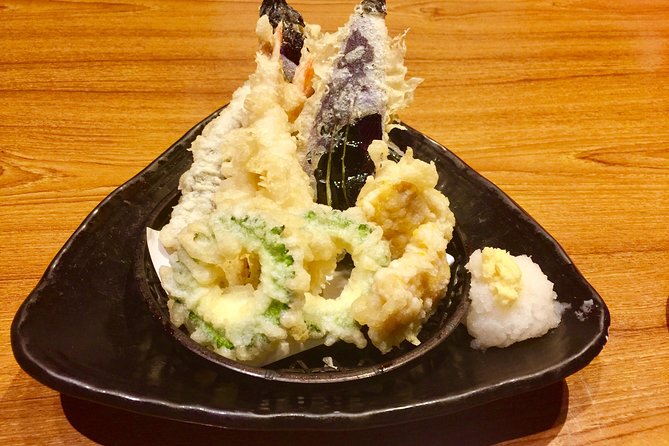
The guide is more than a person who leads you from one restaurant to the next. The tour promises local stories, food explanations, and traditions, and the guide’s role is especially important in a city where menus and restaurant customs can be unfamiliar.
Past guides named for this experience include Asli, Melissa, and Marie. The strongest guide experiences described in the available feedback combine food knowledge with local history and practical help. Melissa, for example, helped arrange vegetarian choices at each stop while also explaining Osaka’s past.
That point matters if you are traveling with different appetites or diets. Vegetarian and pescetarian options are supported, but you should communicate your needs clearly when booking. Gluten-free diners should choose another experience, since this tour is not recommended for that diet.
Guides have also helped people try dishes they would not have ordered on their own. That is one of the clearest reasons to pay for a food tour in Osaka. You are not only buying small portions of food. You are buying a local interpreter for dishes, menus, customs, and neighborhoods.
Is $231 a fair price for three hours?

At $231 per person, this is an expensive three-hour food walk. You need to decide if the convenience and guidance justify the premium.
The price includes four food stops, one drink, a traditional dessert, an English-speaking local guide, and a planned route through several major food areas. It does not include transportation, hotel pickup, additional food, or additional drinks. Hotel pickup may be arranged for an extra charge.
For a person who wants a simple introduction to Osaka’s food culture, the price can make sense. You avoid spending your first evening guessing which restaurant to enter, and you get context along with the food. The small group limit of 10 also gives the experience a more personal feel than a large bus-style outing.
For a confident eater who is comfortable reading menus and choosing restaurants alone, the value is less clear. Osaka has plenty of affordable food, and you could spend far less by ordering takoyaki, kushikatsu, and other local dishes independently.
I would treat this as a guided introduction rather than a bargain dinner. The tour is most useful early in your Osaka visit, when you want to learn what to eat and where to look for it during the rest of your stay.
Walking, weather, and practical planning
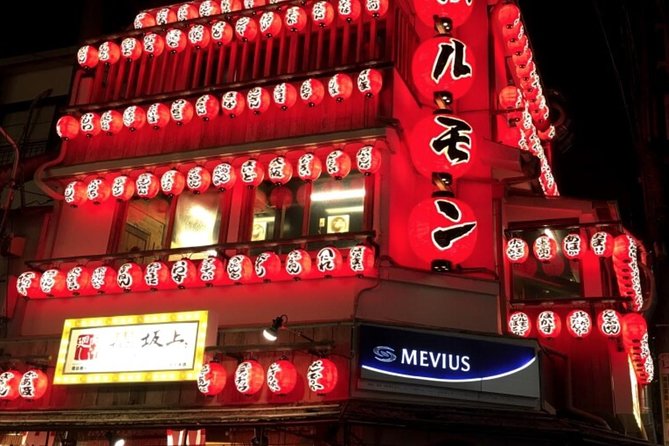
The tour lasts about three hours and requires a moderate level of physical fitness. You will be walking through crowded commercial districts, narrow lanes, and market areas, so comfortable shoes are important.
The start point is in Dotonbori, and the tour ends in the Sennichimae area. Since hotel pickup is not included, allow time to reach the starting point independently. Public transportation is nearby, but transportation costs are your responsibility.
The tour requires good weather. If poor weather causes cancellation, you can receive a different date or a full refund. The operator can also cancel if the minimum number of people is not met, with a different date, another experience, or a full refund offered.
You can cancel for a full refund up to 24 hours before the start time. Changes or cancellations inside that 24-hour window are not accepted for a refund.
Children must be accompanied by an adult. Children aged 10 and above require a copy of passport information, and the minimum drinking age is 21. The experience is family-friendly and accepts solo participants.
Who should book this Osaka food tour?
I would recommend it to first-time visitors who want a guided introduction to Osaka’s famous dishes without spending days researching restaurants. It also suits solo visitors, couples, and small groups who like walking and want local explanations between tastings.
It is a good choice if you are curious about more than food alone. The route adds Dotonbori’s famous sign, Hozenji Yokocho, a shrine, Doguyasuji, Kuromon Market, and Misono Building, giving the evening a wider sense of place.
I would hesitate if you have a strict gluten-free diet, dislike crowded streets, or want a full-sized dinner. I would also compare the price carefully if your main goal is simply to eat takoyaki and kushikatsu as cheaply as possible.
Book it if you value a guide who can help you order, explain local customs, and lead you to several stops in one evening. Skip it if you prefer to explore at your own pace and are happy to make your own food choices. For the right person, the strongest payoff is not one particular dish. It is leaving with a better sense of how Osaka eats and where to continue on your own.
FAQ
How long does the Absolute Osaka Food Tour last?
The tour lasts approximately three hours.
What time does the tour begin?
The tour starts at 5 p.m.
Where does the tour meet?
The meeting point is in Dotonbori, Osaka, near the Glico sign area, at 1-chome 8-19 Dotonbori, Chuo Ward.
Where does the tour end?
The tour ends in the Sennichimae area of Osaka.
How many food stops are included?
The tour includes tastings at four food stops, along with one drink and a traditional Japanese dessert.
Is transportation included?
No. Transportation costs are not included, and hotel pickup is not included. Hotel pickup may be arranged for an additional charge.
Is the tour suitable for vegetarians?
Yes. Vegetarian and pescetarian options are available, though food may change based on season and availability.
Is the tour suitable for gluten-free diners?
No. The tour is not recommended for people who require gluten-free food.
Can I cancel for a refund?
Yes. You can cancel up to 24 hours before the start time for a full refund. Poor weather or failure to meet the minimum number of participants may also result in a different date or a full refund.
Just added in Osaka
- Osaka Temple Cool Foot Bath & Matcha Experience〈45min〉★ 4.9 · 82 reviews
- Osaka: Mind & Spirit Balance Temple Reiki Healing★ 5.0 · 41 reviews
- Full Day Kyoto Tour : Bamboo Forest, Golden Temple, Fushimi Inari★ 5.0 · 84 reviews
- Osaka: Minoh, Katsuoji Temple, & Minoh Falls Full-day Tour★ 4.9 · 172 reviews
- Ramen and Gyoza Cooking Class in Osaka★ 5.0 · 202 reviews
- OSAKA NIGHT FUSION Japanese Taiko Kabuki Samurai Dance Show★ 4.8 · 155 reviews
- Osaka: A Modern Samurai, Kabuki, Taiko, & Dance Show★ 4.5 · 66 reviews
- Osaka: Samurai Training Experience KENDO in Osaka★ 5.0 · 111 reviews
Food Tours, compared.
Shinjuku Food Tour (13 Dishes at 4 Local Eateries)
Read our review →
Osaka Food Tour: 13 Dishes at 5 Local Eateries
Read our review →
Best of Shinjuku: Izakaya Food Tour (4 Stops, 14+ Tastings)
Read our review →
Kyoto Night Foodie Tour in Gion (9+ dishes + 6 Sake tastings)
Read our review →
Hungry Osaka Street Food Tour:15 Tastings & 3 Drinks with a Local
Read our review →
Tokyo Night Foodie Tour in Shinjuku – Seasonal Sushi, Wagyu Beef
Read our review →
Osaka Local Foodie Walking Tour in Dotonbori and Shinsekai
Read our review →
Eat and Drink Like a Local: Tokyo Ueno Food Tour-Taverns&Ramen
Read our review →Browse the lists this tour appears in