
Reviewed · SUMO EXPERIENCES
Authentic Sumo Experience in Tokyo: Enter the Sanctuary
The best part of this sumo outing is that you do more than watch a match. You enter a real stable, sit beside the ring during practice, see the dining room and bath, then step into the training area yourself. The wrestlers teach the movements with plenty of humor, so the morning quickly shifts from quiet observation to good-natured fun.
I especially like the former stable setting, officially used until 2022, and the shared chanko-nabe lunch prepared with the wrestlers. The guide adds useful context, and past sessions have featured strong English speakers such as Charlie, Jim, Lily, and Fugi. The main catch is timing: you must arrive on time, and the stable can cancel a few days before the visit.
Key points to know
- A real former sumo stable: See the dining room, bath, practice space, and ring where wrestlers trained.
- Morning practice up close: Sit directly in front of the ring during a serious training session.
- Hands-on instruction: Try sumo exercises and, if you wish, challenge a wrestler in the ring.
- Chanko-nabe lunch: Help make chicken dumplings and eat at a table once used in the sumo room.
- Small-group format: The maximum group size is 15 people, allowing room for questions and participation.
- Useful extras: Your price includes a certified guide, tour photos, lunch, and an original T-shirt.
Why this is more than watching sumo
A tournament ticket lets you see professional sumo in a large arena. This four-hour, 10-minute experience gives you a different view: the daily life behind the bout.
You begin near Shin-Kawasaki Station in Kawasaki, outside central Tokyo. From there, your guide explains how the sumo world works and takes you to a former stable. This is not a purpose-built visitor attraction. The building was officially used by a sumo stable until 2022, and that detail gives the visit its strongest sense of place.
You see where wrestlers ate, bathed, and trained. Those ordinary rooms matter because sumo is not only a sport performed in public. It is also a strict daily way of life, built around shared meals, early training, and life inside the stable.
The tour works well for first-time visitors because the guide explains the customs before you are asked to participate. If you already follow sumo, you still get something special: a chance to ask questions, meet wrestlers, and watch training at close range.
Other ways to see sumo in Japan:
- Tokyo: Sumo Show Experience with Chicken Hot Pot and a Photo
★ 4.8 · 6,678 reviews - Tokyo: Sumo Show and Dining Experience
★ 4.8 · 2,742 reviews - the SUMO show
★ 5.0 · 1,960 reviews
Meeting at Shin-Kawasaki Station
The stated meeting point is Shin-Kawasaki Station, with the listed starting address at 1-chōme-2-1 Kashimada, Saiwai Ward, Kawasaki, Kanagawa. The experience starts at 9:30 a.m. Check the final meeting instructions carefully, since station areas can have several exits and nearby addresses.
The early start is part of the value. Morning practice in the sumo world usually begins around 7 a.m. and can last three to four hours. By the time you arrive, you may see a later portion of the session rather than the very first exercises. That timing lets you watch real training without needing to find a stable on your own.
Do not treat 9:30 as a loose suggestion. The group starts on time, and arriving more than five minutes late without contacting the operator is treated as a cancellation. You cannot join later, reschedule, or receive a refund if you miss the group.
The experience is near public transportation, and the group can include up to 15 people. That is small enough for questions, though it is not a private tour. Large suitcases are not permitted, so leave major luggage at your hotel or in suitable storage before you arrive.
Inside the former stable
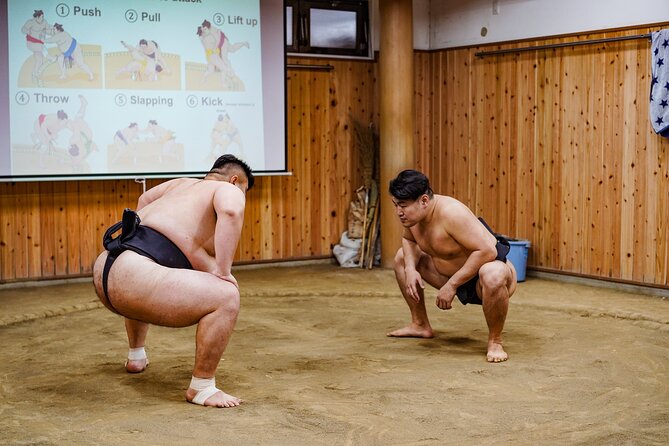
Your guide begins with the customs and daily routine of sumo. The presentation may include visual material, and guides such as Jim have used clear English explanations and presentations to set the scene.
The room tour covers three useful areas:
- The dining room, where wrestlers share meals
- The bath, part of the stable’s communal routine
- The practice area, centered on the ring
This portion is quieter than the later activities. That is a good thing. Sumo has many rules and traditions that are easy to miss if you go straight to the wrestling. Your guide explains what you are seeing, why the stable is organized as it is, and how the sport has continued from the Samurai era.
The setting also helps you understand the scale of the wrestlers’ routine. Sumo life is not limited to the few minutes of a tournament bout. Training, eating, resting, and living together all form part of the system.
You should show respect here. This was a working sumo environment, not simply a stage made for tourists. Follow the guide’s instructions about where to sit, when to take photos, and how to move around the building.
Watching morning practice from the front
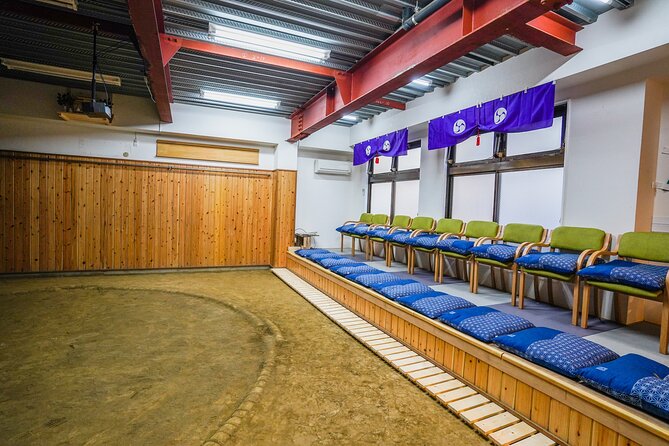
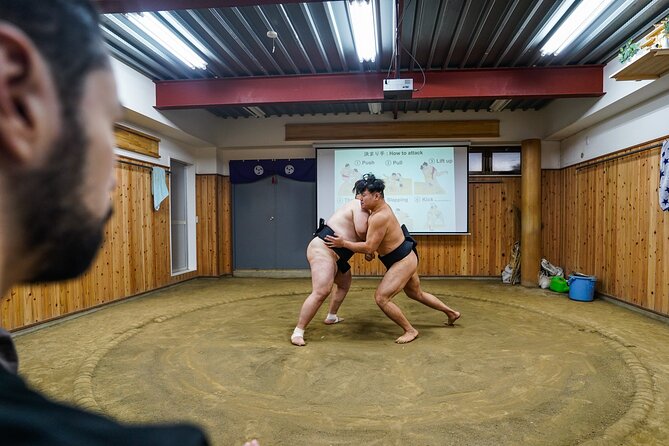
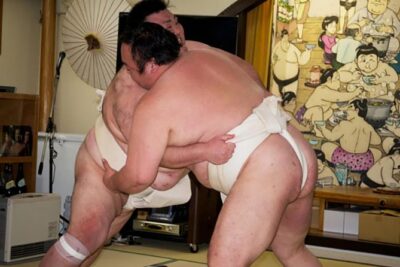
After the introduction, you sit right in front of the ring for a morning practice session. This is the most serious part of the morning.
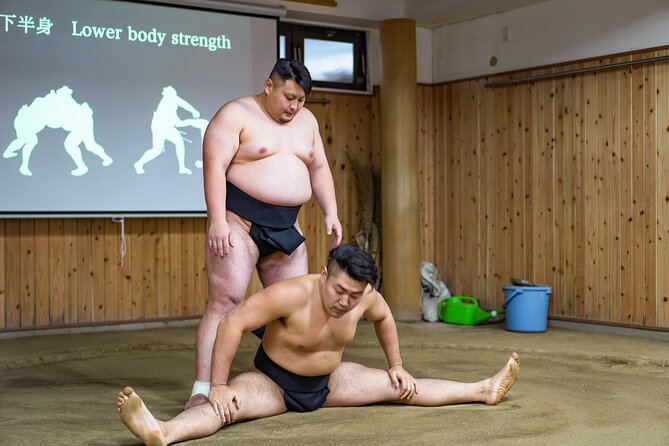
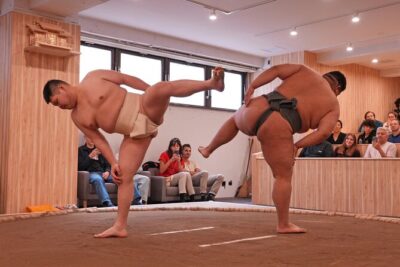
Training includes repeated movements, balance work, strength exercises, and practice bouts. The traditional exercises may look simple at first, but trying them yourself makes the effort clearer. Sumo relies on leg strength, low positioning, control, and an ability to keep moving under pressure.
You may feel a change in the mood here. At first, the group is often quiet and a little unsure of what to expect. That is natural. You are sitting close to a demanding physical routine, and the guides first ask you to watch rather than perform.
The benefit of this arrangement is that you see the contrast between professional training and the later, lighter activities. Do not expect a tournament with formal judging or a full competition schedule. This is practice, and its value comes from seeing the work behind the public sport.
Same base, a different sort of day:
- Mt Fuji and Hakone 1-Day Bus Tour Return by Bullet Train
★ 5.0 · 26,383 reviews - 1-Day Tokyo Bus Tour
★ 5.0 · 14,250 reviews - PERFECT KYOTO 1-Day Bus Tour
★ 5.0 · 13,518 reviews - Tokyo: TOKYO SKYTREE® Admission ticket
★ 4.5 · 11,192 reviews
Trying the movements with sumo wrestlers
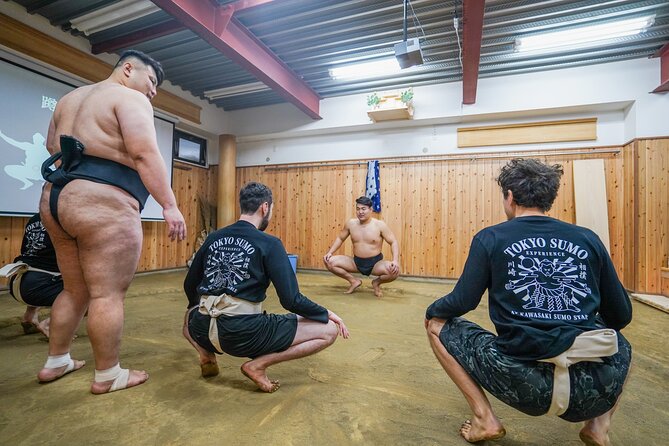
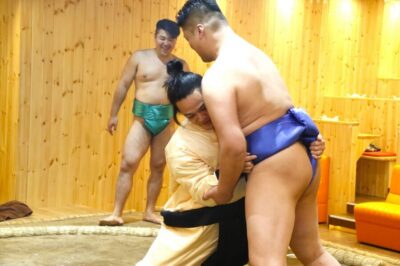
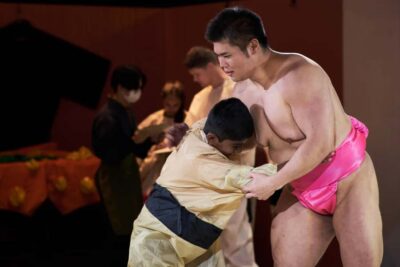
The hands-on section is where the experience becomes especially memorable for families and active adults. Wrestlers demonstrate sumo movements, then invite willing participants to try them.
You may practice basic exercises and enter the ring for a friendly challenge. Several sessions have included two retired sumo wrestlers who involved the whole group, showed the exercises, answered questions, and let participants test themselves.
The word friendly matters. This is not a chance to prove that you can defeat a trained athlete. It is a controlled, humorous way to feel how difficult it is to move another person while staying low and balanced.
Children and teenagers often get a lot from this part because it turns a cultural lesson into something physical. Adults can join too, but you should take the activity at your own pace. The experience information says most people can participate, but it does not promise that every guest must enter the ring.
You also do not have to force yourself to wrestle. Watching the demonstrations, trying the exercises, and asking questions are worthwhile on their own. If you do participate, listen closely to the wrestlers and guide, especially when they explain where to stand and how to move safely.
Making chanko-nabe at the old dining table
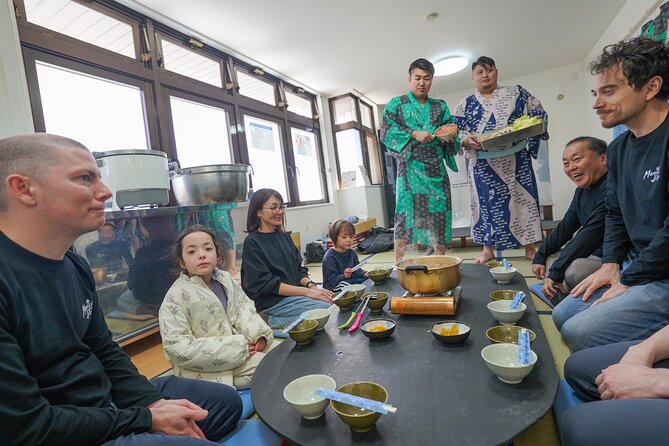
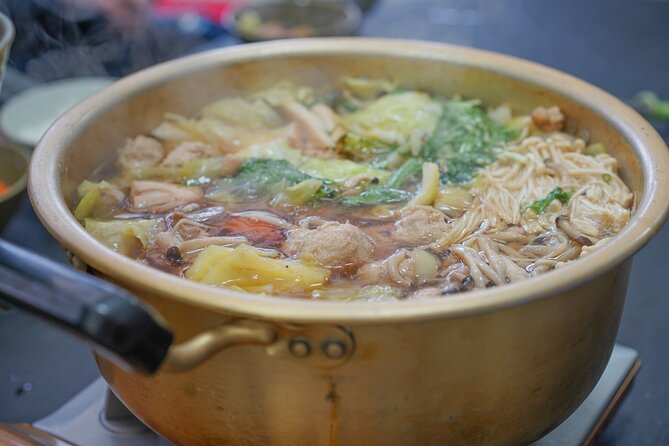
Lunch is not an afterthought. Chanko-nabe is the hearty hot-pot dish associated with sumo wrestlers, and it is served after the practice and demonstrations.
You help prepare chicken dumplings, then eat together with the wrestlers around a table that was actually used in the sumo room. That shared meal gives the morning a natural finish. Instead of leaving after a performance, you sit down and talk over food.
The dish is designed to provide substantial nourishment, and it helps explain how wrestlers support their large bodies. The soup has been a strong part of the experience for many families, with some children happily eating several bowls.
The meal also creates the best chance for informal questions. You can ask the wrestlers about training, daily life, or the sport, while the guide helps with explanations. The tone is more relaxed than during practice, and the wrestlers are described as kind, jovial, and willing to teach.
Additional food and drinks are not included. Tell the operator about allergies or dietary requests at least one day before the tour. The food is prepared in kitchens outside MagicalTrip’s control, so an allergy-free meal or a suitable substitute cannot be guaranteed. Same-day requests cannot be accommodated.
What the $171.12 price covers
At $171.12 per person, this is not a cheap sightseeing stop. The price makes more sense if you use the whole package: a certified guide, access to the former stable, close viewing of practice, hands-on instruction, lunch, tour photos, and an original T-shirt.
A regular sumo match offers the excitement of competition, but it does not normally give you access to the wrestlers’ dining space or practice routine. A museum can explain the rules and history, but it cannot let you try the movements or eat chanko-nabe with retired wrestlers.
I would see this as a special cultural outing rather than a standard four-hour tour. It is most valuable if you want personal contact and participation. If you only want to watch sumo, the price may feel high, especially since additional drinks and food cost extra.
The included photographs are useful for families and groups because nobody has to spend the whole morning taking pictures. The T-shirt is a modest extra, but it gives you a physical reminder of the day.
Who will get the most from this visit
This is a strong choice for families. Children can see a serious cultural tradition, then take part in exercises and a ring challenge. The meal adds another shared activity, and the group format keeps the morning social.
It also suits couples, friends, and solo visitors. A solo visitor can ask questions, join the exercises, and eat at the communal table without needing to arrange a private tour.
Long-time sumo fans should book for access and conversation, not for a tournament. The opportunity to train with rikishi, meet retired wrestlers, and sit beside a working ring offers something a stadium cannot.
First-time visitors to Japan may find this easier than attending a tournament because the guide explains the customs in plain terms. You do not need previous sumo knowledge to follow the morning.
The experience may be less suitable if you dislike early starts, group activities, communal meals, or physical participation. You can choose to watch rather than wrestle, but the social and interactive side is a major reason to pay this price.
Timing, heat, and practical limits
The activity lasts about four hours and 10 minutes and ends back at the meeting point. Wear comfortable clothes that let you move easily, especially if you plan to enter the ring or practice the exercises.
Summer in Japan can be very hot and humid. Bring water and wear a hat to help avoid heat-related illness, particularly if you are walking to or from transportation in the sun.
The operator asks you to arrive at least a few minutes early. With a strict start, a station pickup, and a group of up to 15 people, there is little room for delays.
The stable can also cancel unexpectedly a few days to a couple of days before the scheduled visit. This is an important consideration when planning a tightly packed Tokyo itinerary. If the operator cancels because the minimum number of people is not reached, you are offered another date or experience, or a full refund. A stable cancellation may require a change of plans, so avoid placing this tour immediately before an important flight or train.
Free cancellation is available up to 24 hours before the start time. Canceling or changing within 24 hours is not accepted, and no-shows or late cancellations are not refunded.
Should you book this sumo experience?
I would book it if you want access rather than spectacle. You see a former stable, watch real practice from the front, try the movements, talk with wrestlers, and share chanko-nabe in a room tied to the sport.
The strongest parts are the setting, the personal instruction, and the lunch. Guides such as Charlie, Jim, Lily, and Fugi have helped make the explanations approachable, though your assigned guide may be someone else. The main drawbacks are the high price, strict arrival rule, possible stable cancellation, and limits on dietary substitutions.
Book this as a half-day cultural experience, not as a substitute for a Tokyo tournament. If you are curious about how sumo wrestlers actually live and train, the $171.12 cost buys access that ordinary sightseeing rarely provides. If you only want a quick photo or a formal match, spend your budget elsewhere.
FAQ
Where does the sumo experience begin?
You meet at Shin-Kawasaki Station in Kawasaki, Kanagawa. The listed start address is 1-chōme-2-1 Kashimada, Saiwai Ward, Kawasaki, and the activity begins at 9:30 a.m.
How long does the activity last?
The experience lasts approximately four hours and 10 minutes. It ends back at the meeting point.
What is included in the price?
The price includes the sumo experience, a certified MagicalTrip guide, a sumo wrestler’s lunch, tour photos, and an original designed T-shirt.
Can I participate in the sumo exercises?
Yes. Participants have the opportunity to try sumo movements and train with the wrestlers. You can take part at your own pace, and participation is not described as mandatory.
Is lunch included, and can dietary requests be made?
Chanko-nabe lunch is included. You must report allergies or dietary requests at least one day before the activity, but an allergy-free meal or substitute cannot be guaranteed.
What happens if I need to cancel?
You can cancel up to 24 hours before the start time for a full refund. Cancellations, changes, and no-shows within 24 hours are not eligible for a refund.
Just added in Japan
- 1 Day Tour: Snow Monkeys & Snow Fun in Shiga Kogen★ 5.0 · 52 reviews
- From Matsumoto/Nagano: Nakasendo Trail Walking Tour★ 4.9 · 33 reviews
- Private Fukuoka Tour with a Local, Highlights & Hidden Gems 100% Personalised★ 5.0 · 143 reviews
- Visit Gunkanjima Island (Battleship Island) in Nagasaki★ 4.0 · 32 reviews
- Best of Himeji Castle: 3hr Tour with Licensed Guide★ 5.0 · 186 reviews
- Hakone 8 hour Private Tour with Government-Licensed Guide★ 5.0 · 63 reviews
- Nagasaki Half-Day Private Tour with Government-Licensed Guide★ 5.0 · 53 reviews
- Daikoku & Tokyo Private JDM Tour by 700HP R34 GT-R★ 4.9 · 101 reviews
Sumo Experiences, compared.
Sumo Show Experience with Chicken Hot Pot and a Photo
Read our review →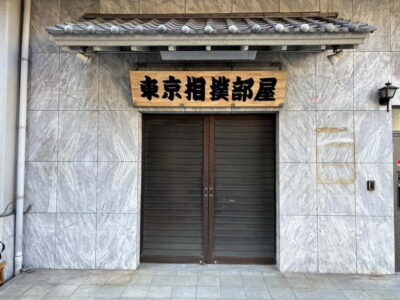
Tokyo Shinjuku Sumo Show & Experience with Photo
Read our review →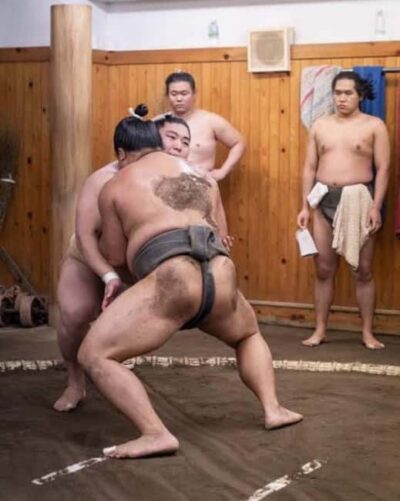
Sumo Show & Experience w/ Optional Kimono & Hot Pot
Read our review →
Luxury Sumo Show Experience & Japanese cuisine & Drink
Read our review →Browse the lists this tour appears in