
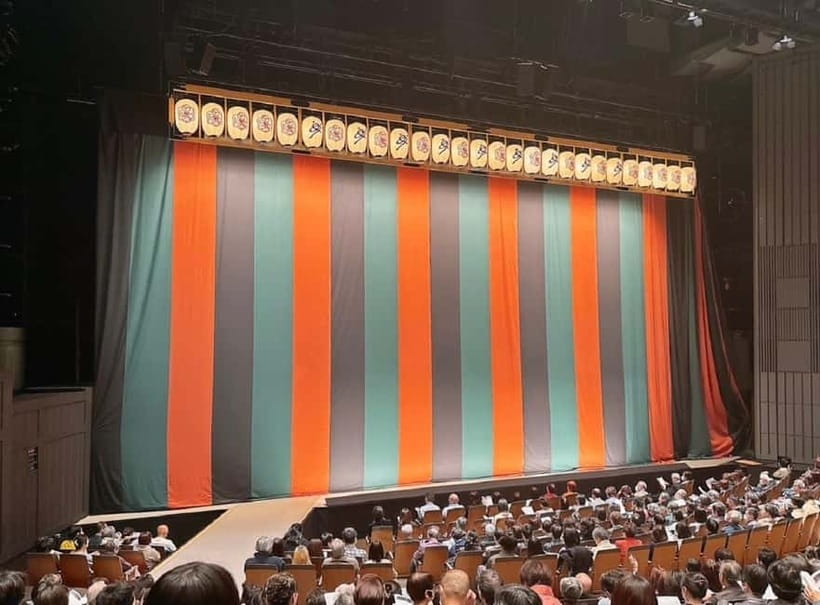
Reviewed · KABUKI & TRADITIONAL THEATRE
Tokyo: KABUKI, BUNRAKU, etc. presented by National Theatre
Japan’s classical stage arts are best understood live, where a singer’s voice, shamisen, movement, costume, and silence do the work without loudspeakers. This National Theatre Japan presentation gives you that authentic performance setting, with Kabuki, Bunraku, or Hogaku depending on the date.
I like the English audio guide for Kabuki and Bunraku, and I like the chance to hear highly trained performers in an established national program rather than a tourist imitation. The main caution is time and pace: some programs last up to three hours, and the English guide explains the action rather than translating every line.
Key points to know before booking
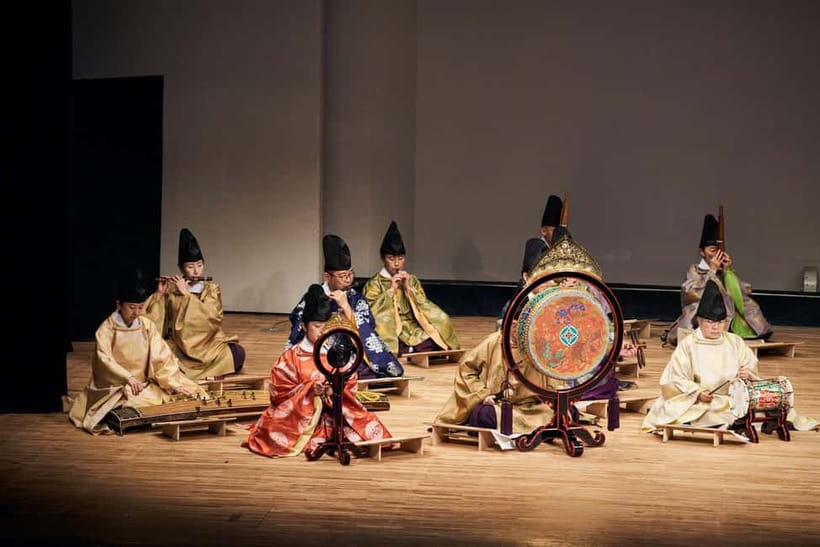
- The art form changes by date: Your option may be Kabuki theatre, Bunraku puppetry, or a Hogaku concert.
- Bunraku uses three arts at once: A narrator, shamisen player, and puppeteers work together in precise coordination.
- English help is practical, not literal: The Kabuki and Bunraku audio guide gives story and cultural context without translating every spoken line.
- The listed Bunraku venue is in Yokohama: KAAT Kanagawa Arts Theatre is about five to eight minutes from nearby Minatomirai Line stations.
- The performance is live and acoustically focused: Smoking, photography, recording, food, drinks, and noise are not allowed inside.
- The $37 price is fair for a genuine stage performance: It makes most sense if Japanese culture and theatre are a real part of your trip, not just a quick stop between sights.
What this National Theatre Japan program really offers
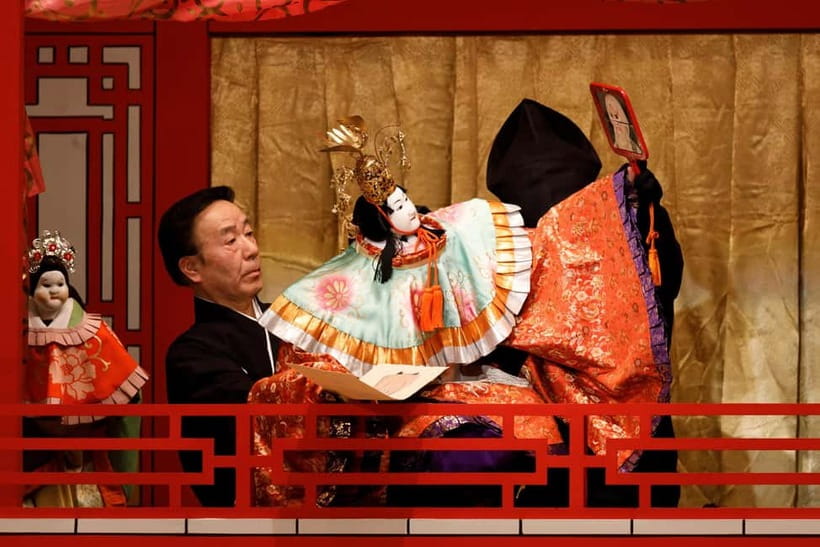
This is not one fixed show. It is a booking option for a changing program of Japanese classical arts. The title and date determine whether you see Kabuki, Bunraku, or Hogaku, so read the selected option carefully before paying.
The program comes from National Theatre Japan, an institution that has supported traditional Japanese performing arts since 1965. That matters because these forms depend on long training, exact musical timing, and conventions that can look unusual if you expect modern Western theatre.
You are seeing the art in its established form, not a shortened cultural demonstration. That can be thrilling, but it also means you need patience. Stories may unfold slowly, several pieces may be presented together, and the program may not give you one tidy beginning-to-end plot.
The performance is also not necessarily at the National Theatre in Hanzomon. The venue changes with the date. For the Bunraku ticket described here, the venue is KAAT Kanagawa Arts Theatre in Yokohama, so check the meeting information before heading out from central Tokyo.
Other performances in Tokyo:
- Tokyo: KABUKI Show at Kabukiza Theatre Admission Ticket
★ 4.8 · 152 reviews - OSAKA NIGHT FUSION Japanese Taiko Kabuki Samurai Dance Show
★ 4.8 · 155 reviews - Osaka: A Modern Samurai, Kabuki, Taiko, & Dance Show
★ 4.5 · 66 reviews
Kabuki: bold acting, music, and stylized drama
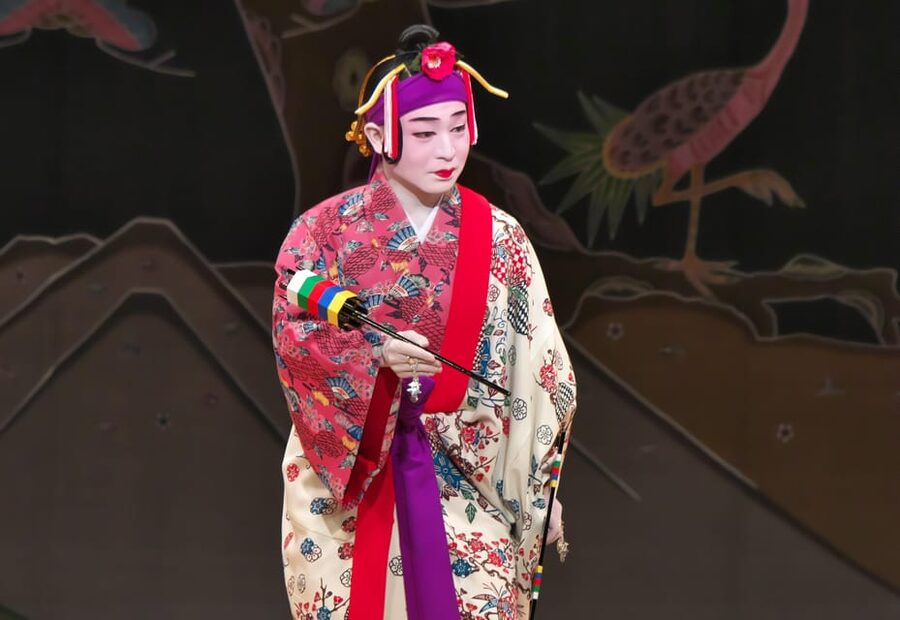
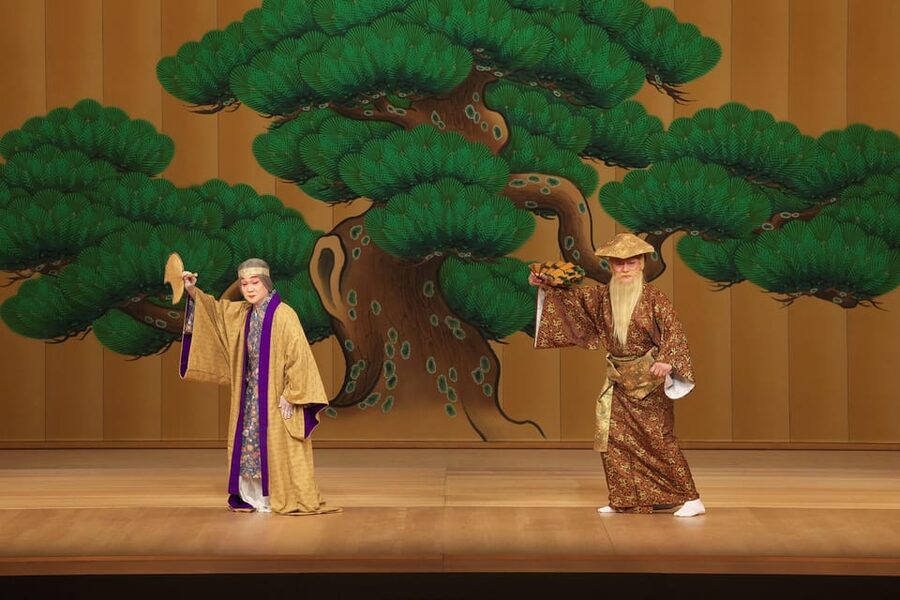
Kabuki combines theatre, music, and dance. It is known for dramatic stories, striking costumes, carefully shaped movements, and stage pictures that can feel very different from ordinary naturalistic acting.
A first Kabuki performance can take a few minutes to adjust to. The gestures are formal, the delivery is stylized, and the story may rely on cultural references that are not obvious to an English-speaking audience. That is exactly where the audio guide earns its place.
The English guide gives you an overview of the main action and explains important points without trying to translate every sentence. You still hear the performers’ voices and music, which is useful because a word-for-word translation would keep your attention on the device instead of the stage.
The guide is English only. It is best treated as a quiet companion, not subtitles for the whole performance. You may miss some dialogue and fine points, but you gain enough structure to follow the main relationships, conflict, and stage business.
I suggest arriving early enough to listen to any introductory explanation before the curtain. It can explain how Kabuki differs from Western theatre and help you notice why a costume, pose, entrance, or musical cue matters.
Bunraku: three artists create one puppet performance
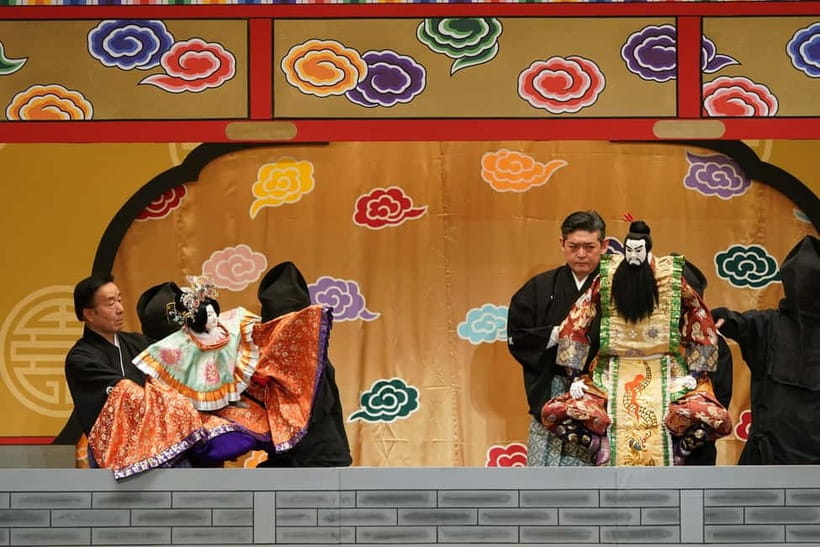
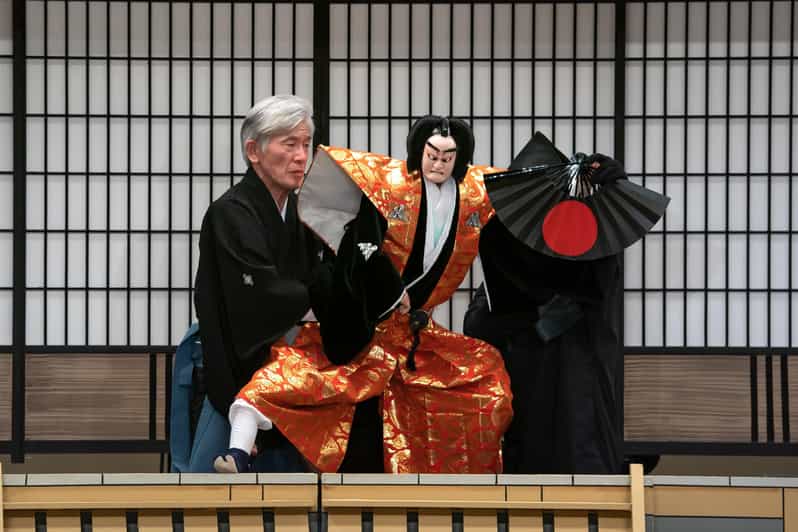
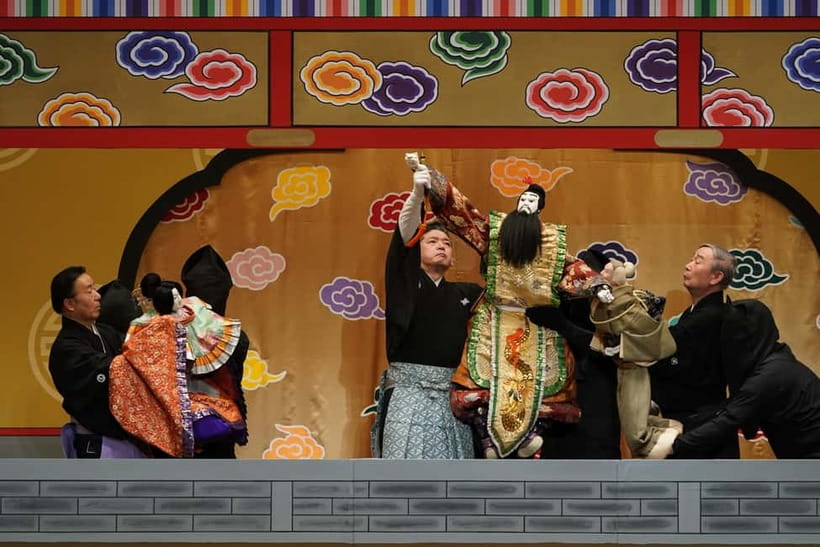
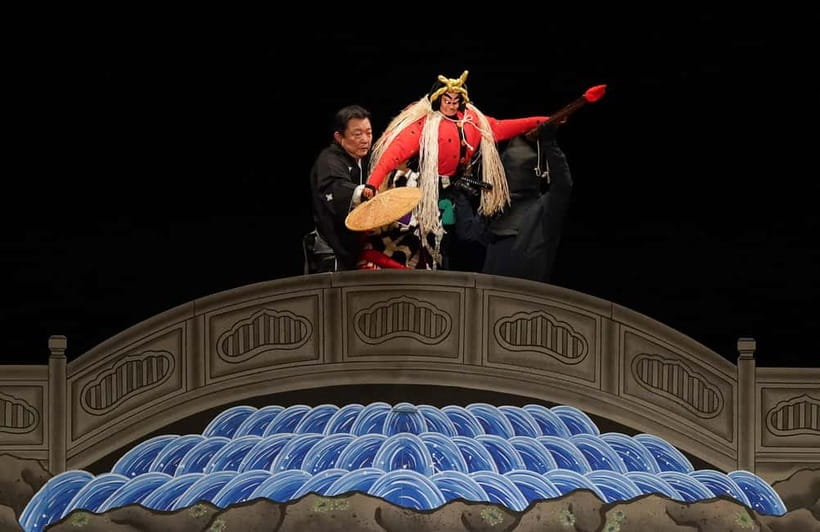
Bunraku is the most unusual option here, and for many people it becomes the most memorable. It is a serious theatrical form built from the coordination of narrative recitation, shamisen music, and puppetry.
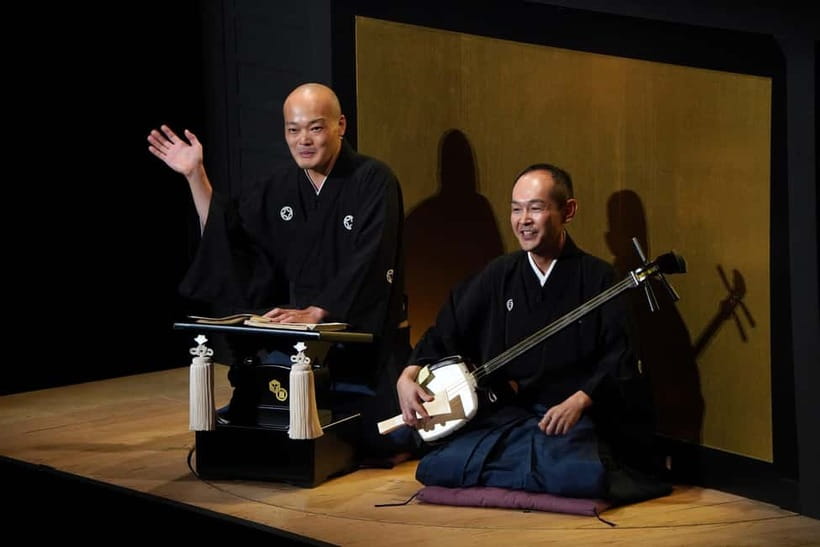
The narrator delivers the story with force and control. The shamisen supplies the musical framework, while the puppeteers guide the figures through precise movements. The result is not a simple puppet show for children. Bunraku is an adult theatre tradition, and its stories can involve intense love, duty, grief, and sacrifice.
The puppets are expressive because every movement has been shaped by training. A turn of the head or shift in posture can carry emotional weight. Once you stop expecting a puppet to imitate a living actor, the form begins to make sense on its own terms.
The English audio guide is especially useful here. It gives you the basic action and context while allowing the Japanese narration and music to remain audible. You will not receive a complete translation of every line, so you need to watch the performance as much as listen to the guide.
Some programs can contain serious themes, including love suicide. If you are taking children, check the performance information and think about their age and comfort with difficult stories. The art may be remarkable, but the subject matter is not always light.
A special program may also differ from a standard Bunraku presentation. One scheduled performance, for example, had no puppets because it was a special show. Read the date-specific description instead of assuming every Bunraku listing has the same format.
Hogaku: traditional music with a useful English sheet
Hogaku is the concert option. The program described here focuses on musical pieces connected by Yuki no Aikata, a long shamisen interlude from the Jiuta piece Yuki, or Snow.
That melody has become a familiar musical representation of falling snow. You may hear it appear in different songs and settings, with each performance handling the image in its own way. The program asks you to listen for those recurring musical ideas rather than follow a conventional play.
There is no English audio guide for Hogaku. Instead, you receive a free English explanation sheet. That is enough to give the concert shape, but it does not function like a spoken running commentary.
Hogaku will suit you best if you enjoy listening closely to traditional instruments and musical texture. If you need a clear plot to hold your attention, Kabuki or Bunraku may be the safer choice. The concert can also feel repetitive if you are not prepared for music that develops through subtle changes instead of a large dramatic climax.
Same base, a different sort of day:
- Mt Fuji and Hakone 1-Day Bus Tour Return by Bullet Train
★ 5.0 · 26,383 reviews - 1-Day Tokyo Bus Tour
★ 5.0 · 14,250 reviews - Tokyo: TOKYO SKYTREE® Admission ticket
★ 4.5 · 11,192 reviews - Tokyo: teamLab Planets TOKYO Digital Art Museum Entry Ticket
★ 4.6 · 9,779 reviews
The English audio guide helps, but it has limits
The guide is one of the strongest practical features of this experience. It makes Kabuki and Bunraku far more approachable for anyone who cannot read or understand Japanese.
Still, you should know what it does not do. It is not a full translation of the script. It summarizes the main points so you can follow the action while still hearing the original performance.
That creates a small listening challenge. One ear receives the English explanation and the other receives the live voices and music. It can take several minutes for your brain to settle into that arrangement. At times, the guide may seem hard to follow while the performance is at its busiest.
The tradeoff is worthwhile. You retain the sound of the original art instead of listening to a complete English voiceover. I would rather understand the broad action and hear the Japanese performance than receive every line in English and lose the character of the production.
If you want extra context, read a short introduction to Kabuki or Bunraku before you go. Even basic knowledge of the costumes, gestures, storytelling roles, and music will make the performance easier to read.
At KAAT Kanagawa Arts Theatre in Yokohama
For the listed Bunraku performance, you go to KAAT Kanagawa Arts Theatre in Yokohama. This is not the National Theatre in Hanzomon, and confusing the two could make for a stressful start to the evening.
The closest station is Nihon-ōdōri Station on the Minatomirai Line, about five minutes on foot from Exit 3 or 4. Motomachi-Chukagai Station is about eight minutes away from Exit 1.
The Minatomirai Line runs directly through to the Tokyu Toyoko Line and Tokyo Metro Fukutoshin Line. From Shibuya, a train bound for Motomachi-Chukagai takes about 45 minutes. Build in enough time to find the theatre and exchange your voucher before the performance begins.
At the entrance, you exchange the GetYourGuide-issued voucher for the theatre ticket. Staff ask for the name used on the reservation. This is a straightforward process, but do not leave it until the last second.
The venue for Kabuki or Hogaku may be different. The date-specific meeting information matters more than the general activity title, so check it again on the day of your show.
Timing, seating, and the rhythm of the program
The stated duration ranges from 75 minutes to three hours. That is a wide spread, and it reflects the different art forms and programs. A short performance may fit easily into a busy sightseeing day, while a longer program deserves a half-day plan.
Some longer programs include two intervals. You can use the breaks to step outside or get food, but drinks are not allowed in the theatre. Plan your coffee carefully, since a hot drink bought during an interval may still be too hot to finish before you must return to your seat.
Seating is assigned by the theatre. You cannot choose your exact position, though a scheduled performance has included very good seats. If you use a wheelchair, contact the provider as soon as possible so accessible seating can be arranged.
The rules are strict and sensible for a quiet performance. Photography, video, and audio recording are prohibited. Smoking, alcohol, drugs, pets other than assistance dogs, and disruptive noise are also not allowed.
Turn off your phone and avoid talking during the show. The sound of an unamplified voice or instrument is part of what you came to hear.
Is $37 good value?
At $37 per person, this is reasonably priced for a ticketed performance by top-level traditional artists, especially when you add the English audio guide for Kabuki or Bunraku. You are paying for the performance itself, not transportation, food, or a personal guide.
The value depends on your interests. If you want a quick, highly explained cultural activity, a shorter show may work well. If you are spending several days in Tokyo and Yokohama and care about theatre, music, or Japanese cultural traditions, the price is easy to justify.
The calculation changes if you have only a few days in Tokyo. A three-hour program, plus the trip to Yokohama for Bunraku, takes a sizeable block of time. One longer performance can replace several sightseeing stops, so do not add it casually to an already packed schedule.
I would choose this over a more polished tourist performance if authenticity matters to you. I would skip it if you dislike slow pacing, symbolic acting, traditional music, or stories that may not resolve in the way you expect.
Who will enjoy this most
This is a strong match for you if you enjoy live theatre, music, visual detail, or cultural traditions that require some adjustment. It also works well for repeat visitors who have already covered Tokyo’s major sights and want a more focused cultural evening.
Kabuki suits people drawn to costume, drama, and stylized acting. Bunraku is ideal if the relationship between voice, music, and movement interests you. Hogaku fits listeners who enjoy traditional Japanese music and can pay attention to gradual changes in melody.
I would be cautious about bringing very young children. The performances can be lengthy and slow paced, and quiet behaviour is expected. Older children may appreciate Bunraku if you explain the format and check the story beforehand.
Practical verdict: book it if the art matters to you
Book this experience if you want to encounter Japanese classical performance in a serious setting, with enough English support to follow the main action. The combination of live voices, shamisen, stage movement, puppetry, and silence offers something you will not get from a standard sightseeing tour.
Choose your option carefully. Confirm the art form, duration, date, and venue, especially if you are booking Bunraku in Yokohama. Allow time for the voucher exchange and travel from central Tokyo.
I would book Kabuki or Bunraku for a first introduction because the audio guide gives you a useful framework. I would select Hogaku if traditional music itself interests you. Skip the booking if your schedule is tight or you need fast-moving entertainment. For the right audience, $37 buys a rare and genuine look at Japan’s performing arts, not a staged substitute made only for tourists.
FAQ
Is the performance held at the National Theatre in Hanzomon?
No. The venue is not always the National Theatre in Hanzomon. It varies by date. The listed Bunraku performance takes place at KAAT Kanagawa Arts Theatre in Yokohama.
Where is the Bunraku performance held?
The Bunraku performance is held at KAAT Kanagawa Arts Theatre in Yokohama.
How do I reach KAAT Kanagawa Arts Theatre?
Nihon-ōdōri Station on the Minatomirai Line is about a five-minute walk from Exit 3 or 4. Motomachi-Chukagai Station is about an eight-minute walk from Exit 1.
Is English support provided?
Kabuki and Bunraku performances include an English audio guide. Hogaku performances include a free English explanation sheet.
Does the audio guide translate every line?
No. The audio guide explains the main points and overall action rather than providing a literal translation of all dialogue.
How long does the performance last?
The duration varies by date and program, from about 75 minutes to three hours. Check the selected performance for its exact starting time and length.
Are theatre tickets included?
Yes. Theatre admission is included. Transportation to the theatre is not included.
Can I choose my seat?
No. Seating positions are assigned by the theatre.
Can I take photographs or record the performance?
No. Photography, video recording, and audio recording are not allowed inside the theatre. Smoking, alcohol, drugs, pets other than assistance dogs, and making noise are also prohibited.
Just added in Tokyo
- Nikko: Edo Wonderland Edomura Cultural Theme Park Ticket★ 4.3 · 205 reviews
- 《MEMBERS-ONLY-BAR-HOPPING》Discover Your Special Whiskey in Tokyo!★ 5.0 · 29 reviews
- Japanese Whisky Hunting《HIGH-QUALITY-ONLY》Rare Tasting Class★ 5.0 · 20 reviews
- Luxury Tokyo Sake, Cocktail, Whisky and Pairing Tour★ 5.0 · 18 reviews
- Wagyu & Sake Pairing in Shinjuku – Steak, Shabu-Shabu & More★ 5.0 · 112 reviews
- Small-Group Wagyu Beef and 7 Japanese Dishes Tokyo Cooking Class★ 5.0 · 190 reviews
- From Tokyo: Private Tour to Fuji/Hakone – Onsen, Art, Nature★ 5.0 · 116 reviews
- Tokyo: KABUKI Show at Kabukiza Theatre Admission Ticket★ 4.8 · 152 reviews
Kabuki & Traditional Theatre, compared.
OSAKA NIGHT FUSION Japanese Taiko Kabuki Samurai Dance Show
Read our review →
KABUKI Show at Kabukiza Theatre Admission Ticket
Read our review →
Browse the lists this tour appears in