

Reviewed · CYCLING TOURS
Okunoshima Rabbit Island Cycling Tour with Local Guide
Okunoshima is famous for its friendly wild rabbits, but the island’s most important story is much darker. This two-hour cycling tour takes you past poison gas ruins, a power plant, a shrine, and old cannon sites while a local guide explains why this peaceful island once disappeared from maps.
I like the mix of rabbits and wartime history, and I like that a bicycle lets you cover the island’s roughly 4-kilometer loop without a long walk. Guide Junko is especially praised for her warmth and passion. The main drawback is that two hours goes quickly, and several buildings are closed for safety, so you view some ruins from outside.
Key points to know
- Wild rabbits share the route: Okunoshima’s rabbits add charm, but this is not only an animal visit.
- Guide Junko brings the history to life: Her explanations focus on the island’s painful wartime role, not just its cute reputation.
- The route covers about 4 kilometers: A bicycle makes the short island circuit practical and easy to manage.
- Several ruins can only be viewed from outside: The poison gas storage site and power plant are closed for safety.
- The ferry costs extra: The ride from Tadanoumi to Okunoshima costs 360 yen and is not included.
- Small groups keep the tour personal: The maximum is five people, though the departure is shared and needs at least two participants.
Why Okunoshima is more than Rabbit Island
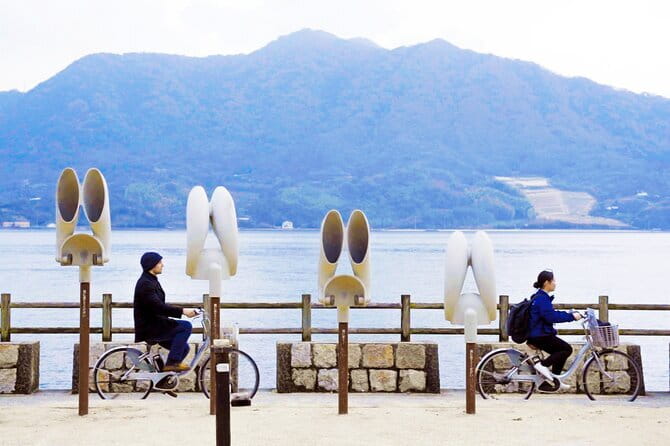
The first thing you notice about Okunoshima may be the rabbits. They are the island’s friendly public face, and you will likely see them around the roads, shrine, and wooded areas. Yet the island also carries the weight of a hidden wartime past.
Okunoshima was once left off maps because poison gas was made and stored here. That contrast gives the island its unusual character. You can pedal through a quiet setting in the Seto Inland Sea, surrounded by distant islands, while standing near buildings tied to a grim chapter of Japanese history.
I appreciate that this tour does not treat the rabbits as the whole story. They make the ride light and memorable, but the guide also helps you understand why the island’s ruins matter. Without that context, the old concrete buildings might look like little more than abandoned shells.
The tour is led by a local guide, and Junko is specifically praised for her gentle manner and strong commitment to teaching visitors about the island. That matters here. The sites are not presented as simple photo stops. You are given a reason to pause and think.
The tour is rated 4.7 out of 5 from 17 ratings, with 94 percent recommending it. The numbers suggest a strong experience, but you should still know what you are booking: this is a short, shared outing with some serious subject matter, not a full-day island visit.
Other cycling tours in Hiroshima people book:
- Hiroshima 2hr Peace Cycling Tour with Local Guide
★ 5.0 · 321 reviews - Hiroshima: Peace Cycling Tour with Local Guide
★ 4.8 · 286 reviews - Hiroshima 3hr Peace Cycling Tour with Local Guide
★ 5.0 · 131 reviews
Cycling a compact Seto Inland Sea island
Okunoshima has a circumference of about 4 kilometers, so the bicycle is a useful choice rather than a fancy extra. You can cover the main route in the allotted time and move between sites without making the day physically demanding.
The tour requires a moderate level of fitness. You do not need to be an athlete, but you should be comfortable riding a bicycle and stopping several times along the way. The route includes a mix of cycling and short visits at the stops, so you are not simply sitting in the saddle for two hours.
The small maximum group size of five is another practical advantage. A guide can usually speak to the group without the feel of a large organized outing. At the same time, this is a shared tour, so other people may join your departure.
Your meeting and ending point is in front of Kyukamura Ohkunoshima. The tour information lists the location as 5476-4 Tadanoumicho, Takehara, Hiroshima. Since the ferry fare is not included, you need to budget an additional 360 yen for the Tadanoumi to Okunoshima crossing.
That ferry detail is easy to miss when comparing prices. At $59.12 per person, the tour includes the bicycle, taxes, and travel insurance, but not food, drinks, private transport, or the ferry. The price is reasonable if you value a guide and want the island’s history explained while you ride. It is less attractive if you only want to borrow a bicycle and see the rabbits on your own.
The lighthouse and the first views
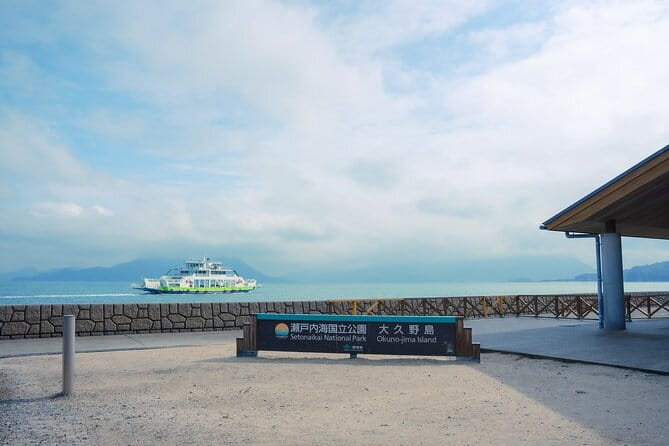
The Okunoshima Lighthouse is a short early stop, lasting about 10 minutes. You cannot enter it, so this is an outside viewing point rather than a climb to the top.
That limitation is worth knowing before you arrive. The stop is about the lighthouse and the scenery around it, not an interior visit. From here, you can take in the Seto Inland Sea views and the surrounding islands.
I like this kind of brief stop on a cycling route. It gives you a reason to pause and look outward before the tour turns toward the island’s more difficult history. Just do not expect a long lighthouse visit or access to the structure itself.
The island loop and its wild rabbits
The main Okunoshima portion takes about an hour, making it the heart of the tour. You will cycle through the small island setting and encounter the rabbits that made Okunoshima famous.
The rabbits are wild, so their behavior can vary. The tour promises the chance to see many of them, but it does not turn them into a staged animal show. That is part of the appeal. You are seeing animals that have made the island their home while moving through a real historic site.
The rabbits also create a sharp contrast with the old military buildings. One moment you may be watching a rabbit near the road, and the next you may be listening to an explanation of the island’s wartime work. That shift can feel uncomfortable, but it is central to understanding Okunoshima.
This is where I think the bicycle format works best. Walking the entire circuit would take more time and energy, while cycling gives you room to see several locations during a short visit. You still have time to stop, listen, and take photographs without spending the whole outing on foot.
Other rides on two wheels around Hiroshima:
- Hiroshima: Best of Hiroshima Guided Bike Tour
★ 4.9 · 89 reviews - Iya Valley BROMPTON Slow Cycling Tour
★ 5.0 · 28 reviews - Hiroshima Country Cycling: Explore Rural Life 1 HR from City
★ 5.0 · 22 reviews - Hiroshima Scenic Cycling Guided Tour
★ 5.0 · 19 reviews
Okuno Shrine, where the mood changes
Okuno Shrine is the only shrine on the island. The stop lasts about 10 minutes, and rabbits are also found around the shrine.
The setting brings together several sides of Okunoshima. You have a traditional religious site, wild animals, and the island’s quiet wooded surroundings. It is a smaller stop than the main island loop, but it helps show that Okunoshima is not just a collection of wartime ruins.
You may find this to be one of the more peaceful moments on the route. The shrine gives the tour a change of pace after the open views and before the more troubling industrial sites. The short visit also keeps the schedule moving.
The poison gas storage ruins

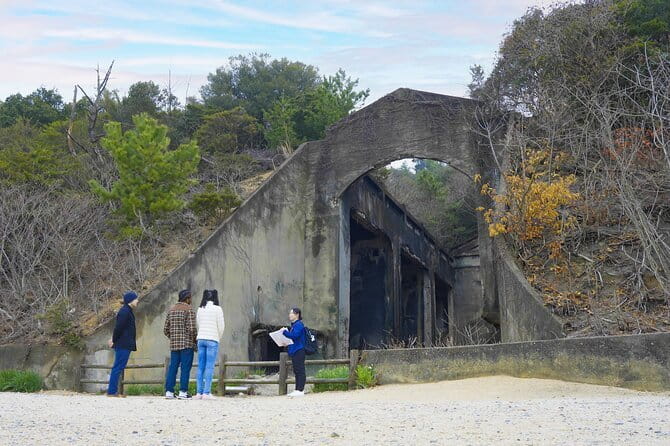
The Nagaura Poison Gas Storage Ruins are one of the most important stops. This facility once stored tanks filled with poison gas. Today, you cannot enter it for safety reasons, so you view the building from a short distance.
That restricted access is not a flaw in the tour. It is simply part of the site’s condition. The value comes from having a guide explain what the structure was used for and why it matters.
If you arrive expecting to walk through every ruin, you may feel limited. The tour is better suited to someone who wants context and an outside view of historic remains. Junko’s role is especially important here because an empty building does not explain itself.
This is also where the island’s pleasant appearance can feel most misleading. The quiet setting and nearby rabbits may make the site seem harmless at first. The story behind the building changes that impression quickly.
The old power plant and hidden wartime work
The Power Plant Ruins offer another look at the island’s wartime role. The facility was used when poison gas was secretly made on Okunoshima.
Like the storage site, the power plant is closed to entry for safety reasons. You view it from outside during a stop of about 10 minutes. The short visit gives you a clear look at the remains without pretending that the site is open for exploration.
This stop helps connect the different parts of the story. The storage facility shows where poison gas was kept, while the power plant points to the work carried out on the island. You do not need a long lecture to understand that the island was part of a planned operation rather than an isolated outpost.
For me, this is one of the strongest reasons to choose a guided ride instead of a simple bicycle rental. A rental gets you to the building. A local guide can explain why it exists and how it fits into Okunoshima’s past.
Northern Cannon Battery Remnants
The Northern Cannon Battery Remnants are the final listed stop and last about 15 minutes. Unlike the poison gas storage and power plant, you can see this site closely.
The battery remains add a military layer to the tour beyond the chemical weapons facilities. You are not only learning about what happened inside the island’s industrial buildings. You are also seeing how Okunoshima was prepared for defense.
This stop may appeal to anyone interested in military remains and old fortifications. It is also a useful ending because it gives you a site that can be viewed more closely after several stops where you had to remain outside.
The route then returns to Kyukamura Ohkunoshima. Since the tour ends where it begins, you do not need to arrange a separate pickup at another part of the island.
What the short format does well
Two hours is long enough to see the principal sites and hear the main story, but it is not long enough for a slow, detailed exploration of every corner. You should think of this as an introduction to Okunoshima.
The compact schedule works well if you are fitting the island into a wider Hiroshima-area trip. The bicycle reduces wasted time, and the stops are short enough to keep the route moving. You get a clear sense of the island’s scenery, rabbits, shrine, defenses, and poison gas facilities in one outing.
The tradeoff is depth. If you want long periods at each ruin, extended photography, or plenty of unstructured time with the rabbits, you may want to stay on the island beyond the tour. The tour itself is designed to give you an organized circuit and historical explanation.
The weather policy is also worth noting. If the Japan Meteorological Agency forecasts a 60 percent or higher chance of rain by noon on the day before the tour, the outing is canceled without a cancellation fee. Poor weather can also lead to a different date or a full refund.
For a normal cancellation, you can receive a full refund if you cancel at least 24 hours before the start time. Cancellations or changes made less than 24 hours before the start are not accepted for a refund.
Who should book this Okunoshima cycling tour
I would choose this tour if you want more than a quick rabbit encounter. It suits you if you enjoy local stories, can manage a moderate amount of cycling, and want a guide to explain sites that would otherwise be easy to overlook.
It is also a good fit for visitors with limited time. The route covers the main points in about two hours and returns to the hotel meeting point. The small group limit should make it easier to hear the guide and ask questions.
Families and casual cyclists should note the serious nature of the history. The rabbits are appealing, but the poison gas story is not light entertainment. You should be comfortable pairing cute animals with a difficult wartime subject.
I would think twice if you want to enter the ruins, spend the entire visit feeding or watching rabbits, or avoid a fixed schedule. Several important buildings are off-limits, and the tour has a set route with short stops.
Should you book it?
Book this tour if you want the full Okunoshima picture, not just its famous rabbits. The bicycle, small group, local guide, and clear route make the $59.12 price fair, especially when you value explanation rather than simple transportation.
The strongest reason to book is the human side of the tour. Guides such as Junko bring care and purpose to a place that could otherwise be reduced to a cute island stop. Add the 360-yen ferry fare, plan for reasonable cycling ability, and leave room in your expectations for both beauty and difficult history.
FAQ
How long does the Okunoshima cycling tour last?
The tour lasts approximately two hours.
Where does the tour start and end?
It starts and ends in front of Kyukamura Ohkunoshima, listed at 5476-4 Tadanoumicho, Takehara, Hiroshima.
Is the ferry included in the tour price?
No. The ferry from Tadanoumi to Okunoshima costs 360 yen and is paid separately.
Is bicycle use included?
Yes. Bicycle use is included in the tour.
Are taxes and travel insurance included?
Yes. All fees and taxes, along with travel insurance, are included.
Can you enter the Okunoshima Lighthouse?
No. Entry to the lighthouse is currently prohibited, so you view it from a short distance.
Can you enter the poison gas storage ruins?
No. The Nagaura Poison Gas Storage Ruins are closed for safety reasons and are viewed from outside.
Can you enter the power plant ruins?
No. The Power Plant Ruins are also closed for safety reasons and are viewed from a short distance.
How many people can join the tour?
The maximum group size is five people. It is a shared tour, and at least two participants are required for the tour to operate.
What happens if the weather is poor?
If the Japan Meteorological Agency forecasts a 60 percent or higher chance of rain by noon on the day before the tour, the tour can be canceled without cancellation fees. If poor weather causes a cancellation, you can be offered another date or a full refund.
Just added in Hiroshima
- Iya Valley BROMPTON Slow Cycling Tour★ 5.0 · 28 reviews
- Iya Valley All Must-Sees Private Chauffeur Full-day Tour with a Driver★ 5.0 · 20 reviews
- Shore Excursion from Hiroshima Port : Private Tour in Hiroshima★ 5.0 · 17 reviews
- Hiroshima & Miyajima All-Inclusive Tour w/Licensed guide Pancho★ 5.0 · 54 reviews
- The Peace Memorial to Miyajima : Icons of Peace and Beauty★ 4.5 · 31 reviews
- Private Full Day Hiroshima Tour★ 4.5 · 29 reviews
- Hiroshima Saijo Sake Tasting Tour with visit to 7 Breweries★ 5.0 · 104 reviews
- Hiroshima Private Tour with a Local – Highlights & Hidden Gems★ 4.5 · 24 reviews
Cycling Tours, compared.

3h Tokyo E-Bike Tour: Hidden Gems, and Local Life with guide
Read our review →
Arashiyama Bamboo Forest & Hidden Gems Bike Tour (Early Bird)
Read our review →
5 Top Highlights of Kyoto Full Day Bike Tour (E-bike option)
Read our review →
Hiroshima 2hr Peace Cycling Tour with Local Guide
Read our review →Browse the lists this tour appears in