
Reviewed · CYCLING TOURS
Kyoto: Full Day Bike Tour
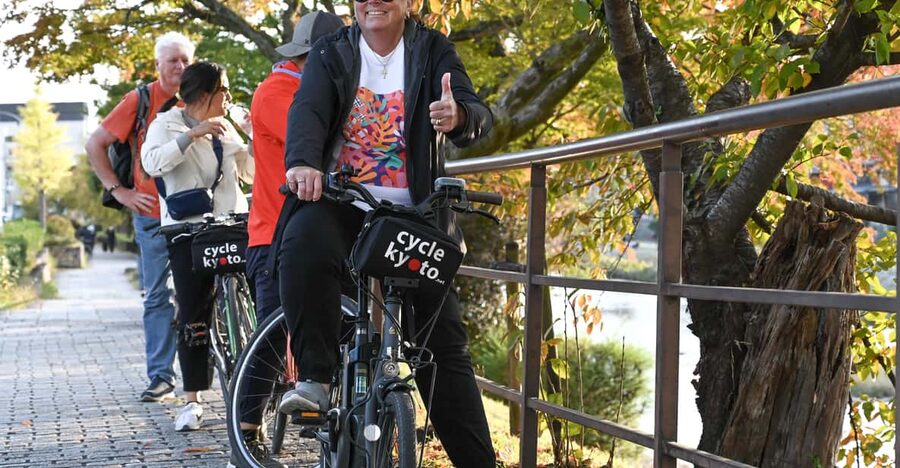
Kyoto’s best moments are often between the famous sights, and this tour gives you plenty of time to find them. Over roughly seven and a half hours, you ride from Toji to Fushimi Inari, passing temple grounds, shopping arcades, the Kamo River, Gion lanes, and neighborhoods that most visitors see only through a taxi window.
I like the small group size, capped at nine, and the fact that the English-speaking guides have lived in Japan for a long time. I also like the useful mix of major sights and local streets, with lunch, a helmet, bike rental, and the Golden Pavilion admission already covered.
The catch is simple: this is a full day of cycling, not a gentle sightseeing ride. You should be comfortable on a bike, ready for roughly 18 miles of riding, and prepared for Kyoto’s heat, sun, or sudden rain.
Key points to know before you ride
- See Kyoto’s big names in one day: Toji, Nishi Honganji, Kitano Tenmangu, Kinkaku-ji, the Imperial Palace, Gion, Tofukuji, and Fushimi Inari all fit into one long route.
- Expect about 18 miles on two wheels: The city is fairly flat, but the distance and repeated stops make this a serious active day.
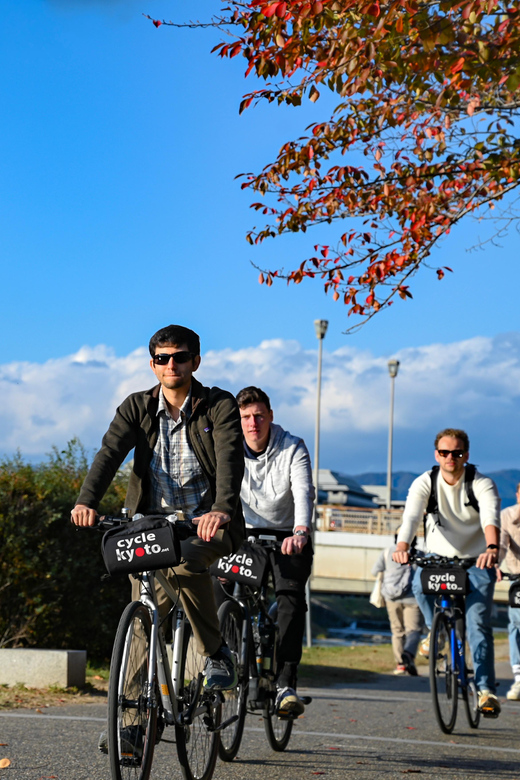
- Ride good-quality cross bikes: The fleet uses well-maintained Giant and Trek bikes, with e-bikes available if requested.
- Small groups make the route more personal: Up to nine people can join, giving you a better chance to hear the guide and ask questions.
- Lunch and Golden Pavilion entry are included: The lunch venue varies, which keeps the meal flexible rather than fixed.
- Guides add local context: Guides such as Jay, Karl, Juan, and Shawn have been praised for humor, patience, history, and practical Kyoto advice.
Why a bicycle is a smart way to see Kyoto
Kyoto is spread out. Its temples and shrines do not line up neatly along one train route, and a day spent moving only by bus can mean waiting, standing, and missing the feel of the neighborhoods between stops.
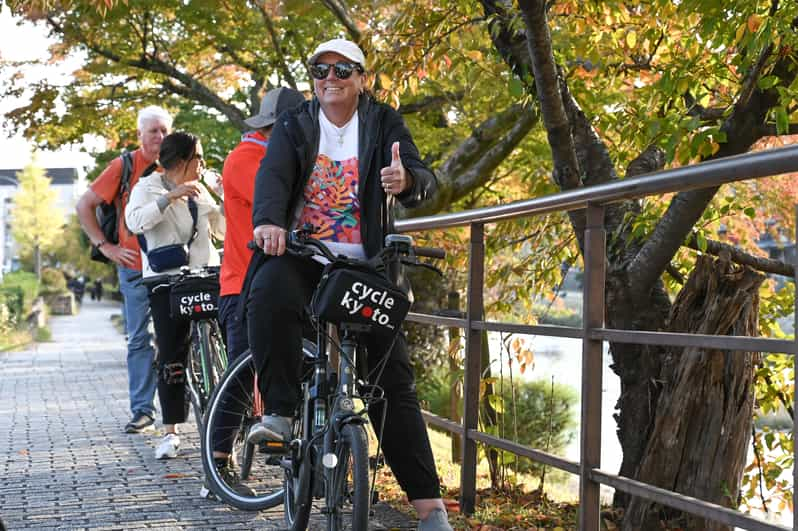
A bicycle changes that rhythm. You can move from a major temple to a quiet lane in minutes, pause beside the Kamo River, and reach Gion without being sealed inside a vehicle. I like this kind of touring because the city becomes more than a checklist of famous buildings.
The route is designed for people who want to cover a lot. It combines two shorter rides into one long day, so you get both the western and eastern sides of central Kyoto. That makes the tour a strong choice if you have limited time and plenty of energy.
You should still be honest about your fitness. One participant recorded a little over 18 miles, along with walking at the temple and shrine stops. Kyoto is generally flat, which makes a standard bike manageable for many riders, but a full day in the saddle can still be tiring.
Other cycling tours in Kyoto people book:
- Bike Tour Exploring North Kyoto plus Lunch
★ 5.0 · 1,087 reviews - Arashiyama Bamboo Forest & Hidden Gems Bike Tour (Early Bird)
★ 5.0 · 613 reviews - 5 Top Highlights of Kyoto Full Day Bike Tour (E-bike option)
★ 5.0 · 511 reviews
Starting at Cycle Kyoto and getting fitted
The day begins at Cycle Kyoto at 9:30 AM sharp. Arrive 15 minutes early so there is time to choose a bike, adjust the saddle, collect a helmet, and listen to the safety briefing.
Bike fitting matters more than many first-time riders expect. A seat set too low can make the ride harder on your legs, while an uncomfortable reach can bother your back and shoulders by lunchtime. Tell the guide at once if anything feels wrong.
The standard bikes are cross bikes made by Giant and Trek. They are a sensible choice for Kyoto’s paved streets and longer distances. E-bikes are available on request, but you should arrange that in advance rather than assume one will be waiting.
You can leave larger luggage in the secure shop space. Keep what you carry on the bike to a minimum, since storage is limited. A small day bag, water bottle, sunscreen, camera, and a light hat are more useful than a large backpack.
Toji and Nishi Honganji: a strong start
The first stop is Toji, identified as Kyoto’s oldest temple. The opening 25 minutes include the safety briefing, followed by about 30 minutes to look around the temple grounds.
Toji gives the day a proper sense of place right away. It is not just a convenient first stop, but an important Buddhist site with a long connection to Kyoto. Starting here also lets the guide explain how temples and shrines differ before you see a long series of them.
From Toji, it is about a 10-minute ride to Nishi Honganji. The route begins to show the advantage of cycling: the two sites are close enough to connect easily, but far enough apart that a walking day would already be losing time.
The guided visit at Nishi Honganji lasts about 50 minutes. This is a chance to slow down and look carefully rather than rush through a photograph. Guides can give the buildings and rituals more meaning, especially if this is your first visit to Japan.
Sanjo Arcade, Shinsen-en, and Kitano Tenmangu
After Nishi Honganji, the route heads north through the Sanjo Shopping arcade. This section gives you a different view of Kyoto. Instead of only grand temple gates, you see the everyday city, with shops and local streets shaping the ride.
A short stop at Shinsen-en gardens follows. It is a smaller, more picturesque pause before the route continues to Kitano Tenmangu. These in-between stops are a real strength of the day. They break up the large attractions and help you notice how Kyoto works at street level.
At Kitano Tenmangu, expect about an hour, including a guided walk around the grounds. The shrine is dedicated to Sugawara no Michizane, a scholar and political figure associated with learning. Even without knowing the full story, the grounds give the guide plenty to explain about Japanese shrine customs and local worship.
The pace here is not simply pedal, photograph, pedal. You park, walk, listen, and then get moving again. Wear shoes that are comfortable both on a bike and on temple paths.
Other rides on two wheels around Kyoto:
- E-Bike Tours of the highlights of Kyoto!!!
★ 5.0 · 291 reviews - Afternoon Kyoto Bike Tour: Bamboo Forest, Monkeys & Hidden Spots
★ 5.0 · 283 reviews - South Kyoto in a Nutshell: Gentle Backstreet Bike Tour!
★ 5.0 · 225 reviews - Pedal Adventure Kyoto’s iconic landmarks on an e-bike tour
★ 5.0 · 189 reviews
Kinkaku-ji, the Golden Pavilion
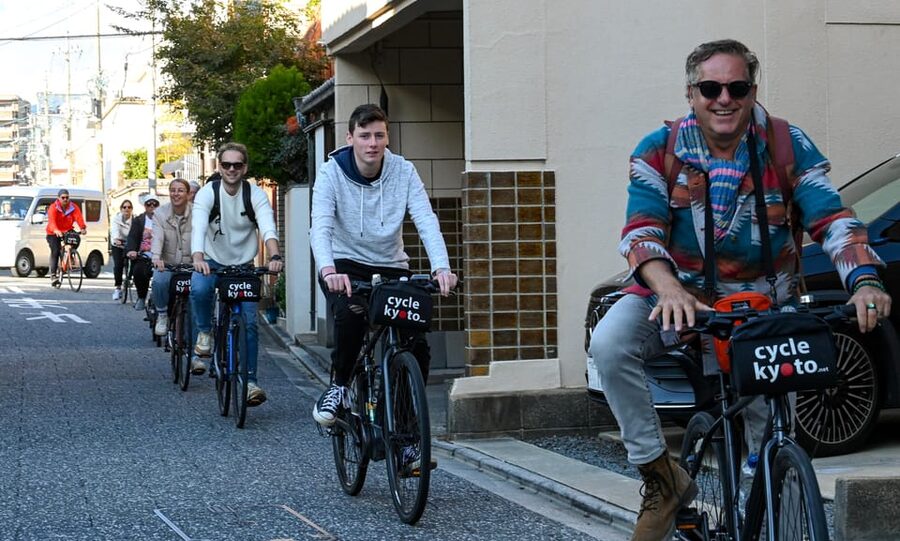
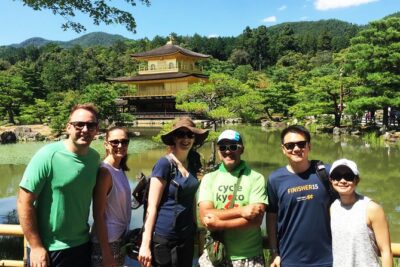
Kinkaku-ji is the most famous stop of the day, and admission is included. You have about an hour at the site, with approximately 25 minutes set aside to explore the pavilion itself and its grounds.
The Golden Pavilion is visually striking, especially when its reflection appears in the pond. It is also one of Kyoto’s busiest sights, so the experience can feel more managed and crowded than the quiet lanes earlier in the morning. That is not a flaw in the tour, but it is worth expecting.
The guide helps you get more from a short visit. You can focus on the building, the garden, and the story of the site without spending time figuring out where to go or how to fit it into your day.
Since the entry fee is covered, the price is easier to assess. You are not paying separately at each major stop, though most temples and shrines on the route do not include general admission beyond the Golden Pavilion. Bring a camera, but leave room to simply look. Kinkaku-ji is one of those places where a quick glance does not quite do it justice.
Lunch and the ride toward the Imperial Palace
Lunch follows at a local restaurant, with about an hour for the break. The location can change based on availability, so do not book the tour expecting one fixed restaurant.
That flexibility can work in your favor. One lunch described by a participant included ramen with a special duck broth, while other groups may be taken elsewhere. The important point is that lunch is a proper stop, not a hurried snack while standing beside the bikes.
A traditional Japanese lunch is included in the price. This is useful in practical terms, since you do not need to search for food while navigating an unfamiliar part of the city. It also gives the guide a natural chance to recommend other foods and places for later in your trip.
After lunch, the route heads toward the Kyoto Imperial Palace. The palace area provides a change of scale after the compact temple grounds. Plan on about an hour here, with the guide explaining the role of the imperial court and the grounds you are seeing.
The Imperial Palace is not just another landmark to tick off. It helps connect Kyoto’s religious sites with the city’s political past. By this stage, the route has already shown you temples, a shrine, shops, gardens, and local streets, so the palace adds another useful piece to the picture.
Following the Kamo River into Gion
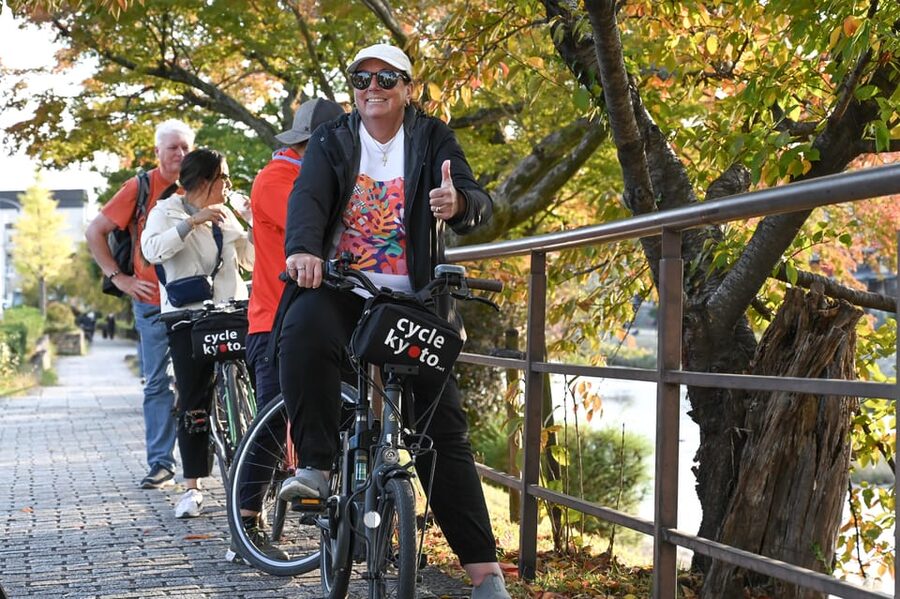
The ride picks up the Kamo River and heads south. The river section is one of the day’s best chances to relax your eyes after several formal sites.
There is a planned photo stop of about 40 minutes. That may sound long, but it gives you time to take pictures, stretch, and enjoy a less structured part of Kyoto. River views also give you a better sense of the city’s layout than you get from temple courtyards alone.
From the river, you enter the back streets of Gion, Kyoto’s famous geisha district. The guide leads you through the area rather than leaving you to search for the right lanes on your own. Keep your camera ready, but remember that Gion is a living neighborhood, not a stage set. Follow the guide’s advice about respectful photography and do not block doorways or private entrances.
Gion is especially rewarding on foot, but arriving by bike lets you cover more ground before walking the most interesting sections. You might see traditional facades, narrow lanes, and small details that disappear when you are focused on a bus timetable.
One participant on a spring tour even saw a geisha, but that is not something anyone can promise. Treat it as a possible moment, not the reason to book.
Tofukuji and the red gates of Fushimi Inari
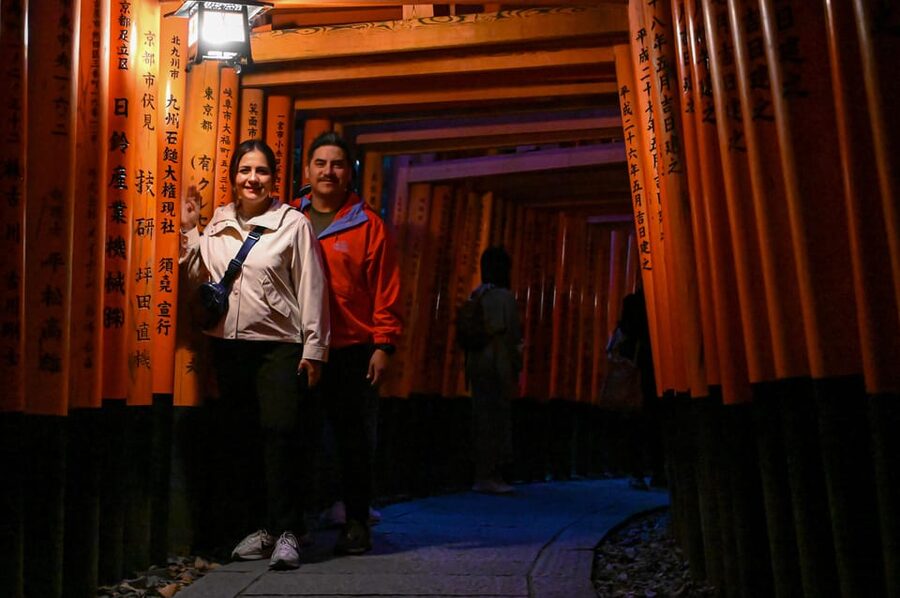
The final section heads south to Tofukuji Temple, followed by Fushimi Inari Taisha. Tofukuji is listed as a 30-minute photo stop, so this is a shorter look rather than a full temple visit.
That brief pause works well late in the day. You can take in the setting, photograph the architecture, and save your legs for Fushimi Inari, the grand finale.
At Fushimi Inari, the tour visits the Senbontorii, the famous corridor of red torii gates. The guided portion lasts about an hour. The gates create one of Kyoto’s most recognizable scenes, but the experience is more enjoyable when you understand that they were donated by individuals and businesses as expressions of devotion and thanks.
You will walk here, so the practical advice matters: wear comfortable shoes and expect stairs or uneven ground in parts of the shrine area. The tour does not mean climbing every section of the mountain. The time is focused on the striking torii corridor and the shrine grounds before cycling back to Cycle Kyoto.
The guides and the feel of a small group
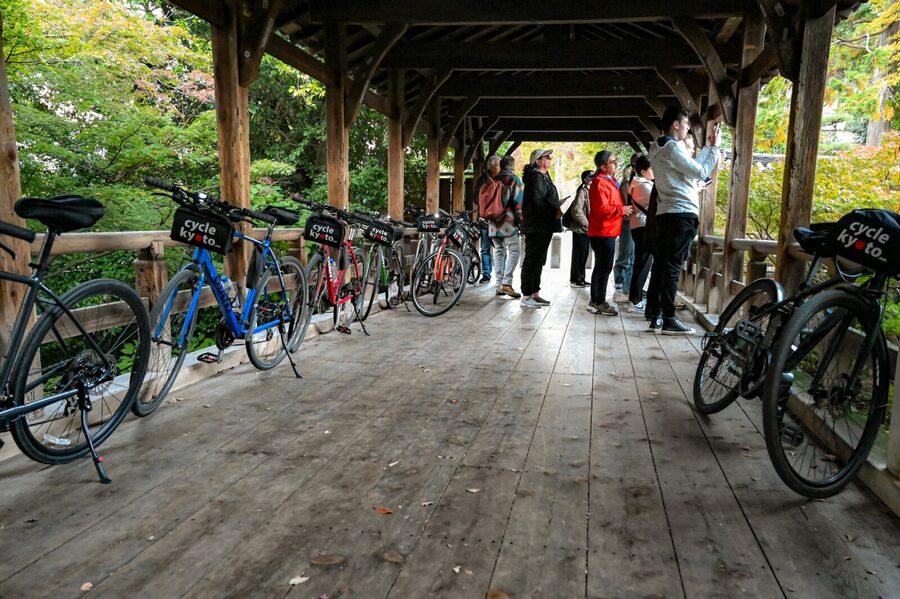
The guides are fluent in English and have lived in Japan for a considerable time. That combination matters because the day includes many cultural questions that a simple audio guide cannot answer.
Jay has been praised for his humor, enthusiasm, and ability to make Kyoto feel lively. Karl has helped make lunch and the city’s history part of the fun. Juan has been described as patient and helpful with suggestions for places to visit on later days. Shawn has led a tour that mixed temple explanations with enjoyable rides through small alleyways.
Names and guide assignments can change, so you cannot request a particular person unless the operator confirms it. Still, the format gives you a good chance to ask questions and get advice tailored to your interests.
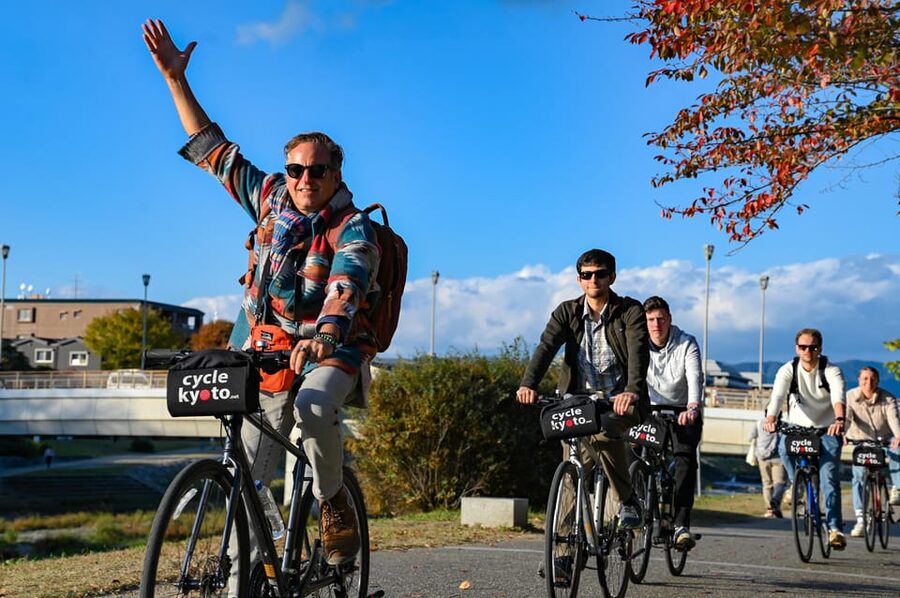
A maximum of nine people is another advantage. The guide can keep an eye on the group at crossings and adjust explanations more easily than on a large coach tour. The tradeoff is that you still need to follow the group’s pace and be ready when it is time to ride.
Price, equipment, and what to bring
At $116 per person, the tour is not the cheapest way to see Kyoto, but the value is reasonable if you use the whole day. The price includes the bike, helmet, Golden Pavilion admission, English-speaking guide, and traditional Japanese lunch.
You are also paying for route planning. Reaching this many places independently would require a mix of trains, buses, walking, map checks, and separate entrance arrangements. If you have only one full day for Kyoto, that saved time has real value.
Bring:
- Comfortable cycling and walking shoes
- Water
- Sunscreen
- A hat
- A camera
- Light, comfortable clothing
High heels and smoking are not allowed. The tour may not run in all weather, and heavy rain can lead to cancellation with a refund. Dress for the forecast, but keep your plans flexible.
Cancellation is free up to 24 hours before departure, and you can reserve now and pay later. The tour is not suitable for children under 12, pregnant women, or anyone who cannot ride a bicycle.
Who should book this Kyoto bike tour?
I would choose this tour if you want a broad first look at Kyoto and enjoy being active. It is particularly useful for a short visit, since the route covers famous sights that are spread across the city and adds local neighborhoods that are easy to miss.
It also suits curious eaters and culture-minded visitors who want a guide to explain what they are seeing. The lunch stop, Gion ride, river section, and smaller temple visits keep the day from feeling like a parade of only the biggest attractions.
I would think twice if you dislike long rides, have trouble cycling for several hours, or want slow, extended visits at each temple. The itinerary is ambitious, and the day can feel full. An e-bike may help, but it does not remove the need to pedal, park, walk, and keep up.
Should you book it?
Book this tour if you want to cover a lot of Kyoto in one energetic day, prefer local streets to buses, and value a guide who can connect the sights. The strongest reasons are the carefully linked route, small group, good bikes, included lunch, and mix of major landmarks with ordinary neighborhoods.
Skip it if your ideal Kyoto day means lingering for hours at one temple or moving at a very slow pace. For everyone else, this is a practical way to see the city on two wheels, with enough history, food, river scenery, and back-street riding to make the day feel like more than a sightseeing checklist.
FAQ
What time does the Kyoto bike tour start?
The tour starts at 9:30 AM. You should arrive 15 minutes early for bike fitting and the safety briefing.
How long does the tour last?
The stated duration is 450 minutes, or about seven and a half hours.
What is included in the price?
Bike rental, a helmet, admission to the Golden Pavilion, and a traditional Japanese lunch are included.
Are e-bikes available?
Yes. E-bikes are available on request, so arrange one in advance.
How many people can join the tour?
The tour is limited to nine participants.
Is the tour suitable for children or non-riders?
No. It is not suitable for children under 12, pregnant women, or people who cannot ride a bicycle.
Just added in Kyoto
- Private Cooking Class Udon in Kyoto Japan★ 5.0 · 23 reviews
- Your Private Vacation Photography Session In Kyoto★ 5.0 · 110 reviews
- Kyoto: Zen Meditation at a Private Temple with a Monk★ 5.0 · 25 reviews
- Private Pewter Sake Cup Experience with a Kyoto Artisan★ 5.0 · 31 reviews
- Kyoto Wagashi(Japanese sweets) Cooking Class near Fushimiinari★ 5.0 · 60 reviews
- Kyoto:Family-Friendly Kimono & Yukata Experience at WARGO★ 5.0 · 147 reviews
- Private Guided Traditional Buddhist Cooking in Japan★ 5.0 · 16 reviews
- Kyoto: Gion Geisha District & Sake-in-Hand Walking Tour★ 5.0 · 37 reviews
Cycling Tours, compared.
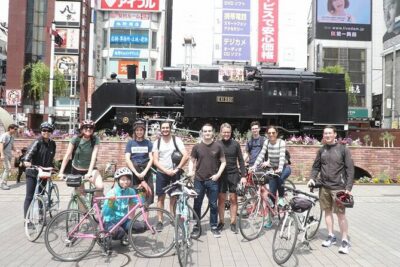
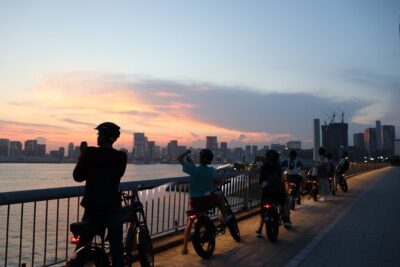

3h Tokyo E-Bike Tour: Hidden Gems, and Local Life with guide
Read our review →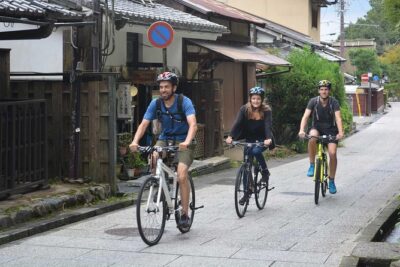
Arashiyama Bamboo Forest & Hidden Gems Bike Tour (Early Bird)
Read our review →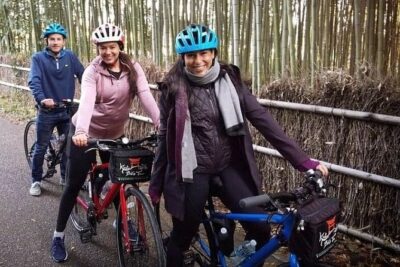
5 Top Highlights of Kyoto Full Day Bike Tour (E-bike option)
Read our review →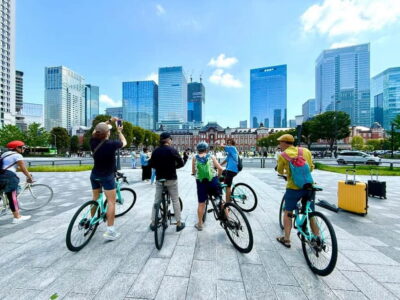
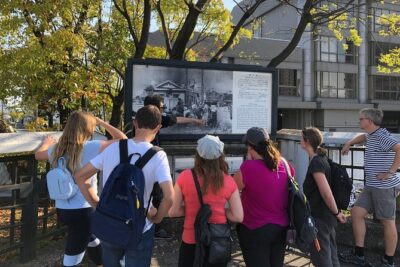
Hiroshima 2hr Peace Cycling Tour with Local Guide
Read our review →Browse the lists this tour appears in