
Reviewed · GEISHA & GION DISTRICT TOURS
Kyoto: Gion Geisha District & Sake-in-Hand Walking Tour
Kyoto’s Gion district is at its best after dark, when lanterns soften the wooden facades and the narrow lanes feel far removed from the city around them. This tour gives you a guide for the maze, a small group of no more than 10 people, and sake to taste as you walk between Gion’s teahouses, shrines, and old streets. Geisha culture is the main subject, but the evening also touches on samurai life, Zen, and local customs.
I like two things especially: the route links Gion with Higashiyama’s best-known lanes, so you see more than one isolated district, and the sake tasting gives the walk a social, distinctly Japanese twist. Guides including Shumpei and Mune have been praised for answering questions about daily life in Japan, and the tour can feel almost private when numbers are low.
The main consideration is the walking-to-commentary balance. One hour to 1.5 hours is a short time for eight stops, and the experience depends heavily on your guide’s energy. If you want a deep lesson in geisha history or a formal tasting, this relaxed street walk may feel too light.
Key points to know before booking

- Nighttime Gion is the real draw: Lantern-lit lanes, quiet shrine grounds, and wooden machiya houses give the walk its strongest atmosphere.
- The group is capped at 10 people: That is small enough for questions and easier movement through tight streets.
- Sake is part of the experience: You taste local sake during the walk, with some experiences also including small snacks.
- The route covers two classic Kyoto areas: Gion leads into Yasui-Konpiragu, Yasaka Pagoda, Ninenzaka, Sannenzaka, Nene-no-Michi, and Yasaka Shrine.
- You may learn more than geisha etiquette: Commentary can include samurai culture, Zen meditation, shrine customs, and everyday life in Japan.
- Plan for a real walk: Comfortable shoes matter, and the tour is for adults aged 20 and older.
Why Gion works so well after dark
Gion can feel crowded and overly photographed during the day. At night, its wooden buildings and narrow lanes take on a calmer mood, especially when the streets are softly lit. This tour is designed around that change in atmosphere rather than around a long list of indoor admissions.
The opening area near the Kamo River gives you a useful sense of place. The river runs through central Kyoto, and its banks are known for seasonal scenery, including cherry blossoms. From here, the route moves toward Gion, where traditional machiya houses and teahouses line streets that are easy to miss if you are exploring alone.
Do not expect a guaranteed geisha sighting. The tour can point out places and customs linked to geiko and maiko, and you might happen to see one passing through the district, but this is a working neighborhood, not a performance arranged for visitors. That distinction matters. The best approach is to listen, keep your voice down, and treat the area as a residential and cultural district.
The evening sake helps break the ice. It is not presented as a formal winery-style tasting with a long lecture. Instead, you taste local sake as part of the walk. One account describes a selection from different regions of Japan, which can make the tasting more interesting than a single sample. Since the exact selection may vary, think of it as a pleasant extra rather than the main reason to book.
Other walking tours in Kyoto people book:
- Kyoto Geisha Walking Tour: Gion District & Hidden Gems
★ 4.7 · 3,273 reviews - Kyoto: Gion Magical Night Walking Tour with Geisha Trivia
★ 4.9 · 2,393 reviews - Kyoto: Gion Geisha District Walking Tour – Stories of Geisha
★ 4.7 · 2,187 reviews
Hanamikoji Street and the Gion back lanes
Gion is best understood on foot. Cars and buses cannot give you the same view of the dark wooden fronts, modest entrances, and narrow lanes. The route includes Hanamikoji Street, one of the district’s most recognizable historic streets, with well-preserved machiya buildings and traditional teahouses.
Hanamikoji is photogenic, but it is also one of the places where good manners matter most. Keep your voice low, do not block entrances, and follow any posted rules about photography. The tour’s reminder about residential areas at night is practical, not fussy. You are walking through a real neighborhood where people live and work.
The guide’s role makes a big difference here. A good explanation can help you understand why the district looks the way it does, how teahouse culture works, and why geisha traditions continue to attract so much attention. The strongest accounts of this tour describe guides who answer questions about Japanese life rather than simply reciting dates.
Shumpei is specifically praised for making the walk friendly and answering questions about Japan beyond the sights. Mune is also singled out for clear information about the area and a pleasant manner. Guide assignments can change, so book this for the format and route rather than for one guaranteed individual.
Yasui-Konpiragu and the meaning of shrine visits
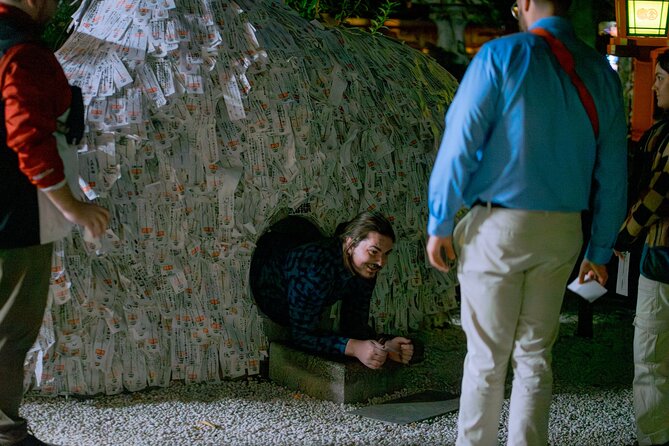
Yasui-Konpiragu provides a change of mood from the polished streets of Gion. The shrine is known for its association with cutting ties to harmful relationships and forming better ones. Its large enshrined object is part of a ritual that attracts people seeking a personal fresh start.
This is a useful stop because it shows how Japanese religious practice can be personal, visual, and hands-on. Your guide can explain the custom and place it in the wider setting of Shinto practice. You will have about 15 minutes here, enough to look around and hear the main story without turning the stop into a full shrine visit.
There is one limitation. The itinerary moves at a brisk clip, so you will not have the time you would get on a dedicated temple and shrine tour. I see this stop as cultural context rather than a complete exploration. If you enjoy learning what a place means to local people, it earns its place on the route.
Yasaka Pagoda and the famous Higashiyama slopes

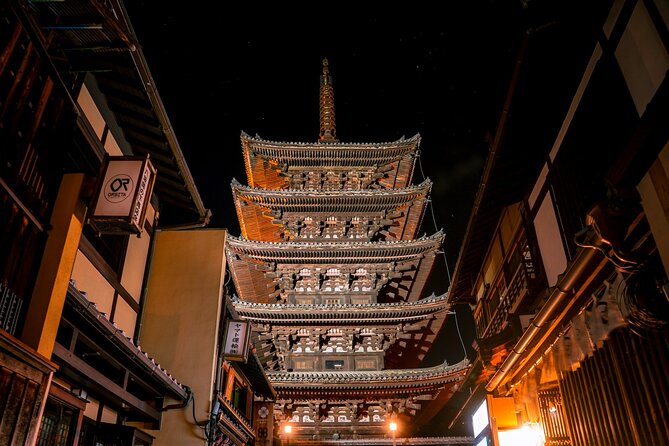
Hokan-ji Temple, better known as Yasaka Pagoda, is one of the most recognizable sights in Higashiyama. The five-story pagoda rises above the surrounding streets and gives the walk one of its best photo settings. The pagoda dates back to the sixth century, adding a long historical thread to an already old-looking neighborhood.
The tour allows about 15 minutes here. That is enough for views and explanation, but not for a long temple visit. Admission is listed as free for the stops, though this does not mean every interior area or nearby attraction is included. The value comes from seeing the pagoda as part of the street scene and learning how it fits into Kyoto’s religious setting.
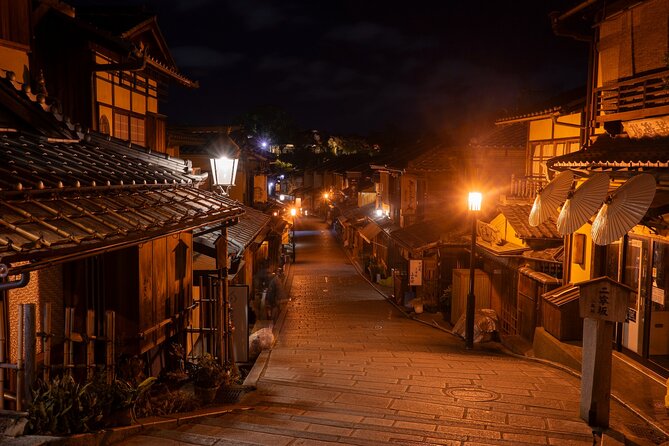
From there, the route reaches Ninenzaka and Sannenzaka. These stone-paved slopes are lined with traditional wooden buildings, small shops, and places to stop later if you want to return in daylight. The scheduled time is short, around five minutes at each slope, so expect a guided pass through rather than a shopping break.
That timing is worth noting. You will see the character of the streets, but you will not have much time to browse, sit down, or take every photograph you want. If you want a relaxed shopping visit, return on your own. The tour’s purpose is to connect the sights and give them context.
Other evenings in the old entertainment quarters of Kyoto:
- Best of Kyoto: Gion, Geisha, Pagodas & Cobblestones
★ 4.9 · 2,058 reviews - Night Walk in Gion: Kyoto’s Geisha District
★ 4.5 · 2,003 reviews - Kyoto Night Foodie Tour in Gion (9+ dishes + 6 Sake tastings)
★ 5.0 · 1,762 reviews - Kyoto Gion Geisha District Walking Tour – The Stories of Geisha
★ 5.0 · 1,441 reviews
Nene-no-Michi and the quieter side of Higashiyama

Nene-no-Michi is one of the more peaceful sections of the route. This stone-paved path is named for Nene, the wife of Toyotomi Hideyoshi, and connects the Kodaiji area with Maruyama Park. The street feels less like a major sightseeing corridor than Ninenzaka, which makes it a good place to slow down and notice the setting.
The tour allows about 10 minutes here. That may be enough for a short explanation and photographs, especially if the group is small. In rain, the stone lanes can look especially atmospheric, but you should wear shoes with a firm grip and be prepared for wet weather. The experience requires good weather and may be canceled if conditions are poor.
This part of the walk also shows why the small group matters. Ten people is the maximum, and some departures may be much smaller. A very small group makes it easier to hear the guide and move through narrow lanes. It can also make the evening feel more personal, though the quality of conversation still depends on the guide and on how actively you ask questions.
Ending at Yasaka Shrine
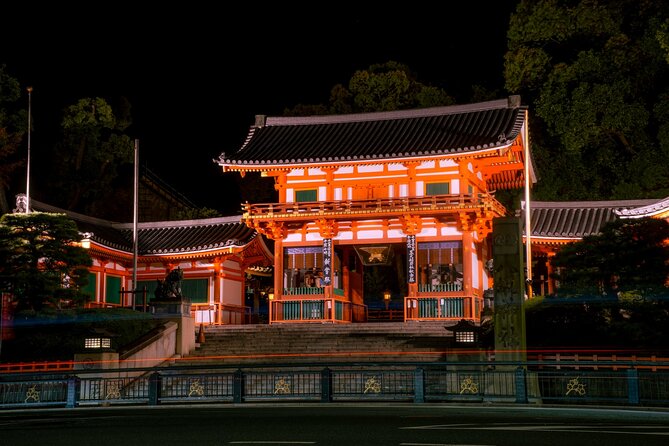
Yasaka Shrine is the final stop and the longest scheduled visit, at about 20 minutes. Also called Gion Shrine, it is one of Kyoto’s best-known Shinto shrines and is traditionally dated to 656. Its position at the eastern edge of Gion makes it a natural ending point.
Finishing here works well because you can look back at the route as one connected district. Gion’s teahouses, Higashiyama’s slopes, the pagoda, and the shrine are not separate postcard stops. Together, they show how Kyoto’s religious sites and traditional streets sit within an active urban neighborhood.
The tour ends at the shrine rather than returning to the starting point near the Kamo River. That is useful if you plan to continue around Higashiyama, but less convenient if you need to retrieve something or return directly to your hotel. The tour information warns that many buses may have stopped running by the end and says the operator can help arrange a taxi or guide you back toward the start.
What the price of $27.84 gets you
At $27.84 per person, this is priced as an accessible guided walk rather than a premium private tour. You are paying for a guide, route planning, local explanation, and sake tasting. The stops themselves do not require admission fees, so the main value is the interpretation and the ease of moving through places you might otherwise pass without understanding.
I think the price is fair if you want a gentle introduction to Gion at night and would otherwise wander without much context. It is especially useful early in a Kyoto visit, when you are still learning how the districts fit together. The group discount may improve the value for companions booking together.
The calculation changes if you mainly want a substantial sake experience. This is not described as a dedicated tasting session, and the walk lasts only about one to 1.5 hours. Likewise, if you prefer detailed history at every stop, you may find the commentary too brief. One disappointing experience described little conversation and an ending closer to an hour and 10 minutes, so I would not book it expecting a guaranteed full 90-minute lecture.
How demanding is the walk?
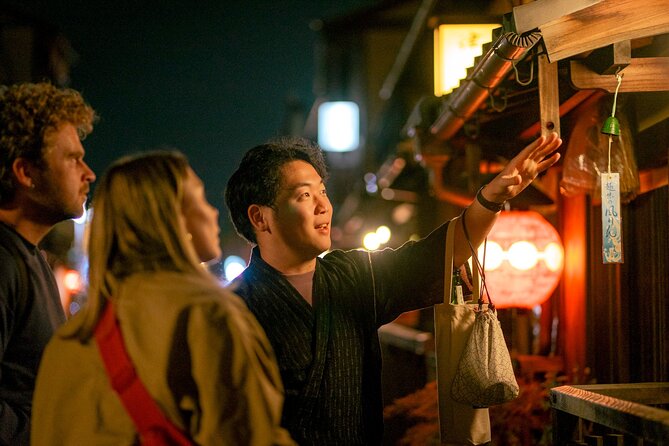
The route involves a lot of walking through streets, lanes, slopes, and stone-paved paths. You do not need athletic ability, but the tour asks for a moderate level of fitness. Comfortable shoes are essential, especially on Ninenzaka, Sannenzaka, and Nene-no-Michi.
The walk is also more tiring if you have spent the day sightseeing. Kyoto’s traditional districts are easy to underestimate because the route looks compact on a map. Add uneven paving, stairs or slopes nearby, and time standing while listening, and the right shoes become more important than stylish footwear.
Participants must be at least 20 years old because alcohol is provided. Drink responsibly, particularly if you are walking on uneven streets. The tour is not a good fit for anyone looking for a late-night pub crawl. It is a cultural walk with sake included, not a drinking tour.
Who will get the most from this Kyoto walk?
I would recommend it to you if you want:
- A first look at Gion after dark
- A small group instead of a large bus tour
- A guide who can explain local customs and answer questions
- A short evening activity before dinner or after a daytime temple visit
- A mix of scenery, history, shrine visits, and sake
- Help finding back streets without getting lost
It is less suitable if you want a private tour, extensive time inside temples, a formal sake education, or a guaranteed geisha encounter. It may also disappoint you if you dislike walking while holding or tasting alcohol, or if you prefer a tightly timed sightseeing program with no variation.
The experience seems strongest when you take an active part. Ask about geisha culture, samurai traditions, Zen, shrine customs, and everyday life in Kyoto. The guide can provide the setting, but your questions help turn a simple walk into a more useful conversation.
Booking and practical details
The meeting point is Kikunoi Roan near the Kamo River in Saitocho, Shimogyo Ward. The tour ends at Yasaka Shrine in Gion, so plan your evening around that one-way route. A mobile ticket is accepted, and confirmation is provided when you book.
The tour is capped at 10 people and offers group discounts. It requires good weather, and a departure can be canceled if the weather is poor or if the minimum number of participants is not met. You can receive a full refund if you cancel at least 24 hours before the start time. Inside that window, changes and refunds are not accepted.
Because the walk passes through residential areas at night, keep conversations quiet and follow the guide’s lead. The best photographs will come from observing the streets rather than stopping in doorways or treating working businesses as movie sets.
Should you book the Gion Geisha District and Sake-in-Hand Walk?
Book it if you want an affordable, atmospheric introduction to Gion and Higashiyama, with a small group and a little sake along the way. The combination of lantern-lit streets, Yasaka Pagoda, old slopes, shrine grounds, and local commentary gives you a strong first taste of Kyoto after dark.
Go in with the right expectations. This is a relaxed walking tour, not a full academic treatment of geisha culture or a polished tasting event. Its success depends on your guide, your willingness to ask questions, and your comfort with walking for most of the evening.
For roughly $28, I think it makes the most sense for first-time Kyoto visitors, couples, friends, and solo travelers who want company while exploring Gion. If you value quiet streets, cultural context, and a flexible human pace more than a packed schedule, this is a sensible buy.
FAQ
How long does the Gion Geisha District and Sake-in-Hand tour last?
The advertised duration is approximately one hour to one hour and 30 minutes. The actual finish can vary, so do not plan another activity too tightly against the scheduled end time.
Where does the tour start and finish?
The tour starts at Kikunoi Roan near the Kamo River in Saitocho, Kyoto. It finishes at Yasaka Shrine in Gion.
Is sake included in the tour price?
Yes. A local sake tasting is included, and alcohol is provided to participants aged 20 or older. You should drink responsibly while walking.
How many people can join the tour?
The maximum group size is 10 people. The small-group format is intended to make movement through narrow streets easier and allow more room for questions.
What should I wear?
Wear comfortable clothing and walking shoes. The tour includes a lot of walking through narrow streets and stone-paved areas in Gion and Higashiyama.
Can I cancel for a full refund?
Yes, if you cancel at least 24 hours before the experience start time. Cancellations or changes made within 24 hours are not refunded. If poor weather or an insufficient number of participants causes the operator to cancel, you can choose another date or receive a full refund.
More walking tours elsewhere in Japan
- Nishiki Market Brunch Walking Tour (7 Tastings + Brunch)
★ 5.0 · 1,355 reviews - Kyoto Arashiyama Walking Tour: Bamboo, Monkeys, Gardens & Secrets
★ 5.0 · 1,216 reviews - Kyoto Gion: 2-Hour Geisha Culture & History Walking Tour
★ 5.0 · 1,186 reviews - Kyoto: Izakaya Bars Guided Walking Tour
★ 4.9 · 815 reviews
More sake tastings elsewhere in Japan
- 3-Hour Kyoto Insider Sake Brewery Tour with Tastings & Pairings
★ 5.0 · 917 reviews - Arashiyama Bamboo, Temple, Monkeys, or Secret Sake Brewery
★ 4.8 · 886 reviews - Kyoto: Insider Sake Brewery Tour with Sake and Food Pairing
★ 5.0 · 704 reviews - Kyoto Sake Brewery & Tasting Walking Tour
★ 5.0 · 623 reviews
Just added in Kyoto
- Private Cooking Class Udon in Kyoto Japan★ 5.0 · 23 reviews
- Your Private Vacation Photography Session In Kyoto★ 5.0 · 110 reviews
- Kyoto: Zen Meditation at a Private Temple with a Monk★ 5.0 · 25 reviews
- Private Pewter Sake Cup Experience with a Kyoto Artisan★ 5.0 · 31 reviews
- Kyoto Wagashi(Japanese sweets) Cooking Class near Fushimiinari★ 5.0 · 60 reviews
- Private Guided Traditional Buddhist Cooking in Japan★ 5.0 · 16 reviews
- Kyoto:Family-Friendly Kimono & Yukata Experience at WARGO★ 5.0 · 147 reviews
- Tour in Kyoto with a Goverment Certified Tour Guide★ 3.5 · 117 reviews
Geisha & Gion District Tours, compared.

Kyoto Geisha Walking Tour: Gion District & Hidden Gems
Read our review →
Gion Geisha District Walking Tour – Stories of Geisha
Read our review →
Best of Kyoto: Gion, Geisha, Pagodas & Cobblestones
Read our review →
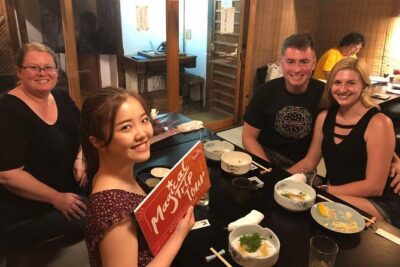
Kyoto Night Foodie Tour in Gion (9+ dishes + 6 Sake tastings)
Read our review →
Kyoto Gion: 2-Hour Geisha Culture & History Walking Tour
Read our review →
Chopsticks Making Workshop in Gion with Engraving Option
Read our review →
Browse the lists this tour appears in