
Reviewed · NARA & THE DEER PARK
Nara: Bike Tour in Ancient Capital UNESCO World Heritage
Heijo Palace is Nara away from the deer crowds: a wide, quiet UNESCO site where you can cycle between grand gates, reconstructed halls, excavation pits, gardens, and a pond alive with birds. Guide Kay gives the scattered remains a clear story, explaining how Nara functioned as Japan’s ancient capital.
I like the small group of no more than eight, which keeps the pace friendly and leaves room for questions and photos. I also like the value: for $22, you get a bike, helmet, guide, admissions, and a traditional costume experience. The main drawback is that much of the palace site is open and exposed, and one reviewer found two hours a little long in the August heat.
Key points at a glance
- Cycle through the former imperial capital: A bike lets you cover the broad palace grounds far more easily than walking.
- See the site’s layers: Reconstructed buildings, preserved excavation remains, gardens, tombs, museums, and old tiles each show a different part of Nara’s past.
- Meet the site through Kay’s guiding: Her English explanations cover history, culture, and local traditions, with time for questions.
- Pause beside Minakami Pond: The ride includes a calm stretch with birds, ducks, turtles, and a welcome change of pace.
- Try Tenpyo-period clothing: The costume stop gives you a light, memorable way to connect with Nara’s ancient court culture.
- Skip the busiest Nara route: This tour has little to do with the famous deer park and much to do with the city’s role as an ancient capital.
Why Heijo Palace works better by bicycle
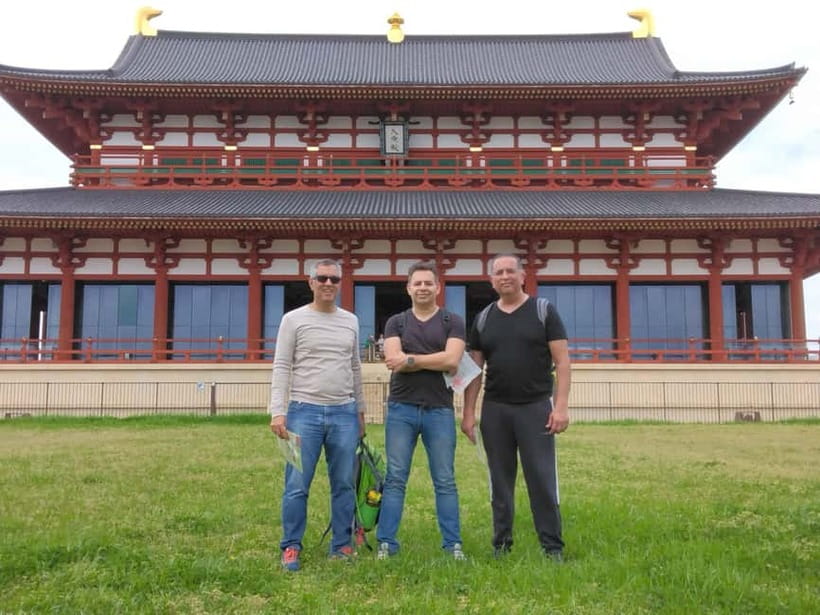
Heijo Palace is not one compact monument. It is a large site with gates, gardens, museums, open spaces, reconstructed halls, and archaeological remains spread across the former palace grounds. On foot, you can see the major buildings, but the distances between them take time. A bicycle makes the visit feel connected.
The route is gentle enough to suit families and casual cyclists, according to the tour details and past experience on the ride. The pace includes regular stops, so you are not simply pedaling from one point to the next. You ride, listen, take photos, and move on.
This is also a good way to see a quieter side of Nara. The tour does not focus on Nara Park or the deer. Instead, you spend your time around the palace site, where open space and fewer people can make the ancient capital easier to picture.
The group is limited to eight people, and the guide speaks English or Japanese. That matters here. Heijo Palace can feel spread out and abstract if you only read signs. A small group allows Kay to explain what you are looking at without turning every stop into a long lecture.
Other day trips out of Nara:
- World Heritage Kyoto & Nara Uji Authentic Matcha Experience
★ 5.0 · 1,573 reviews - Nara Half Day Trip Walking Tour (Private Option Available)
★ 5.0 · 937 reviews - Nara Early Morning Tour (Kyoto or Osaka Departure Available)
★ 5.0 · 676 reviews
Meeting at Suzaku Square
You meet at the rental bike reception counter inside Miharashi-Kan in Suzaku Gate Square. Arrive 10 minutes before the scheduled start. The meeting point coordinates are 34.68628944048124, 135.7926401146025.
The easiest public transport option is the Nara Kotsu bus to the Suzakumon Hiroba Mae stop. From Kintetsu Nara Station, the bus ride takes about 16 minutes, followed by a five-minute walk north. From Kintetsu Yamato-Saidaiji Station’s South Exit, the bus takes about 10 minutes, then you walk for around five minutes.
From JR Nara Station’s West Exit, the bus ride is about 10 minutes, with another five minutes on foot. You can also walk from Kintetsu Yamato-Saidaiji Station’s South Exit or Shin-Omiya Station, with each walk taking about 20 minutes.
The bikes and helmets are included. Bike insurance is not included, so check that point before booking if insurance matters to you. Hotel pickup is not offered, and a missed tour is non-refundable. The operator can cancel for heavy rain, storms, or other bad weather, with a full refund in that case.
Suzaku Gate introduces the ancient capital
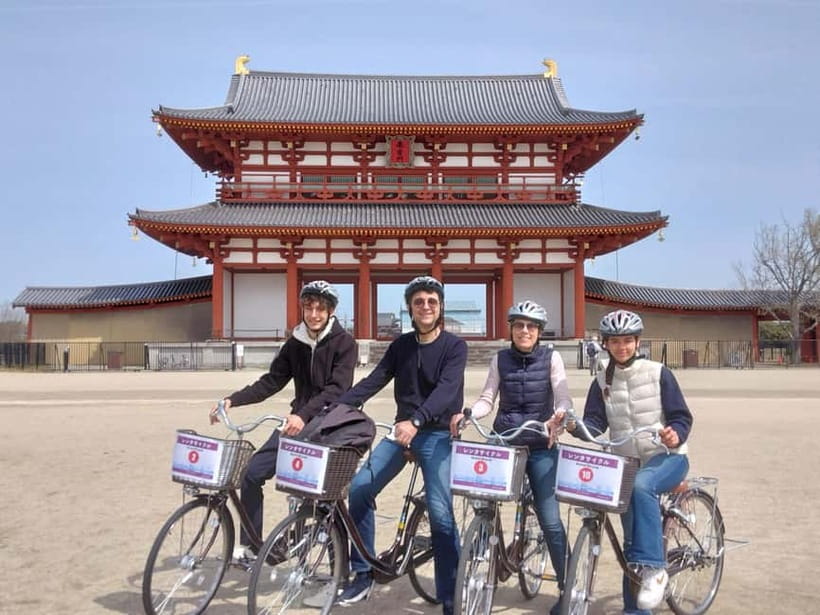
The first stop is Suzaku Gate, the main entrance to Heijo Palace. This is the right place to begin because the gate gives you an immediate sense of ceremony and scale. You can stop for photos while Kay explains the palace and the role of Nara during the Nara period.
The stop lasts about 15 minutes. That is enough time to look closely, hear the basic story, and take photos without lingering too long at the first point. The surrounding nature also helps. You are not looking only at a rebuilt gate. You are seeing it against open grounds and greenery.
A photo tip: the gate is one of the clearest visual markers on the route, so take your main portrait here before the ride gets underway. The costume experience comes later, and Suzaku Gate can provide a strong backdrop for a more formal image.
Toin Garden shows courtly design
Toin Garden, also called the East Palace Garden, is one of the most graceful stops. It represents the kind of Japanese garden design that took root during this period, with bridges, buildings, and carefully arranged rocks.
The garden was connected to the role of a state guest house. That detail gives the setting more meaning than a simple photo stop. You can consider how the garden, buildings, and water were arranged for formal visits and court life.
You spend about 10 minutes here. That may sound brief, but the garden is part of a moving route rather than a stand-alone garden visit. I like this balance. You get enough time to notice the arrangement and take pictures, then return to the bike before the tour loses momentum.
The garden also provides a visual break from the broad open palace grounds. If you enjoy Japanese gardens, this is likely to be one of your favorite stops. If gardens are not your main interest, Kay’s explanation of their function helps make the visit worthwhile.
Other listed sites reached from Nara:
- World Heritage Shirakawa-go and Experience Tours from Kanazawa
★ 5.0 · 4,049 reviews - Kanazawa: World Heritage Shirakawa-go Morning Guided Tour
★ 4.9 · 988 reviews - Hiroshima Peace (Heiwa) Walking Tour at World Heritage Sites
★ 5.0 · 872 reviews - Kanazawa: World Heritage Shirakawa-go & Two Local Experience
★ 4.9 · 274 reviews
Excavation remains make the past feel physical
The Excavation Site Exhibition Hall is unusual because the remains are preserved and displayed in the same state in which they were found. Instead of viewing only polished reconstructions, you see evidence of the work that revealed the ancient capital.
This is an important part of the tour. Rebuilt gates and halls show what the palace may have looked like, but excavation remains show how historians and archaeologists piece the place together. The site becomes less like a collection of attractive buildings and more like an ongoing record.
The stop takes about 10 minutes. You will not get a long museum visit, but it is enough for Kay to explain what you are seeing and why the excavation matters. The nearby Nara Palace Site Museum adds another layer with ancient tiles, wooden tablets, and models.
Together, these two museum stops suit anyone interested in archaeology or how historical sites are interpreted. They also help if you find reconstructed buildings a little distant. The preserved ground and everyday objects offer a more direct connection to the people who used the palace.
Minakami Pond slows the ride down
The ride around Minakami Pond, also called Mizukami Pond, is the calmest part of the route. You feel the breeze, hear birds, and may see ducks and turtles. It is a simple stop, but it keeps the tour from becoming a fast procession of historical facts.
This is where the bicycle feels especially useful. You can move around the pond without treating it like a formal museum visit. The pace is peaceful, and the water gives you a chance to look at the site as a place people still use rather than only as an archaeological zone.
Several families have found the relaxed pace suitable for young children. One family specifically appreciated Kay’s patience with a six-year-old, while another child enjoyed collecting stamps and spotting local sites. Still, you should be comfortable riding a bike and following the group.
The pond is also a good reason to avoid the hottest part of the day if you have a choice. August can be very hot, and there is open exposure around much of the palace site. The tour operator may cancel in severe weather, but ordinary summer heat remains your responsibility.
Hishiage Kofun adds an ancient tomb
Hishiage Kofun is a short stop of about 10 minutes. Here you see an ancient tomb and grave goods, giving the tour a wider historical frame. The palace was not an isolated project. It belongs to a much older world of burial, ritual, rank, and political power.
The stop is best approached as a place for explanation rather than a dramatic monument. Depending on your interests, the tomb may feel understated beside the large reconstructed palace buildings. Kay’s context is useful because it connects the site to the broader development of ancient Nara.
If you enjoy archaeology, this small stop adds real variety. If your interest is mainly architecture, it may be less memorable than the gates and audience hall. The short visit keeps it from taking too much time.
The Imperial Audience Hall gives you the big view
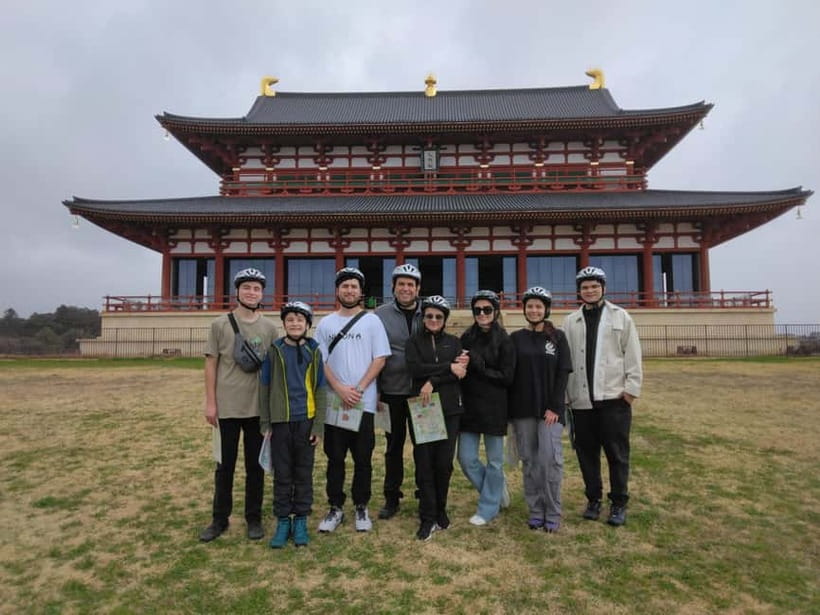
Daiichiji Daigokuden, the Imperial Audience Hall, was reconstructed as a major palace building used for special ceremonies. The interior includes paintings, displays, and ornaments, while the surrounding grounds offer a wide view across the former palace site.
This is probably the route’s grandest stop. After seeing excavation remains and smaller objects, you encounter a building designed to express imperial ceremony. The contrast is useful. You see both the fragile traces of the past and the formal setting meant to represent power.
The stop lasts about 15 minutes. Use some of that time to look inside, then step back and take in the view. The building can photograph well from a distance, especially when you want to show its scale against the open grounds.
The nearby Daichiji Daigokudenin Daigokumon, the South Gate, is a shorter five-minute stop. It adds another formal entrance and gives Kay a chance to explain how the palace was organized. You will not spend long there, but it helps complete the picture of movement through the imperial complex.
The museums fill in the small details
The Nara Palace Site Museum is described as the oldest museum at the Heijo Palace site. Its displays include ancient roof tiles, wooden tablets, and models. These objects may look modest, but they are the sort of details that make a large palace easier to understand.
A wooden tablet or roof tile can tell you more about daily administration and construction than another distant view of a hall. The models also help you imagine how the different buildings related to each other.
The museum visit takes around 10 minutes. You should not expect a full morning behind glass, but the stop works well within a two-hour route. It adds texture before you return to the rental bikes.
The tour combines this museum with the Excavation Site Exhibition Hall, so you get two different approaches to the site: objects and models in one place, preserved remains in another. That variety is one of the route’s strengths.
The Tenpyo costume is more than a photo prop
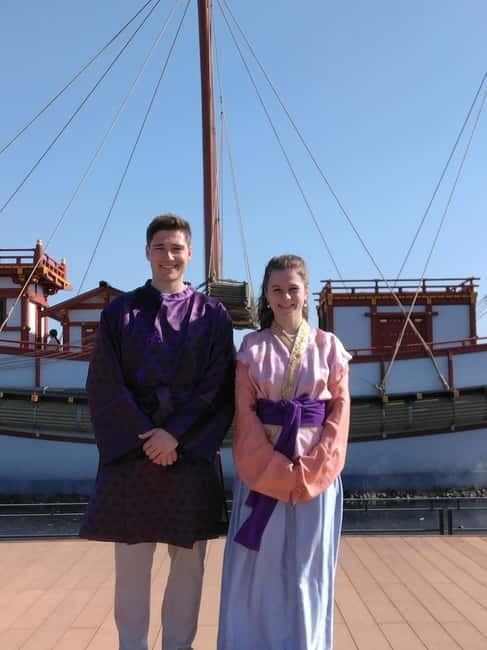
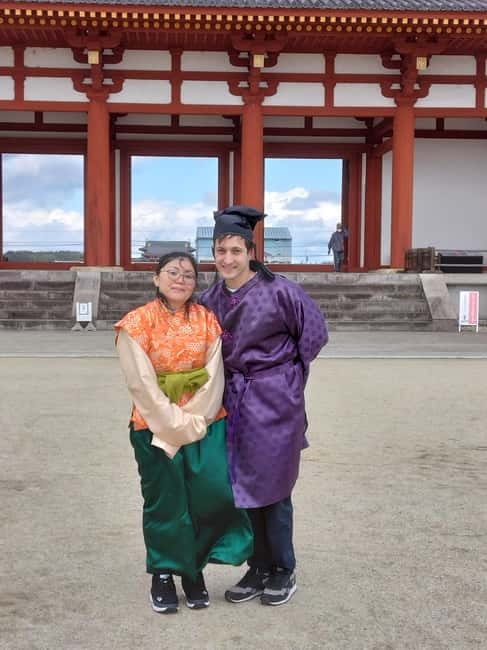
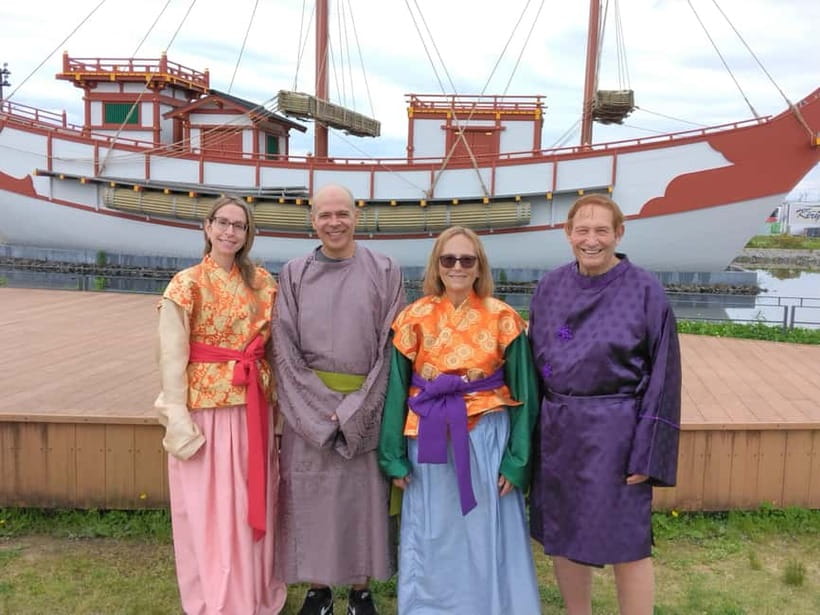
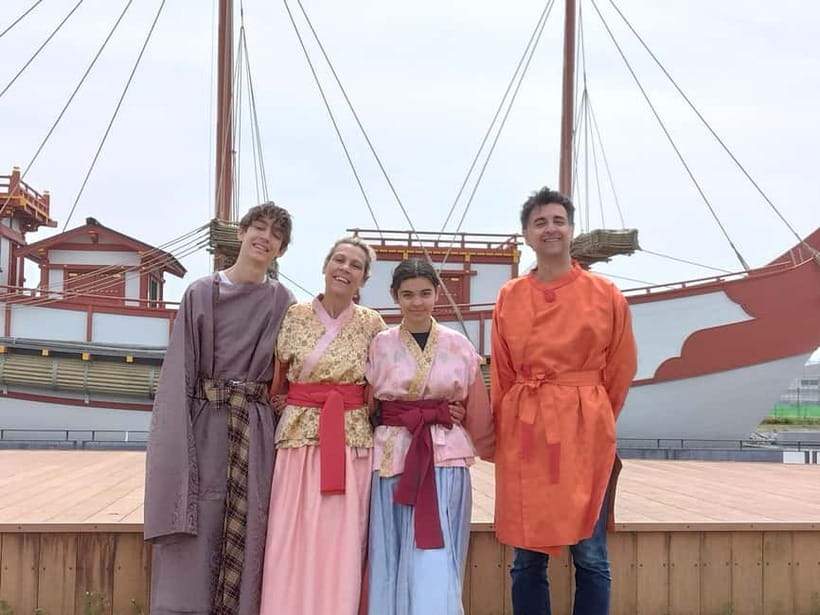
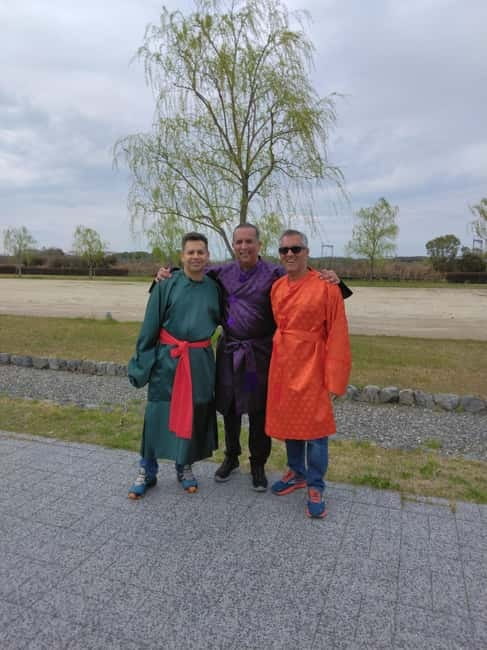
The traditional costume experience lets you wear Tenpyo-period clothing and take photos. The activity details do not specify how long the costume portion lasts, so treat it as a short included experience rather than a separate dressing session.
I like this addition because it gives the tour a playful finish. Nara’s ancient court culture can feel remote, especially when you are looking at foundations or museum objects. Putting on period clothing gives you a visual way to imagine the people connected with the palace.
It is also practical for families and anyone who enjoys photos. You do not need to book a separate costume activity, and the experience is already included in the $22 price. The exact range of sizes, changing arrangements, and photo assistance is not specified, so ask the provider if those details matter to you.
Is the $22 price good value?
At $22 per person, this is an unusually full package for a two-hour activity. You get the rental bike, helmet, guide, admission fees, and traditional costume experience. Food, drinks, hotel pickup, and bike insurance are extra or unavailable.
The strongest value comes from transport and interpretation. You could walk around the palace site without paying for a guided ride, but you would cover less ground and might miss the meaning behind the excavation areas, garden, tomb, and palace buildings. The guide turns several separate stops into one clear visit.
The small group also adds value. With no more than eight participants, the experience should feel more personal than a large bus tour. Kay has been praised for clear English, patience, answering questions, helping with photos, and even extending the ride when the pace required it. Those touches matter more than a long list of facts.
I would not choose this tour only for spectacular architecture. Some buildings are reconstructions, and some points are simply holes, foundations, or archaeological displays. One honest assessment found the site underwhelming for anyone without a strong interest in ancient Japanese culture, especially after cycling in intense summer heat.
Who should book this Nara bike tour?
I would choose this tour if you want to understand Nara’s role as an ancient capital rather than spend another morning around the deer park. It suits people interested in Japanese history, archaeology, palace design, gardens, and quiet outdoor sightseeing.
Families can also do well here if everyone can ride. The easy pace, pond, stamps, costume photos, and short stops give children several ways to stay interested. Kay’s patience with a six-year-old is a useful sign, though you should judge your own child’s cycling ability and attention span.
The tour is less suitable if you cannot ride a bike, are pregnant, use a wheelchair, or have a visual impairment. It also may not suit you if you want a fully indoor activity, dislike reconstructed sites, or are visiting during very hot weather.
Book a morning start if the available schedule allows it, especially in summer. Bring water, wear comfortable clothing, and leave enough time to reach Suzaku Square. The tour ends back at the rental bike location, so you can arrange lunch or continue by bus afterward. Kay has helped participants call a taxi, but hotel pickup is not part of the activity.
Should you book it?
Book this tour if you want a low-cost, active introduction to Heijo Palace with a guide who can connect gates, gardens, excavations, tombs, museums, and ceremonies into one story. The combination of bicycle access, small-group guiding, and included admissions makes $22 strong value.
Skip it if you mainly want Nara’s deer, famous temples, or polished historic streets. This is a quieter and more archaeological experience, and some of what you see is reconstructed or reduced to remains. For the right visitor, that is precisely the point.
FAQ
How long is the Nara bike tour?
The tour lasts two hours, with stops at the palace gates, garden, museums, ancient tomb, audience hall, and pond before returning to the rental bike location.
What is included in the price?
The price includes the guided biking tour, rental bike, helmet, admission fees, and the traditional Tenpyo costume experience.
What languages does the guide speak?
The tour is offered in English and Japanese. Guide Kay leads the English-language experience.
Where do I meet the guide?
Meet at the rental bike reception counter at Miharashi-Kan in Suzaku Gate Square. You should arrive 10 minutes before the scheduled start.
How do I reach the meeting point?
You can take a Nara Kotsu bus to Suzakumon Hiroba Mae, followed by a five-minute walk north. The meeting point is also about a 20-minute walk from Kintetsu Yamato-Saidaiji Station’s South Exit or Shin-Omiya Station.
Is the tour suitable for children?
Children who can ride a bike can join, and the relaxed pace has suited families with young children. The tour is not suitable for people who cannot ride a bike.
Can I cancel the booking?
You can cancel up to 24 hours in advance for a full refund. No-shows and missed tours are non-refundable. If heavy rain, storms, or other severe weather cause the operator to cancel, you receive a full refund.
More cycling tours elsewhere in Japan
- E-Bike Nara Highlights – Todaiji, Knives, Deer, Shrine
★ 4.8 · 186 reviews - Nara: City Highlights Shared Group or Private Bike Tour
★ 4.9 · 34 reviews - Bike Tour Exploring North Kyoto plus Lunch
★ 5.0 · 1,087 reviews - Tokyo Great Cycling Tour
★ 5.0 · 811 reviews
Just added in Nara
- Nara:5 Type of Tea Tasting & Mindful Tea Ceremony★ 5.0 · 28 reviews
- Nara:Authentic Tea Ceremony(Max 5 ppl) -Master Matcha Making★ 5.0 · 119 reviews
- Nara: Todai-ji y parque de Nara (Spanish Guide)★ 5.0 · 16 reviews
- Nara: Private Tour with Private Guide★ 4.8 · 66 reviews
- Nara: Essential Private Tour with Deer Park and Temples★ 5.0 · 24 reviews
- Nara: Private Walking Tour with a Local★ 4.3 · 36 reviews
- Nara Early Bird Tour (Kyoto Departure Option Available)★ 4.9 · 142 reviews
- Nara: City Highlights Shared Group or Private Bike Tour★ 4.9 · 34 reviews
Nara & the Deer Park, compared.
World Heritage Kyoto & Nara Uji Authentic Matcha Experience
Read our review →
Kyoto/Osaka: Nara, Fushimi Inari Taisha, Arashiyama Bus Tour
Read our review →
Nara Half Day Trip Walking Tour (Private Option Available)
Read our review →
Osaka/Kyoto: Arashiyama, Nara & Fushimi Inari Shrine w/Lunch
Read our review →
Nara Early Morning Tour (Kyoto or Osaka Departure Available)
Read our review →
Full Day Guided Tour to Kyoto and Nara from Osaka by Van
Read our review →
Browse the lists this tour appears in