
Reviewed · HIROSHIMA & MIYAJIMA DAY TRIPS
Hiroshima 3hr Peace Cycling Tour with Local Guide
Hiroshima’s story comes into sharper focus when you travel beyond the Peace Park. This three-hour e-bike route links famous memorials with quieter places, including the Red Cross Hospital remains, a surviving willow, and the railway line that kept running after the atomic bomb.
I like the way the tour covers a lot of ground without turning into a race. I also like the small group size, capped at 10, and the personal stories shared by guides such as Shin and Moe, whose families have direct connections to Hiroshima’s wartime history.
The main drawback is that the schedule is full. Stops are short, and the emotional weight of the subject can be considerable. If you want long museum visits or plenty of unstructured time at each memorial, you may prefer to explore on foot over a full day.
Key points to know before you book
- Personal family stories: Guides including Shin and Moe bring family memories of the bombing into the wider history.
- A gentle three-hour route: E-bikes and mostly flat riding help you cover far more ground than walking.
- Ten people maximum: The group is small enough for questions and direct conversation.
- Beyond the usual memorials: You visit Hiroshima Castle, surviving trees, railway landmarks, and the Red Cross Hospital remains.
- Good value at $85.89: The price includes the bike, bicycle accident insurance, and entrance fees.
- Rain plan available: You can switch to a walking route focused on the Peace Park and nearby atomic bomb sites, or receive a refund if the cycling plan is canceled.
Why the bicycle makes Hiroshima easier to understand
The Peace Memorial Park and Atomic Bomb Dome are essential, but they show only part of Hiroshima’s story. The bombing affected a wide area, and the city’s recovery makes more sense when you see locations spread along the rivers and through ordinary neighborhoods.
That is where the bicycle helps. You move from the castle area to the Peace Park, then south along the river toward places that are easy to miss if you stay near the museum. The ride is described as gentle, and the route is generally flat. E-bikes are especially helpful in summer heat or if you are not a confident cyclist.
I would not treat this as a sporty bike outing. The point is to stop, listen, look, and connect one site to the next. The pace may also slow if children or less experienced riders are in the group. That is useful for safety, but it means the tour is not designed for people chasing speed.
The group limit of 10 matters here. A guide can speak to everyone, answer questions, and adjust the pace without the outing feeling like a large procession. Some groups are smaller, which can make the experience feel close to a private conversation.
Other cycling tours in Hiroshima people book:
- Hiroshima 2hr Peace Cycling Tour with Local Guide
★ 5.0 · 321 reviews - Hiroshima: Peace Cycling Tour with Local Guide
★ 4.8 · 286 reviews - Hiroshima: Best of Hiroshima Guided Bike Tour
★ 4.9 · 89 reviews
Starting at the Peace Park Rest House
Meet at the Hiroshima Peace Memorial Park Rest House at 10:00 for the morning departure, or 14:00 for the afternoon version. The tour begins with introductions, an outline of the route, bicycle instructions, and safety procedures.
The Rest House is a sensible starting point because you are already in the heart of Hiroshima’s memorial district. It is also where the tour ends, so you do not need to arrange a second pickup across town.
There is no luggage storage at the Rest House. If you are carrying bags, coin lockers are available at the International Conference Center Hiroshima and Hiroshima Peace Memorial Museum, about a six-minute walk away. I would sort this out before the meeting time, since arriving late without prior notice can lead to cancellation with no refund.
Hiroshima Castle and Gokoku Shrine: the city before and after 1945
The first ride takes you to Hiroshima Castle, the site of the former military headquarters that was among the first places to report the atomic bombing. The castle gives the opening part of the tour a broader frame. Hiroshima was not only a city of memorials. It was also a military center, and that role shaped what happened on August 6, 1945.
You have about 20 minutes here. That is enough for an explanation and a look around, but not a detailed castle visit. The tour is using the site as a historical marker rather than offering a long interior exploration.
Next comes Hiroshima Gokoku Shrine and its gate. The guide points out the Guardian Dog statue and the shrine gate that survived the blast. These details are powerful because they are small and concrete. Instead of hearing only about the scale of destruction, you see individual objects that endured it.
The short stop also introduces an important theme: Hiroshima’s past is layered. Military buildings, religious sites, memorials, and modern city life all occupy the same space.
Central Park, Aioi Bridge, and the Atomic Bomb Dome
The route continues through Hiroshima Central Park, a broad green space where you get a pause from the heavier history. I appreciate this change of rhythm. The tour does not ask you to stand at memorials for three straight hours, and the ride between stops gives you time to absorb what you have heard.
At Aioi Bridge, the guide explains its role as the intended target of the bomb. The bridge and river remain, making the location easier to picture than a site marked only by a plaque. You spend about 10 minutes here, so expect a focused explanation rather than a long stop.
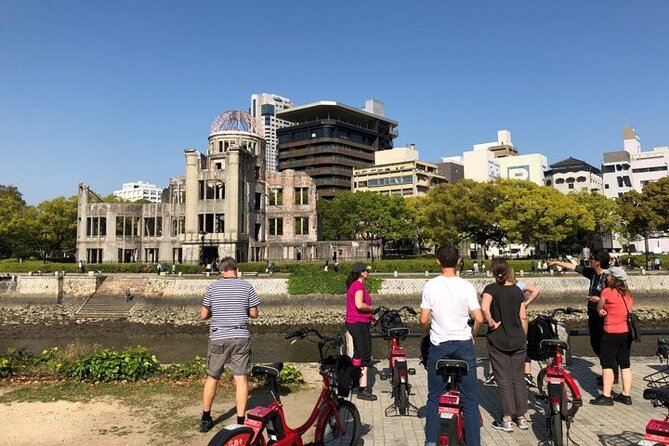
The Atomic Bomb Dome follows. This is the tour’s most recognizable landmark, but seeing it after the castle, shrine, park, and bridge adds context. The building’s damaged frame is not just a symbol. It is a physical reminder of the blast and of the city’s decision to preserve a ruin within a rebuilt city.
You have around 15 minutes at the Dome. If you want extensive time for photographs, quiet reflection, or a close look at nearby memorials, you may wish to return later. The tour gives you an introduction, then keeps moving.
Other long days west of Hiroshima:
- Peaceful Hiroshima & Miyajima UNESCO 1 Day Bus Tour
★ 5.0 · 5,309 reviews - Hiroshima: Hiroshima and Miyajima UNESCO Sites 1-Day Tour
★ 4.9 · 2,330 reviews - Hiroshima / Miyajima Full-day Private Tour with Government Licensed Guide
★ 5.0 · 1,298 reviews - Hiroshima Historical Walking Tour – Why A-Bomb was Dropped
★ 4.8 · 893 reviews
Along the Motoyasu River and through the Peace Park
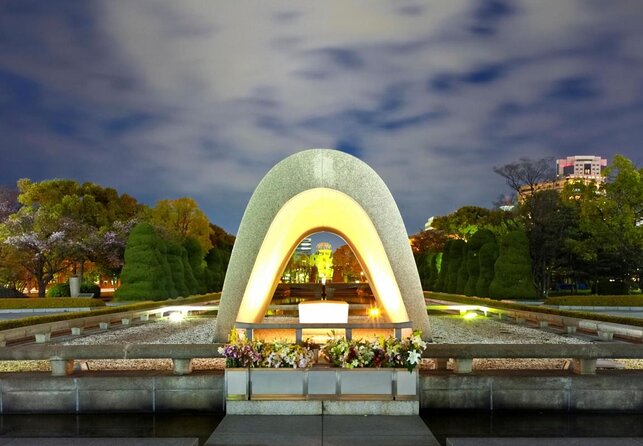
From the Dome, the route follows the Motoyasu River and crosses near the Peace Bridge. The rivers are central to Hiroshima’s identity, both as part of the city’s setting and as places linked to the bombing’s human consequences.
Riding beside the water changes the mood. You see trees, open space, and present-day Hiroshima while the guide explains what happened in the same area in 1945. This contrast is one of the strongest parts of the experience. The city is not preserved as a ruin. It is a functioning place that carries its history openly.
The route then reaches Higashisenda Park, about one kilometer from the blast center. Trees from different countries grow here, and the guide explains the stories tied to the site. It is a quieter stop than the Atomic Bomb Dome, but that is exactly why it works. You get a sense of international remembrance without remaining in the busiest memorial area.
The scheduled stop is about 20 minutes. Bring your attention, not just your camera. The guide’s explanation is the main reason to visit this park.
The Red Cross Hospital remains and the limits of destruction
At roughly 1.5 kilometers from the blast center, the tour visits the remains connected with Hiroshima Red Cross Hospital. The Atomic Bomb Window Frame Monument shows part of the old building and helps convey how far the bomb’s force reached.
This is one of the more sobering stops. The Dome is famous and visually dramatic, but a hospital remnant brings the event closer to daily life. It connects the bombing to patients, medical workers, and the ordinary functions of a city suddenly destroyed.
You spend about 20 minutes here, one of the longer stops on the route. The extra time is welcome because the site needs explanation. It is also a place where the tour’s emotional tone may become heavier. I would prepare children and teenagers for difficult subject matter rather than presenting this as a light sightseeing ride.
Trains that survived and a bridge at the edge of the blast
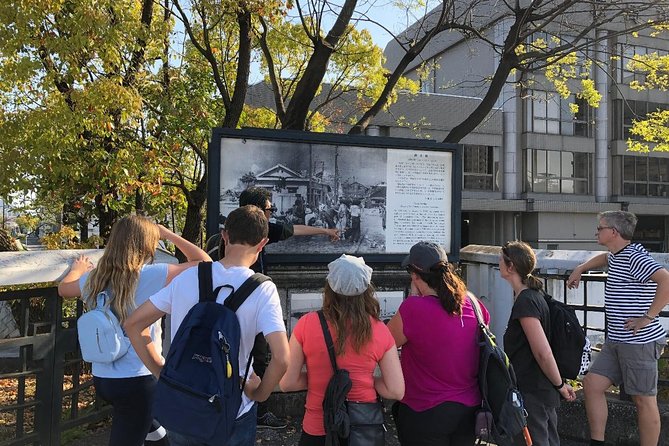
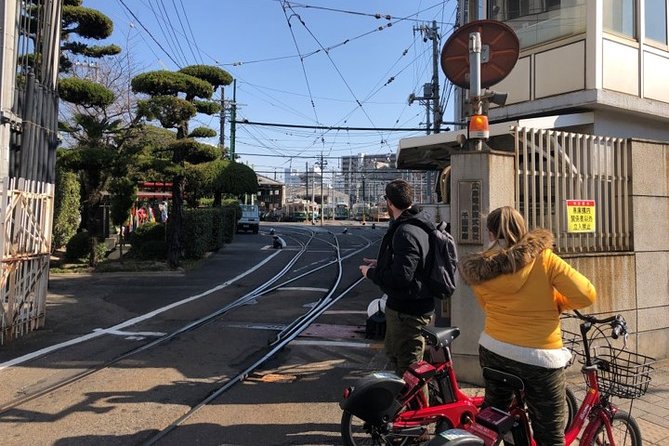
The next stop concerns Hiroshima’s railway. The tour explains that two trains survived the bombing and continued to be used. This is a striking example of how Hiroshima recovered in practical, everyday ways.
The railway stop lasts about 10 minutes. It is not a grand memorial, and that is part of its value. You are looking at transport, movement, and the return of ordinary life. The story shifts from destruction to the city’s ability to function again.
At Miyuki Bridge and the Kobayashi River, you reach the area described as the point where the bomb’s reach ended. A displayed photograph shows the difference between the scene then and the city now.
That comparison is useful because it makes reconstruction visible. Hiroshima’s recovery was not an abstract promise. It happened in streets, along rivers, and around bridges that people still use.
The surviving weeping willow and Peace Boulevard
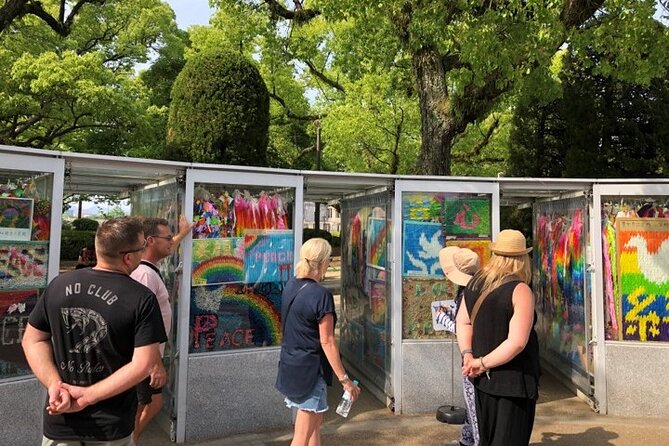
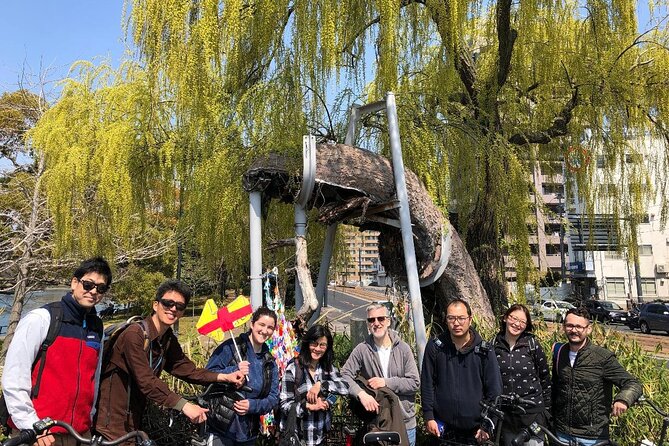
The surviving weeping willow is presented as a highlight of the route. It continued growing despite the belief that natural growth would not return for many decades. The tree represents endurance, but the guide also places it within the larger story of Hiroshima’s surviving plants and rebuilding.
This is a short stop of about 10 minutes. You will not spend a long time beneath the tree, yet it offers a quiet pause after the more graphic reminders of the bomb’s force.
The final ride follows Peace Boulevard back toward the park. Along the way, you pass monuments and trees tied to Hiroshima’s history while seeing the present-day city around them.
This last section is important. Hiroshima is not presented only as a place frozen in grief. The route shows a living city that remembers, rebuilds, and continues. That balance keeps the tour from becoming a simple sequence of tragic sites.
The guides make the history personal
The strongest part of this experience depends on who leads your group. Guides vary, but named guides connected with the tour include Shin, Moe or Moet, Toma, Thomas, and Kana.
Shin is particularly associated with personal family stories connected to the bombing. His mother was not yet born when the bomb fell, and his family’s experience gives his explanations a direct human angle. Moe has also shared that all four of her grandparents lived through the bombing. These stories do not replace historical facts. They give them a human scale.
Toma, Thomas, and Kana have also been praised for clear explanations, warmth, and the ability to answer questions. You should not assume you will receive one specific guide, but you can expect the experience to be shaped by a local person rather than a recorded commentary.
The best guides move between facts, family memories, and the city’s future without turning the tour into a lecture. They also keep the mood approachable. That matters because Hiroshima can feel emotionally difficult, especially for children. Personal storytelling can make the subject easier to understand, while still treating it with respect.
What $85.89 buys you
At $85.89 per person, this is not the cheapest way to see Hiroshima. You can visit many public spaces independently and explore the Peace Park at no extra charge.
The value comes from the combination of transport, interpretation, and access to sites spread across the city. A bicycle lets you cover the castle area, river routes, Peace Park, Red Cross Hospital remains, railway landmarks, and southern memorial points in three hours. Entrance fees are included, and bicycle accident insurance is included as well.
You are also paying for structure. Hiroshima is easy to visit but harder to interpret. A guide helps you understand why a bridge, tree, hospital window frame, or railway line matters. If you would otherwise rent a bicycle and visit only the Dome and museum, this tour gives you a much wider picture.
I see the price as fair for a visitor who values local explanation and wants to use one morning or afternoon efficiently. It is less compelling if you already plan a full day at the Peace Memorial Museum, want to read every memorial plaque slowly, or prefer to travel alone.
Who will enjoy this ride most
I would recommend it to you if you want a guided introduction to Hiroshima, enjoy gentle outdoor activity, and prefer seeing a city through its streets rather than from one museum room.
It suits first-time visitors, couples, families with older children, and people making a short trip from another Japanese city. The 10-person limit keeps the group manageable, while e-bikes remove much of the effort from the ride.
The bicycle requirements are specific. Adult electric bicycles are for people at least 145 centimeters tall. Children from 110 to 145 centimeters can use one of the two children’s bicycles available for a booking, and children under 15 can use children’s or adult bicycles at the child rate. Child seats are available for children under 22 kilograms and under 115 centimeters.
If you are not comfortable cycling, the information provided describes the route as relatively flat and uncrowded, and the e-bikes as easy to use. Still, you need enough control to ride safely in a shared group. The pace may be adjusted for children or riders who are not used to cycling.
Weather, timing, and the practical details that matter
The morning tour runs from 10:00 to 13:00. The afternoon version runs from 14:00 to 17:00. I prefer the morning if you want to visit the Peace Memorial Museum afterward, since the museum can require several hours of attention. The afternoon ride leaves your morning free for another activity.
Rain does not automatically end the experience. If cycling is unsafe, you may be offered a Rainy Day Limited Peace Route, a walking tour that includes the Peace Memorial Park, Atomic Bomb Dome, hypocenter, Former Bank of Japan, Fukuromachi Elementary School, and the main street. That route is scheduled to finish at 13:00 or 17:00, depending on departure time.
If you do not want the walking alternative, a refund is offered when the cycling plan cannot run because of rain. Other poor weather may also lead to cancellation for safety reasons.
Free cancellation is available up to 24 hours before the start time. A late cancellation or a change within 24 hours is not refundable. The tour can also be canceled if you arrive late, so give yourself time to find the Rest House and prepare your bicycle.
Should you book the Hiroshima Peace Cycling Tour?
I would book this tour if you want Hiroshima’s story to extend beyond the Atomic Bomb Dome and museum. The route gives you a clear picture of the city before the bombing, the physical reach of the blast, and the long work of rebuilding afterward.
The personal accounts from guides such as Shin and Moe can make the experience especially memorable, but the tour is worthwhile even when your guide is someone else. You see more by bike, ask questions in a small group, and reach several sites you might skip on foot.
Choose something else if you want a quiet, self-guided day, long visits at each memorial, or a purely athletic ride. For most first-time visitors with three hours to spare, this is a thoughtful and efficient way to meet Hiroshima on its own streets.
FAQ
How long is the Hiroshima Peace Cycling Tour?
The tour lasts about three hours. The morning departure runs from 10:00 to 13:00, and the afternoon departure runs from 14:00 to 17:00.
Where does the tour start and finish?
It starts and ends at the Hiroshima Peace Memorial Park Rest House in Hiroshima’s Naka Ward.
How many people can join the tour?
The shared tour has a maximum of 10 participants.
Are electric bicycles provided?
Yes. Adult electric bicycles are available for people at least 145 centimeters tall. Children’s bicycles and child seats are also available under the stated height and weight limits.
What happens if it rains?
The tour may change to a walking route covering the Peace Memorial Park, Atomic Bomb Dome, hypocenter, Former Bank of Japan, Fukuromachi Elementary School, and the main street. If you do not want the walking route, a refund is offered. A different date or full refund may also be available if poor weather cancels the experience.
Can I cancel for a full refund?
You can cancel at least 24 hours before the start time for a full refund. Cancellations or changes made less than 24 hours before the tour are not accepted for a refund.
More cycling tours elsewhere in Japan
- Bike Tour Exploring North Kyoto plus Lunch
★ 5.0 · 1,087 reviews - Tokyo Great Cycling Tour
★ 5.0 · 811 reviews - Tokyo Top Highlights 3h Guided E-bike Tour
★ 5.0 · 714 reviews - 3h Tokyo E-Bike Tour: Hidden Gems, and Local Life with guide
★ 5.0 · 670 reviews
Just added in Hiroshima
- Day Trip to Hiroshima & Miyajima with Itsukushima Shrine★ 4.6 · 124 reviews
- Hiroshima: Best of Hiroshima Guided Bike Tour★ 4.9 · 89 reviews
- Hiroshima & Miyajima 6.5h Guided Tour – Dome, Park & Shrine★ 4.9 · 83 reviews
- Hiroshima Local guided Hiking Tour&Open-air Tea Ceremony★ 5.0 · 213 reviews
- Hiroshima: Food and Culture Guided Walking Tour with Dinner★ 4.9 · 212 reviews
- Hiroshima & Miyajima: Full-Day Private Tour & Licensed Guide★ 4.8 · 252 reviews
- Hiroshima: History of Hiroshima Group Walking Tour★ 4.8 · 266 reviews
- Hiroshima: Peace Cycling Tour with Local Guide★ 4.8 · 286 reviews
Hiroshima & Miyajima Day Trips, compared.
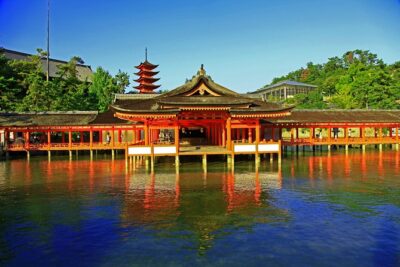
Peaceful Hiroshima & Miyajima UNESCO 1 Day Bus Tour
Read our review →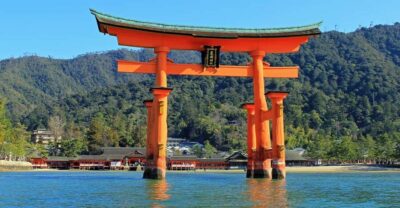
Hiroshima and Miyajima UNESCO Sites 1-Day Tour
Read our review →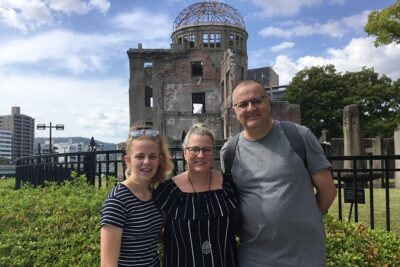
Hiroshima / Miyajima Full-day Private Tour with Government Licensed Guide
Read our review →
Osaka/Kyoto: Hiroshima Miyajima Bus Tour & Shinkansen Ticket
Read our review →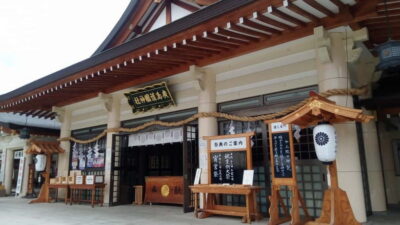
Hiroshima Historical Walking Tour – Why A-Bomb was Dropped
Read our review →
Hiroshima Peace (Heiwa) Walking Tour at World Heritage Sites
Read our review →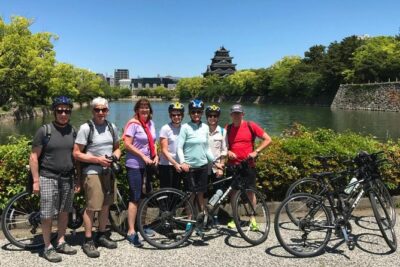
Hiroshima in a Nutshell: Morning Bike Adventure
Read our review →
Hiroshima City 4hr Private Walking Tour with Licensed Guide
Read our review →Browse the lists this tour appears in