Reviewed · TOURS IN TOKYO
Asakusa: A Big-picture History Walk to Know Japan
Asakusa is one of the few places in Tokyo where a short walk can connect Japan’s isolation, religion, art, and opening to the world. This tour uses the Sumida River, Kaminarimon, Nakamise, Sensō-ji, and Asakusa Shrine as chapters in a larger story, rather than treating them as separate photo stops.
I like the clear comparison between Buddhism and Shinto, and I like the way ukiyo-e links an old shopping street in Tokyo with European Impressionist painting. The drawback is that the tour covers a lot in two hours, so it suits you best if you want a big-picture introduction rather than a slow, detailed study of every building.
Key points to know before you go
- The Sumida River explains Japan’s opening to the world: Learn about the Edo shogunate, Dutch trade, Admiral Perry, Odaiba’s old gun batteries, and the Statue of Liberty replica.
- Buddhism and Shinto are explained side by side: You’ll learn how prayer, symbols, and sacred spaces differ, and why they can share one historic site.
- Ukiyo-e connects Asakusa with Western art: Nakamise becomes a lesson in how Japanese woodblock prints influenced European painters.
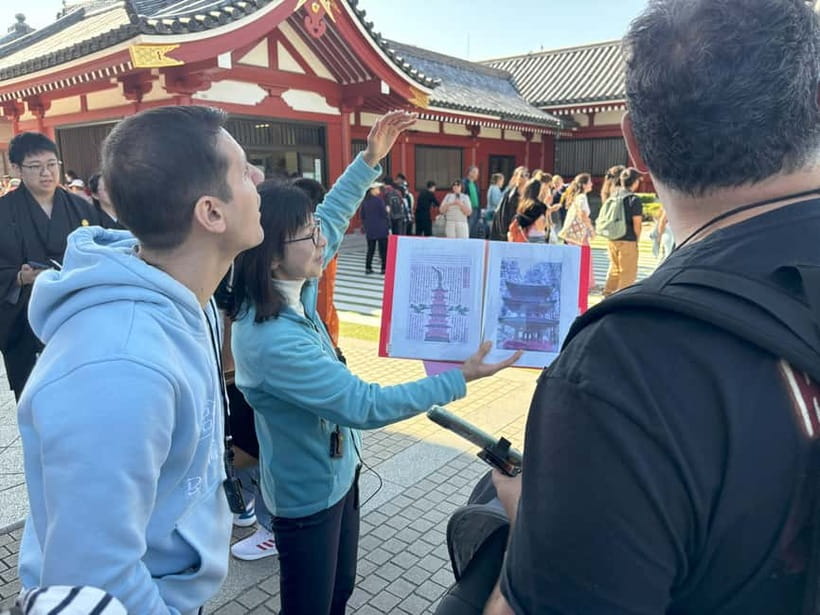
- The tour uses visual teaching aids: Amy brought printed images to make complex historical points easier to follow.
- Guides adapt well to families: Choco, Sachi, and other guides have kept children and teenagers involved with activities and clear explanations.
- It is short but not effortless: Expect moderate walking, outdoor conditions, and crowds around Sensō-ji.
Asakusa in two hours, with Japan as the subject
The route begins near Exit 4 of Asakusa Station on the Ginza Line, in front of the Burger King at 2-chōme-20-6 Kaminarimon. That meeting point is practical, but do not rush out of the station and start looking around randomly. Step outside Exit 4 and make sure you are beside the restaurant before the walk begins.
The tour costs $58 per person and lasts two hours. I see the price as reasonable if you want interpretation rather than simple directions. Asakusa’s main sights are free to approach, but the value here is the connection between them. You are paying for an English-speaking certified guide who turns familiar landmarks into a lesson about Japan’s past and its links with Europe and the United States.
The walk includes a traditional snack tasting. Groups of three or more receive headsets, which should help you follow the guide near busy roads and crowded temple approaches. One person found the earpiece created some echo, so sound quality may vary. If that happens, tell the guide early instead of trying to follow a muffled voice for two hours.
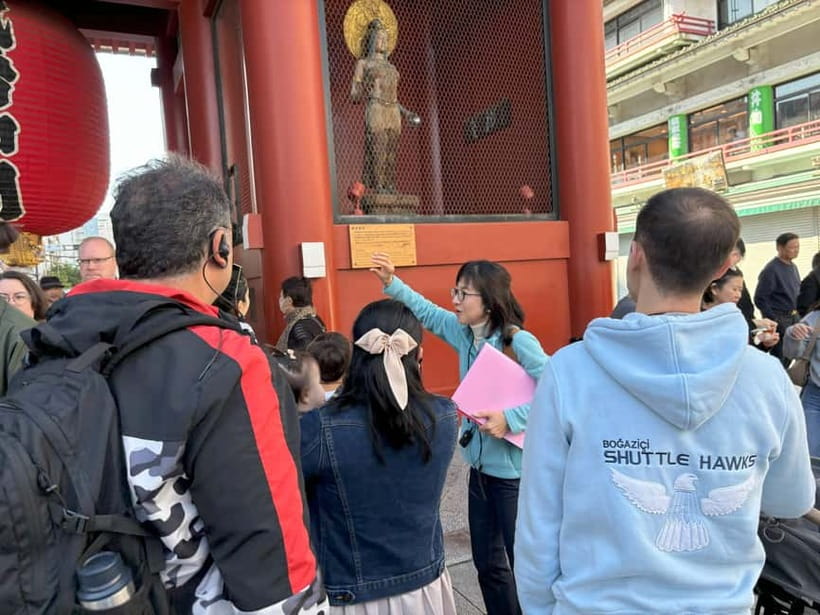
Guides named in the feedback include Choco, Sachi, Sachiko, Amy, Yasu, Yoko, and Kay. The strongest pattern is clear teaching with a friendly manner. Sachi kept a 13-year-old interested, Choco engaged both adults and children, and Amy used printed images to support her explanations. Those details matter because this is not a tour built around silence and photo stops. The guide is the main attraction.
Other experiences people book in Tokyo:
- Mt Fuji and Hakone 1-Day Bus Tour Return by Bullet Train
★ 5.0 · 26,383 reviews - 1-Day Tokyo Bus Tour
★ 5.0 · 14,250 reviews - Tokyo: TOKYO SKYTREE® Admission ticket
★ 4.5 · 11,192 reviews
The Sumida River and the story of a closed Japan
The first 15-minute stop is at Tokyo Cruise Asakusa Pier. Here, the river becomes a useful stage for explaining Japan’s long period of restricted foreign contact under the Edo shogunate.
You’ll hear why Japan was closed to most overseas trade for more than 200 years, why the Netherlands was allowed a limited trading role, and how Admiral Perry’s arrival helped force the country to reopen. This gives you a better way to understand modern Tokyo. Japan did not simply change overnight from old customs to modern technology. It faced outside pressure, then moved through a rapid period of political, military, and social change.
The guide also links that story to Odaiba, the modern entertainment district across Tokyo Bay. The area once had gun batteries intended to protect Edo from ships. Its present-day Statue of Liberty replica faces the Pacific, creating a neat visual link between old defenses and Japan’s later relationship with the wider world.
The river stop is brief, but that is part of its value. You are not standing through a long lecture about every detail of the Edo period. You get a framework that helps later stops make more sense. If you already have a strong grasp of Japanese history, this section may feel familiar. If this is your first visit, it gives you useful bearings fast.
The tourist center and two religious traditions
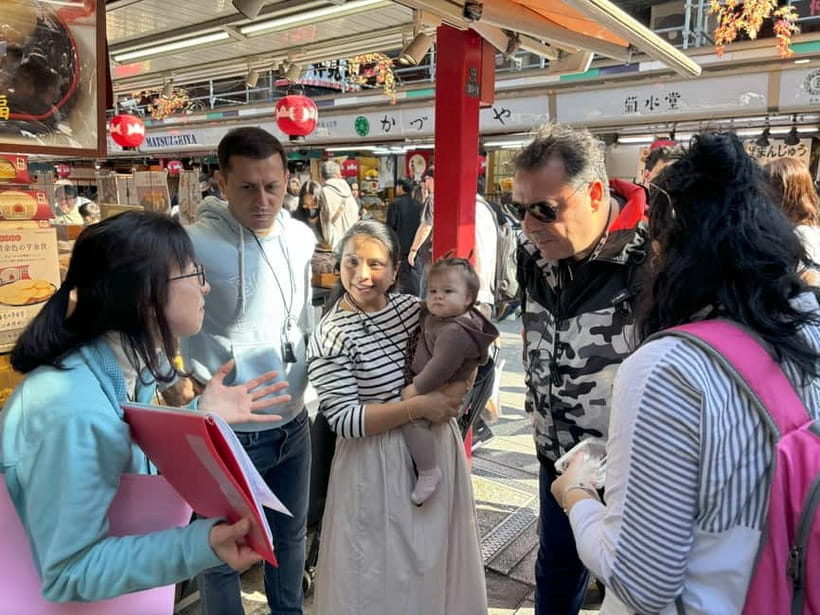
The Asakusa Culture Tourist Information Center is the next 15-minute stop. This is where the tour lays out its explanation of Buddhism and Shinto before you enter the main religious sites.
That preparation is important. Without it, many first-time visitors see a gate, a lantern, incense, a temple, and a shrine, but do not know what separates one tradition from the other. The guide explains the difference in a visual, practical way, including how prayer works in Buddhism and Shinto.
You will not get a university course in Japanese religion, and two hours cannot cover every school, symbol, or historical dispute. What you do get is a usable set of ideas for the rest of your time in Japan. You can begin to notice which places are Buddhist temples, which are Shinto shrines, and how the two traditions have often existed beside each other.
This was one of the tour’s most useful choices. The information comes before the major sights, not after you have already walked past them.
Kaminarimon and the two kinds of dragon
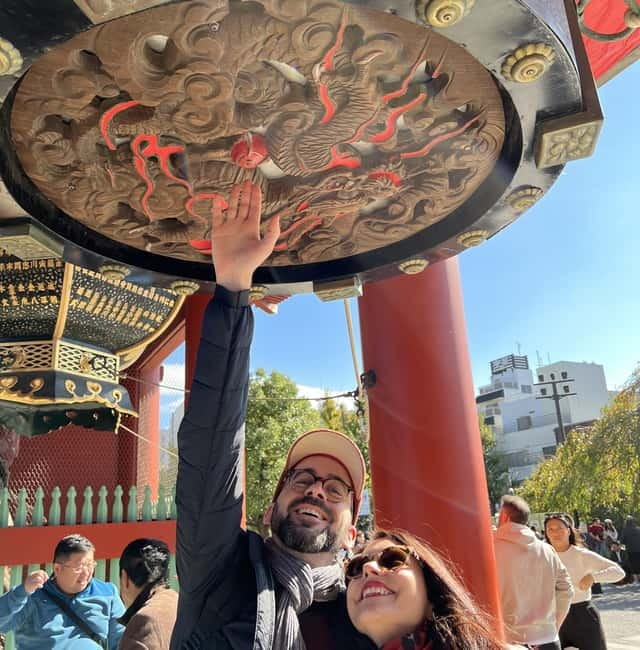
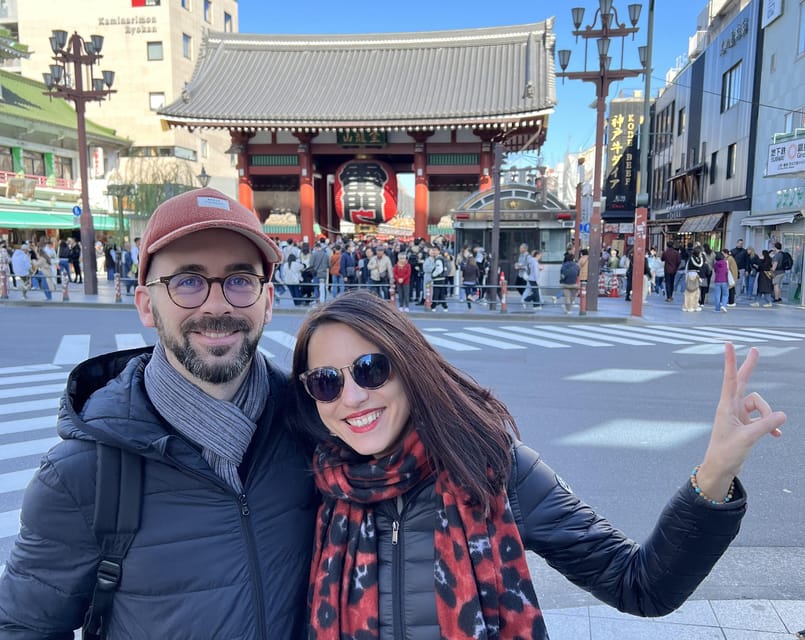
Kaminarimon, or Thunder Gate, receives about 15 minutes. This is Asakusa’s famous entrance, with its large lantern and imposing guardian figures. It is also a good place to discuss Japanese and Western dragons.
The guide explains why the Japanese dragon plays an almost opposite role from the dragon familiar in much of Western legend. In many European stories, dragons are enemies to defeat. In Japan, dragons can be linked with water, protection, and spiritual power.
That comparison gives you something better than a quick photograph. You start looking at the gate as a statement about local belief rather than as a colorful entrance to a shopping street. It also shows the general method of the walk: each stop supplies one memorable idea, then that idea connects to a larger part of Japanese culture.
Kaminarimon can be crowded, and the road area is active. Stay close to the guide and keep your attention on the group when crossing or moving through the entrance. The stop is short enough to avoid becoming tiring, but not so short that you only hear the name of the gate.
Same base, a different sort of day:
- Tokyo: teamLab Planets TOKYO Digital Art Museum Entry Ticket
★ 4.6 · 9,779 reviews - Mt Fuji & Hakone Cruise, Drum Show Bullet Train 1 Day from Tokyo
★ 4.0 · 7,413 reviews - Tokyo: Sumo Show Experience with Chicken Hot Pot and a Photo
★ 4.8 · 6,678 reviews - Tokyo: Shinjuku Food Tour (13 Dishes at 4 Local Eateries)
★ 5.0 · 6,603 reviews
Nakamise, snacks, symbols, and ukiyo-e
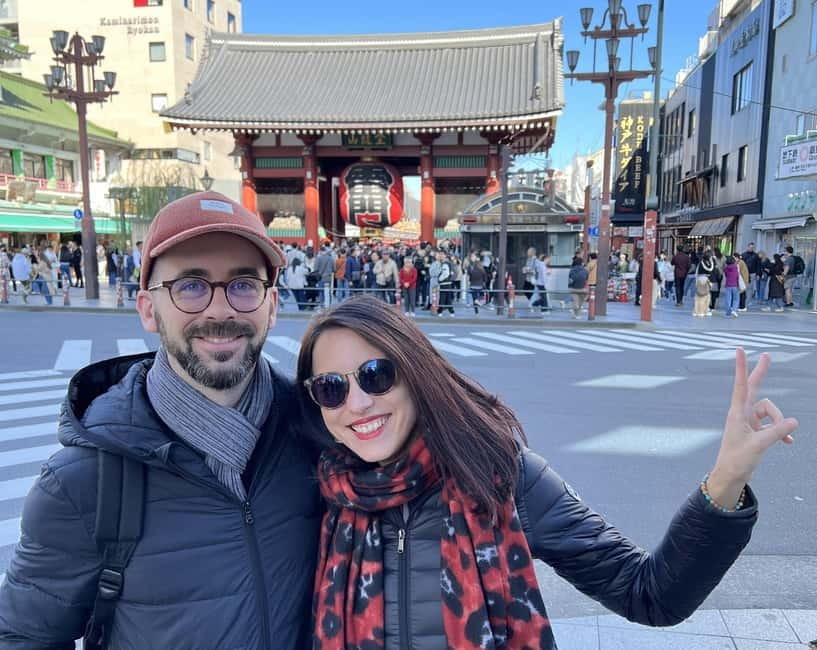
The 30-minute walk along Nakamise Shopping Street is the longest section of the tour. That makes sense. Nakamise is one of Japan’s old shopping streets, and it supplies several different subjects in one compact stretch.
You’ll learn about the vajra, also called tokko, a Buddhist object and symbol. The guide uses the street’s shops and religious setting to show how symbols can carry meaning beyond decoration. If you enjoy learning how to behave around sacred places, this is also a useful moment to ask questions about respectful conduct.
The traditional snack tasting adds a small local touch. It is not a full food tour, so you should not book this expecting a series of meals or specialist tastings. Think of it as a pause that lets you sample something associated with the area while continuing the cultural explanation.
The most memorable subject here may be ukiyo-e woodblock printing. These prints traveled from Japan to Europe and influenced Western Impressionist painters. That connection can be surprising when you are standing among shops selling souvenirs near Sensō-ji. It reminds you that cultural exchange did not move in only one direction. Japan was not simply absorbing Western ideas after the nineteenth century. Japanese art also changed how European artists saw composition, line, color, and everyday subjects.
Nakamise is usually the point where the tour feels most crowded and visually busy. If you prefer quiet streets, you may find the shopping approach distracting. If you like seeing history mixed into ordinary city life, this is one of the route’s strongest sections.
Hōzōmon and a shared medieval mindset
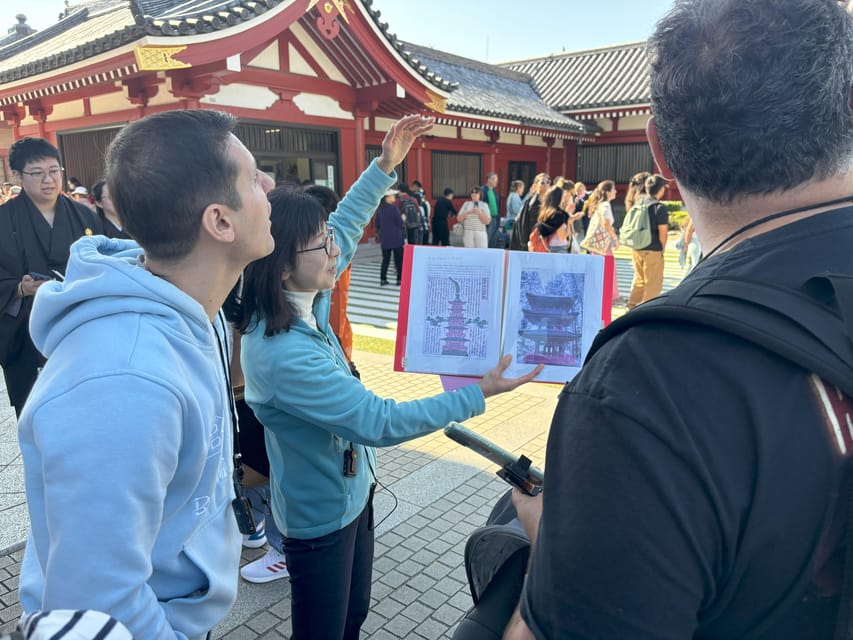
Hōzōmon Gate receives another 15 minutes. The guide uses the gate to make a more unexpected comparison: people in Japan and Europe had surprisingly similar ways of thinking about 1,000 years ago.
This idea helps correct a common mistake. It is easy to treat medieval Japan and medieval Europe as completely separate worlds, with nothing in common. The tour points you toward shared human concerns, including religion, social order, protection, art, and the meaning of sacred buildings.
The explanation is designed to be accessible rather than technical. You will not leave with a detailed timeline of every Japanese period. You should leave with a better sense that Japan developed its own institutions and customs while also dealing with questions familiar across continents.
This is a good stop for curious adults and older children. Younger children may find the comparison abstract, although a guide such as Choco can make the overall walk more approachable with simple explanations.
Sensō-ji, prayer, and Japan’s oldest Buddhist temple
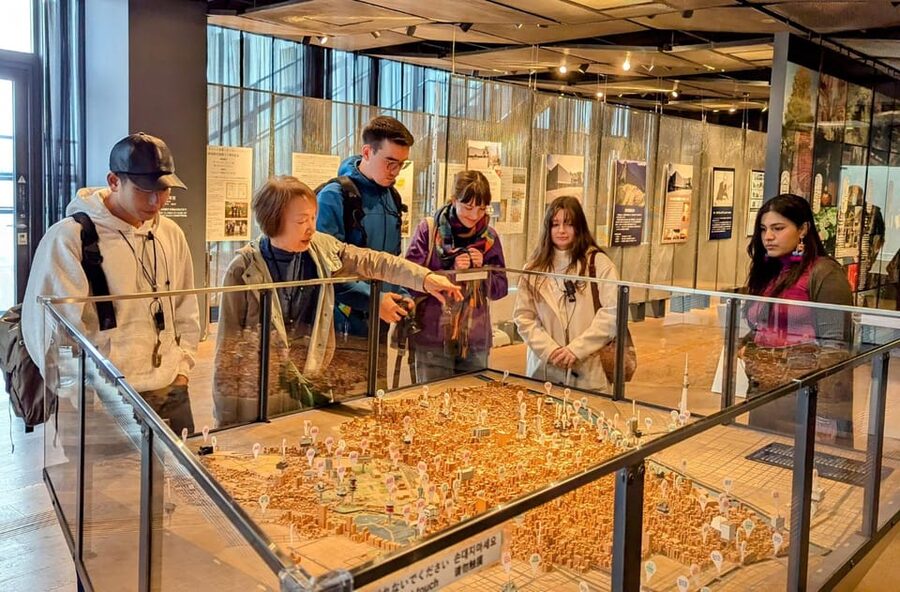
Sensō-ji gets 15 minutes. It is Japan’s oldest Buddhist temple and the emotional center of the walk.
The guide explains how to approach the temple and what prayer means in a Buddhist setting. That matters because many people copy what they see without understanding it. You may learn how Buddhist prayer differs from Shinto practice, and why the smoke, gestures, and arrangement of the grounds have a purpose.
The temple is also where the tour’s earlier ideas come together. The religious explanation from the information center, the symbols introduced at Nakamise, and the historical comparisons at Hōzōmon all meet here. Sensō-ji is not treated as a single grand building. It becomes evidence of how belief, art, community life, and history have stayed linked in Asakusa.
A small activity can help children stay involved. One eight-year-old especially enjoyed fortune telling at the temple entrance. That is a useful clue for families: the tour is historically focused, but it is not delivered as a stern lecture.
Allow extra personal time after the official walk if you want to explore Sensō-ji at your own pace. The guided stop is only 15 minutes, and that is enough for interpretation but not for a leisurely look at every corner.
Asakusa Shrine and 1,000 years of coexistence
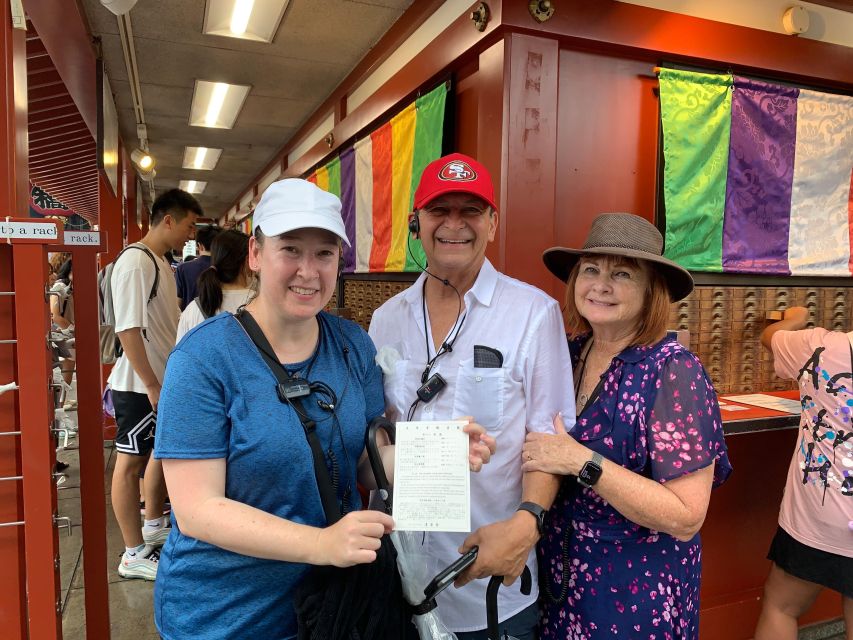
The final 15-minute stop is Asakusa Shrine, beside Sensō-ji. This is the tour’s best payoff because it makes the Buddhist and Shinto relationship visible in one place.
A Shinto shrine and a Buddhist temple share the same grounds, worshippers, and long local story. The guide explains why this coexistence lasted for more than a millennium. For many visitors, this is the point when the earlier religious explanations become concrete.
The distinction is worth understanding. Japan’s traditions were not always placed in separate boxes. Buddhist and Shinto practices often overlapped, and local religious life could include both. The relationship changed during later political reforms, but Asakusa still shows the older pattern clearly.
This stop also makes the tour more than a sightseeing circuit. You are not only looking at a shrine after a temple. You are seeing how Japanese religious life developed through combination, adaptation, and shared space.
What the two-hour format does well
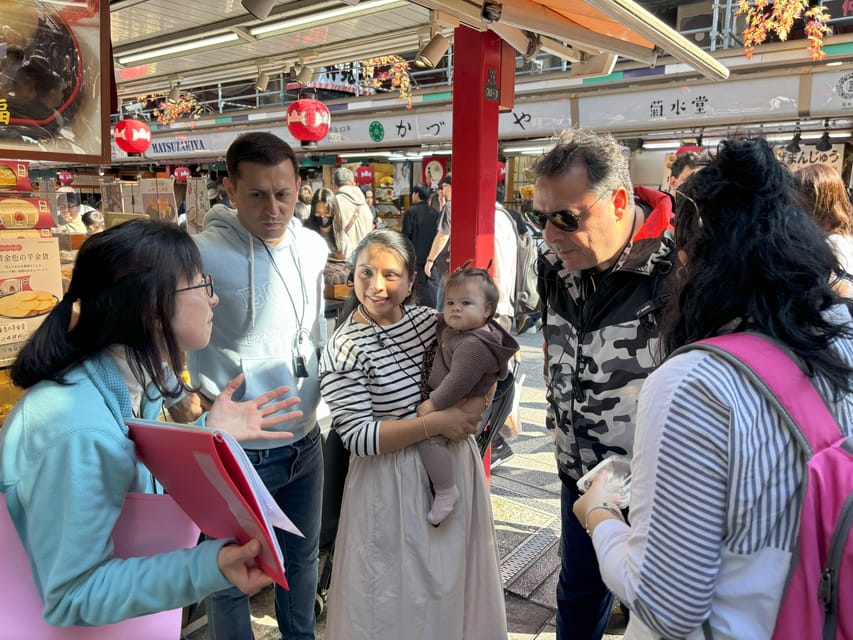
The tour’s greatest strength is its structure. You move from the river and foreign policy to religion, then to dragons, shopping culture, art, medieval comparison, Buddhism, and Shinto. The subjects are broad, but they follow a sensible path.
I also like that the guide uses physical places as evidence. The river explains isolation and foreign pressure. Nakamise explains trade, symbols, and art. Sensō-ji and Asakusa Shrine explain religious coexistence. You are less likely to forget the information because each point is tied to something you can see.
The 4.6 rating from 77 bookings fits the experience described here: the guides receive repeated praise for warmth, clarity, and the ability to keep families engaged. Sachi, Choco, Amy, and the other guides seem to bring different personalities, but the common thread is active explanation and willingness to answer questions.
The limitation is pace. Fifteen minutes at a major site goes quickly, especially if you want photographs, ask questions, and listen carefully. This walk gives you a strong introduction, not a full study of Asakusa.
Who should book this Asakusa walk?
I would choose this tour early in a Tokyo visit if I wanted a clear framework for the rest of Japan. It suits first-time visitors, families with older children, and anyone who enjoys history told through real places.
It is also a good choice if you want to understand religious etiquette before visiting more temples and shrines. The English guide, visual aids, snack tasting, and headsets for larger groups make the material easier to follow.
You should think twice if you have significant mobility limits. The activity involves a moderate amount of walking, and it is not recommended for people with mobility impairments. Contact the supplier before booking if you need an accommodation. The walk operates in rain or shine, so bring comfortable shoes, water, and clothing suited to the forecast.
Children under six can join without charge, though the historical focus is aimed more at adults. Families should consider the interests of their children. An eight-year-old enjoyed the fortune telling, and a 13-year-old stayed engaged, but a very young child may not follow the broader history.
Free cancellation is available up to 24 hours before the start, and you can reserve now and pay later. The tour requires a minimum number of participants, and cancellation notice is sent at least 24 hours ahead if that number is not reached.
Should you book it?
Book this walk if you want Asakusa to make sense beyond its famous gate and temple. The best reasons are the clear Buddhism and Shinto explanation, the ukiyo-e connection to Western art, and the unusual look at a temple and shrine sharing one religious setting.
Skip it if you want a slow photography walk, a long food tour, or detailed time inside every building. For most first visits, though, $58 buys a useful two-hour introduction, especially when the guide is as engaging as Sachi, Choco, or Amy. You will leave with more than a handful of temple photos. You will understand why Asakusa matters.
FAQ
Where does the tour start?
Meet in front of the Burger King beside Exit 4 of Asakusa subway station, G19, on the Ginza Line. The listed meeting address is 2-chōme-20-6 Kaminarimon.
How long does the walking tour last?
The tour lasts two hours and includes guided stops at the Tokyo Cruise Asakusa Pier, Asakusa Culture Tourist Information Center, Kaminarimon, Nakamise Shopping Street, Hōzōmon Gate, Sensō-ji Temple, and Asakusa Shrine.
What language is the tour conducted in?
The live tour guide speaks English, and an English audio guide is included.
Are headsets provided?
Headsets are provided for groups of three or more so you can hear the guide more clearly.
Is a snack included?
Yes. Traditional snack tastings are included in the experience.
Can children join the tour?
Children younger than six may join free of charge. Families are welcome, though the historical focus is recommended more for adults.
What happens if the tour is cancelled?
The tour will not operate unless the minimum number of participants is met. If it is cancelled, the operator will notify you at least 24 hours before the start and provide a full refund.
Just added in Tokyo
- The 10 Tastings of Tokyo With Locals: Private Street Food Tour★ 5.0 · 48 reviews
- Small Town in the Big City: Tasting Tokyo’s Kichijoji★ 5.0 · 195 reviews
- Small Town in the Big City: Tasting Tokyo’s Kichijoji★ 5.0 · 16 reviews
- EXCLUSIVE Tokyo Secret: Kichijoji Small-Group Food & Bar Hopping★ 5.0 · 29 reviews
- Explore Kichijoji: Walk Through One of Tokyo’s Beloved Districts★ 5.0 · 21 reviews
- :Tokyo,Shibuya/ Pro Photography in Kimono / English-Friendly★ 5.0 · 26 reviews
- 【R34】Tokyo:Private Daikoku tour in Modified R34★ 4.9 · 92 reviews
- Tokyo:Calligraphy &Make your original folding fan in Asakusa★ 5.0 · 62 reviews
Tours in Tokyo, compared.
Mt Fuji and Hakone 1-Day Bus Tour Return by Bullet Train
Read our review →
teamLab Planets TOKYO Digital Art Museum Entry Ticket
Read our review →
Mt Fuji & Hakone Cruise, Drum Show Bullet Train 1 Day from Tokyo
Read our review →
Sumo Show Experience with Chicken Hot Pot and a Photo
Read our review →
Shinjuku Food Tour (13 Dishes at 4 Local Eateries)
Read our review →