Reviewed · TOURS IN TOKYO
Asakusa: 3.5-hour Big-picture History Walk
Asakusa is much more than Tokyo’s famous temple district. This 3.5-hour history walk uses Sensō-ji, old shopping streets, theaters, river views, and neighborhood pubs to explain how Japan moved from an isolated feudal society to a modern global power. You are not just checking off gates and pagodas. You are learning why the places matter.
I especially like the way the route connects Buddhism and Shinto, two traditions that share many Japanese worshippers, and the way it links Japan’s opening to the West with the art that later influenced French Impressionist painters. I also like the small group size, limited to eight, and the practical touches such as traditional snacks, headsets for larger groups, and guides who point out restrooms before you need one.
The main drawback is the pace. Three and a half hours means a moderate amount of walking, outdoor time, and several stops where you stand while listening. Anyone with mobility limitations should contact the operator first, and families with very young children should know that the historical focus is aimed mainly at adults.
Key points to know before you book
- Japan’s opening to the world becomes easier to understand: The walk explains isolation, Dutch trade, the arrival of Western influence, and the cultural shift toward modern Japan.
- Sensō-ji and Asakusa Shrine show two faiths side by side: You learn how Buddhism and Shinto developed different roles while sharing the same worshippers.
- The route moves beyond the postcard sights: After the temple, you explore entertainment streets, old-style pubs, theaters, and quieter corners of Asakusa.
- The guides shape the experience: Yasu, Taka, Yoko, Ai, Jun, Akiko, and Satchi have all led this walk, with special praise for clear English, patience, and local insight.
- The $88 price buys interpretation, not just access: There are no major admission benefits, but you receive three and a half hours of guided context, snacks, and a small group setting.
- Plan for weather and footwear: The walk operates in all weather, and comfortable shoes plus water are essential.
Why Asakusa makes such a good classroom for Japanese history
Asakusa gives you a useful introduction to Japan because several eras sit close together. The area contains a sacred temple, a Shinto shrine, commercial streets, entertainment lanes, postwar drinking spots, and modern views toward Tokyo’s changing skyline.
That mix helps you see Japan’s dual nature. One moment you are in a temple courtyard shaped by centuries of ritual. A few minutes later, you are among souvenir shops, small pubs, theater buildings, and signs of everyday working life.
The guide’s job is to connect these places. Instead of treating each stop as an isolated sight, the walk asks why a temple became surrounded by commerce, why entertainment grew beside religious sites, and how Asakusa changed as Tokyo’s center shifted toward areas such as Shinjuku and Shibuya.
That approach is the main reason to choose this tour. If you only want photographs of Kaminarimon and Sensō-ji, you can visit them on your own. If you want a clear explanation of how the district reflects Japanese society, the guided format earns its price.
Other experiences people book in Tokyo:
- Mt Fuji and Hakone 1-Day Bus Tour Return by Bullet Train
★ 5.0 · 26,383 reviews - 1-Day Tokyo Bus Tour
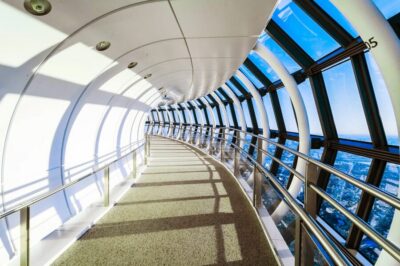
★ 5.0 · 14,250 reviews - Tokyo: TOKYO SKYTREE® Admission ticket
★ 4.5 · 11,192 reviews
Meeting near Exit 4 and beginning beside the river
The walk begins outside the Burger King next to Exit 4 of Asakusa Station on the Ginza Line. The meeting point is practical, but give yourself time to find the correct exit and come above ground before the start time.
The first stop is the Tokyo Cruise Asakusa Pier, where the guide spends about 15 minutes. This opening gives you a wider view of Asakusa and its position along the river. It also helps you understand why the neighborhood became important as a place of movement, trade, leisure, and public life.
Starting beside the water is a smart choice. It keeps the tour from rushing straight into the temple crowds and gives you a few minutes to settle into the group. You can also ask early questions and get a sense of the guide’s style.
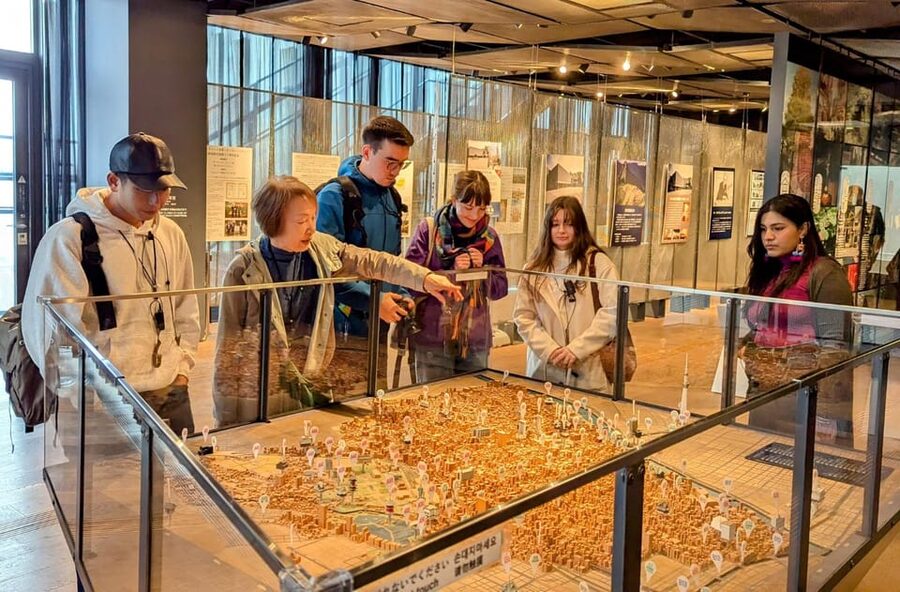
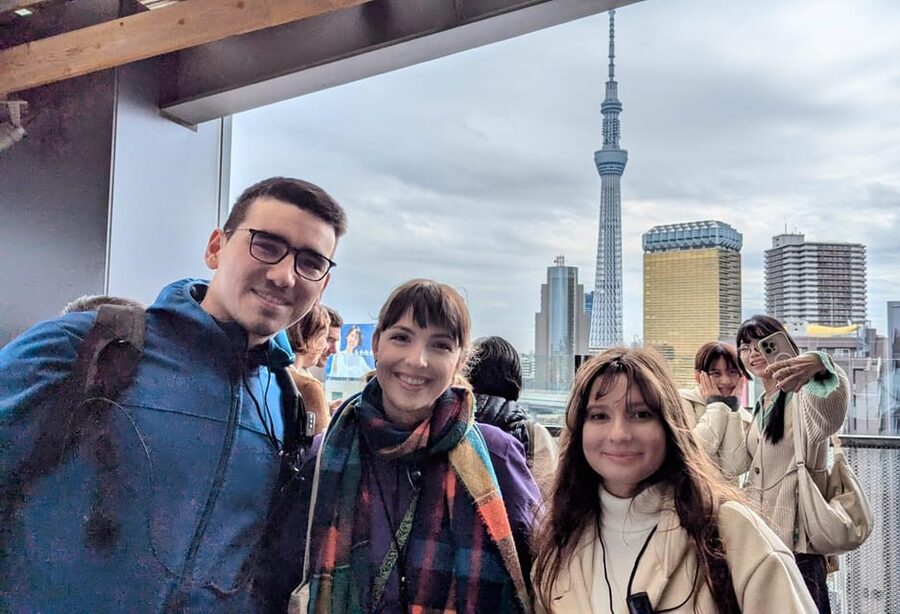
The route then moves to the Asakusa Culture Tourist Information Center for about 30 minutes. The building itself is part of the experience, with modern design that contrasts sharply with the older streets below. From its upper levels, you may get a useful view of Asakusa and the Tokyo Skytree.
One guide has explained the Skytree’s 634-meter height through the Japanese reading mu-sa-shi, a sound linked to the number 634. Details like this are small, but they make the city feel less like a collection of numbers and more like a place where language, memory, and geography overlap.
Kaminarimon and the commercial road to Sensō-ji
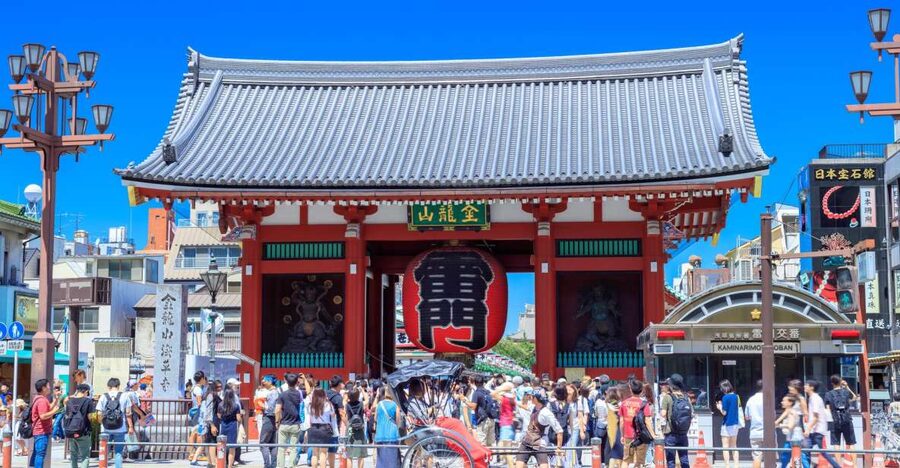
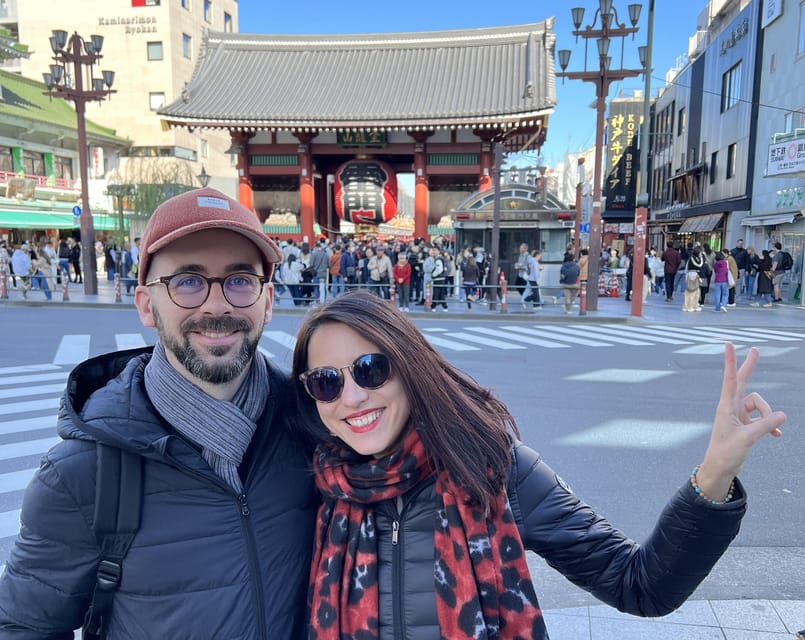
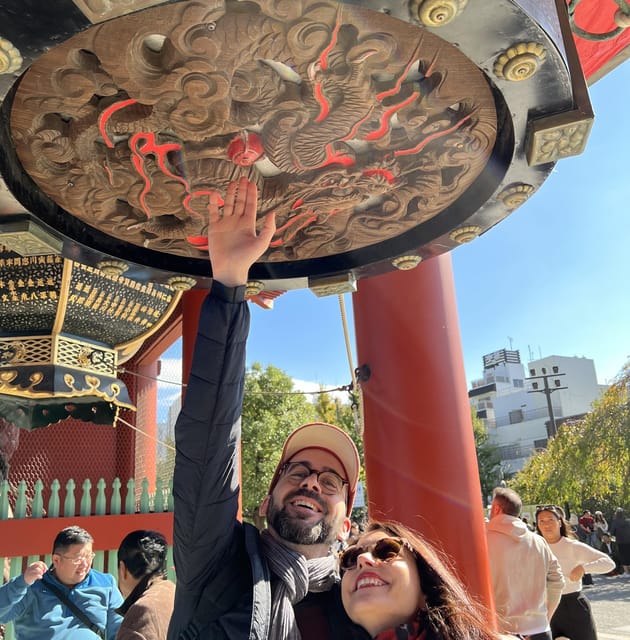
At Kaminarimon, the tour spends about 15 minutes unpacking the meaning of the gate and its famous giant lantern. This is one of Asakusa’s most photographed spots, so the explanation helps you look beyond the obvious image.
From there, you walk along Nakamise Shopping Street for about 30 minutes. The street leads toward Sensō-ji and is lined with shops selling snacks, sweets, souvenirs, and traditional goods. It can be crowded, especially at popular times, so stay close to the guide and expect a slower pace.
Nakamise is useful because it shows how commerce and worship have long occupied the same space. You can buy something to eat, watch the flow of people, and still be moving toward one of Tokyo’s most important religious sites.
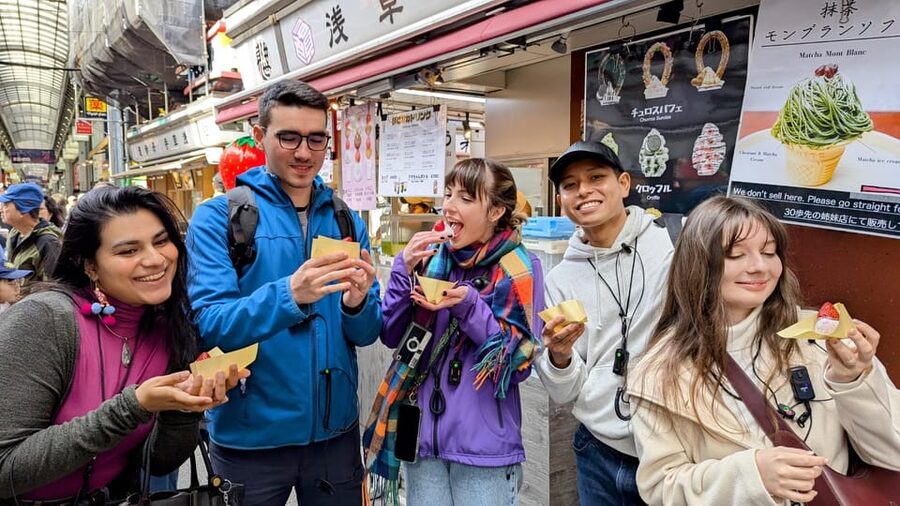
The tour includes a selection of freshly made Japanese traditional snacks and sweets. This is not a full meal, so you should still eat beforehand if you need substantial food. The tasting adds a pleasant break and gives the guide a natural way to talk about local customs and everyday Japanese tastes.
If you are not interested in shopping, do not worry that the walk will become a sales stop. The route continues through the street while the guide focuses on history, culture, architecture, and the meaning of the district.
Hōzōmon Gate and the many layers of Sensō-ji
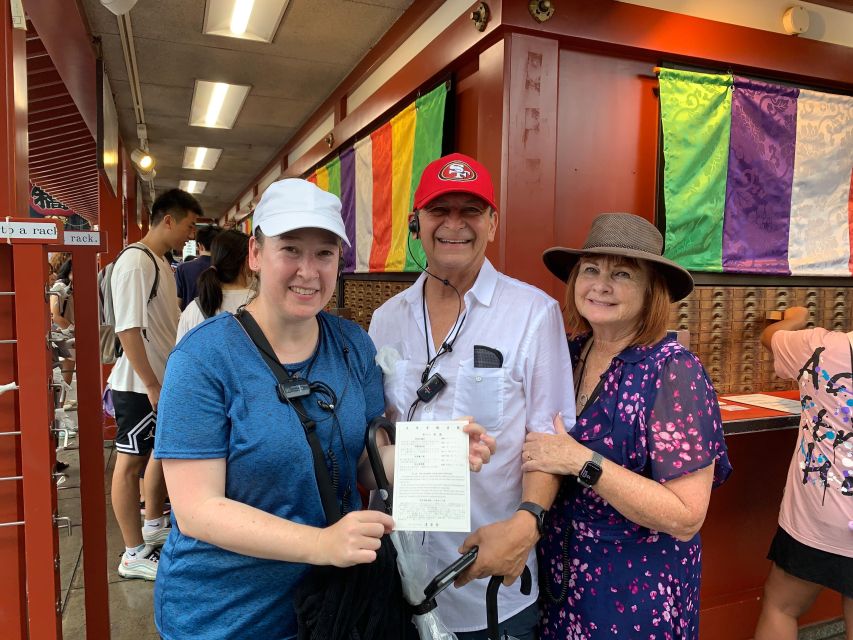
The Hōzōmon Gate follows, with about 15 minutes of guided explanation. It is another point where the tour shifts your attention from surface beauty to symbolism, religious practice, and the long development of the temple grounds.
Sensō-ji receives the longest visit, about 45 minutes. That extra time matters. A short stop can leave you with a few photographs, but a longer explanation gives you room to understand how the temple functions and why it remains such a central part of Asakusa.
The guide explains Buddhism in relation to Shinto, Japan’s other major religious tradition. You learn how the two developed different roles while remaining part of the daily lives of many of the same people. The central idea is not that Japanese people must choose one faith, but that religious practice can be shared, layered, and practical.
This is one of the strongest parts of the walk. Visitors often see a temple and a shrine as similar tourist sights, but the difference between them is important. The tour uses the nearby buildings to explain how Japanese beliefs have coexisted rather than being kept in separate boxes.
You also get context for Japan’s long isolation and later opening. The guide discusses why Japan closed itself, why the Netherlands remained its main European trading partner during that period, and how the country eventually shifted toward greater contact with the outside world.
That history is especially useful at Sensō-ji because the temple represents continuity, while the surrounding crowds, shops, and modern city show constant change.
Same base, a different sort of day:
- Tokyo: teamLab Planets TOKYO Digital Art Museum Entry Ticket
★ 4.6 · 9,779 reviews - Mt Fuji & Hakone Cruise, Drum Show Bullet Train 1 Day from Tokyo
★ 4.0 · 7,413 reviews - Tokyo: Sumo Show Experience with Chicken Hot Pot and a Photo
★ 4.8 · 6,678 reviews - Tokyo: Shinjuku Food Tour (13 Dishes at 4 Local Eateries)
★ 5.0 · 6,603 reviews
Asakusa Shrine and the conversation between Buddhism and Shinto
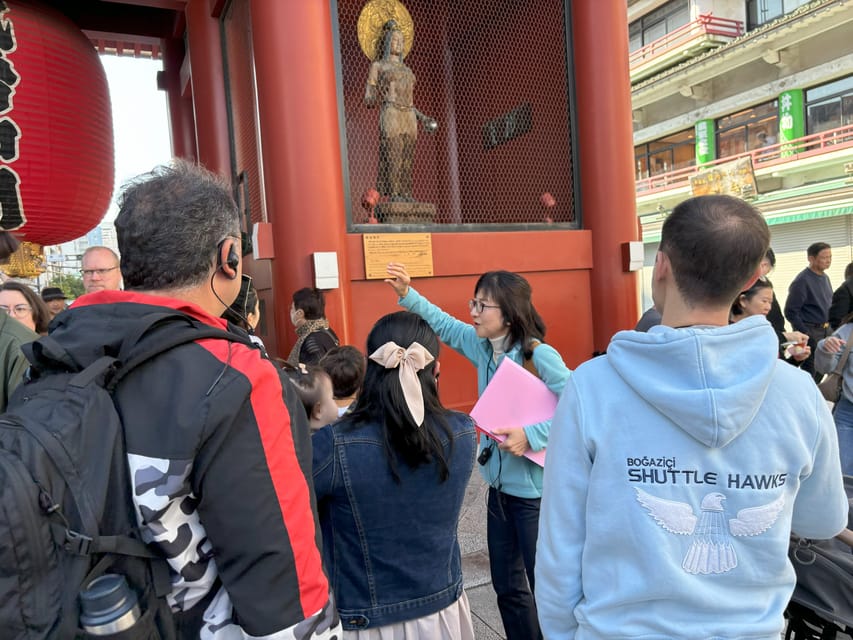
Asakusa Shrine receives about 15 minutes. Its location near Sensō-ji makes the relationship between Buddhism and Shinto easy to see in physical form.
The guide explains how the two traditions complement each other in daily life. You may learn how one setting can relate to community, local identity, festivals, or life events, while another supports different forms of devotion and ritual. The exact emphasis can vary with the guide, but the goal is to give you a workable framework rather than a list of religious vocabulary.
This is also a good place to ask questions. The small group limit gives the guide more freedom to adjust the explanation to your interests. Guides such as Yasu, Yoko, Taka, Ai, Akiko, Jun, and Satchi have been praised for clear English and patient answers.
The use of headsets for groups of three or more is helpful here. Religious sites can be noisy, and it is frustrating to miss the explanation just when the guide is making an important comparison.
Yōgō-dō Pavilion and the quieter side of the temple area
The route continues to Yōgō-dō Pavilion for about 15 minutes. This stop adds another layer to the temple complex and gives the tour a chance to slow down after the main gates and crowds.
A guided visit here is valuable because smaller religious buildings are easy to pass without understanding their purpose. The walk encourages you to notice how a major temple district is made up of several spaces, not just one dramatic hall.
You should expect to spend much of the tour on foot and outdoors. There are breaks between major explanations, but this is not a hop-on, hop-off sightseeing trip. Wear shoes you can comfortably use for several hours, and carry water. Vending machines are available, but bringing your own bottle is sensible.
Nishi-sandō, old theaters, and Asakusa’s entertainment past
Asakusa Nishi-sandō Shopping Street receives about 15 minutes. Compared with Nakamise, this smaller street offers a quieter, more nostalgic atmosphere. It helps you picture an older Tokyo without leaving the main historic district.
The next stop is Asakusa Mokubakan, also for about 15 minutes. The walk uses this area to discuss Asakusa’s role as an entertainment center in the early 20th century, when cinemas, vaudeville theaters, and performance halls drew crowds.
This section gives the tour welcome balance. Without it, Asakusa could seem like a preserved religious quarter. In fact, it has long been a place where sacred life and popular entertainment sit close together.
That contrast is one of the walk’s most memorable themes. Human beings move between the solemn and the ordinary, often within the same city block. You can pray at a temple, buy a sweet, watch a performance, and meet friends for a drink without feeling that these activities belong to separate worlds.
The route also connects this older entertainment culture with the later rise of Shinjuku and Shibuya. As Tokyo’s centers shifted, Asakusa kept its own character while becoming a place where you can still sense earlier forms of city life.
Hoppy Street and postwar working-class energy
The final stop is Hoppy Street, another 15-minute visit. The narrow lane is known for old-style Japanese pubs and gives you a look at Asakusa’s postwar working-class spirit.
This is not a formal food tour, and the route does not promise a meal or drink. Instead, the guide explains the atmosphere and history of the lane. You can decide later if you want to return for dinner or drinks.
Hoppy Street is a fitting ending because it takes the tour away from grand symbols and back to ordinary people. Japan’s history is not only about emperors, isolation, industrial growth, or international trade. It is also about neighborhoods rebuilding, workers gathering, and local traditions surviving change.
By this point, the earlier themes should connect. The temple shows religious continuity. The shopping streets show commerce. The theaters show popular culture. Hoppy Street shows postwar resilience and daily life.
What the $88 price really includes
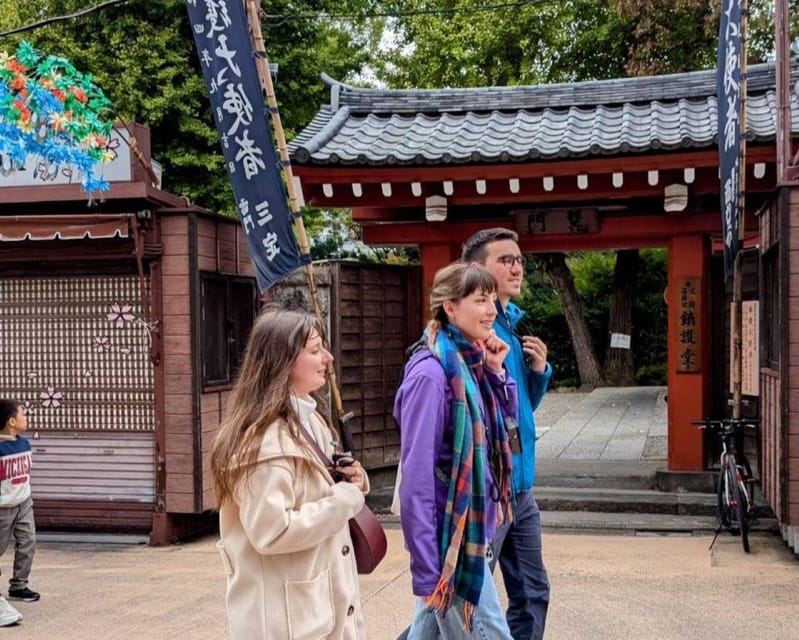
At $88 per person, this is not the cheapest way to see Asakusa. You can enter the public streets, temple grounds, and shrine area without paying for a guide.
The value comes from interpretation. You receive 210 minutes with an English-speaking certified guide, a group limited to eight, traditional snacks, and headsets when the group has at least three people. You also gain a planned route that moves beyond the most obvious sights.
I would consider the price fair for a first visit if Japanese history and culture are central to your trip. It is less compelling if you already know Asakusa well or prefer to wander alone at your own pace.
The guides make a real difference. Taka has been especially good at adjusting to personal interests, including architecture, gardens, history, and photography, while avoiding pressure to shop. Other guides, including Yasu, Yoko, Ai, Akiko, Jun, and Satchi, have been praised for friendly manner, clear English, and careful attention to the group.
The tour has a 4.7 rating from 39 ratings, which fits the experience described here: the strongest feature is not a rare access perk but the quality of the human explanation.
Weather, mobility, and the right kind of visitor
The walk operates in all weather, so bring suitable clothing. Rain can make the route less comfortable, but the guide can still help you understand the district. One guide took special care of the group when cold rain began, which is reassuring, though you should not rely on the tour providing rain gear.
You should be comfortable walking for a moderate amount of time and standing at landmarks. The experience is not suitable for people with mobility impairments as described, though anyone with specific mobility concerns should contact the operator before booking because they will try to accommodate requests.
Children younger than six may join free of charge. Families are welcome, but the content is aimed mainly at adults. Older children and teenagers who enjoy stories about history, religion, or city life are likely to get more from it than very young children.
The small group format suits solo visitors, couples, and families who want to ask questions. It also works well for first-time visitors who want a clear framework for later independent exploring.
Should you book this Asakusa walk?
Book it if you want Asakusa to make sense as more than a temple photo stop. You will get the most from the tour if you care about Japan’s isolation and reopening, the relationship between Buddhism and Shinto, the influence of Japanese art abroad, and the way sacred and everyday life share the same streets.
Skip it if you want a fast highlights tour, a food crawl, or a fully flexible walk with no scheduled explanations. The route is long enough to require comfortable shoes, and the historical detail may feel heavy if you only want casual sightseeing.
For most first visits, I think the tour offers solid value. It connects Sensō-ji, Asakusa Shrine, Nakamise, old entertainment streets, and Hoppy Street into one readable story. Afterward, you can return to the places that caught your attention, perhaps staying in Asakusa for dinner as one visitor did after the walk.
FAQ
Where does the Asakusa history walk start?
It starts in front of the Burger King next to Exit 4 of Asakusa subway station on the Ginza Line, at 2-chōme-20-6 Kaminarimon.
How long does the tour last?
The walk lasts 210 minutes, or three and a half hours.
What language is the tour conducted in?
The live tour is conducted in English by an English-speaking certified guide. An English audio guide is also included.
How large is the group?
The maximum group size is eight participants. Headsets are provided for groups of three or more so you can hear the guide clearly.
Are food and drinks included?
A selection of freshly made Japanese traditional snacks and sweets is included. Bottled water is not included, though vending machines are available.
Can children or people with mobility issues join?
Children younger than six may join without charge, and families are welcome. The historical focus is recommended for adults. The activity is not suitable for people with mobility impairments, but you can contact the operator about specific mobility needs.
Just added in Tokyo
- The 10 Tastings of Tokyo With Locals: Private Street Food Tour★ 5.0 · 48 reviews
- Small Town in the Big City: Tasting Tokyo’s Kichijoji★ 5.0 · 195 reviews
- Small Town in the Big City: Tasting Tokyo’s Kichijoji★ 5.0 · 16 reviews
- EXCLUSIVE Tokyo Secret: Kichijoji Small-Group Food & Bar Hopping★ 5.0 · 29 reviews
- Explore Kichijoji: Walk Through One of Tokyo’s Beloved Districts★ 5.0 · 21 reviews
- :Tokyo,Shibuya/ Pro Photography in Kimono / English-Friendly★ 5.0 · 26 reviews
- 【R34】Tokyo:Private Daikoku tour in Modified R34★ 4.9 · 92 reviews
- Tokyo:Calligraphy &Make your original folding fan in Asakusa★ 5.0 · 62 reviews
Tours in Tokyo, compared.
Mt Fuji and Hakone 1-Day Bus Tour Return by Bullet Train
Read our review →
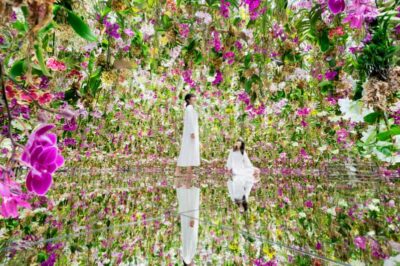
teamLab Planets TOKYO Digital Art Museum Entry Ticket
Read our review →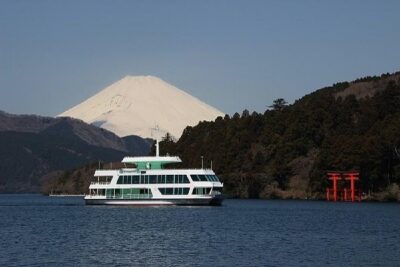
Mt Fuji & Hakone Cruise, Drum Show Bullet Train 1 Day from Tokyo
Read our review →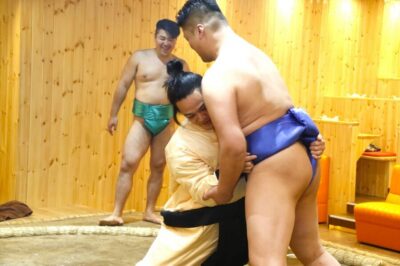
Sumo Show Experience with Chicken Hot Pot and a Photo
Read our review →
Shinjuku Food Tour (13 Dishes at 4 Local Eateries)
Read our review →