
Reviewed · GOVERNMENT-LICENSED GUIDE TOURS
Kyoto 6hr Instagram Highlights Private Tour with Licensed Guide
Kyoto’s best photo stops are scattered across the city, and this private six-hour tour lets you choose which ones matter most. You can focus on red torii gates at Fushimi Inari, bamboo at Arashiyama, temple views at Kiyomizudera, or the old lanes of Gion instead of following a fixed script. Guides such as Yoshii Kenichi, Kazuo Sumi, Tomy, Tark, and Hiro T. have led this experience, though your guide is assigned separately.
I like the custom itinerary, which is useful when you already know your must-see places. I also like the practical help with trains and directions, especially in a city where major sights sit far apart. The tradeoff is clear: transportation, entry fees, lunch, and personal costs are not included, and trying to cover too many distant stops can leave you rushing.
Key points at a glance
- Choose three or four sights: The six-hour format is designed around a short list of priorities, not every stop at once.
- Use public transit with a guide: You meet on foot, and there is no private vehicle included.
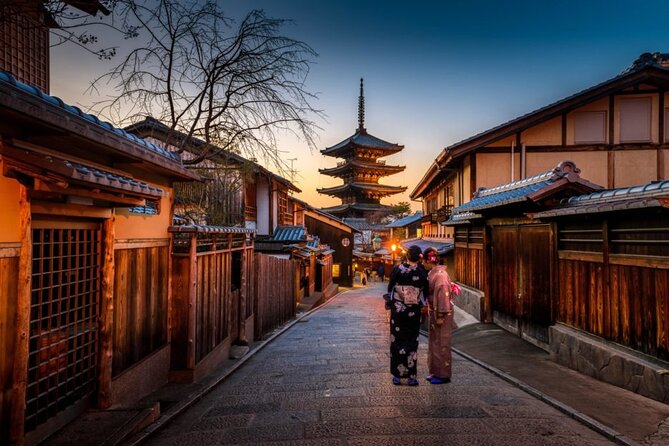
- Photograph Kyoto’s icons: Fushimi Inari, Arashiyama Bamboo Forest, Kiyomizudera, Gion, and Yasaka are the main draw.
- Get cultural context: The guide is a Japanese government licensed English-speaking interpreter.
- Plan for extra costs: Transportation and most admission fees are separate from the tour price.
- Best for private groups: Families, couples, and small groups can shape the day around their own interests.
A private Kyoto route built around your priorities
The main strength here is control. You choose three or four places from the available list, then the guide shapes a six-hour outing around them. That matters in Kyoto because the city’s famous sights are not clustered in one compact center.
A first-time visitor might choose Fushimi Inari, Kiyomizudera, Gion, and Arashiyama. That gives you a strong first look at Kyoto, but it also creates a demanding day because Arashiyama is away from the eastern and southern sights. A slower plan could pair Arashiyama with Kinkakuji, though the Golden Pavilion is not described in the standard stop list and should be confirmed when you arrange the route.
The private format is especially useful if you have a child, a photographer in your group, or a clear interest in temples and shrines. Tomy, for example, adjusted the pace for a young child and included breaks. That is the sort of flexibility a large group tour cannot usually offer.
Your guide can also help with photo timing and viewpoints. Tark was praised for shaping the route around personal interests and pointing out good places to take pictures. You should still tell the operator your priorities before the day begins. The more specific you are, the less time you lose making decisions on the street.
Other tours with a licensed guide in Kyoto:
- Kyoto 6hr Private Tour with Government-Licensed Guide
★ 5.0 · 1,369 reviews - Kyoto 4hr Private Tour with Government-Licensed Guide
★ 5.0 · 629 reviews - Kyoto: Private Tour with Local Licensed Guide
★ 4.8 · 463 reviews
Togetsukyo Bridge and Arashiyama’s bamboo path
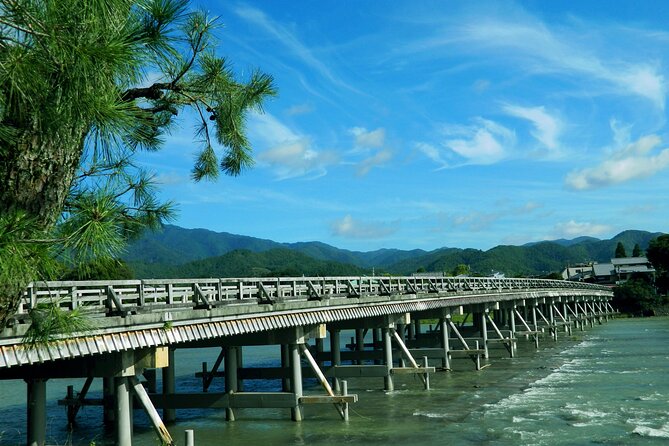
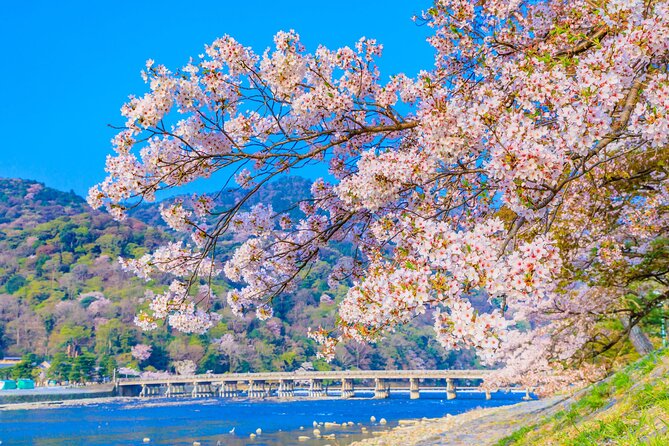
Togetsukyo Bridge crosses the Katsura River for about 155 meters and connects the Saga Arashiyama area. The bridge itself is only part of the appeal. The footpath, river, and wooded hills behind it give you a classic Kyoto view with room for wider photographs.
The planned visit is about 30 minutes, which is enough for bridge photos and a short look along the river. It is not enough for a long Arashiyama walk, a meal, and several temple visits. Keep that in mind before adding too many other stops.
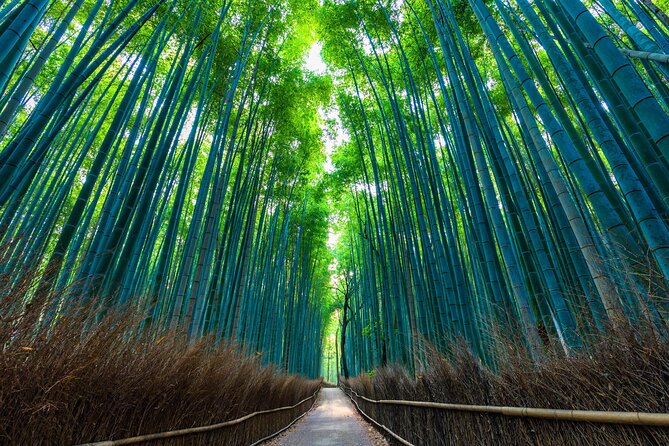
The nearby Bamboo Forest Street is one of Kyoto’s most recognizable scenes. Tall bamboo lines the path, creating a narrow green corridor that works well for portraits and vertical phone photos. The path is free, but its fame means you should not expect a private forest walk. Your guide can help you find the main route and keep the visit moving.
I would choose both Arashiyama stops together if bamboo and river views are high on your list. If you also want Fushimi Inari and Gion, ask the guide to explain the travel time before finalizing the plan. The tour can use public transit effectively, but Kyoto remains a large city.
Kiyomizudera’s wooden terrace
Kiyomizudera is one of Kyoto’s major temple sights, set among wooded slopes on the eastern side of the city. Its large open wooden terrace is the main visual prize, giving you a broad view over the surrounding area.
The listed stop time is about 30 minutes. That works for a focused visit, but it is brief for a full temple visit and the surrounding approach. Entrance is not included, so add the admission charge to your budget.
This is a good stop if you want a classic Kyoto temple image without spending the whole day at religious sites. The guide can explain what you are seeing rather than simply leading you to the terrace, and the government license indicates formal training in Japanese culture and history.
Kiyomizudera also pairs naturally with Gion and Yasaka. Those sights sit in the same general eastern Kyoto zone, so you spend less of your six hours crossing the city. If you want the most efficient route, I would put these together rather than combine them with both Arashiyama and Uji.
Yasaka Shrine, Yasaka Pagoda, and Gion
The Yasaka portion of the experience includes one of Kyoto’s best-known eastern areas. Yasaka Shrine is free to enter, while nearby Hokanji Temple is associated with the five-story Yasaka Pagoda, a 46-meter landmark often photographed from the surrounding streets.
The description of this stop focuses on the pagoda, so clarify whether your preferred photo is the shrine, the pagoda, or both. They are related to the same sightseeing zone, but they are not the same sight. A short 30-minute stop can work for exterior photos and a quick look, but it will not allow a leisurely exploration of every lane.
Gion adds a different mood. Its preserved streets and traditional buildings are linked with Kyoto’s former entertainment quarter and with geisha and maiko culture. You may see people dressed for traditional work or tourism, but the important point is to treat the area as a living neighborhood, not a stage set. Walk quietly, follow posted rules, and ask your guide where photography is appropriate.
Time management matters here. One guide explained that a group had very little time left for Gion after spending longer elsewhere and reached the area near the end of the visit. That is useful warning: if Gion matters to you, name it as a must-see rather than leaving it as an optional final stop.
Same base, a different sort of day:
- PERFECT KYOTO 1-Day Bus Tour
★ 5.0 · 13,518 reviews - Kyoto: Fushimi Inari, Kinkakuji, Bamboo Grove 1 Day Bus Tour
★ 4.8 · 4,316 reviews - Kyoto: Tea Ceremony in a Traditional Tea House in Kiyomizu
★ 4.9 · 3,519 reviews - Kyoto Geisha Walking Tour: Gion District & Hidden Gems
★ 4.7 · 3,273 reviews
Fushimi Inari’s tunnel of red torii
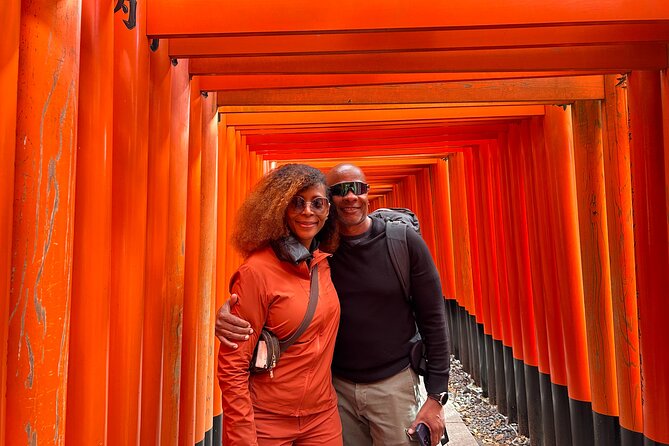
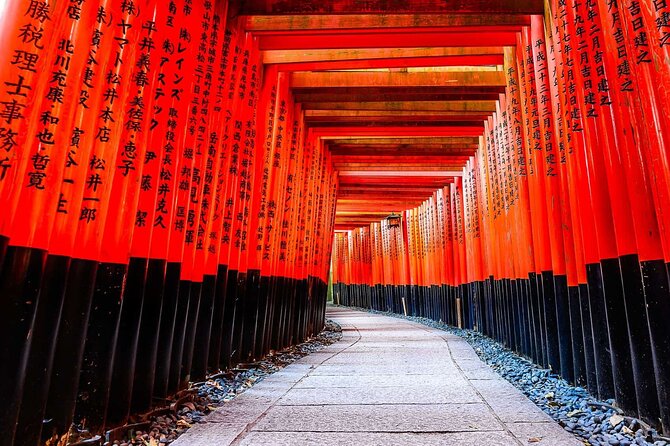
Fushimi Inari-taisha is the tour’s strongest choice for instantly recognizable Kyoto photographs. More than 1,000 vermilion torii gates form paths up Mount Inari, creating the famous tunnel effect.
The listed visit is about 30 minutes, which gives you a taste of the shrine and its lower paths. It does not allow a full climb through the mountain route. If you want to walk far beyond the first gates, make that clear before the itinerary is set.
Fushimi Inari is free to enter, so it helps keep admission costs down. It is also a shrine rather than a temple, giving your day a useful contrast if you are already visiting Kiyomizudera or Kenninji.
The site is particularly strong for photography, but your guide’s value is not limited to finding a red gate. A licensed interpreter can explain the religious setting and help you understand why the gates are there. That turns a quick photo stop into something more meaningful.
I would make Fushimi Inari a priority for a first Kyoto visit. Pair it with Gion and Kiyomizudera for a compact eastern and southern Kyoto day, then add one more stop only if your guide says the timing works.
Kenninji’s gardens near Hanamikoji
Kenninji Temple sits close to Hanamikoji and Shijo streets, making it a useful choice if you want a quieter temple setting near Gion. Its grounds include two dry gardens, with carefully arranged stones and gravel that invite a slower look.
The listed visit is only 15 minutes, and admission is extra. That is enough for a quick introduction, but not enough if you want to sit, study the garden design, and explore the temple buildings at leisure.
I would choose Kenninji when you prefer calm temple details over another major landmark. It also fits well with Gion because the two areas are close. The short stop may be a sign that it works best as part of a Gion-focused route, not as a reason to cross Kyoto by itself.
Byodoin Temple and the extra journey to Uji
Byodoin Temple is in Uji, within Kyoto prefecture, and is famous for Phoenix Hall. Phoenix Hall is a National Treasure of Japan and part of a UNESCO World Heritage Site.
The listed visit is only 15 minutes, while the route notes extra travel time because the temple is outside central Kyoto. That is the clearest planning issue in the entire experience. Uji can be worthwhile, but it consumes more of a six-hour day than a central Kyoto stop.
Admission is not included. You should also confirm exactly how much time remains for the temple after transit. If Phoenix Hall is your main goal, build the day around Uji rather than treating it as a quick add-on to Fushimi Inari, Arashiyama, and Gion.
For most first visits, I would choose Byodoin on a separate outing or select it only when you have already seen Kyoto’s central highlights. The custom format gives you that choice, which is better than being locked into an overfilled route.
What the licensed guide adds
The guide is a Japanese government licensed English-speaking interpreter. The certification requires a good understanding of Japanese culture and history, which is useful when a short stop needs more than directions and photo assistance.
The strongest guide qualities shown by this experience are flexibility, route management, and clear explanations. One guide was described as energetic and kept the group moving while helping them get oriented to Kyoto. Another was praised for easy-to-understand stories and efficient use of public transit. Tomy adjusted to a child’s needs, while Hiro T. was patient and kept the pace comfortable.
Guide quality can vary from person to person, so I would not book this expecting one named guide unless the operator confirms availability. The names connected with past departures include Yoshii Kenichi, Kazuo Sumi, Amira-san, Tomy, Tark, and Hiro T. Use them as examples of the guide team, not as a promise about your own assignment.
The guide also helps reduce the mental work of Kyoto. You do not have to work out every train connection or decide which lane leads to the next sight while trying to keep your group together. That convenience is a real part of the price.
Is $154.37 per person good value?
At $154.37 per person, this is not a cheap way to see Kyoto. It becomes better value when you are traveling as a private group and want a guide to organize a complicated day around your own interests.
The price covers the licensed local English-speaking guide and a six-hour private experience. It does not cover your trains or buses, entrance fees, lunch, or other personal spending. There is no private car, and the pickup is an on-foot meeting within the designated Kyoto area.
That means you should compare the price with the cost of hiring a guide for the day, not with the cost of a basic group sightseeing bus. If you are happy to plan your own route and use public transit, you can see these places for much less. If you value personal attention, help with directions, cultural explanation, and photo suggestions, the extra cost may make sense.
Group discounts are offered, which improves the calculation for families or friends sharing one guide. Since the tour is private, you also avoid being tied to strangers’ interests or waiting for a large group at every stop.
The six-hour pace and practical limits
Six hours sounds generous until you look at the geography. Arashiyama, Gion, Fushimi Inari, and Uji are not one compact sightseeing circuit. Public transit can cover a lot of ground, and one departure was praised for using it quickly and effectively, but transfer time still reduces time at the sights.
I would choose three major sites, or four if two are close together. Good combinations include:
- Kiyomizudera, Yasaka, Gion, and Kenninji
- Fushimi Inari, Yasaka, and Gion
- Togetsukyo Bridge, Bamboo Forest Street, and one nearby priority
- Byodoin with only a small number of additional stops
The tour runs on foot between meeting points and sights, with public transit used as needed. Wear shoes suited to walking, particularly if you choose Arashiyama, Fushimi Inari, or the sloping streets around Kiyomizudera. The information does not promise a private vehicle, hotel-room pickup, or included transport, so confirm the meeting area before the day starts.
Most people can participate, and service animals are allowed. The tour operates near public transportation. Weather can affect comfort, too. A previous group dealt with light rain but found the cooler temperature made the walk manageable.
Who should book this Kyoto tour?
I would recommend it to couples, families, and small private groups who want a flexible first look at Kyoto. It is also a good match if you care about photography but want someone else to handle the route and explain what you are seeing.
It is less suitable if you want deep, unhurried visits at every temple. The six-hour plan works best when you accept that each chosen stop may be a focused introduction rather than a full exploration.
Book it when you can name your top three or four sights. Ask about travel time if you want to mix Arashiyama, Uji, and southern or eastern Kyoto. If Gion, Phoenix Hall, or a full Fushimi Inari climb matters most, say so at the planning stage.
Free cancellation is available up to 24 hours before the start time. Changes or cancellations inside that period are not accepted for a refund.
FAQ
How long is the Kyoto Instagram Highlights tour?
The private tour lasts approximately six hours.
How many sights can I choose?
The experience is customized around three or four sites selected from the provided sightseeing list.
Is transportation included?
No. Transportation fees are separate, and the tour does not include a private vehicle. You meet the guide on foot within the designated Kyoto area.
Are entrance fees included?
Only guide entry fees for sights listed under the expected stops are covered. Your own entrance fees are not included, and the listed prices for Kiyomizudera, Kenninji, and Byodoin specifically exclude admission.
Is this a private tour?
Yes. Only your group participates, and multiple tour groups cannot be combined.
Can I cancel for a full refund?
Yes, if you cancel at least 24 hours before the experience start time. Cancellations or changes made less than 24 hours before the start are not refunded or accepted.
Just added in Kyoto
- Private Cooking Class Udon in Kyoto Japan★ 5.0 · 23 reviews
- Your Private Vacation Photography Session In Kyoto★ 5.0 · 110 reviews
- Kyoto: Zen Meditation at a Private Temple with a Monk★ 5.0 · 25 reviews
- Private Pewter Sake Cup Experience with a Kyoto Artisan★ 5.0 · 31 reviews
- Kyoto Wagashi(Japanese sweets) Cooking Class near Fushimiinari★ 5.0 · 60 reviews
- Kyoto:Family-Friendly Kimono & Yukata Experience at WARGO★ 5.0 · 147 reviews
- Private Guided Traditional Buddhist Cooking in Japan★ 5.0 · 16 reviews
- Kyoto: Gion Geisha District & Sake-in-Hand Walking Tour★ 5.0 · 37 reviews
Government-Licensed Guide Tours, compared.
Tokyo 6hr Private Tour with Government-Licensed Guide
Read our review →
Hiroshima / Miyajima Full-day Private Tour with Government Licensed Guide
Read our review →
Kyoto 4hr Private Tour with Government-Licensed Guide
Read our review →
Hiroshima City 4hr Private Walking Tour with Licensed Guide
Read our review →
Private Kyoto Tour with Licensed Guide & Vehicle (Max 15 persons)
Read our review →
Nikko Full-Day Private Tour with Government-Licensed Guide
Read our review →
Himeji Half-Day Private Tour with Government-Licensed Guide
Read our review →Browse the lists this tour appears in