
Reviewed · TEA CEREMONY EXPERIENCES
Kyoto: Table-Style Tea Ceremony at a Kyo-Machiya
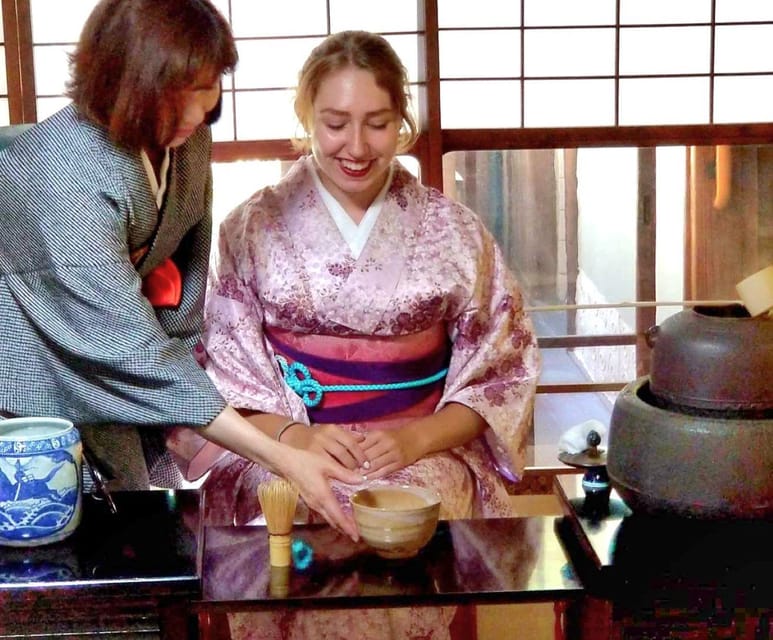
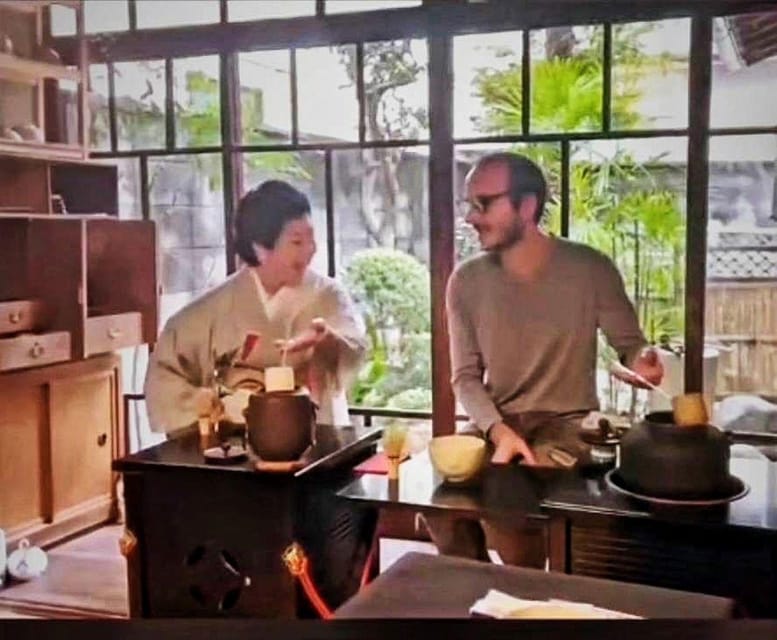
This tea ceremony solves one common Kyoto problem before it begins: you sit on a chair, not on the floor. In a more than 100-year-old Kyo-machiya in southern Kyoto, English-speaking hosts introduce tea manners, serve sweets and matcha, and let you prepare your own frothy bowl.
I like the mix of hands-on activities, especially whisking matcha and writing your name in Japanese. I also like the setting: a lived-in townhouse with a garden, old Buddhist and Shinto altars, antiques, and photo props such as folding fans, umbrellas, and swords. The main drawback is location. You need a train ride from central Kyoto, and the upstairs areas and traditional layout are not suitable for wheelchair users.
Key points
- Chair-based tea ceremony: Learn the basic movements without kneeling on tatami.
- 100-year-old Kyo-machiya: Walk through a traditional townhouse with a garden, household altars, and antiques.
- Make your own matcha: Use a bamboo whisk to create a creamy, foamy tea.
- More than tea: Try calligraphy, flower arranging, Japanese sweets, and a welcome drink.
- Optional kimono rental: Arrive 30 minutes early for dressing, hairstyling, and photos.
- Easy side trips: Combine the visit with Fushimi Inari, Uji, Fushimi sake shops, Osaka, or Nara.
A tea ceremony that does not require kneeling
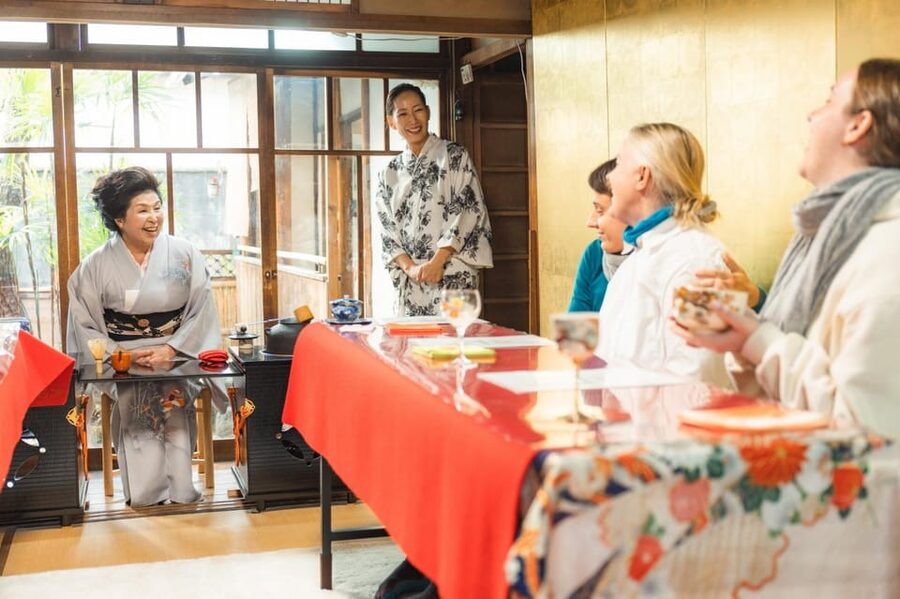
Many first-time visitors picture a tea ceremony as a quiet ritual performed on the floor, with legs folded beneath you for a long stretch. That can be uncomfortable, especially for older adults, children, or anyone with stiff knees. This Kyoto experience uses tables and chairs, so you can pay attention to the gestures, utensils, and explanations instead of your legs.
The ceremony still introduces the important ideas of Japanese tea culture. You learn how guests behave, why certain movements matter, and how the ceremony developed in Japan. The hosts use English and explain the process with a presentation before showing you the movements in person.
This format is friendly to beginners. You are not expected to know when to bow, how to hold the bowl, or which details to notice. The hosts guide you through each step, then give you a chance to try it yourself.
I would not book this expecting a silent, formal tea school lesson. The 90-minute program is designed for international visitors, and it combines instruction with photos, calligraphy, flower arranging, and a hands-on matcha session. That makes it accessible and fun, but less austere than a ceremony aimed at advanced tea students.
Other tea ceremonies in Kyoto people book:
- Kyoto: Tea Ceremony in a Traditional Tea House in Kiyomizu
★ 4.9 · 3,519 reviews - Kyoto: Tea Ceremony Ju-An at Jotokuji Temple
★ 4.9 · 3,207 reviews - Kyoto: 45-Minute Tea Ceremony Lesson Experience
★ 4.3 · 2,378 reviews
Finding the blue-curtained townhouse in Fushimi
The experience takes place in the southern part of Kyoto, in the Fushimi area. This is not central Gion, and you should allow roughly 20 to 25 minutes by train from the main central stations, plus a short walk.
From Kintetsu Kyoto Station, take an express train for about 15 minutes to Kintetsu Momoyama-Goryo-mae Station. From Keihan Gion-Shijo, use the train to Fushimi-Momoyama Station. If you arrive by JR at Momoyama Station, walk northwest toward the Otesuji shopping arcade.
Once you reach the arcade, look for Mizuho Bank or the Rakuten mobile shop and turn right. Continue for about two to three minutes. The townhouse has a blue curtain, and guides wearing kimono wait near the entrance.
The directions are manageable, but this is one place where arriving early helps. Southern Kyoto streets can feel less familiar than the major sightseeing corridors, and the modest exterior may not look like a formal tea house. Inside, the old house provides the atmosphere the exterior does not advertise.
The neighborhood is a useful part of the plan. Fushimi is known for sake, with casual restaurants, shopping streets, and places to eat before or after the session. You can also pair the visit with Fushimi Inari Shrine, which is about 15 minutes from Keihan Fushimi Inari Station, or continue to Uji, a town associated with Japanese tea.
Inside a more than 100-year-old Kyoto home
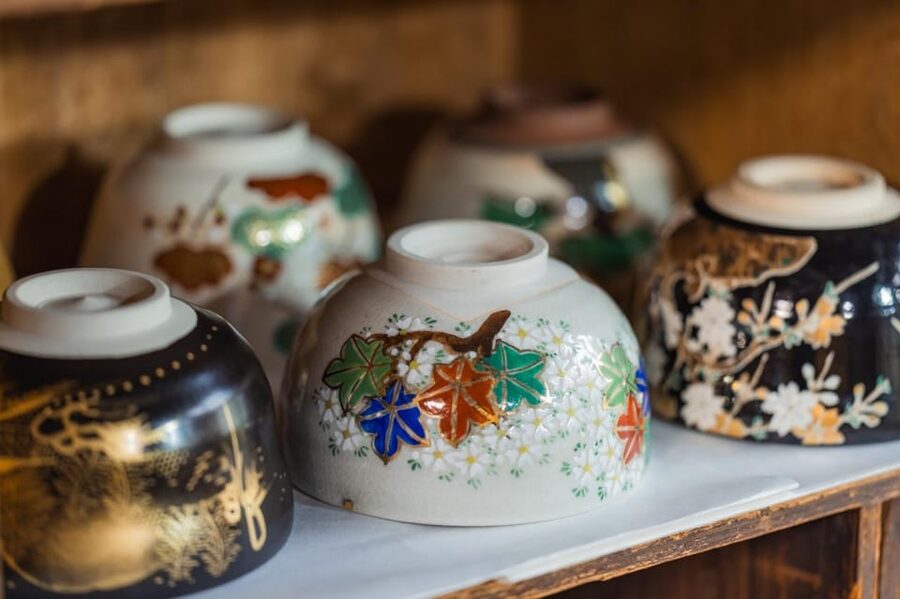
The townhouse is one of the strongest reasons to choose this activity. Rather than meeting in a modern studio, you enter a traditional home that reflects everyday Kyoto architecture. You can walk through the rooms, look at old Buddhist and Shinto altars, and see antiques that help explain how a Japanese household was arranged.
The garden provides a calm setting for the opening ritual and photos. You learn how to purify yourself at a stone basin, in a manner similar to the cleansing ritual at a shrine. This gives you a small but useful connection between tea customs and wider Japanese manners.
The setting also makes the ceremony feel less like a staged demonstration. You are welcomed into a house, not simply seated in a room with a tea display. The hosts are careful and attentive, and the pace allows time for questions and pictures.
If you choose the kimono option, arrive 30 minutes before the scheduled start. The hosts help you select and put on a kimono, and the dressing process can be a highlight in itself. Several visitors praised the range of outfits, the careful fitting, and the hairstyling. The extra time also lets you take photographs before the tea portion begins.
The kimono is an optional addition, and its price is not included in the $45 base cost. Check the available options carefully when booking. If you are pregnant, the provider asks you not to wear a kimono for health and safety reasons.
What happens during the 90-minute visit
The exact order can vary, but the program moves through several connected parts. You begin with a welcome drink, which may be sake or juice, and an introduction to the house and the ceremony.
The hosts explain the origins and spirit of tea ceremony through a presentation. This is useful because the movements make more sense once you know that the ceremony is built around attention, respect, cleanliness, and hospitality. You also learn basic manners before being asked to copy them.
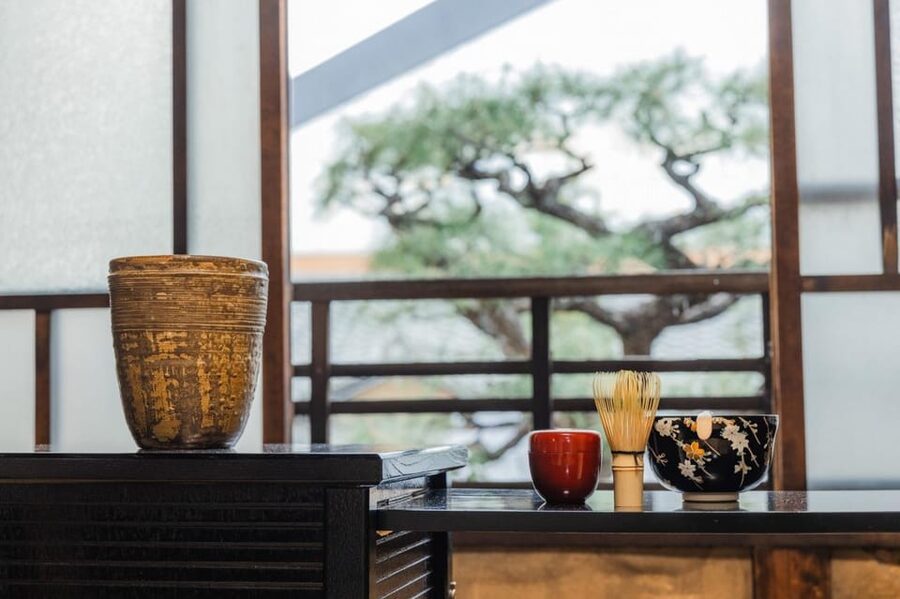
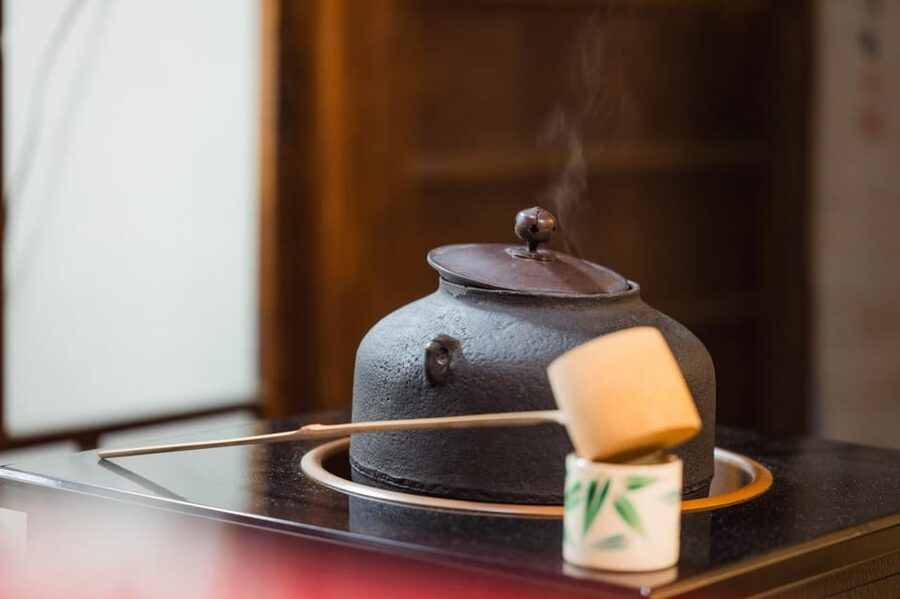
Next comes the demonstration. Watch how the host handles the tea bowl, scoop, whisk, and other utensils. Small gestures matter here, and the English explanations help you notice details that would otherwise pass quickly.
You then receive traditional sweets with the tea. The sweets are not just a snack. Their sweetness balances the bitter edge of matcha and prepares your palate for the drink. The presentation gives you a chance to practice how to receive and enjoy the tea in the proper order.
The chair seating makes this portion much easier for most people. You can sit comfortably while watching the host and then repeat the movements yourself. It is a practical choice for couples, families, and anyone who wants cultural instruction without the physical challenge of floor seating.
Other tea rooms and ceremonies in Kyoto:
- Kimono Tea Ceremony at Kyoto Maikoya, NISHIKI
★ 5.0 · 911 reviews - Kyoto: Arashiyama Bamboo Forest, Monkeys, Matcha & Temple Tour
★ 5.0 · 759 reviews - Kyoto: Tea Museum Tickets and Matcha Grinding Experience
★ 4.9 · 739 reviews - Kyoto: Kimono Tea Ceremony at Orizuruya Gion
★ 4.9 · 618 reviews
Whisking your own creamy matcha
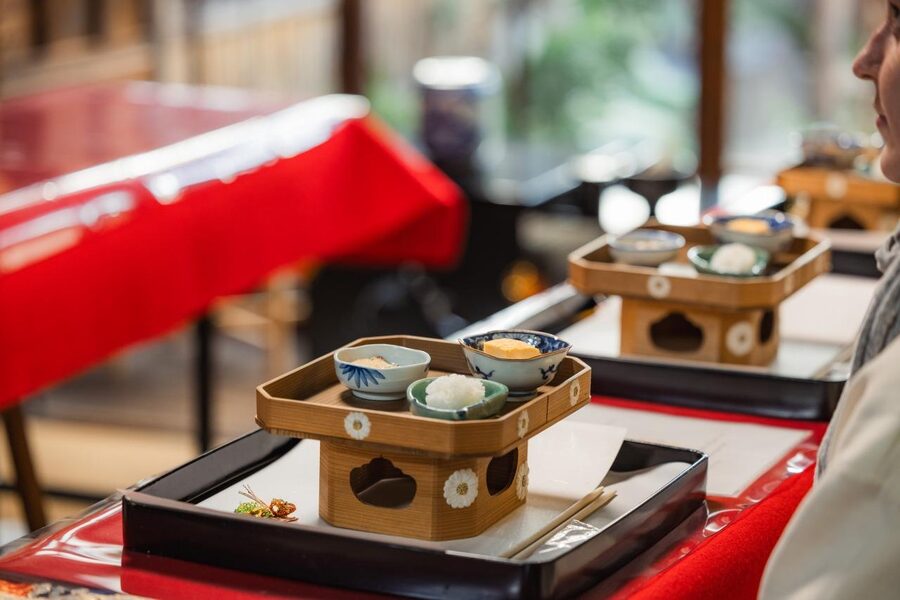
The most satisfying hands-on part is making your own matcha. You use a bamboo whisk to combine powdered tea with hot water until the surface becomes light and foamy.
Do not expect a sweet green-tea latte. Traditional matcha has a strong, grassy taste and can be bitter if you are new to it. The sweets help, and preparing the drink yourself makes the flavor easier to understand.
The hosts show you how to hold the whisk and create the froth. You do not need previous experience. The activity is simple enough for children and teenagers, but precise enough to give adults a sense of the care behind the drink.
A latte-art element using thick tea is also included. This adds a playful touch to the formal lesson and gives you another photographable moment. If you enjoy Japanese tea, you may also be able to purchase matcha powder at the end, though shopping is not the main purpose of the visit.
Calligraphy, flower arranging, and photo time
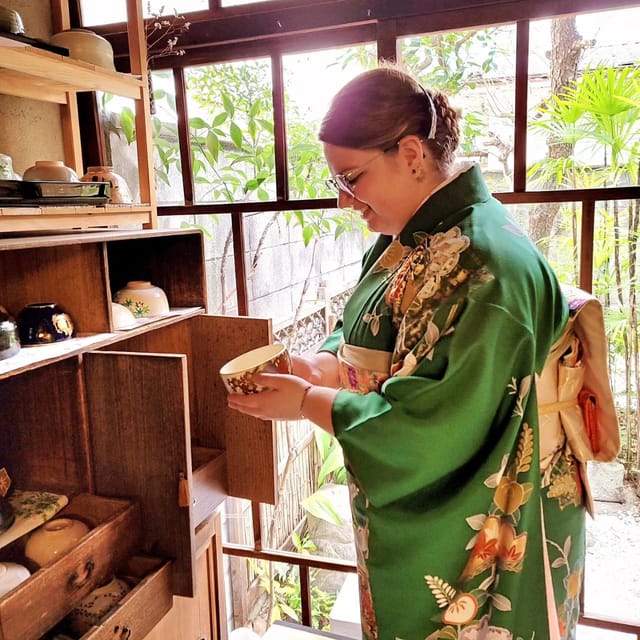
The program offers more than a single cup of tea. You write your name in Japanese, using kanji or hiragana, and in some sessions participants practice several Japanese writing styles. A host helps you choose the characters and form them on paper.
You receive a hanging scroll or envelope with your name written in Japanese kanji or hiragana. This is a useful keepsake because it connects directly to what you learned rather than being a generic souvenir.
Flower arranging, or ikebana, adds another traditional skill. The activity is short, but it shows how Japanese aesthetics can focus on placement, balance, and space. You do not need to treat it as a formal ikebana course. Think of it as a compact introduction that rounds out the tea lesson.
There is also plenty of time for photos. The house and garden provide a better backdrop than a plain activity room, especially if you have chosen the kimono option. Umbrellas, folding fans, and katana swords are available as props.
Use the props with some restraint. The best pictures will likely include the garden, the townhouse details, and the kimono itself, rather than every available object in one frame. The hosts are happy to help with photos, and their warm manner is one of the most consistently praised parts of the experience.
Why the hosts matter
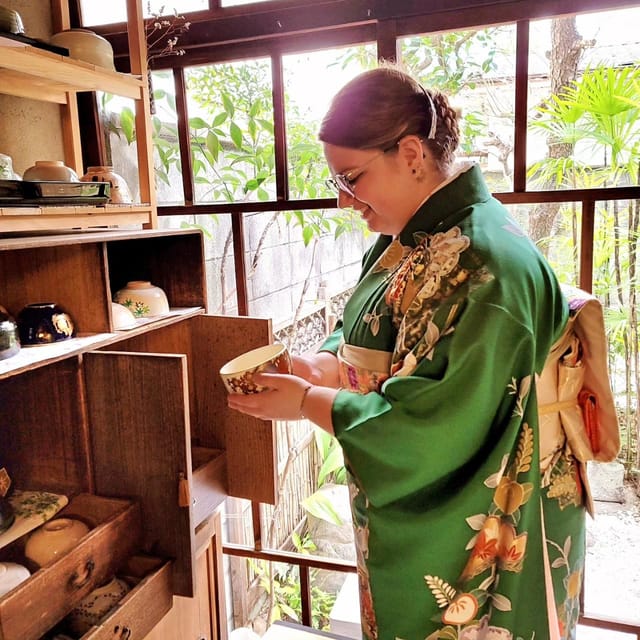
The people running the session shape the mood. The hosts are Japanese women who wear kimono and guide you through the ceremony in English. Their style is patient and practical. They explain the reason behind each task, help with clothing, and adjust their pace when someone needs extra help.
English is the main language, and the explanations are designed for beginners. One session was also offered in French, but English is the stated language, so do not book expecting a guaranteed French-language program.
The hosts also share suggestions for the area after the ceremony. That is useful in Fushimi, where a short visit can easily become a half-day plan involving sake shops, restaurants, the shopping arcade, or nearby sights.
The small-group and private formats are worth considering. A small group gives you a social atmosphere while still leaving room for questions. A private booking may suit couples, families, or anyone who wants more control over the pace and photos. Availability depends on the date and selected option.
Is $45 good value?
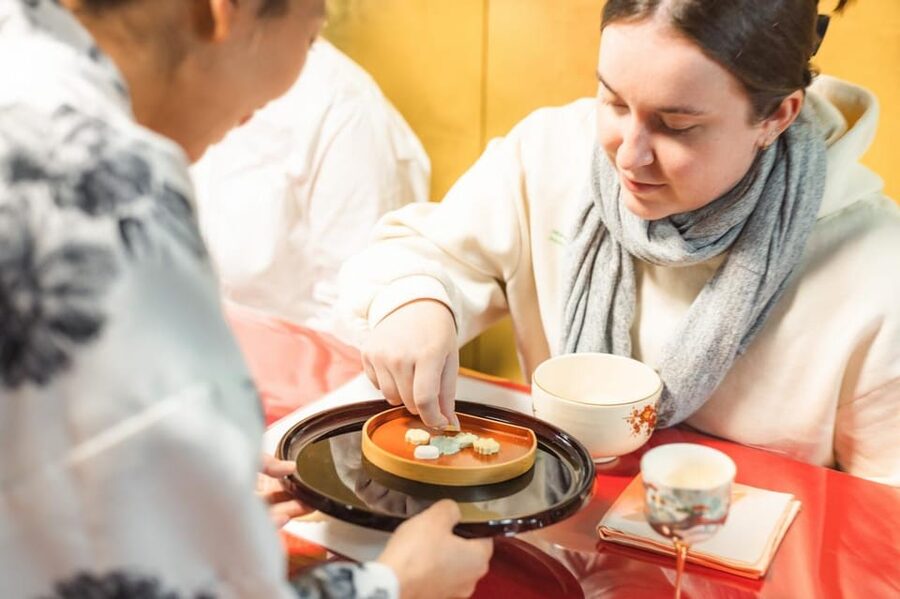
At $45 per person, the base experience is priced well for Kyoto. You receive a 90-minute activity in a historic townhouse, a welcome drink, traditional sweets, a tea demonstration, your own matcha preparation, calligraphy, a Japanese name keepsake, flower arranging, and time for photographs.
The value comes from the variety. A short tea ceremony alone might suit someone seeking a formal ritual, but this program gives you several ways to take part. You are not simply watching a host prepare tea.
The kimono option changes the calculation. It costs extra, requires arriving 30 minutes early, and adds dressing, styling, and more photo time. For many people, that will be worth it because the clothing becomes part of the lesson and gives the visit a stronger sense of occasion. If you are mainly interested in learning about matcha, the base option should be enough.
The experience is also a good use of time for a family. Children and teenagers can whisk tea, write their names, arrange flowers, and take photos rather than sitting through a long lecture. Adults who care about Japanese customs will appreciate the explanations and the chance to ask questions.
How to fit it into a Kyoto day
Plan this as part of a southern Kyoto day rather than as a quick detour from central sights. You could visit Fushimi Inari before the appointment, continue to the townhouse, then eat in the Fushimi sake district.
Uji is another good pairing. It takes about 20 minutes by train and is known for tea. You can place the ceremony before or after Uji, depending on your starting point and booking time.
The train connections also make this activity useful beyond Kyoto. Osaka is about 40 minutes away by express train, and Nara takes about 50 minutes. Those times make the area well connected, but do not treat them as a reason to rush the ceremony. Allow extra time for walking, finding the townhouse, and enjoying the neighborhood.
The 90-minute duration is enough for a satisfying introduction but not enough for a full study of tea ceremony. You leave with a taste of the customs, a practical understanding of matcha, and a few souvenirs. You will not become a tea master in one visit, and the program does not claim to make you one.
Who should book this experience
I would recommend it to first-time visitors who want Japanese culture explained in plain English. It suits couples looking for a memorable shared activity, families with older children, and anyone who wants photos in a traditional setting.
It is particularly useful if you are curious about kimono but do not want to commit to a full-day rental. The optional clothing gives you the visual experience while keeping the main program short.
I would also choose it if floor seating worries you. Chair-based seating removes a physical barrier without stripping away the ceremony’s manners and structure.
You should think twice if you want a highly formal, silent tea-school session, or if you have limited mobility. Wheelchair users cannot take part, and the old townhouse includes stairs and traditional features. People with leg injuries may receive patient assistance, but the setting remains an old house rather than a fully accessible modern venue.
Should you book the Kyoto table-style tea ceremony?
Book it if you want a friendly, hands-on introduction to tea culture in a real old townhouse. The combination of chair seating, English instruction, matcha preparation, calligraphy, flower arranging, sweets, and optional kimono rental gives you more to do than a basic tea demonstration.
I would choose the kimono option for a special occasion, a couple’s activity, or a family photo day. I would choose the base option if your schedule is tight or your main goal is to learn how matcha is prepared.
The only serious cautions are the out-of-center location and the lack of wheelchair suitability. For most able-bodied visitors, Fushimi’s train access and sake-town setting make the extra ride worthwhile.
FAQ
How long does the tea ceremony last?
The experience lasts 90 minutes. If you select the kimono option, arrive 30 minutes before the scheduled start.
Is the tea ceremony performed on the floor?
No. This experience uses tables and chairs, so you do not need to kneel or sit on the floor.
What is included in the $45 price?
The base experience includes the tea ceremony, traditional sweets, a welcome drink, thick-tea latte art, calligraphy, a hanging scroll or envelope with your name in Japanese, and flower arranging.
Is kimono rental included?
Kimono rental is available only if you select that option. It is not included in the base experience, and you should arrive 30 minutes early when booking it.
Is the activity offered in English?
Yes. English is the stated language, and the hosts explain the ceremony, manners, and activities in English.
Where does the experience take place?
It takes place in a more than 100-year-old traditional townhouse in southern Kyoto, near the Otesuji shopping arcade in the Fushimi area.
How do I reach the townhouse?
From Kintetsu Kyoto Station, take an express train to Kintetsu Momoyama-Goryo-mae Station. From Keihan Gion-Shijo, get off at Fushimi-Momoyama Station. Walk along Otesuji shopping arcade, turn right near Mizuho Bank or the Rakuten mobile shop, and look for the townhouse with a blue curtain.
Can wheelchair users join?
No. The activity is not suitable for wheelchair users.
Can I cancel the booking?
You can cancel up to 24 hours in advance for a full refund. A reserve-now, pay-later option is also available.
Just added in Kyoto
- Kyoto: Private Photoshoot Service★ 5.0 · 158 reviews
- Kyoto Rickshaw Tour★ 5.0 · 210 reviews
- Izakaya Style Cooking Class★ 5.0 · 219 reviews
- Kyoto: Traditional Concert at Townhouse or Bathhouse★ 4.9 · 224 reviews
- Ninja 2-hour Hands-on Lesson by Japanese master in Kyoto -Medium★ 5.0 · 218 reviews
- Kyoto: Arashiyama Bamboo, Temple, Matcha, Monkeys & secret spots★ 5.0 · 219 reviews
- Kyoto: Gion & Pontocho Food Tour with 13 Dishes★ 4.9 · 235 reviews
- Kyoto: Afternoon Japanese Izakaya Cooking Class★ 4.9 · 241 reviews
Tea Ceremony Experiences, compared.
Tea Ceremony in a Traditional Tea House in Kiyomizu
Read our review →
World Heritage Kyoto & Nara Uji Authentic Matcha Experience
Read our review →
Arashiyama Bamboo Forest, Monkeys, Matcha & Temple Tour
Read our review →
Browse the lists this tour appears in