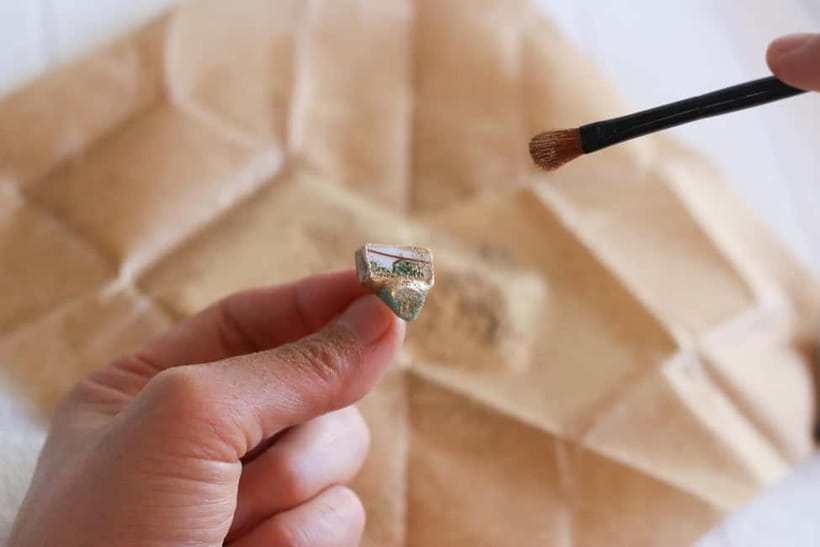
Reviewed · TOURS IN KYOTO
Kyoto: Kintsugi Jewelry Workshop with Natural Stones
Broken pottery becomes wearable art in this 150-minute kintsugi workshop near Fushimi Inari Taisha. In a 100-year-old Kyoto townhouse, instructor Natsuka shows you how to combine Japanese pottery fragments, natural stones, and gold powder into jewelry you can take home the same day.
I like two things especially: you choose every visible part of your pieces, and the small group, capped at 10, gives you time for calm, personal help. The selection includes pottery from several Japanese regions, plus shells, pearls, stained glass, and colorful stones.
The main consideration is that this is a hands-on craft class, not a quick souvenir stop. You need patience for the design and finishing work, and the atelier is not suitable for wheelchair users.
Key points to know before booking
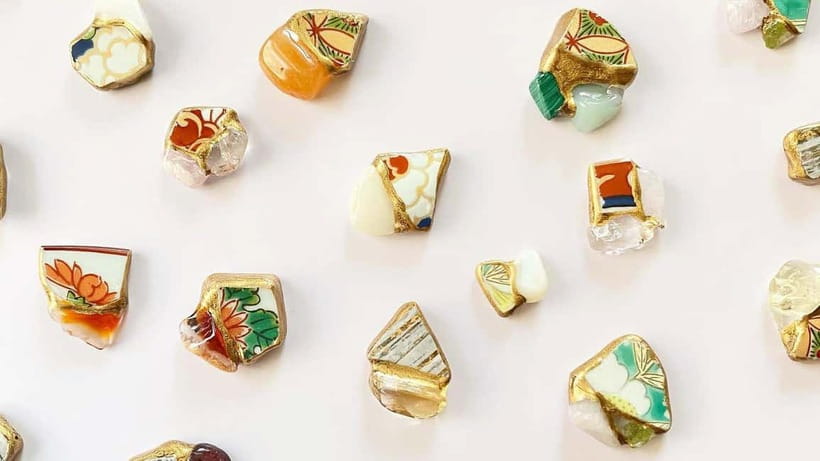
- Make two jewelry pieces: Several participants specifically appreciated being able to create a couple of finished items for the $106 fee.
- Work with Japanese pottery fragments: Choose from Arita, Karatsu, Oribe, Kyoto, Shigaraki, and Hagi ceramics, each with its own colors and patterns.
- Meet instructor Natsuka: She teaches in English or Japanese and guides you through each stage at an unhurried pace.
- A quiet break near Fushimi Inari: The atelier is about a three-minute walk from Fushimi Inari Taisha, yet the workshop itself takes place in a peaceful traditional home.
- Pick your own jewelry format: Options include earrings, rings, necklaces, brooches, tie pins, cufflinks, and more.
- Bring home the finished work: You can take your handmade jewelry with you on the same day.
Making kintsugi personal in a Kyoto townhouse
Kintsugi is the Japanese art of repairing broken ceramics with lacquer and gold. Instead of hiding a crack, the technique gives it a visible new life. This workshop adapts that idea into jewelry, so you are not repairing a full bowl or plate. You are turning small pieces of damaged pottery into something wearable.
That change makes the craft approachable. You do not need prior experience with ceramics or jewelry. Natsuka explains the process step by step, then gives you room to decide what your piece should look like.
The setting adds much of the charm. You enter a traditional one-story Kyoto house with a white noren, or entrance curtain, hanging at the front. The workshop is not held in a slick design studio. It takes place in a home and atelier with roughly a century of local character, which gives the activity a more intimate feel than a large craft center.
I would plan this as a slower afternoon rather than something to squeeze between several major sights. The work involves looking closely, comparing small fragments, and making choices. That pace is part of the appeal, especially after a morning of temples, trains, and crowds.
Other experiences people book in Kyoto:
- PERFECT KYOTO 1-Day Bus Tour
★ 5.0 · 13,518 reviews - Kyoto: Fushimi Inari, Kinkakuji, Bamboo Grove 1 Day Bus Tour
★ 4.8 · 4,316 reviews - Kyoto: Tea Ceremony in a Traditional Tea House in Kiyomizu
★ 4.9 · 3,519 reviews
Getting to the atelier from Fushimi Inari
The workshop is easy to pair with Fushimi Inari Taisha. It is about a three-minute walk from the shrine and about five minutes on foot from either Keihan Ryukoku Daimae-Fukakusa Station or JR Inari Station.
For most visitors, JR Inari Station is the clearest landmark because it sits directly by Fushimi Inari. Keihan Ryukoku Daimae-Fukakusa Station gives you another useful option if you are coming from the Keihan line.
Use the supplied photo map carefully on the final approach. The atelier is on a narrow alley, and there is no parking. Cars cannot comfortably use the street in front, so driving is a poor choice even if you are carrying luggage or shopping bags.
Look for the traditional house with the white entrance curtain. That detail matters because the approach is not described as a large commercial storefront. Give yourself a few extra minutes to find the door, especially if you are arriving directly from the shrine.
Choosing pottery from six Japanese traditions
The first creative decision is the pottery. You can choose from fragments associated with Arita, Karatsu, Oribe, Kyoto, Shigaraki, and Hagi. You are not simply picking a random colored chip. You are selecting a small piece of Japanese ceramic tradition to become part of your jewelry.
Arita pottery is known in Japan for its long porcelain tradition. Karatsu is associated with a more earthy ceramic style. Oribe often brings strong green color and bold decoration. Kyoto pottery can offer a more refined local connection, while Shigaraki and Hagi are well known for their distinctive clay and glaze qualities.
You do not need to arrive with a ceramics background. The point is to see how shape, color, surface, and gold will work together. A fragment that looks plain on its own may become the right center for a brooch. Another piece might work better beside a blue stone or a pale pearl.
The selection also includes stained glass, natural stones, shells, and pearls. This gives you more control than a standard pottery-painting class. You can make something subdued and simple, or combine several colors for a bolder piece.
Take your time here. The first choice can feel like the hardest part because there are many possible combinations. Natsuka helps explain the materials and gives you time to design instead of pushing you toward a preset pattern.
How the 150-minute workshop unfolds
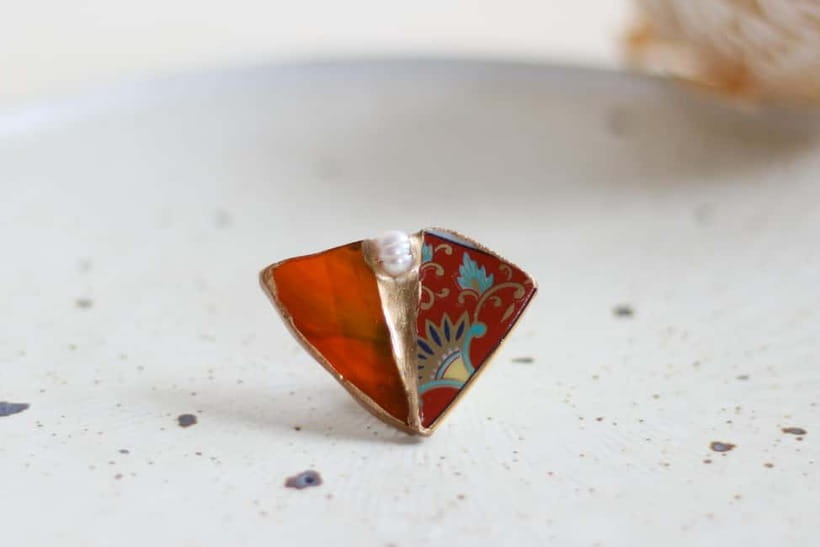
The class begins with an explanation of kintsugi and its place in Japanese culture. You learn about the idea of giving broken objects a second life, along with the related Japanese concept of wabi-sabi, which finds beauty in imperfection, age, and change.
That background gives the craft more meaning. You are not just gluing a ceramic piece onto a pin or earring. You are working with an idea that values the marks left by damage. The gold accent makes the break part of the design rather than something to disguise.
Next comes the design stage. You choose your pottery fragments and pair them with stones, shells, pearls, or stained glass. You also select the type of accessory you want to make. Options include earrings, rings, necklaces, brooches, tie pins, and cufflinks.
The exact number of pieces can depend on your pace and design choices, but the experience information and participant feedback indicate that making two jewelry pieces is a common part of the session. That makes the price easier to assess. You are not paying for a single tiny object with little control over its appearance.
Natsuka then demonstrates the working method. The class uses synthetic lacquer rather than traditional lacquer. That choice is intended to avoid allergic reactions and makes the workshop more practical for an international group.
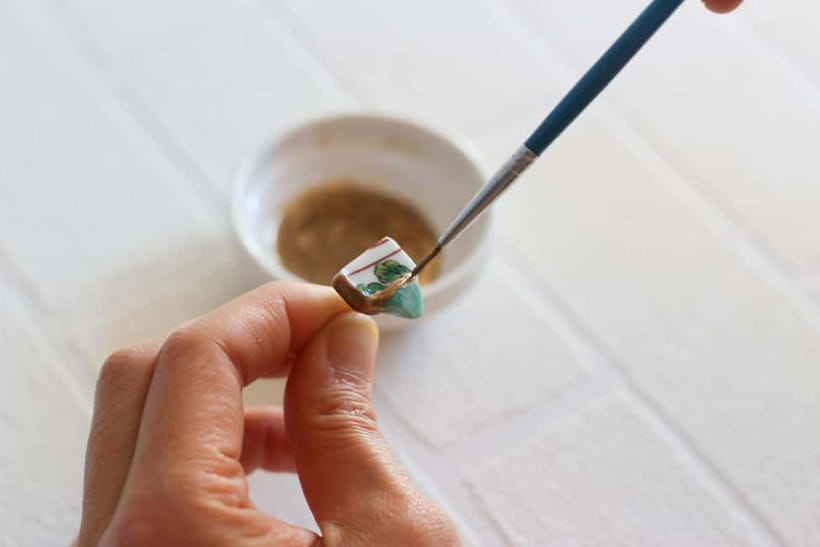
You apply the materials carefully, add the gold powder, and assemble the ceramic and decorative elements. This is precise work, but it is not presented as a high-pressure technical exam. The instructor provides direct help, and the small group means you should be able to ask for advice when a design is not coming together.
The final stage is seeing the completed jewelry as a finished object. You can take your creations home on the same day, so you do not need to return to the atelier later in your trip.
Same base, a different sort of day:
- Kyoto Geisha Walking Tour: Gion District & Hidden Gems
★ 4.7 · 3,273 reviews - Kyoto: Tea Ceremony Ju-An at Jotokuji Temple
★ 4.9 · 3,207 reviews - Kyoto: Gion Magical Night Walking Tour with Geisha Trivia
★ 4.9 · 2,393 reviews - Kyoto: 45-Minute Tea Ceremony Lesson Experience
★ 4.3 · 2,378 reviews
Why the small group matters
The group is limited to 10 people. That is small enough for the instructor to watch the work closely, but large enough to create a pleasant shared activity.
This matters because craft workshops can lose their appeal when the teacher is rushing between too many tables. Here, the format allows for step-by-step explanations and personal suggestions. Natsuka has been praised for being patient and calm, including with people who work slowly.
That last point is worth noting. You should not book this expecting to finish in a few minutes. The design stage may take longer than expected, especially if you are deciding between several pottery pieces or trying to match stones and colors.
The atmosphere is intended to be relaxed. Refreshments have been provided during the workshop, and the traditional home gives you a quiet place to sit and concentrate. Several participants used the session as a break from Kyoto sightseeing, including on a rainy day.
If you are traveling with a child, the activity may work well for an older, focused child. One participant completed it with an eight-year-old daughter and found the instructor patient and kind. The supplied information does not give a formal minimum age, so check the booking details if age is important for your family.
Understanding the $106 price
At $106 per person, this is not a bargain craft activity. The value comes from the combination of instruction, materials, setting, and finished jewelry.
You receive the workshop itself, synthetic lacquer and gold powder, access to pottery fragments and decorative materials, instructor assistance, and the ability to take home the finished pieces. The choice of accessory type also adds value. A brooch, pair of earrings, or cufflinks can feel more personal than a standard pre-made souvenir.
The cost makes more sense if you plan to create two pieces. It also helps that you are choosing the materials rather than receiving a fixed kit. The pottery has a direct connection to Japan, and the gold repair idea gives the finished jewelry a story you can explain when you give it as a gift.
Still, you should be honest about what you want. If you only want an inexpensive souvenir, a craft shop will cost less and take less time. If you want an activity that teaches you something and leaves you with handmade objects, the price is more reasonable.
I also like that the activity turns broken pottery into something useful. You are not buying a mass-produced trinket with a generic Kyoto label. Your piece will be shaped by the fragments and colors you select.
What makes the materials special
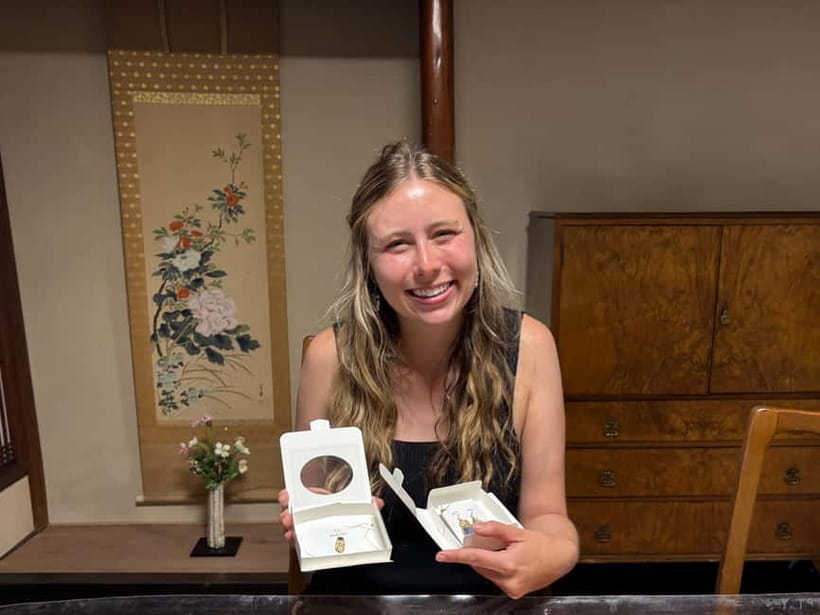
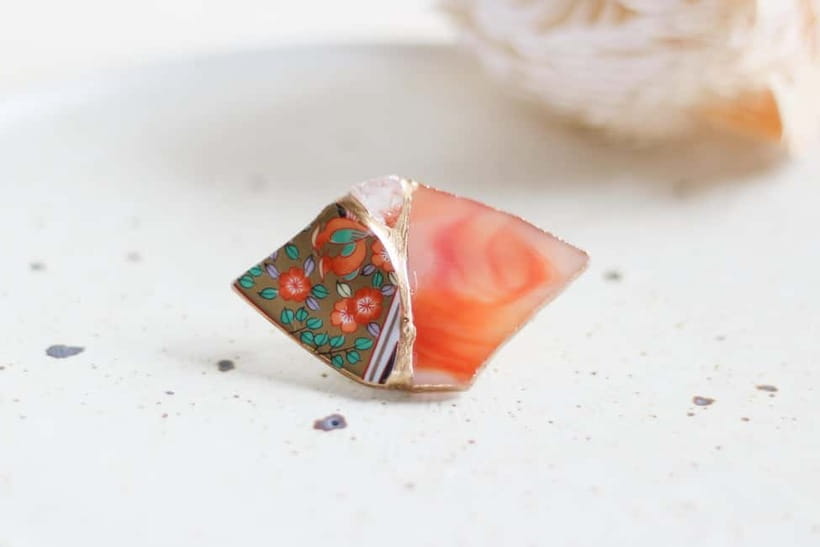
The pottery fragments are the heart of the workshop, but the supporting materials let you set the mood of the jewelry.
Natural stones can bring color and texture. Pearls offer a softer, classic look. Shells can give a lighter coastal feel, while stained glass can add a brighter, more graphic accent. Gold powder ties the parts together and makes the repaired edge visible.
The best designs may not be the most elaborate. A single ceramic shard with one carefully chosen stone can look more balanced than a piece crowded with every available material. Natsuka gives you guidance, but the final call is yours.
This is also a good activity for people who enjoy meaningful souvenirs. The pottery fragment may come from a Japanese ceramic tradition, the gold line reflects kintsugi, and the finished shape records the choices you made in Kyoto. That is more personal than simply picking up a magnet at the end of the day.
English instruction and the pace of the class
Instruction is available in English and Japanese. The information provided about the class describes clear demonstrations and step-by-step guidance, and Natsuka is the named instructor associated with the experience.
You should still expect a practical craft lesson rather than a long academic lecture. The cultural explanation covers kintsugi, Japanese pottery, the source regions of the ceramics, and wabi-sabi, then connects those ideas to the work in front of you.
The pace is one of the strongest reasons to book. Natsuka has allowed extra time when participants needed it, rather than forcing everyone to finish quickly. That is useful if you are nervous about making the wrong choice or have limited craft experience.
The tradeoff is that a careful session may run longer than the listed 150 minutes. One participant described receiving almost twice the scheduled time because the group worked slowly. Do not schedule a train departure or restaurant reservation immediately afterward.
Pairing the workshop with Fushimi Inari
The location makes this easy to add to a day in southern Kyoto. Fushimi Inari Taisha is only about three minutes away, so you can visit the shrine before or after the class.
The two experiences have very different energy. Fushimi Inari is famous for its long rows of orange torii gates and can be very busy near the main entrance. The workshop gives you a quiet place to sit and work with your hands.
You could visit the shrine first, then walk to the atelier for a late morning or afternoon session. Or take the class before visiting the shrine, when your jewelry design is still fresh in your mind. Check the available starting times when booking, since the exact schedule is not fixed in the information provided.
I would avoid treating the workshop as a filler activity between sights. The class deserves your attention, and you will enjoy it more if you arrive without rushing from across the city.
Who will enjoy this most
This is a strong choice for you if you like hands-on activities, Japanese design, small-group classes, or souvenirs with a personal story. It suits couples, friends, solo visitors, and families with children who can focus on careful craft work.
It is also a good rainy-day plan. Much of the experience takes place indoors, and the calm setting gives you something useful to do when outdoor sightseeing is less pleasant.
You may want to skip it if you dislike making design decisions, have very little free time, or want a quick activity with a guaranteed identical result. The handmade nature means your pieces will reflect your choices, and that also means they may not look exactly like a professional jeweler’s work.
The atelier is not suitable for wheelchair users. There is no parking, and the narrow alley makes vehicle access impractical.
Cancellation and planning details
You can cancel up to 24 hours in advance for a full refund. The reserve-now, pay-later option also keeps your plans flexible, which is useful when your Kyoto schedule is still changing.
The activity lasts 150 minutes, and group size is limited to 10. Materials and instructor assistance are included, so you do not need to arrange anything special beyond getting to the atelier.
Wear something that lets you sit comfortably and concentrate. The supplied information does not list a dress code, but this is a careful, hands-on activity rather than a sightseeing stop.
Should you book the kintsugi jewelry workshop?
Book it if you want two personal souvenirs, a calm cultural activity, and a chance to learn from Natsuka in a traditional Kyoto home. The pottery choices, natural stones, and accessory formats give you real creative control, while the small group keeps the lesson friendly and manageable.
The $106 price is best justified by the instruction and the finished pieces, not by the length alone. If you value handmade objects and want a break from shrine-hopping, I think it is a worthwhile Kyoto experience.
Skip it if your priority is the lowest-cost souvenir or if your schedule has no room for a slow, creative afternoon. For everyone else, this is a thoughtful way to connect a familiar Japanese craft with something you can wear long after leaving Kyoto.
FAQ
Where does the kintsugi jewelry workshop take place?
It takes place in a 100-year-old traditional Kyoto townhouse near Fushimi Inari Taisha.
How close is the atelier to Fushimi Inari Taisha?
The atelier is about a three-minute walk from Fushimi Inari Taisha.
How do I reach the workshop by train?
It is about a five-minute walk from Keihan Ryukoku Daimae-Fukakusa Station or JR Inari Station.
Is parking available at the atelier?
No. There is no parking, and the narrow street in front of the atelier is not suitable for vehicles.
How long does the workshop last?
The scheduled duration is 150 minutes.
What languages does the instructor speak?
Instruction is available in English and Japanese.
How many people can join the workshop?
It is a small-group activity limited to 10 participants.
What types of jewelry can I make?
Options include earrings, rings, necklaces, brooches, tie pins, cufflinks, and other accessory types.
What materials can I use?
You can choose from pottery shards, natural stones, shells, pearls, stained glass, synthetic lacquer, and gold powder. Pottery options include Arita, Karatsu, Oribe, Kyoto, Shigaraki, and Hagi.
Can I take my jewelry home after the class?
Yes. You can take your finished creations home on the same day.
Just added in Kyoto
- Private Cooking Class Udon in Kyoto Japan★ 5.0 · 23 reviews
- Your Private Vacation Photography Session In Kyoto★ 5.0 · 110 reviews
- Kyoto: Zen Meditation at a Private Temple with a Monk★ 5.0 · 25 reviews
- Private Pewter Sake Cup Experience with a Kyoto Artisan★ 5.0 · 31 reviews
- Kyoto Wagashi(Japanese sweets) Cooking Class near Fushimiinari★ 5.0 · 60 reviews
- Kyoto:Family-Friendly Kimono & Yukata Experience at WARGO★ 5.0 · 147 reviews
- Private Guided Traditional Buddhist Cooking in Japan★ 5.0 · 16 reviews
- Kyoto: Gion Geisha District & Sake-in-Hand Walking Tour★ 5.0 · 37 reviews
Tours in Kyoto, compared.
Tea Ceremony in a Traditional Tea House in Kiyomizu
Read our review →
Kyoto Geisha Walking Tour: Gion District & Hidden Gems
Read our review →

Gion Geisha District Walking Tour – Stories of Geisha
Read our review →
Best of Kyoto: Gion, Geisha, Pagodas & Cobblestones
Read our review →