
Reviewed · TOURS IN KYOTO
Kyoto Morning Tour from Kyoto or Osaka
Kyoto packs centuries of power, religion, and fine design into a surprisingly small area. This morning bus tour gives you a quick look at three major sights: Nijo Castle, the Golden Pavilion, and the former Imperial Palace. It is a smart way to get your bearings if your Kyoto visit is short or you are making a day trip from Osaka.
I like two things here. First, the air-conditioned bus saves you from piecing together several city connections. Second, the tour gives you useful historical context, from the Tokugawa shoguns at Nijo Castle to the emperor’s former home. The main catch is pace: you get a sampler, not a lingering visit, and substitute sights may be used when the palace or castle is closed.
Key points to know before booking
- Three major Kyoto sights in one morning: Visit Nijo Castle, Kinkakuji Temple, and Kyoto Imperial Palace in about 4 hours and 40 minutes.
- Comfortable transport between stops: An air-conditioned vehicle handles the longer hops across the city.
- A guide adds historical context: Guides such as KC, Casey, Jun, Jessie, and Mr. Harada have been praised for clear explanations, humor, and good group management.
- The Imperial Palace is not guaranteed: On closure days, the tour substitutes Kitano Tenmangu Shrine or, on the 25th, Nishi Hongan-ji Temple.
- The meeting point needs care: Departure and return are at Kyoto Avanti, across from Kyoto Station’s Hachijo Exit.
- The pace is brisk: Expect walking, uneven rocky steps at Kinkakuji, and limited time to pause at each place.
A fast introduction to Kyoto’s power and beauty
This is the kind of tour I would choose when I had one morning in Kyoto and wanted more than a single temple. It links a shogun’s castle, a famous Zen temple, and the former imperial compound, three places that show very different sides of Japanese history.
The order may change because of traffic, crowd levels, or site conditions. You should also expect a group of up to 40 people, so this is not a quiet private outing. The bus keeps the day practical, but the group can make listening harder in crowded courtyards.
The tour includes admission fees and transport, which helps explain the price of $87.19 per person. You are paying for convenience, a guide, and a carefully linked morning rather than simply for entry to three sites. If you already know Kyoto well and are comfortable using public transport, you may get more time at each place on your own. If this is your first visit, the saved planning time has real value.
The tour begins and ends at Kyoto Avanti, in front of the building across from Kyoto Station’s Hachijo Exit. This is convenient for a Kyoto base and workable for an Osaka day trip, but there is an important limitation: the tour does not include your return transportation from Kyoto to Osaka. Plan that separately.
Other experiences people book in Kyoto:
- PERFECT KYOTO 1-Day Bus Tour
★ 5.0 · 13,518 reviews - Kyoto: Fushimi Inari, Kinkakuji, Bamboo Grove 1 Day Bus Tour
★ 4.8 · 4,316 reviews - Kyoto: Tea Ceremony in a Traditional Tea House in Kiyomizu
★ 4.9 · 3,519 reviews
Nijo Castle: where the shogun displayed his power
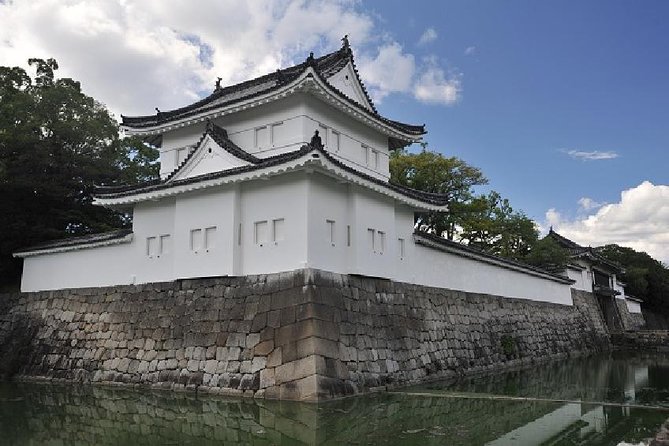
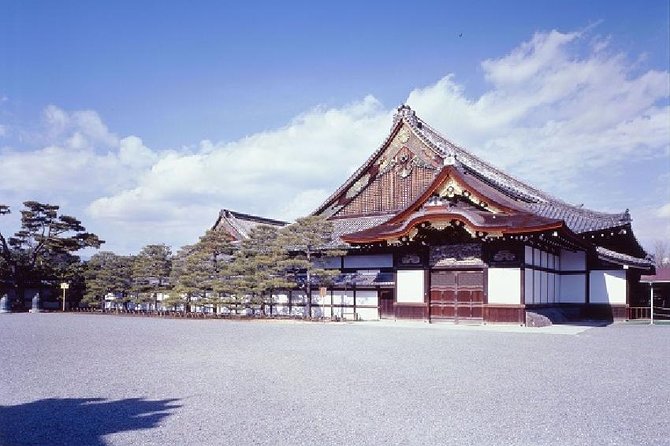
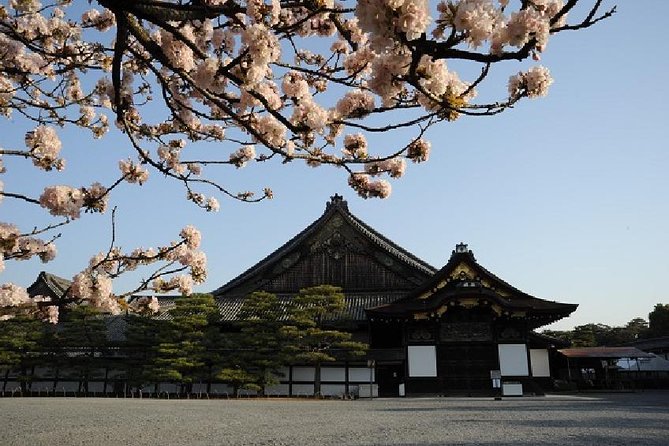
The first stop is Nijo Castle, built in 1603 on the orders of Tokugawa Ieyasu, founder of the Tokugawa shogunate. The castle is not simply a military fortification. It was also a stage for political theater, where the shogun could receive the emperor and display his authority.
You have about 50 minutes here, with admission included. The main prize is Ninomaru Palace, a connected group of cypress buildings decorated with elaborate carvings, painted panels, and gold leaf. The interiors were made to impress, and they still do.
The castle also includes gardens, a kitchen, and a guardhouse. These details help you picture the practical machinery behind court life. It was not all formal rooms and elegant screens. Servants, guards, cooks, and officials kept the place running.
The grounds are generally easier on the feet than Kinkakuji because much of the walking is on flatter surfaces. Still, 50 minutes passes quickly. You may need to stay with the guide’s route rather than wander every garden path.
This is one place where a strong guide makes a difference. A guide can explain why the castle’s design mattered, point out details that are easy to miss, and connect the building to the long Tokugawa period. Guides named KC, Casey, Jun, Jessie, and Mr. Harada have all been singled out for lively explanations, though your guide will depend on the departure date.
Kinkakuji: Kyoto’s famous golden image
Kinkakuji Temple, commonly called the Golden Pavilion, is the tour’s most instantly recognizable stop. The wooden pavilion is covered in thin layers of gold and reflected in a pond surrounded by carefully arranged gardens.
You get about 45 minutes here. That sounds reasonable until you account for the crowds and the one-way walking route. The path leads you around the grounds and includes uneven rocky steps, with a climb in parts. Wear shoes that are comfortable and secure, especially if you have already spent several days walking around Kyoto.
The pavilion itself is a viewing stop rather than a building you enter. The appeal comes from the contrast between the bright gold structure, the water, and the restrained garden design. It is a place where a few minutes of quiet looking can be rewarding, but busy conditions may make that difficult.
This is also the stop where the group system can matter most. Several tour groups may be nearby, and voices can overlap. Some people have found it hard to hear the guide in crowded areas, particularly when the guide is speaking without a working wireless headphone system. Stay close when the explanation begins, then take your own photographs and enjoy the view during the free time.
Kinkakuji is popular for good reason, but it can feel like a quick photograph stop on this schedule. If you want a slow garden visit, tea, or time to study every detail, you will need to return independently.
Kyoto Imperial Palace: quiet formality in the old capital
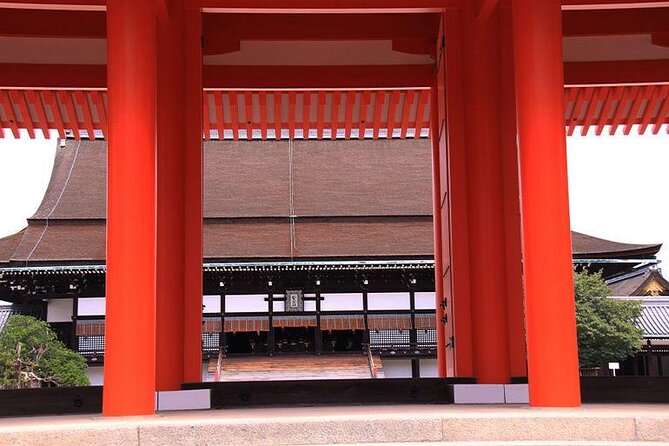
The final main stop is Kyoto Imperial Palace, used as the emperor’s residence until the capital moved to Tokyo in 1868. You will see the former site of imperial enthronement ceremonies and the restrained architecture associated with the court.
The scheduled visit lasts about 40 minutes. Compared with Nijo Castle, the palace can feel less ornate. Its strength is formality, proportion, and space rather than glittering decoration. The contrast is useful: Nijo Castle shows the shogun’s public power, while the palace represents the older imperial tradition.
The palace is not open to this tour every day. It is closed on Mondays, or on the following day when Monday is a public holiday, and it may close for Imperial Household Agency events. When that happens, the tour visits Kitano Tenmangu Shrine instead. If the closure falls on the 25th, the replacement is Nishi Hongan-ji Temple.
This arrangement is clearly important to understand before booking. The tour still operates when a scheduled site is closed, and refunds are not issued simply because a substitute destination is used. If seeing the Imperial Palace is your main reason for booking, check its opening status for your date and accept that special events can still change the plan.
One practical detail can surprise you. After the palace visit, the bus may stop at the lunch venue used by the full-day version of the tour before returning participants to Kyoto Station. Lunch is not included, and the brief stop is part of the larger operating schedule rather than a meal included with this morning experience.
Same base, a different sort of day:
- Kyoto Geisha Walking Tour: Gion District & Hidden Gems
★ 4.7 · 3,273 reviews - Kyoto: Tea Ceremony Ju-An at Jotokuji Temple
★ 4.9 · 3,207 reviews - Kyoto: Gion Magical Night Walking Tour with Geisha Trivia
★ 4.9 · 2,393 reviews - Kyoto: 45-Minute Tea Ceremony Lesson Experience
★ 4.3 · 2,378 reviews
What the bus ride adds, and what it cannot fix
Kyoto’s major sights are spread across different parts of the city. Moving by air-conditioned vehicle is the tour’s practical backbone. You avoid planning several train and bus connections, and you get a place to rest between visits.
That matters in warm or rainy weather, and it is helpful if you are traveling with children or managing tired feet. One parent described the pace as suitable for a three-year-old and a seven-year-old, with enough activity to keep the morning moving without spending too long at any one stop.
The tradeoff is less control. Road conditions and congestion can change arrival times, and seats may not be assigned. A full group also takes longer to gather at entrances and departure points. The vehicle may be comfortable, but the tour cannot remove Kyoto’s crowds.
The bus does not turn this into a door-to-door service. Hotel pickup and drop-off are not included. You must reach Kyoto Avanti yourself, and you must arrange your own onward trip from Kyoto to Osaka. An English-speaking assistant accompanies participants traveling from Hotel Granvia Osaka to the Sunrise Tours Desk in Kyoto Avanti’s basement, but that assistance applies to the outbound connection, not the trip back after the tour.
The guide can shape the whole morning
The strongest part of this experience is the human explanation. The sights are famous, but a short visit can otherwise become a series of attractive buildings with little connection between them.
A good guide links the shogun, emperor, temple, garden, and capital into one story. Several guides have been praised for being funny, organized, patient, and generous with photographs. Mr. Harada, KC, Casey, Jun, and Jessie are names associated with especially warm and energetic guiding, but guide assignments can vary.
English ability and delivery style will not be identical on every departure. Some people have found explanations easy to follow, while others felt the guide spoke too quickly or was difficult to hear in crowded spaces. This is more likely in open courtyards, where other groups may be speaking nearby.
You can improve the experience by staying near the guide during each explanation. Treat the moving bus as the main lecture space, then use the site time to look, take photos, and ask short questions. If you fall far behind, you may miss part of the commentary.
Walking, timing, and the reality of a half-day visit
The itinerary lists 50 minutes at Nijo Castle, 45 minutes at Kinkakuji, and 40 minutes at the Imperial Palace. That is enough to see the key areas, but not enough to explore at a relaxed museum pace.
You should expect a fair amount of walking. Nijo Castle and the Imperial Palace are mostly manageable for people who can walk normally, while Kinkakuji includes uneven rocky steps and a climb. Comfortable shoes matter more than stylish ones here.
The tour is suited to most people who can take part in ordinary sightseeing, but it is not designed around long independent pauses. Children can join free up to age five, though no bus seat is provided unless you book the child rate. Anyone under 18 needs written parental permission, and participants under 15, or not yet in middle school, must be accompanied by a parent or guardian.
The maximum group size is 40. That is large enough for crowd noise and a slower regrouping process, but small enough to keep the bus format manageable. Seats may not be designated, so do not build your plans around sitting in a particular place.
Is $87.19 a fair price?
At $87.19, this is not the cheapest way to see Kyoto. You are paying for a guide, three admission arrangements, and vehicle transport in one package. The value is strongest when you are short on time, visiting from Osaka, or would rather not manage Kyoto’s connections yourself.
The price makes less sense if you want long visits at each location or already have transport and entry plans in place. Nijo Castle, Kinkakuji, and the Imperial Palace are all places where a self-guided visit can give you more freedom to stop, sit, or change the order.
I see this as a time-saving purchase rather than a bargain admission ticket. The tour turns a complicated morning into one fixed route, with the added benefit of historical explanation. For a first look at Kyoto, that can be worth the premium.
The tour is often booked about 31 days ahead, so popular dates may fill. Confirmation is sent within 48 hours, subject to availability. Free cancellation is available up to 24 hours before the start time. After that point, the amount paid is not refunded, and late changes are not accepted.
Who should book this Kyoto morning tour?
I would recommend it to a first-time visitor who has only one morning, a family that wants simple transport, or someone making a day trip from Osaka. It also suits you if you want the major names checked off before spending the afternoon on your own.
I would be more cautious if the Imperial Palace is your single reason for booking. Confirm the palace schedule, then remember that closures and official events can trigger a substitute visit without a refund.
I would also skip it if your ideal Kyoto day means sitting quietly in a garden, taking slow photographs, or reading every sign. The pace is efficient, but it is not leisurely. You will see a lot, learn a fair amount, and leave with a useful first map of Kyoto, but you will not fully explore any one site.
For most short visits, that is the point. This tour gives you the city’s shogun, temple, and imperial story in one organized morning, then leaves the rest of the day open for your own discoveries.
FAQ
How long does the Kyoto morning tour last?
The tour lasts approximately 4 hours and 40 minutes.
What sights are included?
The main itinerary includes Nijo Castle, Kinkakuji Temple, also called the Golden Pavilion, and Kyoto Imperial Palace.
Are admission fees included?
Yes. Admission fees and transportation costs are included.
Is food included?
No. Food and drinks are not included.
Where does the tour begin?
The tour begins at Kyoto Avanti, at 31 Higashikujō Nishisannōchō, Minami Ward, Kyoto. It is across from Kyoto Station’s Hachijo Exit.
Where does the tour end?
The tour ends in front of Kyoto Avanti, across from Kyoto Station’s Hachijo Exit.
Does the tour include transportation back to Osaka?
No. The tour ends in Kyoto and does not include return transportation expenses from Kyoto to Osaka.
What happens if Kyoto Imperial Palace is closed?
The tour visits Kitano Tenmangu Shrine instead. If the closure falls on the 25th, the substitute is Nishi Hongan-ji Temple.
What happens if Nijo Castle is closed?
If Nijo Castle is closed, the tour visits Ryoan-ji Temple instead.
Can children join the tour?
Children up to age five may join free, but they do not receive a bus seat unless you book the child rate. Written parental permission is required for participants under 18.
Just added in Kyoto
- Kyoto: Private Photoshoot Service★ 5.0 · 158 reviews
- Kyoto Rickshaw Tour★ 5.0 · 210 reviews
- Kyoto: Arashiyama Bamboo, Temple, Matcha, Monkeys & secret spots★ 5.0 · 219 reviews
- Izakaya Style Cooking Class★ 5.0 · 219 reviews
- Kyoto: Traditional Concert at Townhouse or Bathhouse★ 4.9 · 224 reviews
- Ninja 2-hour Hands-on Lesson by Japanese master in Kyoto -Medium★ 5.0 · 218 reviews
- Samurai Training with Modern day Musashi in Kyoto★ 5.0 · 256 reviews
- Kyoto: Kimono Tea Ceremony with Matcha and Sweet★ 4.9 · 249 reviews
Tours in Kyoto, compared.
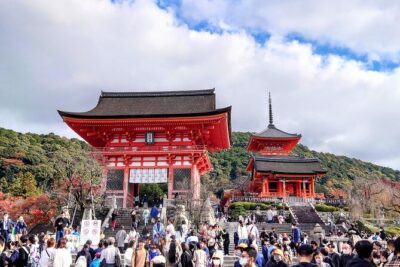
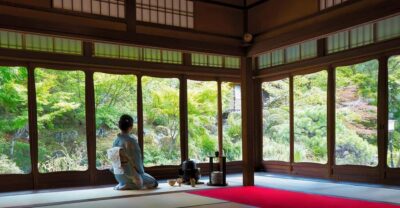
Tea Ceremony in a Traditional Tea House in Kiyomizu
Read our review →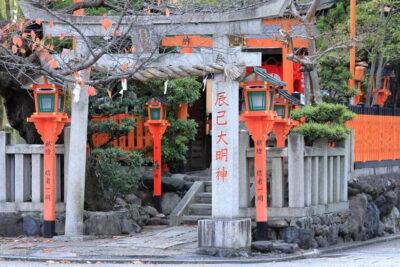
Kyoto Geisha Walking Tour: Gion District & Hidden Gems
Read our review →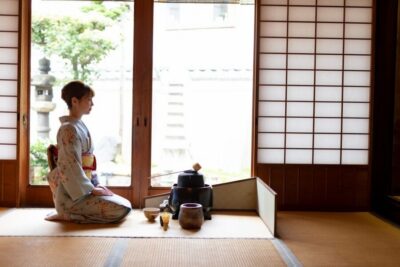
Gion Geisha District Walking Tour – Stories of Geisha
Read our review →
Best of Kyoto: Gion, Geisha, Pagodas & Cobblestones
Read our review →
Browse the lists this tour appears in