
Reviewed · TOURS IN KYOTO
Kyoto: Traditional Concert at Townhouse or Bathhouse
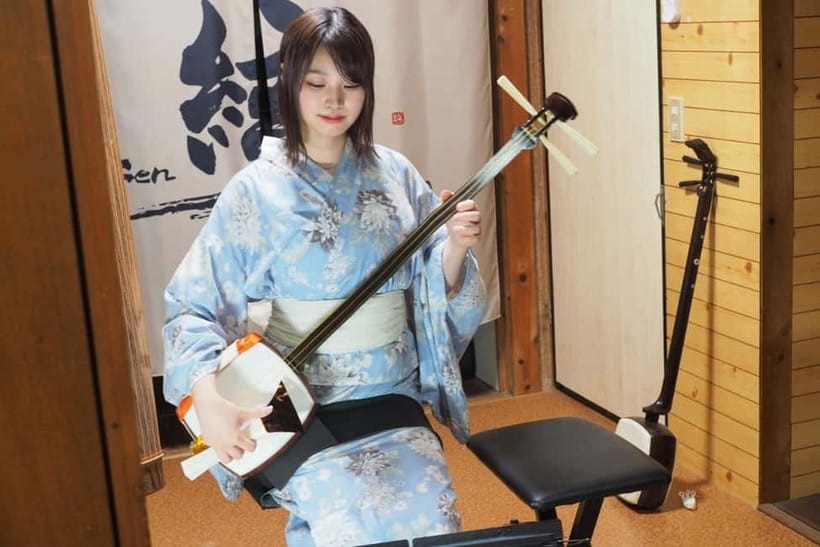
Kyoto’s traditional music is at its best when you can hear each plucked note clearly. This $32 experience puts you close to professional koto and shamisen players in either a tiny traditional townhouse or a former bathhouse hall, with only about 11 people in the smaller setting and about 30 in the larger one.
I like the personal scale and the bilingual explanations. You learn how the instruments work, why the music sounds as it does, and what the performers are playing. I also like the optional koto workshop, where even a complete beginner can sit down, use a pick, and play a short phrase.
The main thing to consider is the choice of venue. The townhouse is offered almost every day but has limited space and a less dramatic acoustic. The bathhouse hall offers fuller sound and duets, yet its concerts are held irregularly on Mondays. Finding the townhouse may also take patience, so allow time to get there.
Key points to know before booking
- Two very different venues: Pick the intimate townhouse for a small solo concert, or the tiled bathhouse hall for resonant duets.
- A real introduction to the instruments: Gen and the English-speaking hosts explain the koto, shamisen, bridges, picks, strings, and Japanese notation.
- Four or five pieces: Expect a mix of classical, contemporary, and original works, with short commentary between selections.
- The workshop is townhouse-only: Add 35 to 40 minutes to try basic koto techniques and play a short melody.
- Small groups make questions easy: There is time for Q&A, photos, and conversation with the musicians.
- Good value at $32: You get a live concert, bilingual cultural background, and a personal meeting with the performers.
A quiet musical hour away from Kyoto’s crowds
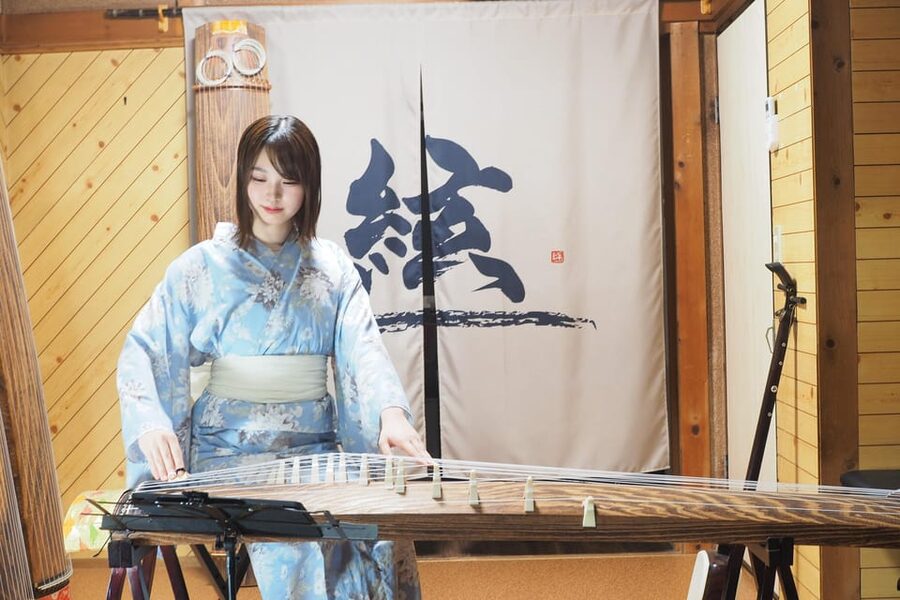
Many Kyoto activities ask you to look at old buildings. This one asks you to listen. A koto’s long strings can sound delicate and bright, while the shamisen has a sharper, more percussive voice. In a small room, you hear the fingers, picks, pauses, and changes in pressure that can disappear in a large concert hall.
The program is made for people who know little about Japanese music. You do not need to recognize a mode, read Japanese notation, or understand the long tradition behind each instrument. The introduction gives you enough background to listen with purpose without turning the event into a lecture.
The performance usually includes four or five pieces. The exact program changes with the musician and season, but it can move from Japanese classical music to contemporary arrangements and original compositions. Sample titles include Kajimakura, Chidorino Kyoku, and Kaede no Hana.
Some musicians also sing. That adds another color to the koto and shamisen, especially in the townhouse programs. The combination can be calm one moment and surprisingly forceful the next.
Other experiences people book in Kyoto:
- PERFECT KYOTO 1-Day Bus Tour
★ 5.0 · 13,518 reviews - Kyoto: Fushimi Inari, Kinkakuji, Bamboo Grove 1 Day Bus Tour
★ 4.8 · 4,316 reviews - Kyoto: Tea Ceremony in a Traditional Tea House in Kiyomizu
★ 4.9 · 3,519 reviews
The traditional townhouse: the best choice for intimacy
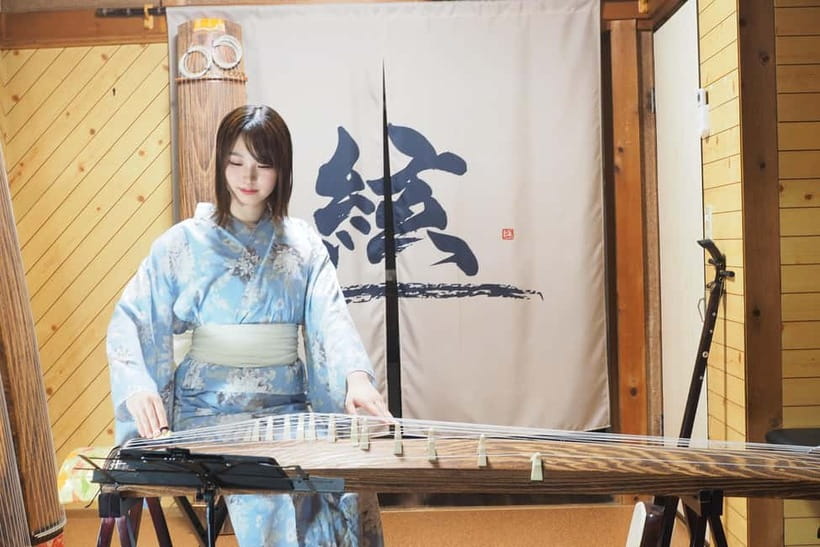
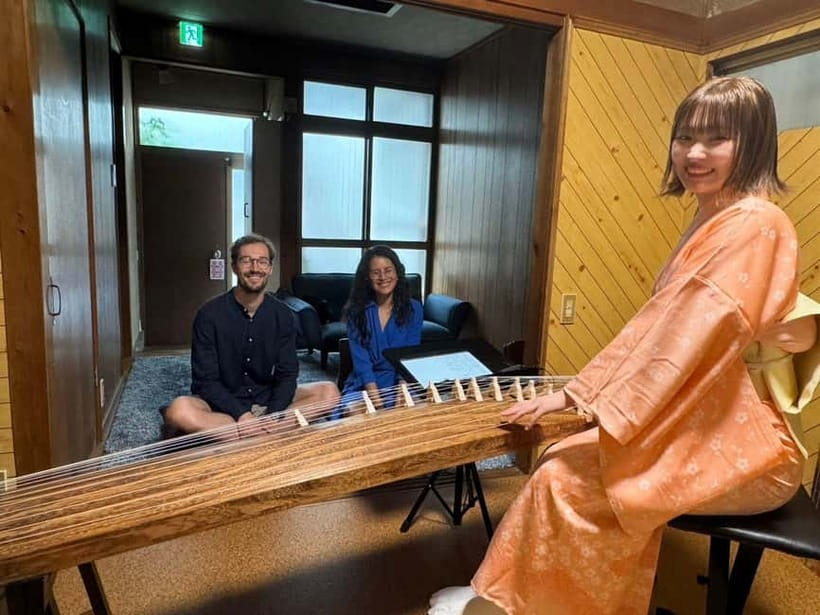
The townhouse holds up to about 11 people, and that small number shapes the entire experience. You sit on cushions or chairs in a home-like room, close enough to see the performer’s hands and the way the strings are set across the instrument.
This is the option I would choose for a quiet evening or for anyone who wants direct contact with the artist. The room feels more like a private salon than a formal concert venue. You may find yourself asking questions during the discussion that you would never get the chance to ask in a large theater.
The solo program focuses on koto and shamisen. One musician may play several pieces on one instrument, then switch to the other, showing how different the two sound and how each is played. The program is selected around the performer’s strengths, so no two visits need to feel exactly alike.
The townhouse program is held almost every day. That makes it easier to fit around a day at Nijō Castle, Nishiki Market, or another major sight. It is also the only venue with the hands-on koto workshop.
There is one practical catch: the location can be difficult to find. It is away from the main tourist routes, and several people have found that using map coordinates is easier than relying only on the street address. Leave extra time, especially if you are arriving after a full day of sightseeing.
The historic bathhouse hall: sound with more drama
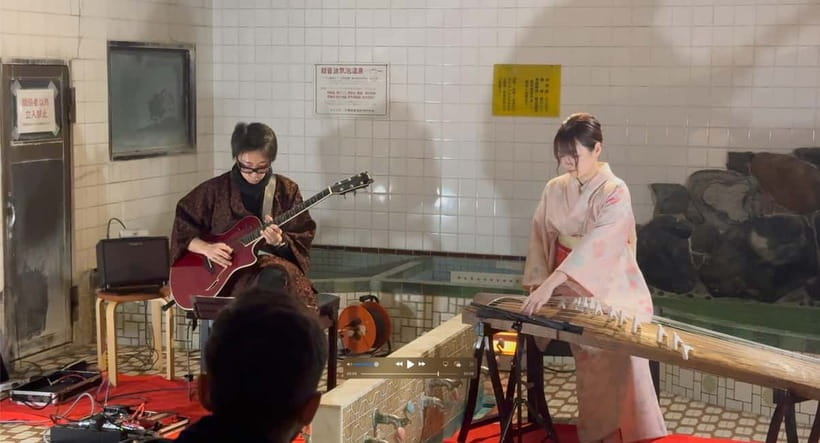
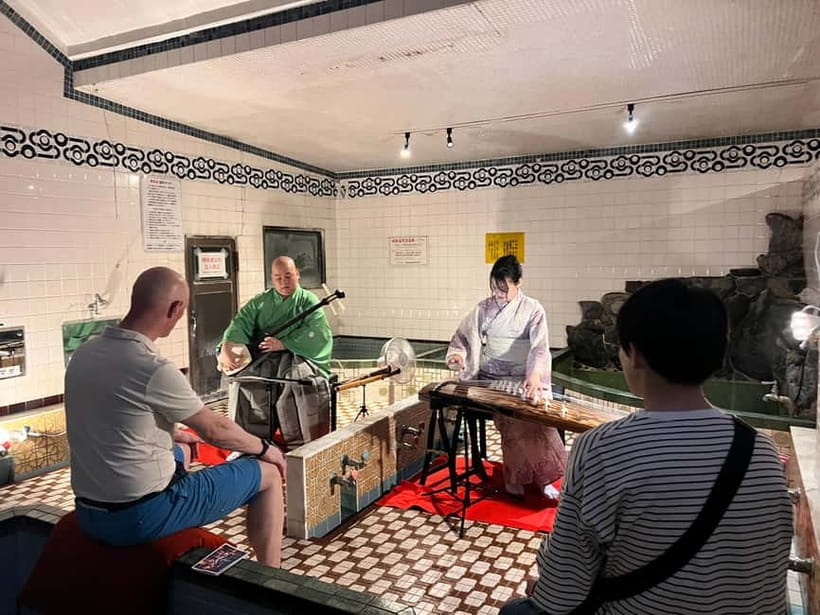
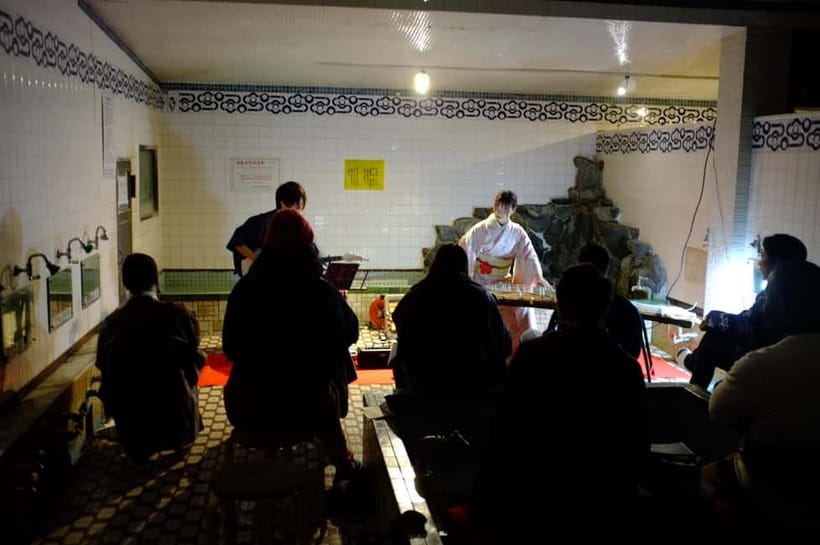
The bathhouse hall offers a different mood. Its tiled walls create natural reverberation, so the koto’s notes hang in the air longer and duets can feel more enveloping. Rows of chairs replace the townhouse’s living-room arrangement, and the larger room can hold about 30 people.
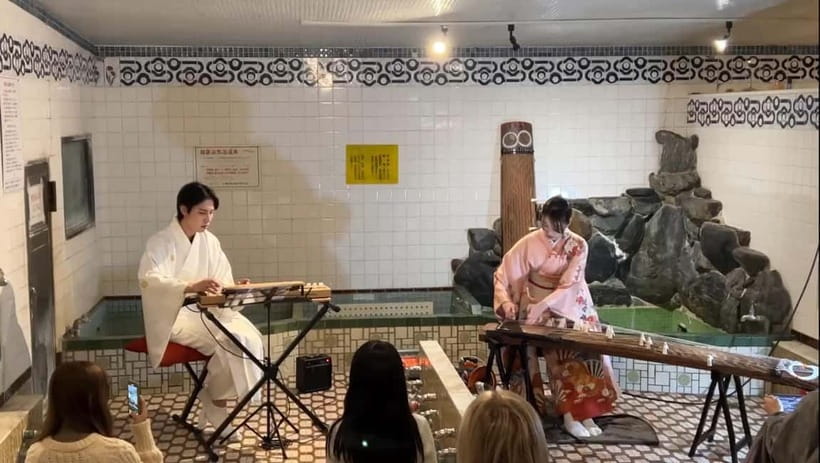
This program pairs the koto with another instrument. Depending on the date, that might be shamisen, shakuhachi, taishōgoto, flute, or guitar. You may hear a solo opening followed by a duet, or a program built around the contrast between solo and collaborative pieces.
The hall is a good pick if you want to hear how traditional instruments work with one another. A koto and shamisen pairing has a distinctly Japanese sound, while flute, guitar, or taishōgoto can push the music toward a newer or cross-genre style.
The tradeoff is scheduling. These performances are offered irregularly on Mondays, so you need to check the calendar rather than assume one will be available during your stay. The bathhouse is used as a concert hall here. Your ticket does not include bathing, food, drinks, or access to bathhouse facilities.
What happens from check-in to the final note
The program is simple and well paced. Plan on 45 to 70 minutes for the concert and discussion, or as much as 105 minutes if you add the workshop.
Same base, a different sort of day:
- Kyoto Geisha Walking Tour: Gion District & Hidden Gems
★ 4.7 · 3,273 reviews - Kyoto: Tea Ceremony Ju-An at Jotokuji Temple
★ 4.9 · 3,207 reviews - Kyoto: Gion Magical Night Walking Tour with Geisha Trivia
★ 4.9 · 2,393 reviews - Kyoto: 45-Minute Tea Ceremony Lesson Experience
★ 4.3 · 2,378 reviews
Check-in and seating
Allow about 5 to 10 minutes to arrive, settle in, and hear the basic etiquette. The townhouse uses cushions or chairs, while the bathhouse hall has rows of seats.
The setting is informal, but it is still a live performance. Listen carefully during the pieces and follow the host’s guidance about photographs and movement. Photo time is provided after the concert.
Instrument introduction
The introduction lasts about 10 to 15 minutes. You learn how the koto and shamisen are built, how picks and bridges are used, and how the strings are arranged. The hosts also explain the unusual notation used for these instruments.
This part matters. Without it, a first-time listener might simply hear pretty sounds. With it, you can watch the performer’s hand position, notice changes in attack, and understand why a piece sounds soft, clipped, or forceful.
English and Japanese are used. Hosts such as Gen and Shohei have helped make the explanations accessible, while performers including Furan, Kyoko, and Aoi have been praised for both their playing and their ability to connect with a small audience. The exact musician depends on the booking date.
The concert
The music itself lasts about 25 to 30 minutes. Expect four or five pieces, with brief commentary about the work, its period, or the way it is performed.
The townhouse program is mainly solo koto and shamisen. The bathhouse selection may include both solo works and duets. Programs often balance older pieces with contemporary works, which gives you a better sense of the instruments as living musical tools rather than museum objects.
Do not expect a long theatrical show. This is a focused concert with explanation around it. That is good news if you want detail and conversation, but less ideal if you are looking for a large-scale performance with staging, lights, or a full orchestra.
Questions, photographs, and conversation
After the music, you have about 5 to 10 minutes for questions and photographs. This is one of the strongest parts of the experience because the small audience makes a real exchange possible.
You can ask about the instruments, the pieces, the performer’s training, or the meaning of the music. The hosts are also happy to explain points that were not clear during the introduction. The atmosphere is friendly rather than formal.
The koto workshop: worth the extra time
The workshop adds 35 to 40 minutes and is available only at the traditional townhouse. Instruments are sanitized, and the instruction is aimed at beginners.
You learn basic sitting position and plucking technique, then try to play a short phrase. Do not expect to become a koto player in one lesson. The value is in feeling how much control is needed to make a clean note and understanding the physical work behind the performance.
This is especially worthwhile for families with older children, curious music lovers, and anyone who likes to learn by doing. It can also be a good choice if you worry that a concert alone might feel too passive. The instruction is patient, and hosts have helped children and first-time players take part.
The workshop changes the tone of the visit. You stop being only an audience member and gain a small, practical connection with the instrument. If you are short on time, the concert itself is enough. If you want the most memorable version of the activity, add the lesson.
How the two programs compare
Use the townhouse if you want:
- The smallest possible group
- A home-like atmosphere
- Solo koto and shamisen
- Flexible scheduling on most days
- The optional hands-on koto workshop
- The clearest view of the performer’s technique
Use the bathhouse hall if you want:
- A larger concert room
- Strong natural reverberation
- Koto duets and mixed-instrument programs
- A more formal seating arrangement
- A performance with a little more acoustic drama
Neither venue is automatically better. The townhouse gives you closeness and flexibility. The bathhouse gives you sound and variety. If you can attend both during a longer Kyoto stay, they should feel like two separate experiences rather than a repeat of the same concert.
Fitting the concert into a Kyoto sightseeing day
The activity works well as an early evening plan, but the exact starting time depends on availability. Since transportation is not included, build in your own travel time and confirm the meeting point for the option you choose.
The nearby sights make planning easy:
- Nijō Castle: About 20 minutes away. The route from Saiin includes one stop on the Tozai subway line, making this a natural pairing.
- Arashiyama: About 25 minutes away. Walk to Saiin Station, take the Hankyu line to Katsura, then transfer to the Randen Line.
- Kinkaku-ji: About 20 minutes away. A bus from Nishioji Sanjō takes about 16 minutes, followed by a short walk.
- Nishiki Market: About 25 minutes away. Take the Hankyu line to Karasuma or Kawaramachi, then eat or shop nearby before the concert.
I would not cram the townhouse concert between several distant sights. The finding-your-way part can be less straightforward than the travel times suggest. Give yourself a cushion, then enjoy the music without watching the clock.
What $32 gets you
At $32 per person, the price is fair for Kyoto. You are not paying only for 25 minutes of music. The fee includes the live performance, the instrument explanation, bilingual commentary, Q&A, photographs, and seating.
The townhouse version offers especially good value if you add the workshop. A private or very small-group concert with a professional musician is hard to compare with a standard stage show, since the point is access and personal attention rather than duration alone.
The bathhouse program may be the better value for people who care most about duet arrangements and acoustics. The larger capacity means it may feel less personal, but the room itself becomes part of the music.
At $32, this is also a reasonable choice for a short Kyoto stay. It does not consume half a day, and it gives you something temples and markets cannot: a guided encounter with a living performance tradition.
Who will enjoy this most
I would recommend it to first-time visitors who want culture without a long lecture. The explanations assume little prior knowledge, so you can arrive without preparation and still follow the program.
It suits music lovers, couples, families with older children, and solo visitors who prefer a small group. The townhouse is particularly good for anyone who values quiet conversation and close-up performance.
It may not suit babies under one year, who are specifically excluded. It is also not the right pick if you want a full bathing experience, a large concert production, food and drink, or a guaranteed daily duet program.
The activity is offered in English and Japanese, and private or small-group bookings are available. That makes it easier to choose the level of intimacy you want, though the meeting point varies by option.
Should you book the Kyoto traditional concert?
Yes, if you want an intimate cultural experience with real explanation and direct contact with the musicians. I would choose the townhouse for most visitors because it runs almost daily, holds only about 11 people, and includes the optional koto lesson. Pick the bathhouse hall if its Monday schedule matches your plans and you especially want duets and fuller sound.
Book this when you are ready to slow down for an hour. The music is the focus, the setting is modest, and the reward comes from listening closely. Allow extra time to find the townhouse, check the venue before paying, and add the workshop if you want more than a performance.
FAQ
How much does the Kyoto traditional concert cost?
The experience costs $32 per person.
How long does the activity last?
The concert and discussion take about 45 to 70 minutes, depending on the option. Adding the koto workshop brings the total duration to as much as 105 minutes.
What instruments will I hear?
You may hear koto and shamisen in the townhouse program. The bathhouse program pairs koto with instruments such as shamisen, shakuhachi, taishōgoto, flute, or guitar.
How many pieces are performed?
The program includes four or five pieces. The exact selection changes by venue, musician, season, and program.
Is the music only traditional?
No. The programs can include Japanese classical works, contemporary arrangements, and original compositions.
Is the koto workshop included?
The workshop is optional and available only with traditional townhouse bookings. It lasts about 35 to 40 minutes and teaches basic techniques before you try a short phrase.
Is the experience offered in English?
Yes. The activity is conducted in English and Japanese, with bilingual explanations of the instruments, notation, and music.
Is this a private activity?
Private or small-group options are available. The traditional townhouse holds up to about 11 people, while the historic bathhouse hall holds up to about 30.
Does the bathhouse ticket include bathing?
No. The bathhouse is used as a concert venue for this activity. Bathing, food, drinks, and transportation are not included.
Just added in Kyoto
- Kyoto: Private Photoshoot Service★ 5.0 · 158 reviews
- Kyoto Rickshaw Tour★ 5.0 · 210 reviews
- Izakaya Style Cooking Class★ 5.0 · 219 reviews
- Ninja 2-hour Hands-on Lesson by Japanese master in Kyoto -Medium★ 5.0 · 218 reviews
- Kyoto: Arashiyama Bamboo, Temple, Matcha, Monkeys & secret spots★ 5.0 · 219 reviews
- Samurai Training with Modern day Musashi in Kyoto★ 5.0 · 256 reviews
- Kyoto: Kimono Tea Ceremony with Matcha and Sweet★ 4.9 · 249 reviews
- South Kyoto in a Nutshell: Gentle Backstreet Bike Tour!★ 5.0 · 225 reviews
Tours in Kyoto, compared.
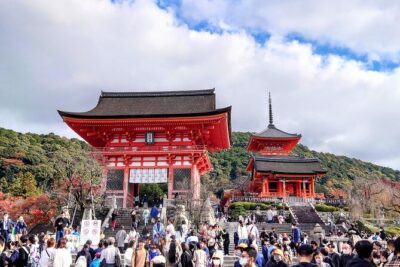
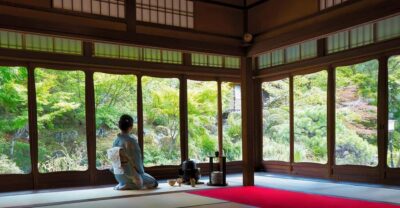
Tea Ceremony in a Traditional Tea House in Kiyomizu
Read our review →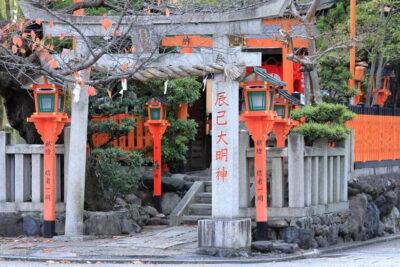
Kyoto Geisha Walking Tour: Gion District & Hidden Gems
Read our review →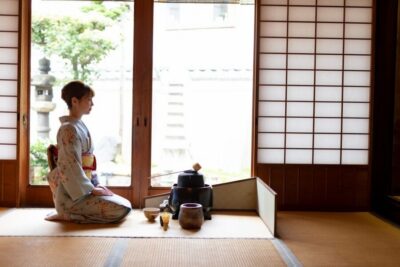
Gion Geisha District Walking Tour – Stories of Geisha
Read our review →
Best of Kyoto: Gion, Geisha, Pagodas & Cobblestones
Read our review →
Browse the lists this tour appears in