
Reviewed · RICKSHAW RIDES
Tokyo Asakusa Rickshaw Tour
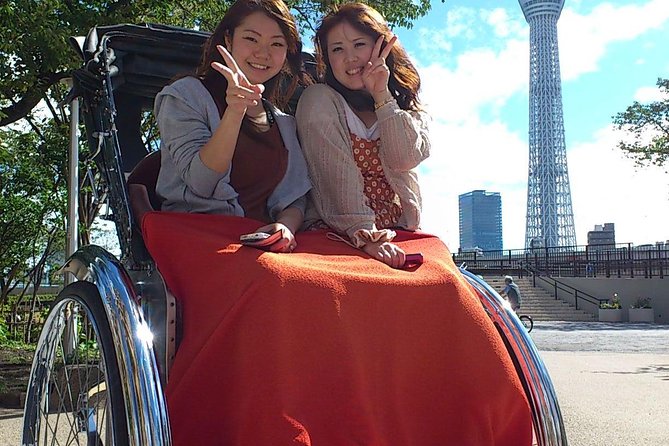
Asakusa is one of Tokyo’s best neighborhoods for seeing old and new Japan side by side. From a rickshaw, you glide past Edo-period facades, small shrines, raccoon statues, and cherry trees, then look across the Sumida River at the Tokyo Skytree. It is sightseeing with a human voice instead of a bus microphone.
I like the flexibility. You can choose a quick 30-minute orientation or stretch the ride to three hours, and you can tell your driver what interests you most. I also like the guides’ personal touch. Drivers such as Koko, Micchy, Taisei, Kei, Yusuke, Nene, and BUCHI are praised for humor, local knowledge, photo help, and restaurant suggestions. The main drawback is space: a rickshaw is only 29.1 inches wide, so two adults sit close together.
Key points
- A private ride with a route shaped around you: Ask for shrines, history, photographs, anime connections, old entertainment streets, or a quick overview.
- The best longer stops: Ushijima Shrine, Honryuin Matsuchiyama Shoden, and Imado Shrine each offer a different look at Japanese religious life.
- Excellent photo opportunities: Expect views of the Tokyo Skytree, the Sumida River, Sensoji’s colorful gates, and Asahi’s famous golden sculpture.
- A useful first look at Asakusa: The rickshaw covers ground quickly, helping you decide where to return on foot.
- Comfort depends on the booking: Two adults fit, but individual rickshaws may be wiser if you need more room.
- Weather matters: Rain protection, rugs, and seat warmers have been used, but the operator can cancel for poor conditions.
Why a rickshaw works so well in Asakusa
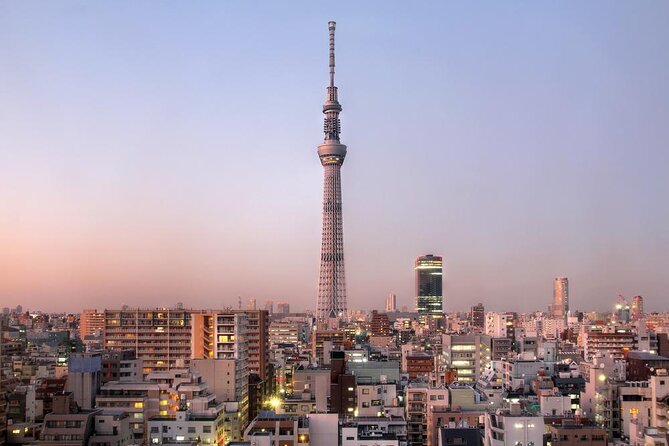
Asakusa can feel confusing at first. Sensoji draws crowds, the Sumida River opens into broad views, and quiet religious sites sit only a few streets from old cinemas, snack shops, and modern businesses. A rickshaw gives you a simple way to connect these pieces.
Your driver pedals while you sit up high enough to see over some street-level clutter. You are close to the neighborhood, not sealed behind glass. You can ask questions as you go, stop for photographs, and request a change of pace.
This is also a practical choice at the start of a Tokyo stay. A short ride helps you understand the shape of Asakusa before you return on foot. A longer ride gives you a more complete tour, with time for several shrines and the older entertainment quarter.
The tour is private for your group. That matters because you do not have to follow a fixed lecture or wait for strangers at every stop. You can ask for more explanation at a shrine, spend longer taking pictures, or finish somewhere useful for lunch or further sightseeing.
Other short rides through Tokyo:
- Kyoto: Arashiyama Customized Rickshaw Tour & Bamboo Forest
★ 5.0 · 432 reviews - Kyoto Arashiyama Rickshaw Tour with Bamboo Forest
★ 5.0 · 354 reviews - Kyoto Rickshaw Tour
★ 5.0 · 210 reviews
Choosing between 30 minutes and three hours
The range in duration is wide, so the tour can mean very different things depending on the option you book.
A 30-minute ride is best for a first taste. You will see some of Asakusa’s character, enjoy the novelty of the rickshaw, and get a few strong views. It is not long enough to expect every stop listed in the route, particularly if you want to leave the rickshaw and visit several sites.
A 45-minute ride gives you more room for photographs and a little explanation without taking a large part of your day. This works well if Sensoji, the river, and a few quieter streets are already on your plan.
A one-hour tour is a better middle ground if you want both a ride and some local background. You can ask for a mix of landmarks, old streets, and photo stops.
The three-hour option is the most useful if Asakusa is a major part of your day. It gives your driver time to reach more of the neighborhood, explain the religious sites, and include areas that a short ride must skip. It also feels less rushed.
Do not assume the longest listed itinerary fits every booking. The route depends on the duration and your requests. Before setting off, tell your driver what matters most. If you want several shrines, say so. If you mainly want photographs and an overview, ask for a route built around views and short stops.
Meeting your driver near Asakusa Station
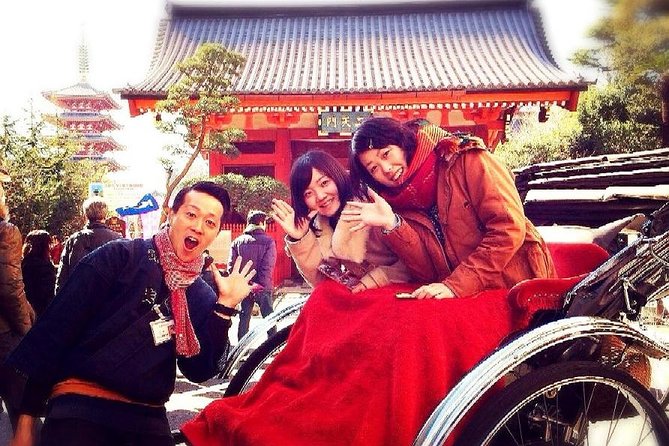
You make your own way to the meeting point at 1-chōme-1-4 Asakusa, in Taito City, near Asakusa Station. The ride includes the rickshaw and a local driver, but not hotel pickup, food, or drinks.
At the start, explain your interests and confirm the ending point. The standard finishing point is near Kan’non-dōri at 1-chōme-2-11 Asakusa, but the final drop-off can be arranged directly with your driver. A different ending point may bring an extra fee.
English and Japanese-speaking drivers are available, subject to availability. If you need English, request it when booking rather than assuming it will be assigned automatically. The drivers are a large part of the experience, and clear communication makes the custom route work better.
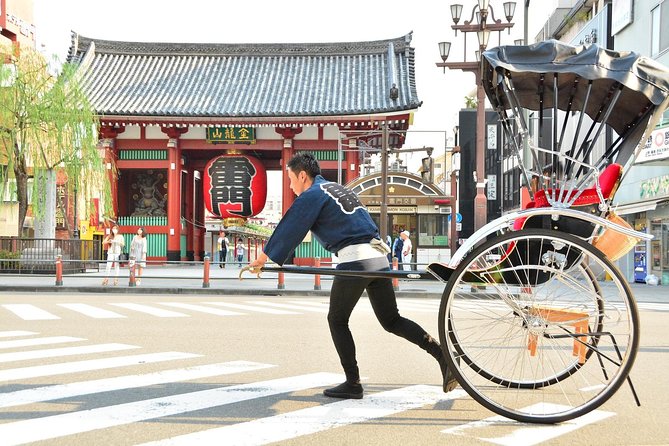
The ride is not a hop-on, hop-off service. You remain with your driver, and the rickshaw cannot enter the Sensoji and Asakusa Temple grounds or Nakamise shopping street. You will get close, then continue on foot in those areas.
Ushijima Shrine and the three-part gate
Ushijima Shrine is one of the strongest stops for visitors who want more than a quick photo. It is a Shinto shrine, and your driver can explain why its entrance has three openings rather than the more familiar single opening.
The stop is listed at about 15 minutes. Admission is not included, though the experience information does not list an admission charge. The value here comes from the explanation. A small design detail becomes a chance to understand how Japanese shrine spaces are arranged and used.
The location also helps break up the ride. You get out, stretch your legs, look more closely at the grounds, and then continue through the surrounding streets. If you choose a short tour, this stop may not be possible, so ask about it before departure.
Same base, a different sort of day:
- Mt Fuji and Hakone 1-Day Bus Tour Return by Bullet Train
★ 5.0 · 26,383 reviews - 1-Day Tokyo Bus Tour
★ 5.0 · 14,250 reviews - Tokyo: TOKYO SKYTREE® Admission ticket
★ 4.5 · 11,192 reviews - Tokyo: teamLab Planets TOKYO Digital Art Museum Entry Ticket
★ 4.6 · 9,779 reviews
Honryuin Matsuchiyama Shoden and its radish symbols
Honryuin Matsuchiyama Shoden is a Buddhist temple connected with the Sensoji temple group. Its most memorable feature is the repeated radish symbol, found around the temple and painted on lanterns.
Your driver explains why radishes matter here. That small detail makes the temple easier to remember than a general stop described only as old or beautiful. You get a piece of local religious symbolism, not just another building on a sightseeing route.
Plan on about 15 minutes. Admission is not included. The temple is especially useful for understanding the difference between Buddhism and Shinto, a subject that can seem unclear when both appear in the same neighborhood.
Imado Shrine and the beckoning cats
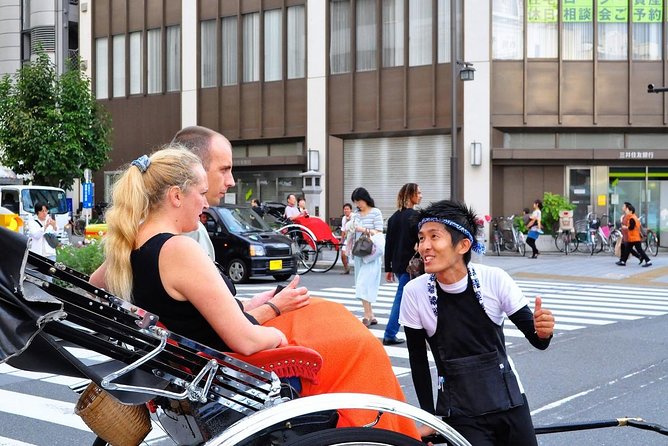
Imado Shrine gives the tour a playful turn. It is a Shinto shrine filled with cat figurines, especially manekineko, the familiar beckoning cat associated with good fortune.
This is a good stop for families and for anyone who enjoys the quirky side of Tokyo. The cat figures also provide easy photographs, and your driver can connect them with Japanese customs and popular symbols.
Again, the listed visit takes about 15 minutes, and admission is not included. If you are choosing between several shrines on a short booking, tell your driver whether Imado’s cats are a priority.
Sensoji, Asakusa Shrine, and the limits of the rickshaw
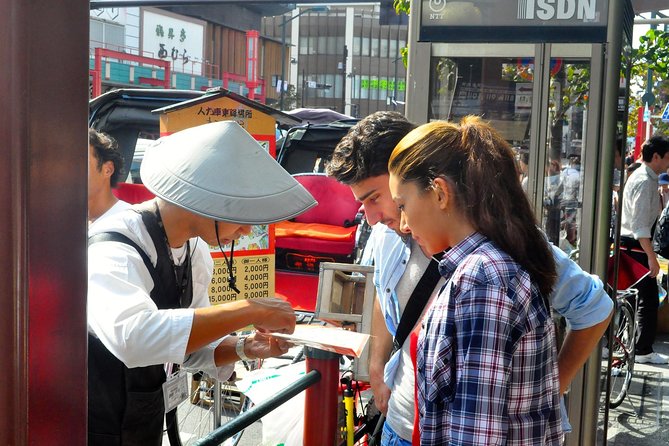
Sensoji is the area’s major landmark, with its bright entrance gate, temple buildings, and Nakamise shopping street. Nearby Asakusa Shrine sits on the temple grounds, giving you a useful lesson in how Shinto and Buddhism have coexisted in Japan.
The rickshaw cannot ride through the temple grounds, the temple buildings, or Nakamise. That is not a flaw in the tour so much as an important practical limit. You will approach the area by rickshaw, then explore the main temple zone on foot.
A rickshaw ride is most useful here as a frame around your visit. Your driver can explain what you are seeing and point out the best approach, but you should leave time to walk through Sensoji separately if it is a major goal.
Edo streets, raccoon figures, and old Tokyo entertainment
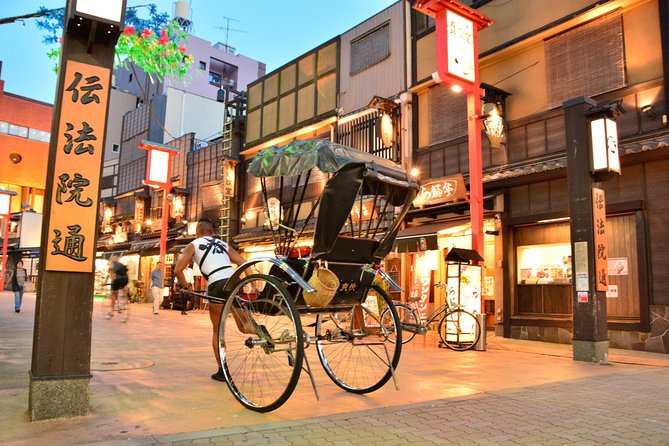
Asakusa is not only temples. The route can include historic streets lined with store fronts and housing facades that recall the Edo period. These streets show how the neighborhood’s older character survives among modern Tokyo businesses.
You may also pass a quirky street decorated with raccoon figures every few meters. It is the kind of detail you could easily miss while trying to reach a famous temple. The statues give the ride a lighter side and make a good change from formal religious sites.
The old entertainment district adds another layer. One venue remains associated with Japanese comedy and shows, while Rokku Street was once Tokyo’s leading entertainment quarter before the war, with cinemas and theaters. Today it is part of Asakusa’s retro district.
This portion of the ride is valuable because it widens your view of the neighborhood. Asakusa was not only a religious center. It was also a place for popular entertainment, shopping, comedy, and cinema.
Sumida River, Asahi, and Tokyo Skytree photographs
The Sumida River provides some of the clearest views on the tour. From across the water, you can photograph the Tokyo Skytree with more space around it than you get in the dense temple streets.
Sumida Park runs along the river and is particularly appealing during cherry blossom season. You can pause there, rest from sightseeing, and take in the skyline. Maple trees add color at another time of year.
The Asahi Beer Headquarters is another distinctive sight. Look for the famous golden flame sculpture on top of the building. It is a reminder that Asakusa is not preserved in a glass case. Traditional shrines, a river park, skyscrapers, and major businesses all share the same view.
Your driver can help with photographs. Several drivers are praised for taking pictures of the people in the rickshaw, not just the scenery. If you want a group photo, ask directly and allow a moment for it.
What the ride feels like in practice
The rickshaw seats up to two adults, but the cabin is only 74 centimeters wide. Two average-sized adults can fit, though you should expect close seating. If you are broad-shouldered, carrying a baby, or simply prefer more space, book a separate rickshaw for each passenger.
The operator recommends an additional rickshaw for passengers who may not fit comfortably together. It may not be possible to add one later, especially if you need an English-speaking driver, so decide at booking time.
Children five and under can ride free when sitting on an adult’s lap. A child using one of the two seats must be booked as an adult. Up to two small children can ride with two adults if they sit on adult laps. Children aged six and over pay the adult price.
The physical effort comes from the driver, not you, but the ride still has an active, open-air feel. Guides such as Koko, Yusuke, and Taisei are praised for their energy and stamina. Their personalities can shape the outing, so expect a friendly conversation rather than a silent transfer.
Rain does not automatically make the experience impossible. Rugs and protective coverings have kept riders warm and dry on wet days. Still, the tour requires good weather, and the operator may cancel if conditions are poor.
Price and value at $42.90 per person
At $42.90 per person, this is not the cheapest way to move around Asakusa. You can walk the neighborhood for little money, and public transportation will take you elsewhere in Tokyo quickly.
The value is in the combination of transport, orientation, local explanation, and private attention. You are paying for a driver who pedals, navigates, points out details, answers questions, and adjusts the route to your interests. That makes the price easier to justify for a first visit, a special outing, or a short stay.
The value improves with a longer booking. A 30-minute ride is a fun introduction, but a three-hour outing gives you far more time with the driver and includes more of the neighborhood’s different sides. For two adults, compare the cost of one shared rickshaw with two individual rickshaws, especially if comfort is important.
This is also a good use of money if you care about photographs. The drivers can suggest photo locations and help take pictures, giving you images of the people in your group rather than a collection of empty landmarks.
Who should book this Asakusa ride
I would recommend it to first-time visitors who want a clear introduction to Asakusa without spending hours figuring out the streets. It also suits families, couples, and small groups looking for an activity that feels different from a standard walking tour.
It is a strong choice if you enjoy questions and conversation. Drivers including Micchy, Kei, Koko, Takumi, and BUCHI are praised for explaining Japanese culture, suggesting restaurants, and adjusting their style to the people in the rickshaw.
It is less suitable if you want to spend most of your time inside Sensoji, browse Nakamise at length, or stop at every site listed. The rickshaw cannot enter the temple grounds, and short rides must leave out several locations.
Book extra time if you want a relaxed pace. Mention particular interests at the start, and confirm the drop-off point before the wheels turn. If you need room, reserve separate rickshaws in advance.
Should you book the Tokyo Asakusa Rickshaw Tour?
Book it if you want a lively introduction to Asakusa, a driver who can explain the details, and a private ride that combines famous sights with odd little corners. The best parts are the personal route, the Skytree and river views, the small shrines, and the chance to see old entertainment streets without walking the entire district first.
Choose at least an hour if you want more than a novelty ride. Choose three hours if you want several shrines, history, photographs, and time to pause. Skip it if you dislike close seating, need a fully fixed sightseeing list, or prefer to explore every temple area on foot.
For most people, this is a memorable way to get oriented. Just treat the rickshaw as the beginning of your Asakusa visit, not a substitute for walking through Sensoji and Nakamise afterward.
FAQ
Where does the Tokyo Asakusa Rickshaw Tour start?
The meeting point is outside Asakusa Station at 1-chōme-1-4 Asakusa, Taito City, Tokyo 111-0032, Japan. You make your own way there.
How long does the rickshaw tour last?
Available durations range from about 30 minutes to three hours. The sites included depend on the option you select and the route you arrange with your driver.
Can I customize the route?
Yes. Tell your driver what interests you most, such as shrines, temples, Edo-period streets, photographs, the Sumida River, or old entertainment areas.
How many people fit in one rickshaw?
A rickshaw holds a maximum of two adults. Up to two children aged five or under can ride with two adults when the children sit on adult laps.
Is an English-speaking driver available?
English and Japanese-speaking drivers are available subject to availability. Request your preferred language when booking.
What happens if the weather is poor?
The experience requires good weather. If the operator cancels because of poor conditions, you can choose another date or receive a full refund. You can also cancel for a full refund up to 24 hours before the start time.
Just added in Tokyo
- Nikko: Edo Wonderland Edomura Cultural Theme Park Ticket★ 4.3 · 205 reviews
- 《MEMBERS-ONLY-BAR-HOPPING》Discover Your Special Whiskey in Tokyo!★ 5.0 · 29 reviews
- Japanese Whisky Hunting《HIGH-QUALITY-ONLY》Rare Tasting Class★ 5.0 · 20 reviews
- Luxury Tokyo Sake, Cocktail, Whisky and Pairing Tour★ 5.0 · 18 reviews
- Wagyu & Sake Pairing in Shinjuku – Steak, Shabu-Shabu & More★ 5.0 · 112 reviews
- Small-Group Wagyu Beef and 7 Japanese Dishes Tokyo Cooking Class★ 5.0 · 190 reviews
- From Tokyo: Private Tour to Fuji/Hakone – Onsen, Art, Nature★ 5.0 · 116 reviews
- Tokyo: KABUKI Show at Kabukiza Theatre Admission Ticket★ 4.8 · 152 reviews
Rickshaw Rides, compared.
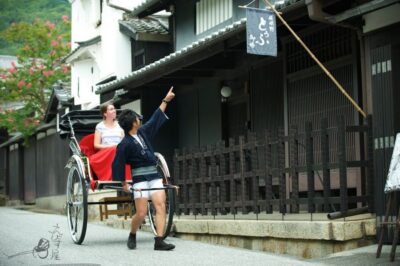
Arashiyama Customized Rickshaw Tour & Bamboo Forest
Read our review →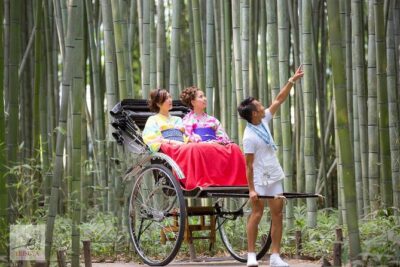
Kyoto Arashiyama Rickshaw Tour with Bamboo Forest
Read our review →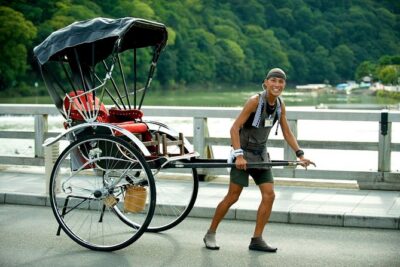
Browse the lists this tour appears in