
Reviewed · GEISHA & GION DISTRICT TOURS
Kyoto: Meet the Geisha Maiko with Gion Walking Tour
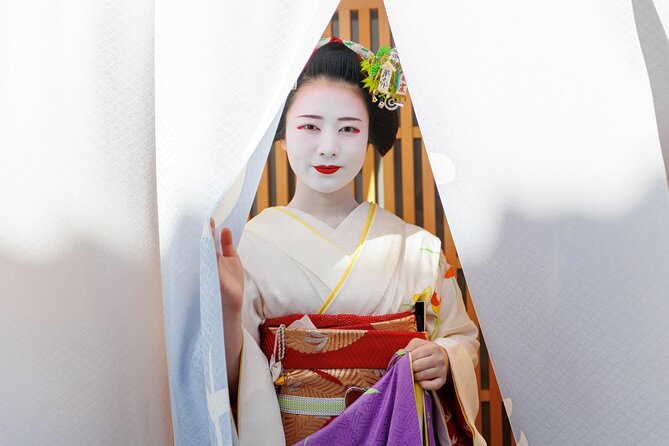
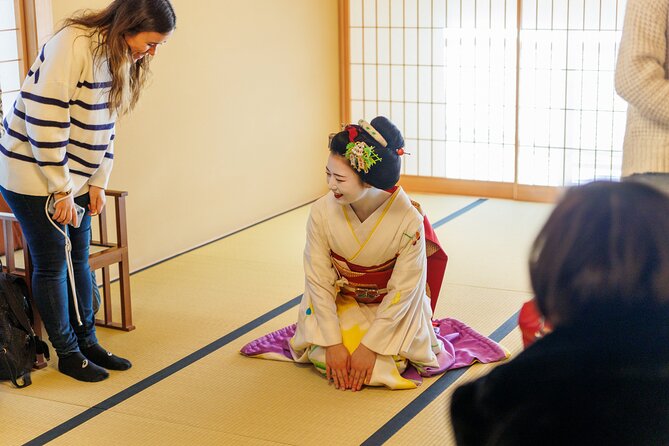
The rarest part of this Kyoto experience comes after the walk: you enter a private ochaya, a traditional entertainment house normally closed to first-time callers, and meet a maiko and retired geiko. You watch a formal dance, hear shamisen music, and ask questions through your guide.
I like two things here. First, the tour shows you how Gion works before the performance, so the painted doorways and quiet lanes mean more. Second, it offers a respectful alternative to chasing maiko through the streets with a camera. The main drawback is pace: some people find the Gion walk repetitive, and soft-spoken translation can be hard to hear in a group.
Key points to know before booking
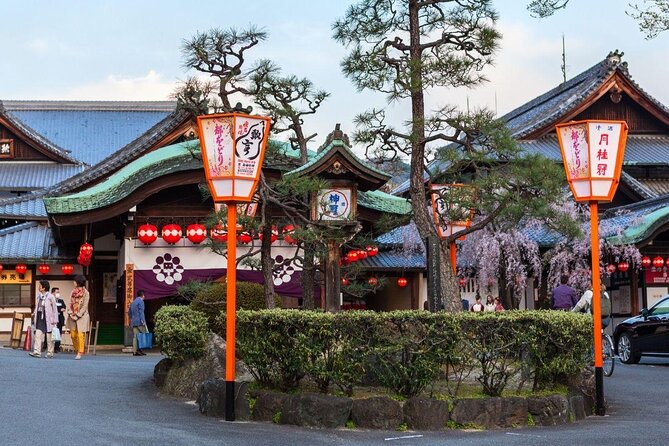
- Private ochaya visit: Enter a traditional Kyoto entertainment house in Miyagawasuji, a rare privilege even by local standards.
- Live maiko performance: See a classical dance, with shamisen accompaniment provided by the house mother on some departures.
- Questions are part of the visit: Your guide translates as you speak with the maiko and retired geiko.
- Gion context first: Walk Gion Shirakawa, Tatsumi Bridge, Hanamikoji Street, shrine grounds, and nearby temple precincts.
- Bring the right footwear: Socks are required, wet socks are not accepted, and the performance room is upstairs.
- Allow three hours: The walking portion can feel long for some people, and the full group may contain up to 30 participants.
Why the ochaya visit is the real heart of the tour
Kyoto’s geisha districts are easy to misunderstand. From the outside, you see elegant kimono, white makeup, wooden houses, and people hurrying between appointments. That tells you very little about the training, manners, music, dance, and social customs behind the appearance.
This tour gives you a better way in. You first walk through Gion with a local guide, then enter a private ochaya for a scheduled meeting with a maiko and a retired geiko. The contrast matters. You are not simply watching someone pass by on the street. You are sitting in a place built for music, dance, conversation, and hospitality.
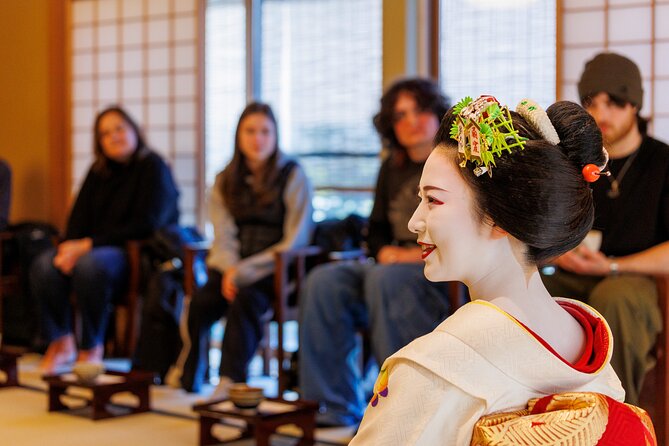
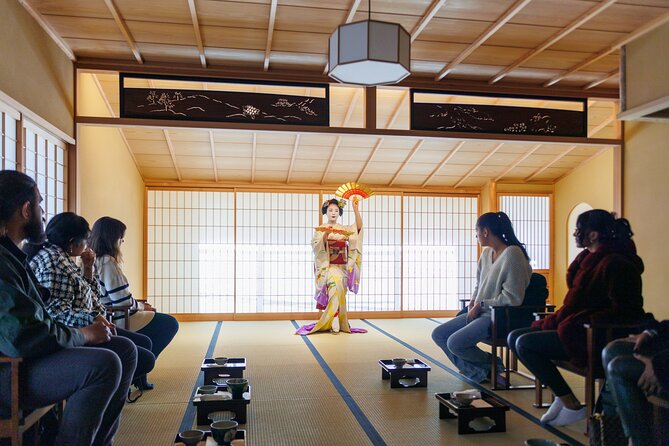
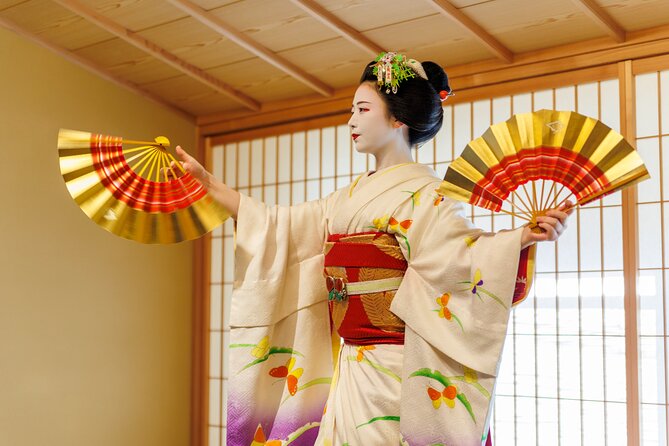
The performance is usually the highlight. You can expect a formal dance by the maiko, followed by time for questions. Depending on the program, the house mother may play shamisen, the three-stringed instrument often linked with geisha entertainment. Your guide translates, allowing you to ask about training, daily life, performance, and the meaning of the customs you have just seen.
I especially value the conversation. A short stage show can be beautiful but distant. The question period gives the experience a human scale. You can learn directly from the maiko and hear from a retired geiko, rather than relying only on a guide’s prepared explanation.
Photography and video are allowed during the performance and photo session. If you want to post an image online, ask the maiko directly first. That simple rule is worth taking seriously. The point is not to treat the encounter as a photo opportunity with a person attached. It is a cultural meeting, and good manners are part of the experience.
Other walking tours in Kyoto people book:
- Kyoto Geisha Walking Tour: Gion District & Hidden Gems
★ 4.7 · 3,273 reviews - Kyoto: Gion Magical Night Walking Tour with Geisha Trivia
★ 4.9 · 2,393 reviews - Kyoto: Gion Geisha District Walking Tour – Stories of Geisha
★ 4.7 · 2,187 reviews
Starting among the willow-lined lanes of Gion Shirakawa
The walking portion begins around Gion Shirakawa, one of the district’s most attractive areas. The canal, old wooden buildings, and carefully maintained streets create the classic Kyoto setting people hope to find.
Here, your guide explains the difference between a maiko and a geiko. A maiko is an apprentice, still training in dance, music, etiquette, and the arts of conversation. A geiko is fully trained. The word geisha is widely understood, but geiko is the term commonly used in Kyoto.
This opening section is useful because it gives you a social and cultural frame. You learn about the working life of the district, not just its pretty façades. Guides such as Haruki, Takuma, Miko, Mika, Chiko, Naomi, and Ellie have received praise for making these explanations approachable and for answering questions in clear English.
The quality of this part depends heavily on the guide assigned to your group. Some guides have been described as friendly, engaging, and excellent translators. One guide, Ayako, even walked with a group to a restaurant after the tour. But language ability and volume may vary, so stay close and speak up if you cannot hear.
Tatsumi Daimyojin and the meaning of a quiet shrine
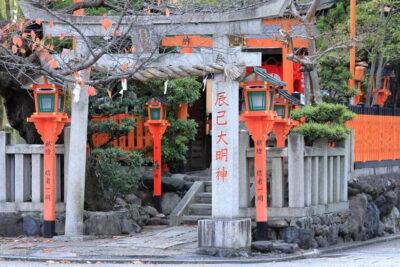
The next stop is Tatsumi Daimyojin, a small Shinto shrine associated with protection, good fortune, and safety. Its roots reach back to the Heian period, from 794 to 1185.
You spend only about five minutes here, so this is not a major sightseeing stop. Its value lies in the connection between the shrine and the district around it. Gion is not a museum set apart from ordinary Japanese life. Sacred places, homes, restaurants, entertainment houses, and narrow lanes sit close together.
The stop also gives your guide a chance to explain how local customs and beliefs fit into the daily life of Kyoto. If you expect a full shrine tour, you may find this portion brief. Think of it as a short piece of context during the walk.
Tatsumi Bridge and the danger of expecting a movie set
Tatsumi Bridge is small, but it is one of those Kyoto corners that photographs beautifully. Traditional wooden machiya houses line the nearby lanes, and the area has the quiet, carefully composed feel often associated with old Kyoto.
Your guide may point out the kinds of buildings used by geiko and maiko, as well as the places where they meet clients and work. This helps you understand why the district has rules about privacy and photography.
There is an important distinction here. The streets are not a public stage. A maiko walking quickly to an appointment is working, not performing for passersby. This tour offers a scheduled meeting, which is far more respectful than following someone through Gion and hoping for a picture.
The walk can also be the least satisfying part for some people. A few sections involve looking at the fronts of buildings and hearing explanations about places you cannot enter. Some people feel the route circles back or spends too much time on similar streets. If your main goal is the maiko encounter, you may wish the walk were shorter.
Other evenings in the old entertainment quarters of Kyoto:
- Best of Kyoto: Gion, Geisha, Pagodas & Cobblestones
★ 4.9 · 2,058 reviews - Night Walk in Gion: Kyoto’s Geisha District
★ 4.5 · 2,003 reviews - Kyoto Night Foodie Tour in Gion (9+ dishes + 6 Sake tastings)
★ 5.0 · 1,762 reviews - Kyoto Gion Geisha District Walking Tour – The Stories of Geisha
★ 5.0 · 1,441 reviews
Hanamikoji Street and Gion’s polished face
Hanamikoji Street is one of Gion’s main roads. Traditional machiya, tea houses, shops, and restaurants line the route, giving it the old Kyoto appearance that draws so many people here.
Your guide uses the street to explain how Gion developed as an entertainment district and how its houses function today. The tour does not enter the buildings along Hanamikoji, so do not expect a behind-the-scenes look at every tea house you pass.
You may also hear about Gion Corner, a venue that presents several traditional Japanese arts. The route can include its exterior or nearby area, but the supplied schedule does not promise entry or a performance there. The important performance takes place later at the private ochaya.
The tour also passes through the precinct of one of Kyoto’s oldest Zen Buddhist temples. You do not enter the temple buildings. Instead, you walk through the grounds as local pedestrians do, getting a brief change of mood from the geisha district’s narrow lanes and wooden façades.
This mixture of streets, shrine, bridge, and temple grounds gives the walk some variety. Still, the focus stays firmly on geiko and maiko culture rather than on broad Kyoto sightseeing. If you want a full introduction to the city’s temples, this is not the right tour.
Miyagawasuji and the private house upstairs
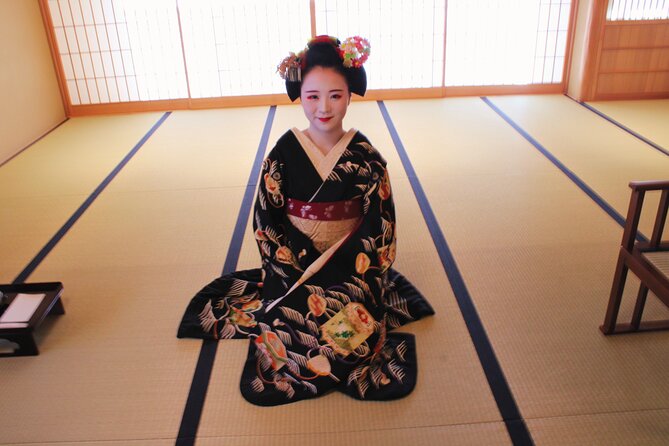
The tour ends in the Miyagawasuji area, close to where it begins. Here you enter the private house for the central performance and conversation.
The word ochaya can confuse first-time visitors. It does not mean a casual tea café or a standard tea ceremony venue. An ochaya is a private entertainment house where geiko and maiko perform for invited patrons. Access is normally restricted, making this visit the most unusual part of the afternoon or evening.
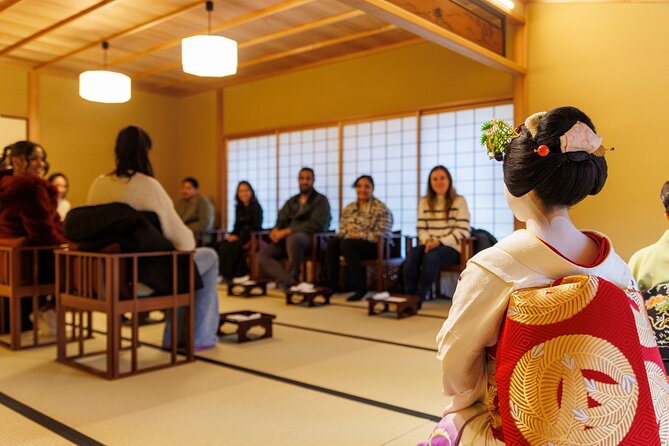
The performance takes place on the second floor, reached by stairs. There is no elevator information provided, so anyone who has trouble with stairs should consider this before booking. You must wear socks inside. On rainy days, wet socks and wet cloth are not accepted at the venue, so use an umbrella during the walk and arrive dry.
Once seated, you watch the maiko perform a classical dance. The choreography is controlled and deliberate, with gestures that may look simple until you understand the years of practice behind them. The setting is intimate, and the performance is not a large theater production with elaborate staging.
Afterward, the maiko and retired geiko take questions. Your guide translates between English and Japanese. This part can be excellent when the guide speaks clearly and positions the group well. It can be frustrating when translation is quiet or when several people speak at once. One practical tip is to sit where you can see and hear the guide, and ask for repetition if needed.
A few people have found that the information during the walk overlaps with the conversation at the house. That is not necessarily a problem if you want reinforcement, but it can make the three-hour schedule feel longer. The performance and personal exchange are the strongest elements. The walking explanations are valuable mainly because they prepare you for what happens inside.
What the guides add to the experience
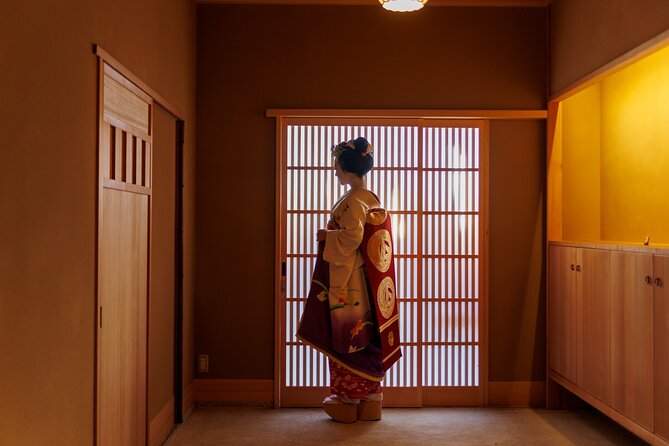
This tour depends more on the guide than a simple sightseeing walk would. The guide explains Gion, manages the group, translates questions, and helps you understand etiquette.
Names praised in connection with the experience include Haruki, Takuma, Miko, Ayako, Mika, Machiko, Ellie, Yoko, Naomi, and Chiko. The strongest descriptions focus on friendly manner, good English, careful explanations, and willingness to answer questions. Naomi and Chiko, for example, were noted for making the history and daily life of geiko and maiko easy to follow.
Do keep your expectations practical. The provider may assign a different guide, and the quality of translation can vary. One criticism focused on a guide who spoke too softly, causing some of the conversation to be missed. Another concerned a late start while the guide helped obtain umbrellas so the group would not enter the traditional house wet.
A group of up to 30 people is permitted. Some departures may feel smaller inside the performance space, but you should not assume a private booking. If hearing every translated answer matters to you, stay near the guide and politely ask for a louder explanation.
Is $109.43 a fair price?
At $109.43 per person, this is not a cheap walking tour. You are paying for access, cultural interpretation, the performance, translation, and the rare chance to enter a private ochaya.
The value depends on what you want. If you only want to stroll around Gion, the price is high. You can walk through Gion Shirakawa, Tatsumi Bridge, and Hanamikoji Street without paying an admission fee. The tour’s cost is justified by the private house visit and the people you meet there.
It also compares differently with a standard evening show. You are not only watching a dance. You receive background information, a live meeting, questions, translation, and a photo session. Food and drinks are not included, so do not book it expecting a dinner or tea ceremony.
I would consider it good value for someone who has long wanted to understand geiko and maiko culture but does not want to chase them in public. It is weaker value for someone who wants a fast tour, a broad survey of Kyoto, or a meal bundled into the price.
Timing, walking, and practical comfort
The experience lasts about three hours and takes place rain or shine. Wear comfortable walking shoes. The route includes outdoor streets, shrine and temple grounds, and the walk between the district and the private house.
The meeting point is in Miyagawasuji, in Kyoto’s Higashiyama Ward, and the tour returns to the same general area at a special private house. Check the exact meeting instructions on your booking confirmation, since the meeting point is not described as a major landmark.
Children under 10 cannot join. A moderate level of fitness is recommended, and the upstairs performance room requires stairs. Mobile tickets are accepted, and confirmation is provided when you book.
Free cancellation is available up to 24 hours before the start time. Cancellations or changes made inside that window are not accepted for a refund. The operator does not cover incidental hotel or bullet train costs if its plans change, so avoid building a tight same-day connection around this activity.
Who will enjoy this Gion experience most?
I would choose this tour for a first visit to Kyoto if geiko and maiko culture is high on your list. It suits people who want explanation as well as spectacle, and people who value a direct question-and-answer session more than a polished stage show.
It is also a good fit for respectful photographers. You have a clear time when photography is allowed, plus a chance to ask about permission before sharing images online.
Families with children aged 10 and older can join, though the three-hour length and quiet cultural setting may suit older children better. Couples and small groups who want a memorable Kyoto evening will likely get more from it than people simply looking for a quick photo stop.
I would hesitate if you dislike walking, stairs, repeated explanations, or group translation. The route can feel too long, and the performance house is traditional rather than modern. You should also be comfortable following Japanese etiquette, including wearing clean, dry socks.
Should you book the maiko and Gion tour?
Book it if entering a private ochaya and speaking with a maiko are the experiences you came to Kyoto hoping to find. The performance, shamisen music, translation, and personal questions offer something far more meaningful than trying to spot a geiko on the street.
Skip it if your priority is low cost, food and drink, or a broad tour of Kyoto’s major sights. The walking portion may feel overextended, and the price is substantial for an activity without refreshments.
My advice is to treat the Gion walk as preparation, not the main event. Stay close to the guide, wear socks and good shoes, bring an umbrella if rain is possible, and protect the time at the ochaya by arriving ready to listen. For the right person, this is one of the few bookable experiences in Kyoto that provides a respectful look into a living artistic tradition.
FAQ
How long does the Gion maiko tour last?
The tour lasts approximately three hours. The timing may run a little longer depending on the day.
Where does the tour start and finish?
The listed meeting area is Miyagawasuji in Kyoto’s Higashiyama Ward. The tour finishes in the same general area at a special private house.
Will I meet a real maiko and geiko?
The experience includes a meeting with a maiko and a retired geiko. You can ask questions through the tour guide’s translation.
Is there a live performance?
Yes. The maiko gives a traditional performance at the private house. Some performances also include shamisen music by the house mother.
Are photographs allowed?
Photography and video are allowed during the performance and photo session. Ask the maiko directly before posting photographs on social media.
Do I need to wear socks?
Yes. Socks are required at the performance venue. On rainy days, wet socks and wet cloth are not accepted.
Are there stairs?
Yes. The performance takes place on the second floor of the private house, and access is by stairs.
Can children join the tour?
Children under 10 years old are not permitted. The activity recommends a moderate level of physical fitness.
Can I cancel for a refund?
You can cancel up to 24 hours before the experience begins for a full refund. Cancellations or changes made less than 24 hours before the start time are not accepted.
More walking tours elsewhere in Japan
- Nishiki Market Brunch Walking Tour (7 Tastings + Brunch)
★ 5.0 · 1,355 reviews - Kyoto Arashiyama Walking Tour: Bamboo, Monkeys, Gardens & Secrets
★ 5.0 · 1,216 reviews - Kyoto Gion: 2-Hour Geisha Culture & History Walking Tour
★ 5.0 · 1,186 reviews - Kyoto: Izakaya Bars Guided Walking Tour
★ 4.9 · 815 reviews
Just added in Kyoto
- Kyoto: Private Photoshoot Service★ 5.0 · 158 reviews
- Kyoto Rickshaw Tour★ 5.0 · 210 reviews
- Izakaya Style Cooking Class★ 5.0 · 219 reviews
- Kyoto: Traditional Concert at Townhouse or Bathhouse★ 4.9 · 224 reviews
- Ninja 2-hour Hands-on Lesson by Japanese master in Kyoto -Medium★ 5.0 · 218 reviews
- Kyoto: Arashiyama Bamboo, Temple, Matcha, Monkeys & secret spots★ 5.0 · 219 reviews
- Kyoto Geisha District Walking Tour in Gion★ 5.0 · 232 reviews
- The right way to know Kyoto★ 5.0 · 257 reviews
Geisha & Gion District Tours, compared.
Kyoto Geisha Walking Tour: Gion District & Hidden Gems
Read our review →
Gion Geisha District Walking Tour – Stories of Geisha
Read our review →
Best of Kyoto: Gion, Geisha, Pagodas & Cobblestones
Read our review →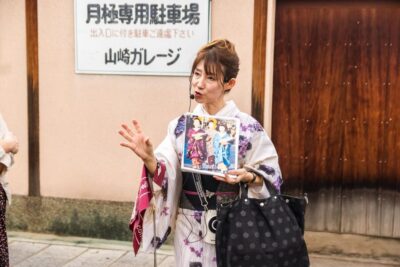
Kyoto Night Foodie Tour in Gion (9+ dishes + 6 Sake tastings)
Read our review →
Kyoto Gion: 2-Hour Geisha Culture & History Walking Tour
Read our review →
Chopsticks Making Workshop in Gion with Engraving Option
Read our review →
Browse the lists this tour appears in