
Reviewed · GEISHA & GION DISTRICT TOURS
Authentic Maiko Experience&Kyoto Dinner (Free drink) at Noh Stage
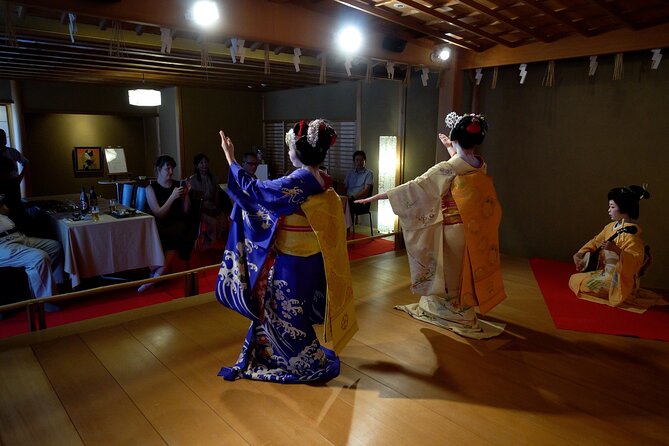
A maiko dance is beautiful from across a room, but this small evening at a Noh stage lets you see the details up close. You’ll watch live shamisen music, share a traditional meal, ask questions, play ozashiki games, and take a two-shot photo with the maiko. The setting aims for the feel of an intimate ozashiki gathering rather than a fast tourist show.
I especially like the direct conversation and the chance to learn about the kimono, kanzashi hair ornaments, and daily life behind the formal appearance. The live music also matters: the dance is not performed to a recording, and the shamisen gives the evening a genuine sense of occasion.
The main consideration is price. At $150 for about two hours, this is not a casual dinner or a quick stage performance. You are paying for a rare cultural meeting, a meal, drinks, interpretation, and a carefully limited format. If your main goal is simply to see a dance, cheaper options may suit you better.
Key points at a glance
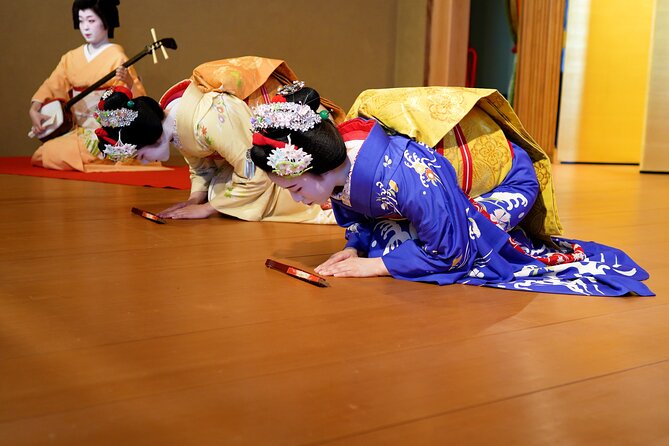
- Live dance on a Noh stage: The maiko performs with a jikata shamisen musician, not with recorded music.
- Real conversation time: You can ask questions through a Kyoto-certified interpreter and learn about the maiko’s work, clothing, and traditions.
- Ozashiki games: Traditional party games bring a playful side to an evening that could otherwise feel formal.
- Kaiseki-style Kyoto dinner: Your meal is part of the cultural experience, not just a plate served between performances.
- Small group format: The maximum is 20 people, with a minimum of two required to operate the experience.
- Two-hour value package: Dinner, unlimited drinks, dance, music, conversation, games, and a photo are included.
A maiko evening with more than a stage show
Kyoto’s maiko are apprentice entertainers trained in dance, music, conversation, and traditional hospitality. Their work belongs to the hanamachi, the city’s historic entertainment districts, where formal gatherings take place in teahouses and private rooms.
That world is not easy to enter on your own. This experience gives you a structured way to see some of its customs without pretending that a public tourist show is the same as a private ozashiki evening. The tone is intended to be personal and refined, with time for questions and simple interaction.
You should still keep your expectations sensible. This is a two-hour hosted program, not a full night in a Kyoto teahouse. The value comes from the access: you are close to the performance, can speak with the maiko, and can take part in activities that turn a viewing experience into a social one.
The evening takes place at Okazaki-an in Kyoto’s Sakyo Ward, near public transportation. It is held on the second floor of a Noh stage, a setting that gives the dance a fitting traditional frame. If you arrive before the doors open, you can wait in the café space on the first floor.
Other evenings in the old entertainment quarters of Kyoto:
- Kyoto Geisha Walking Tour: Gion District & Hidden Gems
★ 4.7 · 3,273 reviews - Kyoto: Gion Magical Night Walking Tour with Geisha Trivia
★ 4.9 · 2,393 reviews - Kyoto: Gion Geisha District Walking Tour – Stories of Geisha
★ 4.7 · 2,187 reviews
Arriving at 5:50 pm in Okazaki
Doors open at 5:50 pm. The formal program begins at 6 pm, so I would arrive with enough time to locate the building and settle in. The meeting address is 9165 Okazaki Enshojicho, Sakyo Ward, Kyoto, postal code 606-8344.
At the start, you gather on the second floor. There is free photo time on the Noh stage before the program begins, but two rules matter: you must wear socks or tabi, and no eating or drinking is allowed on the stage.
That footwear rule is easy to overlook. Bring clean socks if you are wearing sandals, and do not count on going barefoot. It is a small point, but it can affect your first few minutes if you arrive unprepared.
The stage itself is more than a backdrop. Its polished, formal setting changes how the dance feels. You are not watching from a distant theater seat. You are close enough to notice the controlled movements, the kimono, and the way the maiko uses space.
Welcome toast and Kyoto dinner
After the initial stage photographs, the welcome toast and dinner begin. Meals and drinks are included, with unlimited drinks available for the two-hour program.
The food is described as traditional Kyoto cuisine and kaiseki-style dining. Kaiseki is known for careful presentation, seasonal elements, and a measured sequence of small dishes. The precise menu is not provided, so you should not book this expecting a named specialty or a fixed set of courses.
I like that dinner is part of the evening rather than an afterthought. Food gives you time to settle in before the performance and creates a natural setting for conversation. You are not simply watching a cultural demonstration, then leaving. You are sharing a meal within the same program.
The drinks are another practical benefit. Since they are included and unlimited for two hours, you do not have to keep checking the bill during the event. Still, drink responsibly. The maiko dance, questions, and games are the heart of the evening, and it is worth staying alert for all three.
If you have strict dietary needs, the supplied information does not explain whether substitutions are available. Ask before booking if food restrictions are important to you.
The maiko enters with live shamisen music
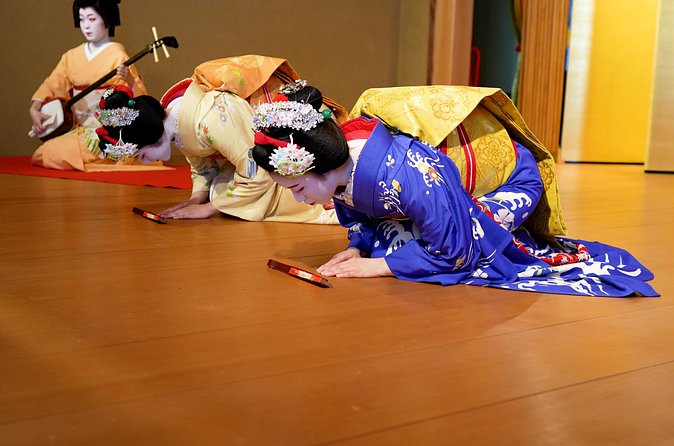
One of the evening’s strongest features is the entrance of the maiko and the jikata, the musician who provides live shamisen accompaniment. The maiko then performs on the Noh stage.
The live shamisen changes the mood immediately. Recorded music can make a cultural presentation feel packaged. A musician playing in the room gives the dance a human rhythm and lets you hear the relationship between movement and sound.
The program includes multiple dance performances. This is useful because one short dance can leave you wanting more, especially if you are interested in the gestures, posture, and costume. The setting also lets you watch at close range without the distance of a large theater.
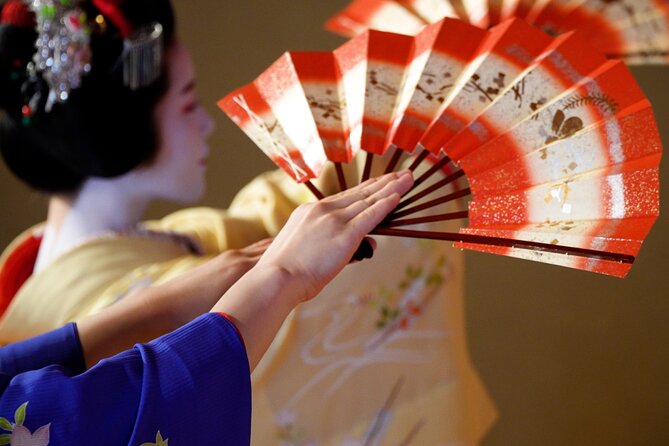
You may notice that the dance is restrained rather than showy. That is part of the point. Maiko performance depends on precision, suggestion, and control. The appeal is not acrobatics or speed. It is the careful handling of fan, sleeves, posture, and expression.
Photography is part of the evening, but be respectful during the performance. The activity specifically provides a later two-shot photograph, so you do not need to spend the dance holding your phone in front of your face.
Same base, a different sort of day:
- PERFECT KYOTO 1-Day Bus Tour
★ 5.0 · 13,518 reviews - Kyoto: Fushimi Inari, Kinkakuji, Bamboo Grove 1 Day Bus Tour
★ 4.8 · 4,316 reviews - Kyoto: Tea Ceremony in a Traditional Tea House in Kiyomizu
★ 4.9 · 3,519 reviews - Kyoto: Tea Ceremony Ju-An at Jotokuji Temple
★ 4.9 · 3,207 reviews
Introductions, questions, and the details of costume
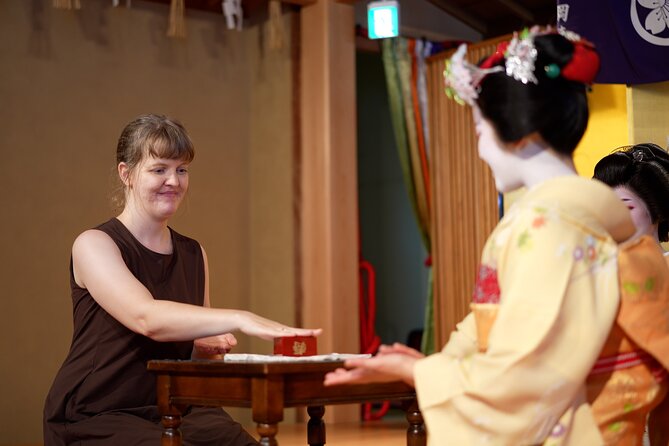
Following the dance, the maiko and participants introduce themselves. A Kyoto-certified interpreter guide helps bridge the language gap, which is important here. The best part of the evening may be the opportunity to ask questions rather than simply observe.
There is also a presentation about the kimono and kanzashi. These details are easy to miss when you see a maiko on a street from a distance. In a formal setting, you can ask about what she is wearing and why the appearance is so carefully arranged.
The information provided does not name the individual maiko, musician, or interpreter in advance. That means you should judge the experience by its format rather than expecting a particular performer.
The question period is also where the evening becomes personal without becoming intrusive. You can learn about the life of a maiko and the traditions connected to the role. The interpreter helps make the exchange useful for English-speaking visitors, rather than leaving you to rely on gestures or a few prepared facts.
I would prepare two or three thoughtful questions before arriving. Ask about training, performance, clothing, music, or the difference between a maiko and a geiko. A little preparation can turn a short question period into one of the most memorable parts of the night.
The two-shot photograph on the Noh stage
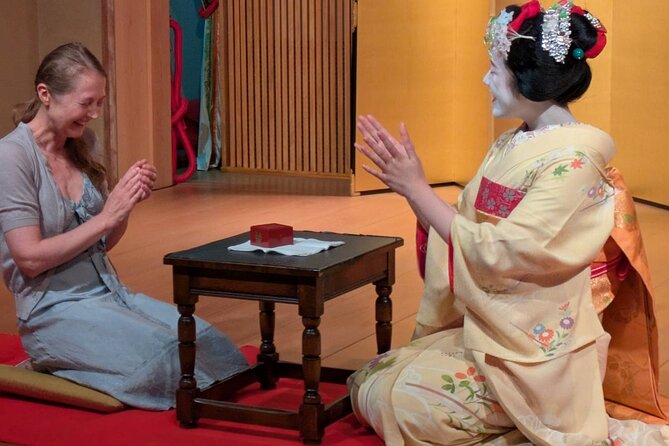
Each participant has time for a two-shot photo with the maiko on the Noh stage. This is more organized than trying to catch a passing photograph on a Kyoto street, and it gives you a clear keepsake from the evening.
The setting matters. A photograph on the Noh stage records the full character of the experience: traditional architecture, formal costume, and the performer who hosted the evening. It is also a practical advantage for families or couples who want one good picture together.
You should follow staff directions and keep the photo session moving. With a maximum of 20 people, the process is more manageable than it would be in a large hall, but every person still has limited time.
The program also allows conversation with the maiko. That time may be brief, but it is more meaningful than a simple posed photograph. You can say thank you, ask a question, and understand the person behind the formal performance.
Ozashiki games bring the evening down to earth
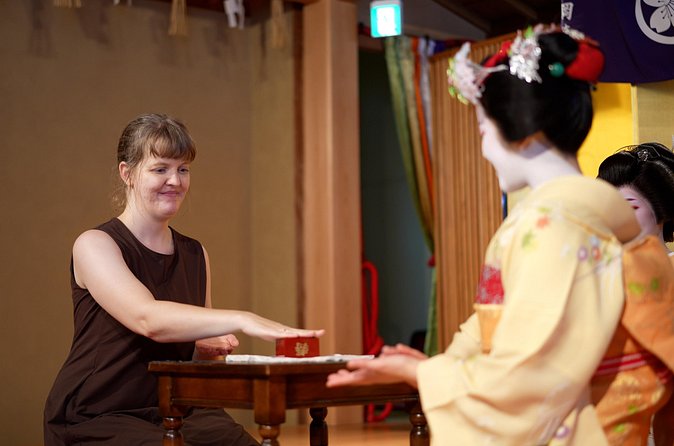
After the formal dance and introductions, the group takes part in ozashiki games on the Noh stage, with live shamisen music. These traditional party games show a different side of maiko hospitality.
The games are designed to be playful and social. You do not need to be an expert in Japanese customs to take part, and the interpreter and staff help explain what to do. This is useful because the rules may not be obvious at first.
I appreciate this portion because it prevents the evening from becoming stiff. The dance and costume presentation are polished and formal. The games add laughter, movement, and direct participation.
Still, the experience may feel more structured than a private party. You are joining a hosted group program, not stepping into an unscripted night with friends. That is a fair trade for access and clarity, especially if this is your first contact with Kyoto’s maiko culture.
Group size, timing, and practical comfort
The maximum group size is 20 people, and at least two participants are required. A group of up to 20 is not completely private, but it is small enough for a photo, introductions, questions, and games to have a reasonable chance of working well.
The program runs from 6 pm to 8 pm. That timing fits neatly into a Kyoto evening. You can arrive before dinner, enjoy the full program, and continue with your night afterward. The activity ends back at the meeting point.
Transportation from your home or hotel is not included. You need to make your own way to Okazaki-an, though the venue is near public transportation. Oversize luggage is not included in the arrangements, so leave large bags at your accommodation rather than bringing them to the Noh stage.
Most people can participate, but the activity information does not give detailed accessibility specifications. If you need particular assistance, contact the provider before booking.
The mobile ticket is convenient, and booking confirmation is provided at the time of purchase. Cancellation is free up to 24 hours before the start time. Within 24 hours, the payment is not refunded, and late changes are not accepted.
Is $150 a fair price?
At $150, this is a premium Kyoto evening. The cost makes more sense when you count the whole package: a traditional meal, unlimited drinks for two hours, live shamisen, several dance performances, interpreter support, direct conversation, an ozashiki game, and a two-shot photo.
It is not good value if you only want a quick glimpse of a maiko. In that case, you may prefer a public performance or cultural show with a lower ticket price.
It is stronger value for someone who wants personal contact and context. A dance alone can be lovely, but you may leave with little understanding of the performer or the customs. Here, the questions, costume explanation, games, and meal help connect the separate pieces.
The small-group limit also supports the price. You are not being placed in a huge auditorium where the maiko becomes a distant figure. The format is designed around proximity and exchange.
I would also compare the price with what a private teahouse experience might cost, though no alternative price is provided here. The important point is that this program gives you some of the atmosphere and interaction associated with an ozashiki gathering in a more accessible, fixed two-hour format.
Who will enjoy this experience most?
I would recommend it to you if Kyoto’s traditional arts are a major reason for your trip, especially if you want more than a performance from a distance.
It suits:
- First-time visitors who want a guided introduction to maiko culture
- Couples seeking a special evening with a memorable photograph
- Families with older children who can take part in questions and games
- Food lovers interested in Kyoto cuisine and formal presentation
- Visitors who do not speak Japanese and want interpreter support
- Anyone who values a small group over a large stage production
It may not suit you if you dislike scheduled programs, do not want a traditional meal, or prefer to explore Kyoto independently. It is also not the right pick if you expect a full private teahouse evening or an unscripted meeting.
Should you book the Kyoto maiko dinner?
Book this experience if you want a close, structured introduction to Kyoto’s maiko traditions and are willing to pay for the setting, food, live music, and personal exchange.
The strongest reasons to choose it are the live shamisen, the two dance performances, the interpreter-supported questions, and the ozashiki games. The dinner and unlimited drinks add practical value, while the Noh stage gives the evening a fitting sense of place.
Skip it if your budget is tight or if seeing a dance is enough for you. At $150, the interaction is the product. If you want to ask questions, take part, and leave with more than a performance photograph, this is a thoughtful choice for a Kyoto night.
FAQ
Where does the maiko dinner experience take place?
It takes place at Okazaki-an, at 9165 Okazaki Enshojicho in Kyoto’s Sakyo Ward, postal code 606-8344. The program is held on the second floor of a Noh stage.
What time does the experience start and end?
Doors open at 5:50 pm. The main program starts at 6 pm and ends at 8 pm.
What is included in the $150 price?
The price includes meals, unlimited drinks for two hours, maiko dance performances, live shamisen music, conversation time, ozashiki games, a two-shot photo with the maiko, and interpreter support.
Is dinner included?
Yes. A traditional Kyoto-style meal, described as kaiseki cuisine, is included.
Can I take a photo with the maiko?
Yes. The program includes a two-shot photo with the maiko on the Noh stage.
Do I need to wear socks?
Yes. Socks or tabi are required for the free photo time on the Noh stage. Bare feet are not permitted.
How many people can join the experience?
The maximum group size is 20 people. At least two participants are required for the experience to take place.
Can I cancel for a full refund?
Yes, if you cancel at least 24 hours before the scheduled start time. Cancellations or changes made within 24 hours are not refunded or accepted.
Just added in Kyoto
- Private Cooking Class Udon in Kyoto Japan★ 5.0 · 23 reviews
- Your Private Vacation Photography Session In Kyoto★ 5.0 · 110 reviews
- Kyoto: Zen Meditation at a Private Temple with a Monk★ 5.0 · 25 reviews
- Private Pewter Sake Cup Experience with a Kyoto Artisan★ 5.0 · 31 reviews
- Kyoto Wagashi(Japanese sweets) Cooking Class near Fushimiinari★ 5.0 · 60 reviews
- Private Guided Traditional Buddhist Cooking in Japan★ 5.0 · 16 reviews
- Kyoto: Gion Geisha District & Sake-in-Hand Walking Tour★ 5.0 · 37 reviews
- Kyoto:Family-Friendly Kimono & Yukata Experience at WARGO★ 5.0 · 147 reviews
Geisha & Gion District Tours, compared.

Kyoto Geisha Walking Tour: Gion District & Hidden Gems
Read our review →
Gion Geisha District Walking Tour – Stories of Geisha
Read our review →
Best of Kyoto: Gion, Geisha, Pagodas & Cobblestones
Read our review →
Kyoto Night Foodie Tour in Gion (9+ dishes + 6 Sake tastings)
Read our review →
Kyoto Gion: 2-Hour Geisha Culture & History Walking Tour
Read our review →
Chopsticks Making Workshop in Gion with Engraving Option
Read our review →
Browse the lists this tour appears in