
Reviewed · HIROSHIMA & MIYAJIMA DAY TRIPS
Hiroshima Peace Park & Atomic Bomb Dome Guided Walk
Hiroshima Peace Park is not simply a sightseeing stop. It is a carefully arranged place of mourning, education, and hope, where a short walk takes you from the Gates of Peace to the Atomic Bomb Dome and the exact point beneath the blast. I like that the route includes both major sights and quieter memorials, including the Korean Victims Memorial and the monument to Dr. Marcel Junod.
I also like the practical value: $21 includes a live guide and Peace Memorial Museum entry, a useful deal if you want context rather than a quick photo stop. Guide Adina is especially well suited to visitors who want technical detail, with one recent tour account noting his explanation of nuclear reactions. The main drawback is pace. Two hours is enough for an overview, but ten minutes at each listed stop leaves little time for long museum viewing or private reflection.
Key points at a glance
- Follow a focused two-hour route: Cover the park’s major memorials, museum, Peace Bell, Hypocenter, and Atomic Bomb Dome without arranging the sequence yourself.
- Hear more than dates and names: Adina can explain the events of August 6, 1945, as well as the basic science behind the atomic bomb.
- See lesser-known memorials: The Dr. Marcel Junod Monument and Korean Victims Memorial add important human detail beyond the best-known sites.
- Museum admission is included: You can enter the Peace Memorial Museum as part of the walk, though the scheduled museum time is brief.
- Choose from three guide languages: Tours are offered in English, Urdu, and Hindi.
- Plan for walking and sun: Wear comfortable shoes, carry water and sunscreen, and confirm accessibility before booking because the information gives conflicting guidance.
Beginning at the Gates of Peace
Meet at the Gates of Peace, in front of an Italian restaurant, at coordinates 34.3906308, 132.4516662. This is a useful place to begin because the gates introduce the park’s central idea: peace is a shared responsibility, not just a local memorial.
The opening explanation takes about ten minutes. I would arrive a little early, especially if you are relying on a phone map. The meeting point is specific, but a clearly marked public entrance can still be easy to miss in a busy city.
From here, the tour puts Hiroshima’s memorial sites into a human frame. The guide is not only pointing out objects. You are being shown how the park’s memorials connect victims, survivors, medical workers, children, and the international call for a world without nuclear weapons.
Other walking tours in Hiroshima people book:
- Hiroshima Historical Walking Tour – Why A-Bomb was Dropped
★ 4.8 · 893 reviews - Hiroshima Peace (Heiwa) Walking Tour at World Heritage Sites
★ 5.0 · 872 reviews - Hiroshima City 4hr Private Walking Tour with Licensed Guide
★ 5.0 · 437 reviews
Dr. Marcel Junod and the human response
The Monument of Dr. Marcel Junod honors a Swiss doctor who helped survivors after the bombing. This stop is valuable because it shifts the focus from military technology to emergency care and individual action.
A guide can explain why Junod’s work mattered in the terrible conditions after August 6, 1945. You may find this one of the more personal moments early in the walk. It reminds you that Hiroshima’s story includes international aid and medical courage, not only destruction.
Adina’s style appears especially useful here if you appreciate detailed explanations. His background as a PhD student and his ability to discuss nuclear reactions can add scientific context without leaving the human story behind. You can ask questions, though the short schedule means it is wise to keep them focused.
The Fountain of Prayer and the Flame of Peace
At the Fountain of Prayer, you pause for the victims of the atomic bomb. The fountain’s role is simple and direct: water is offered in memory of people who suffered from thirst and the effects of the blast.
This is a good point to slow down. The tour covers many sites, but not every stop needs a long lecture. A few quiet minutes can matter more than another string of dates.
The Flame of Peace carries a wider message. It represents the commitment to a world without nuclear weapons. Its symbolism becomes stronger after you have seen the memorials to the dead and heard about the suffering of survivors.
The route is outdoors, so conditions matter. Hiroshima can be hot and sunny, and the tour recommends water, sunscreen, and comfortable shoes. Bring a camera if you wish, but remember that this is a memorial setting. Photography should not become the main purpose of the visit.
What to expect inside the Peace Memorial Museum
The Peace Memorial Museum is the emotional center of the experience. Admission is included, and the guide introduces the history of August 6, 1945, within the larger story of Hiroshima.
The museum deals with the bombing and its effects in a direct way. Expect serious material rather than a light museum visit. You will get more from it if you allow yourself time to read and think instead of treating it as another quick attraction.
Here is the practical concern: the published route gives roughly ten minutes to this stop. That is enough for an introduction, but not enough for a thorough museum visit. If the museum is important to you, consider returning on your own after the guided walk. This tour gives you orientation and context. A separate visit lets you set your own pace.
Food and drinks are not allowed inside the museum. Keep snacks and water in your bag while indoors, and use them before entering or after leaving.
The museum can be difficult for younger children or anyone sensitive to war-related displays. The tour does not promise a softened presentation. Its strength is honesty, but that same directness may feel heavy.
Other long days west of Hiroshima:
- Peaceful Hiroshima & Miyajima UNESCO 1 Day Bus Tour
★ 5.0 · 5,309 reviews - Hiroshima: Hiroshima and Miyajima UNESCO Sites 1-Day Tour
★ 4.9 · 2,330 reviews - Hiroshima / Miyajima Full-day Private Tour with Government Licensed Guide
★ 5.0 · 1,298 reviews - Hiroshima in a Nutshell: Morning Bike Adventure
★ 5.0 · 524 reviews
The Cenotaph and National Peace Memorial
The Hiroshima Victims Memorial Cenotaph is one of the park’s central memorials. It honors those who died and those whose lives were affected by the bombing. The guide helps you understand the memorial’s place within the park rather than leaving you to read a plaque without context.
The Hiroshima National Peace Memorial adds another layer of remembrance. Together, these sites show how Hiroshima remembers both known and unknown victims.
I appreciate this part of the route because it prevents the visit from becoming a single famous photograph. The Atomic Bomb Dome receives most of the attention, but the cenotaphs are where the park’s purpose becomes clear. You are encouraged to remember people, not just an event.
The pace again is worth noting. Ten minutes can be enough for an explanation and a pause, but not for lengthy independent reflection. If you prefer a quiet, unhurried visit, plan extra time after the tour.
Children’s Peace Monument and the Korean Victims Memorial
The Children’s Peace Monument honors young lives lost in the bombing. It is also tied to the wider memory of children affected by the disaster. This stop often gives the tour a different emotional tone, especially after the museum and adult memorials.
The Korean Atomic Bomb Victims Cenotaph is an important inclusion. It honors Koreans who died in Hiroshima, a group that can be missed when visitors focus only on the city’s Japanese victims.
I consider this one of the strongest parts of the route. It broadens your understanding of who was in Hiroshima in 1945 and why remembrance must include people from different communities. The guide’s role matters here because the significance may not be obvious from the monument alone.
These two stops are also a reminder that the park is not built around one single story. It remembers children, medical workers, foreign residents, civilians, and people whose names may never be known.
Ringing the Peace Bell
The Peace Bell offers an active moment during a mostly reflective walk. You can ring it as a gesture for global harmony.
That small action helps break up the sequence of memorials without turning the visit into entertainment. It gives you a way to participate in the park’s message instead of only listening to explanations.
The route also includes the Peace Tower. The supplied details do not specify how much time is spent there or whether a separate interior visit is involved, so treat it as a brief guided stop unless your guide explains otherwise. The same applies to one unnamed itinerary point. The included sights identify the Peace Tower and Hypocenter Monument, but the exact timing between them is not fully clear.
The Rest House and the final approach
The Rest House is included as a historic stop. It offers another connection between everyday life and the bombing, showing that the park was once part of an active city rather than an isolated memorial zone.
This kind of stop is easy to pass without a guide. You may see a building and move on. A short explanation gives it meaning and helps you picture the area before the bombing.
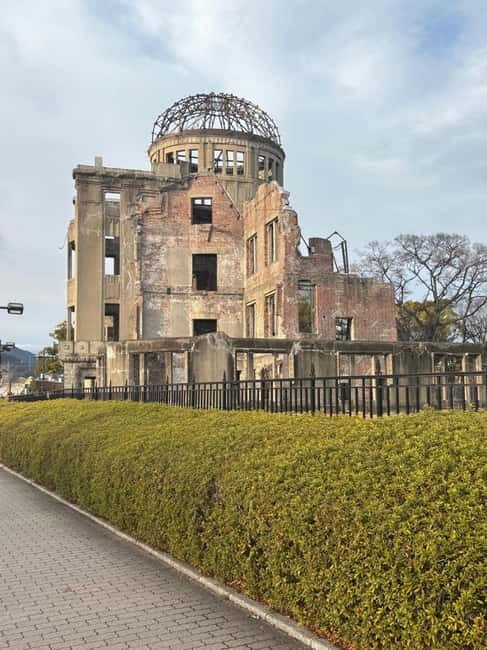
The tour then leads toward the Atomic Bomb Dome. Because several memorials come first, you reach the Dome with more context than you would get from a quick independent visit. The sequence makes the structure feel less like an architectural object and more like part of a larger account of Hiroshima.
The Atomic Bomb Dome and Hypocenter Monument
The Atomic Bomb Dome is the best-known sight in Hiroshima Peace Park. Its damaged frame is a powerful reminder of the blast and the destruction around it. The building was close to the hypocenter, yet portions remained standing after the bombing.
The tour ends with the Dome and the Hypocenter Monument, the marker for the point directly beneath the explosion. These are the stops that most clearly connect the physical city with the event described inside the museum.
At the Hypocenter Monument, you can pause and consider the scale of what happened. The site is not presented as a dramatic spectacle. Its power comes from the plain fact that this small point marks the center of the blast.
I like finishing here because the route moves from broad messages of peace to one precise location. You begin with global unity at the Gates of Peace and end at the place where Hiroshima changed forever. That structure gives the two-hour walk a clear shape.
How much value do you get for $21?
At $21 per person, this is a strong-value introduction to Hiroshima Peace Memorial Park. You receive a live guide, museum entry, and a route that includes more than the Atomic Bomb Dome. The price is especially fair if you want a guide to explain the memorials and connect them into one story.
The value depends on what you want from the museum. If you need a long, detailed museum visit, two hours will feel short. You may want to return separately, which means allowing extra time and possibly treating the guided walk as a first orientation.
If you prefer to explore every site alone, you can walk through the park without paying for a guide. The advantage here is structure and interpretation. You do not have to research the Dr. Junod Monument, Korean Victims Memorial, Peace Bell, or Hypocenter before arriving.
The tour is also flexible at the booking stage. You can reserve now and pay later, and cancellation is free up to 24 hours in advance for a full refund. Hotel pickup, drop-off, and meals are not included, but neither is needed for a compact city-center walk.
Guide style, languages, and pace
The live guide is available in English, Urdu, and Hindi. Adina is the named guide associated with this experience, and the information about his tours points to a patient, engaged approach. He has been described as taking time to explain details and offering more than a surface account of the park.
If you enjoy science, ask about the nuclear reaction behind the bomb and its effects. If you prefer human stories, ask about survivors, medical aid, children, and the people represented by the memorials. A good guide can adjust the emphasis, though the schedule limits how long any one topic can last.
The tour covers many stops in two hours. That means a steady walking pace and short explanations. You should not expect a slow photography walk or a long seminar at each monument.
Who should book this Hiroshima walk?
I would recommend it to a first-time visitor who wants a clear introduction to Hiroshima’s memorial district. It suits you if you prefer learning the meaning of a place while you see it, rather than reading about each monument later.
It is also a good choice for visitors with limited time. The route reaches the park’s main memorials, museum, Peace Bell, Atomic Bomb Dome, and Hypocenter in one organized experience.
You may want another plan if you are mainly interested in an extended museum visit, private contemplation, or detailed photography. In that case, use this walk to get oriented, then return to the museum and park independently.
The accessibility information needs care. The activity details describe the tour as wheelchair accessible, but the same information says it is not suitable for people with mobility impairments or wheelchair users. Contact the provider before booking and ask about the actual walking surface, distance, museum access, and restroom arrangements.
Practical advice before you go
Wear shoes that you can walk in comfortably. The route includes numerous stops across the park, and the tour is not designed around long seated breaks.
Carry water and sunscreen. You can bring a camera, but use it thoughtfully around memorials and during moments of silence. Food and drinks cannot enter the museum.
Meet at the Gates of Peace in front of the Italian restaurant, using the supplied coordinates if needed. Hotel transportation is not provided, so you need to reach the meeting point on your own.
Keep your schedule open enough to return to the museum after the walk if you want more time with the exhibits. The guided portion gives you a meaningful framework, but ten minutes inside the museum is only a first look.
Should you book it?
Book this tour if you want a well-organized introduction to Hiroshima’s memorials, a live explanation in English, Urdu, or Hindi, and museum admission included for $21. The inclusion of the Korean Victims Memorial, Dr. Marcel Junod Monument, Peace Bell, and Hypocenter makes it more thoughtful than a simple Dome photo stop.
Skip it if you already know the park well or want to spend most of your day reading every museum display at your own pace. For most first-time visitors, though, the price, route, and human focus make this a sensible way to begin your Hiroshima visit. Give yourself extra time afterward, and approach the walk with patience. This is a place for understanding, not rushing.
FAQ
How long does the Hiroshima Peace Park tour last?
The guided walk lasts two hours.
What is the meeting point?
Meet at the Gates of Peace, in front of an Italian restaurant. The coordinates are 34.3906308, 132.4516662.
Is entry to the Peace Memorial Museum included?
Yes. Peace Memorial Museum entry is included in the activity.
Which languages are available?
The live tour guide is available in English, Urdu, and Hindi.
Can I cancel the booking?
You can cancel up to 24 hours in advance for a full refund. Reserve now and pay later is also available.
What should I bring?
Bring comfortable walking shoes, water, sunscreen, and a camera. Food and drinks are not allowed inside the museum.
More walking tours elsewhere in Japan
- Hiroshima Walking Tour Why A Bomb was dropped to Hiroshima
★ 5.0 · 347 reviews - Miyajima Half-day Trip Historical Walking Tour
★ 5.0 · 284 reviews - Hiroshima: History of Hiroshima Group Walking Tour
★ 4.8 · 266 reviews - Hiroshima: Food and Culture Guided Walking Tour with Dinner
★ 4.9 · 212 reviews
Just added in Hiroshima
- Iya Valley BROMPTON Slow Cycling Tour★ 5.0 · 28 reviews
- Iya Valley All Must-Sees Private Chauffeur Full-day Tour with a Driver★ 5.0 · 20 reviews
- Shore Excursion from Hiroshima Port : Private Tour in Hiroshima★ 5.0 · 17 reviews
- Hiroshima & Miyajima All-Inclusive Tour w/Licensed guide Pancho★ 5.0 · 54 reviews
- Okunoshima Rabbit Island Cycling Tour with Local Guide★ 4.5 · 17 reviews
- The Peace Memorial to Miyajima : Icons of Peace and Beauty★ 4.5 · 31 reviews
- Hiroshima Saijo Sake Tasting Tour with visit to 7 Breweries★ 5.0 · 104 reviews
- Hiroshima Private Tour with a Local – Highlights & Hidden Gems★ 4.5 · 24 reviews
Hiroshima & Miyajima Day Trips, compared.
Peaceful Hiroshima & Miyajima UNESCO 1 Day Bus Tour
Read our review →
Hiroshima and Miyajima UNESCO Sites 1-Day Tour
Read our review →
Hiroshima / Miyajima Full-day Private Tour with Government Licensed Guide
Read our review →
Osaka/Kyoto: Hiroshima Miyajima Bus Tour & Shinkansen Ticket
Read our review →
Hiroshima Historical Walking Tour – Why A-Bomb was Dropped
Read our review →
Hiroshima Peace (Heiwa) Walking Tour at World Heritage Sites
Read our review →
Hiroshima in a Nutshell: Morning Bike Adventure
Read our review →
Hiroshima City 4hr Private Walking Tour with Licensed Guide
Read our review →Browse the lists this tour appears in