
Reviewed · GEISHA & GION DISTRICT TOURS
Dance and Game with Maiko
Kyoto’s maiko are not just performers in beautiful kimono. They are trained entertainers whose dances use music, gesture, and seasonal themes to tell small stories. This short program gives you a direct look at that world, with two maiko dances, a traditional game, and a photo taken right beside a maiko.
I like the easy fit into a busy Kyoto day, and I like the personal touches: the game invites audience volunteers into the action, and everyone receives a Senjafuda lucky charm. The main caution is timing. Although the program is sold as 45 minutes, some people have found the formal portion closer to 30 minutes, with photos and chatting afterward.
Key points
- Two traditional dances: Watch graceful performances inspired by the seasons, love stories, and everyday Japanese life.
- A playful audience game: Volunteers can play directly with the maiko, while everyone else claps and watches.
- A close-up photo: Take a commemorative picture beside a maiko after the performance.
- A small Kyoto keepsake: Receive a Senjafuda charm before the maiko leaves.
- A central location: The venue is one minute from Exit 1 of Gojo Station on the Subway Karasuma Line.
- A compact schedule: The activity suits a packed sightseeing day, but it is held upstairs and the building has no elevator.
Meeting a maiko without giving up half your day
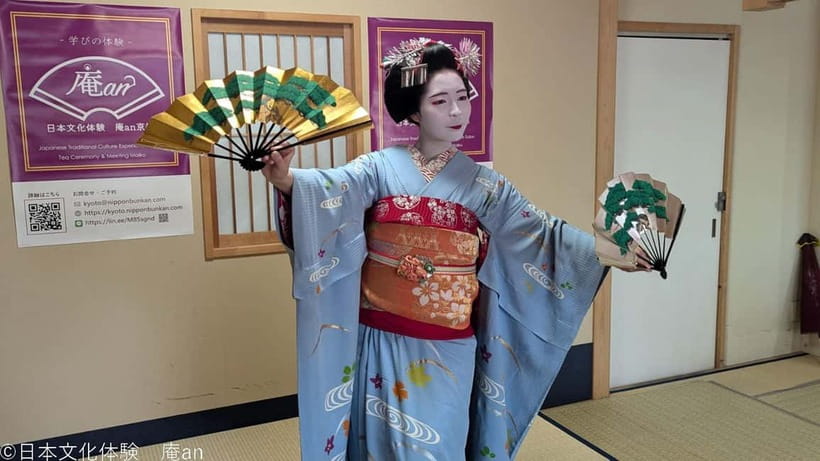
This is a short introduction to the world of maiko, not a long cultural workshop. That is part of its appeal. You can fit it between visits to Kyoto temples, an afternoon in Gion, or an evening meal without setting aside an entire day.
The meeting point is just one minute from Exit 1 of Gojo Station. Look for the entrance facing Gojo-dori, the main street. This is a useful location for anyone using Kyoto’s subway, especially if you want a simple route without a long walk through unfamiliar side streets.
The venue is inside a building, not an ochaya or traditional Japanese house. You should set your expectations accordingly. You will not be entering a historic tea house with tatami rooms and a private dining tradition. Instead, you will find a more relaxed setting with friendly staff and a program built for visitors who want a brief introduction to maiko culture.
That modern setting also makes the activity less intimidating. No special clothing, cultural knowledge, or preparation is required. You simply arrive, take your seat, and watch the program unfold.
Other evenings in the old entertainment quarters of Kyoto:
- Kyoto Geisha Walking Tour: Gion District & Hidden Gems
★ 4.7 · 3,273 reviews - Kyoto: Gion Magical Night Walking Tour with Geisha Trivia
★ 4.9 · 2,393 reviews - Kyoto: Gion Geisha District Walking Tour – Stories of Geisha
★ 4.7 · 2,187 reviews
Two dances that tell small Japanese stories
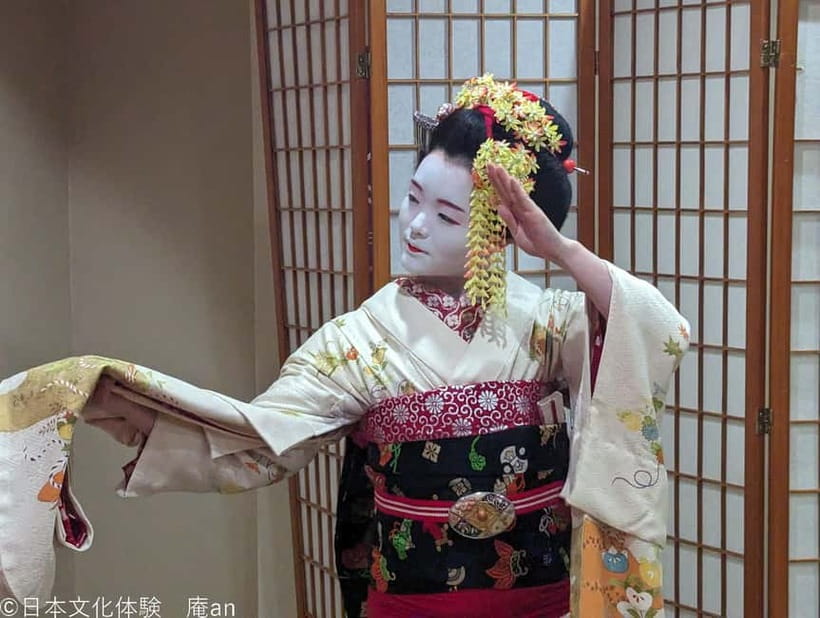
The formal performance begins with two maiko dances. Maiko dance is controlled and expressive rather than fast or theatrical in the Western sense. A small turn of the head, a carefully placed hand, or the movement of a fan can carry meaning.
The dances may portray the seasons, romantic stories, or ordinary scenes from Japanese life. You do not need to know the plot in advance to appreciate the precision. The music, costume, posture, and measured movements create the atmosphere.
This is also the part of the program when you will want your camera ready. The dances offer the clearest chance to photograph the maiko in performance, though you should follow any instructions from the staff about when photography is allowed.
I would not book this activity expecting a full explanation of every symbol or dance movement. The instructor is Japanese, and English translation can be provided as much as possible if you request it. Still, the central experience is visual: you watch the dance, listen to the music, and take in the details of the kimono and styling.
That makes the program a good match for first-time visitors who want to see maiko culture without committing to an expensive private dinner or a longer cultural program.
The traditional game brings the room to life
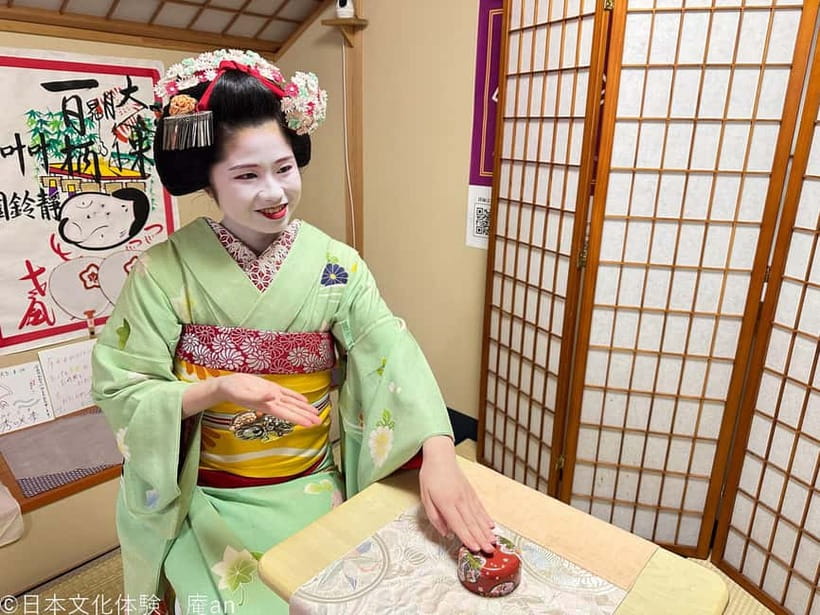
After the dances, the mood changes. The maiko plays a simple traditional game with selected audience volunteers. The game is designed to be easy to follow, and you do not need previous experience.
Only some people may take part directly, but watching is part of the fun. You can clap, cheer, and enjoy the friendly competition from your seat. The activity creates more contact between the maiko and the audience than a performance alone would provide.
If you are shy, you can simply watch. If you are traveling with children or friends, you may want to volunteer, but participation is not forced. This matters because the room can feel more personal than a large stage show. One practical point from the experience is that children may hesitate to join when several people are watching, so do not pressure them. The game is still entertaining from the audience.
The game also gives you a better sense of the maiko as an entertainer. The dances are formal and polished. The game is lighter, more social, and easier to share with the people sitting around you.
Photos and the Senjafuda keepsake
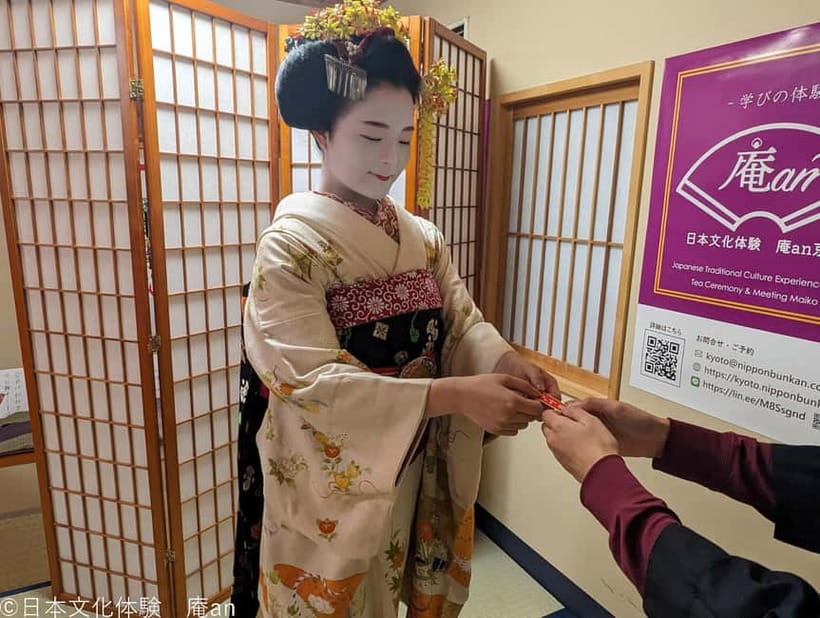
At roughly the 30-minute point, the formal program ends and the photo portion begins. You can take a commemorative picture beside a maiko, giving you a much closer encounter than you get from spotting one at a distance on a Kyoto street.
This is the moment many people will value most. A maiko sighting in Gion can be brief, and approaching someone on the street is not appropriate. Here, the photo is part of the planned experience, so you can enjoy the meeting without wondering about etiquette.
After the photo, the maiko presents a Senjafuda. A Senjafuda is a small paper charm or name card associated with traditional entertainment culture. In this program, it works as a compact souvenir of your time in Kyoto.
The maiko then leaves the room, followed by a period for chatting. The full schedule is described as 45 minutes, with the dance and game taking about 30 minutes, then photos, the charm, and conversation. In practice, the formal activity may feel shorter, around 30 minutes, depending on the pace of the group.
I would think of the 45 minutes as the complete appointment rather than 45 minutes of uninterrupted performance. That is still useful for planning, especially if you have a train, meal, or timed admission afterward.
Same base, a different sort of day:
- PERFECT KYOTO 1-Day Bus Tour
★ 5.0 · 13,518 reviews - Kyoto: Fushimi Inari, Kinkakuji, Bamboo Grove 1 Day Bus Tour
★ 4.8 · 4,316 reviews - Kyoto: Tea Ceremony in a Traditional Tea House in Kiyomizu
★ 4.9 · 3,519 reviews - Kyoto: Tea Ceremony Ju-An at Jotokuji Temple
★ 4.9 · 3,207 reviews
What the $28 price really includes
At $28 per person, this is priced as a short cultural encounter rather than a major sightseeing attraction. The fee covers the dance and game program, the close-up photo opportunity, and the Senjafuda charm.
The value depends on what you want. If you are looking for a long lesson about maiko training, a full tea ceremony, or an intimate meal in a traditional house, this is not the right program. The shorter format and building-based venue keep the experience simple.
If you want a direct introduction to maiko culture at a modest price, the calculation looks better. You receive two performances, a participatory activity, a photo, and a physical keepsake. You also avoid spending a whole evening or paying for a high-end dining experience.
The program may be held in a room where people are having lunch or dinner. That means the atmosphere can vary depending on the session. It also means you should not assume this is a completely private performance for your booking. The setting is designed to let people enjoy the program alongside a meal at times.
Children younger than two years old are free if they sit on a parent’s lap. If a child under two needs a seat or meal, the same fee as one person applies. Older children need their own paid place.
A short program with a few practical limits
The biggest practical issue is the stairs. There is no elevator in the building, and you must use stairs to reach the venue. If you have mobility concerns, contact the operator before booking rather than assuming the venue can accommodate you.
The instructor’s language is Japanese. English translation can be provided as much as possible if you request it, but the program is not presented as a fully English-language guided lesson. You can still follow the dance and game visually, though detailed explanations may be limited.
Arrive on time. The event cannot be held for late arrivals, regardless of the reason. Kyoto’s subway is convenient here, but allow enough time to find Exit 1 and locate the entrance facing Gojo-dori.
The operating hours are 10:00 to 17:00. Reservations received after 17:00 are processed the next day. This is useful to know if you are trying to arrange a last-minute booking in the evening.
Cancellation is free up to eight days in advance for a full refund. After the cancellation fee applies, changing the date or time can also bring a specified fee. The operator will not reimburse your travel costs if the booking is canceled, so check your plans carefully before committing.
How this compares with a tea ceremony
The program itself is clear about what it does not include. It is not a tea ceremony. If you want to prepare and drink tea with a maiko, you need to choose one of the separate tea ceremony programs, including the premium version.
That distinction matters. This activity focuses on watching dance, joining a game, taking a photo, and receiving the charm. A tea ceremony program would suit you better if the ritual of tea, the utensils, and the quiet structure of the ceremony are your main interest.
You can still learn something about maiko entertainment here, but the experience is lighter and more social. I would choose this one if you have limited time or if you want a first encounter before deciding if a longer cultural program appeals to you.
Who will enjoy this Kyoto experience most
This activity suits you if you want a quick, organized introduction to maiko culture. It works especially well for:
- First-time Kyoto visitors with a packed schedule
- Families who want a visual and interactive program
- Photographers looking for a planned close-up photo opportunity
- Visitors who want a small cultural experience near a subway station
- People who prefer a modest price over a full dining or tea ceremony package
It may be less suitable if you want a quiet, private, traditional-house setting. It is also not ideal if stairs are difficult for you or if you need a fully English-speaking instructor.
The game adds a useful choice for families. Children can watch if they do not want to volunteer, and adults can take part if they feel comfortable. Just remember that the room may not be large, and a child may feel shy about performing in front of several people.
A sensible way to fit it into your Kyoto plans
Give yourself enough time to reach Gojo Station, find the entrance, and climb the stairs. Since the program will not wait for delays, arriving at the last second is a poor plan.
You can schedule it before or after nearby sightseeing, but avoid placing a tight reservation immediately afterward. The formal portion may finish in about 30 minutes, while the photo, Senjafuda presentation, and chatting time bring the appointment closer to the advertised 45 minutes.
Keep your camera ready for the dances, then follow staff instructions during the photo session. The most useful souvenir is not large or costly, so this is easy to fit into your luggage.
The overall rating is 3.9 from 46 reviews, which fits the experience’s profile: the maiko, dances, game, and photo are the strongest elements, while the short duration and occasional gap between the advertised 45 minutes and the formal 30-minute portion are the main limits.
Should you book Dance and Game with Maiko?
Book it if you want a short, affordable, and easy-to-schedule meeting with a maiko. The two dances provide the cultural focus, the game adds warmth, and the photo and Senjafuda give you something tangible to remember the visit.
Do not book it expecting a full tea ceremony, a traditional ochaya, or a long stage performance. Think of it as a compact introduction in a modern building near Gojo Station.
For most visitors, the $28 price is reasonable if the photo and personal encounter matter as much as the performance. Check the stairs, language support, timing, and cancellation terms first. If those points work for you, this is a practical way to add a little traditional Kyoto to a busy day.
FAQ
Where is the Dance and Game with Maiko experience held?
The meeting point is one minute from Exit 1 of Gojo Station on Kyoto’s Subway Karasuma Line. The entrance faces Gojo-dori, the main street.
How long does the activity last?
The full appointment is scheduled for 45 minutes. The dance and game portion takes about 30 minutes, followed by photos, the Senjafuda presentation, and chatting time. The formal program may sometimes feel closer to 30 minutes.
How much does the experience cost?
The listed price is $28 per person.
What does the activity include?
It includes the Dance and Game with Maiko program, two maiko dance performances, the traditional game, a photo opportunity, and a Senjafuda charm.
Is the venue a traditional ochaya?
No. The venue is in a building rather than an ochaya or traditional Japanese house. It offers a relaxed atmosphere with friendly staff.
Is the activity offered in English?
The instructor is Japanese. English translation can be provided as much as possible if you request it.
Is the building accessible by elevator?
No. The building has no elevator, and you need to use stairs to reach the venue.
Can children join for free?
Children younger than two years old are free when sitting on a parent’s lap. If a child under two needs a seat or meal, the same fee as one person applies.
What is the cancellation policy?
You can cancel up to eight days in advance for a full refund. Cancellation fees apply after that point, and changing the date or time after a fee has been incurred may also result in a specified charge.
Just added in Kyoto
- Private Cooking Class Udon in Kyoto Japan★ 5.0 · 23 reviews
- Your Private Vacation Photography Session In Kyoto★ 5.0 · 110 reviews
- Kyoto: Zen Meditation at a Private Temple with a Monk★ 5.0 · 25 reviews
- Private Pewter Sake Cup Experience with a Kyoto Artisan★ 5.0 · 31 reviews
- Kyoto Wagashi(Japanese sweets) Cooking Class near Fushimiinari★ 5.0 · 60 reviews
- Kyoto:Family-Friendly Kimono & Yukata Experience at WARGO★ 5.0 · 147 reviews
- Private Guided Traditional Buddhist Cooking in Japan★ 5.0 · 16 reviews
- Kyoto: Gion Geisha District & Sake-in-Hand Walking Tour★ 5.0 · 37 reviews
Geisha & Gion District Tours, compared.

Kyoto Geisha Walking Tour: Gion District & Hidden Gems
Read our review →
Gion Geisha District Walking Tour – Stories of Geisha
Read our review →
Best of Kyoto: Gion, Geisha, Pagodas & Cobblestones
Read our review →
Kyoto Night Foodie Tour in Gion (9+ dishes + 6 Sake tastings)
Read our review →
Kyoto Gion: 2-Hour Geisha Culture & History Walking Tour
Read our review →
Chopsticks Making Workshop in Gion with Engraving Option
Read our review →
Browse the lists this tour appears in