
Reviewed · TEA CEREMONY EXPERIENCES
Cultural Activities :Kimono, tea ceremony, Calligraphy and Amulet
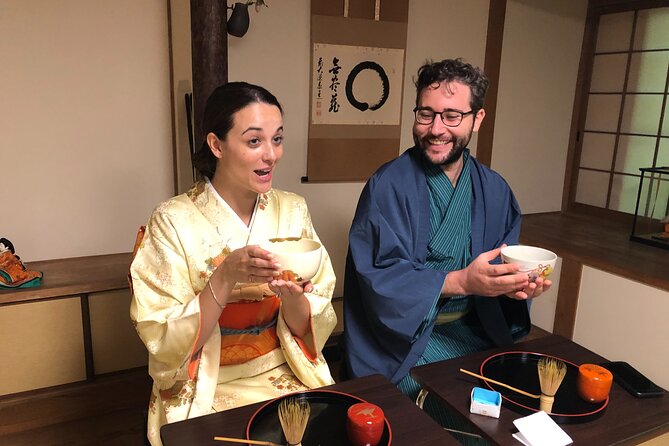
The unusual appeal here is the chance to try three hands-on Japanese customs in one short visit. You dress in a provided kimono and traditional apron, write your name in Japanese, prepare matcha, and make an amulet at Tokuju-ji Temple, a roughly 300-year-old religious site on Miyajima.
I like the mix of quiet learning and keepsakes. The emailed photos preserve the occasion, while the calligraphy and amulet give you something you made yourself. The small maximum group of 10 should also make the lessons easier to follow.
The main consideration is pace. With only about two hours and roughly half an hour for each activity, you will get a friendly introduction rather than a long study of any one art. At $171.73 per person, this is best value for someone who wants several cultural activities without spending separate days on them.
Key points to know before booking
- Three activities in about two hours: Calligraphy, tea ceremony, and amulet making are combined into one compact session.
- A 300-year-old temple setting: Tokuju-ji belongs to the Soto school of Zen Buddhism and is connected to Miyajima’s distinctive blend of Buddhist and Shinto traditions.
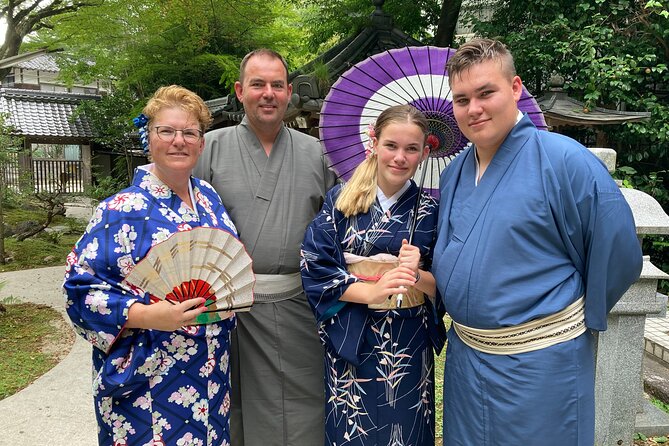
- Kimono included: You wear a provided kimono and traditional apron during the lessons, with time for photos in the garden.
- A personal amulet to make: Amulet making is less commonly offered than calligraphy or tea ceremony, giving this visit a different focus.
- Small group size: The activity accepts no more than 10 people, though the group may be smaller and can occasionally feel almost private.
- Flexible cancellation: You receive a full refund if you cancel at least 24 hours before the local start time.
Three Japanese traditions under one temple roof
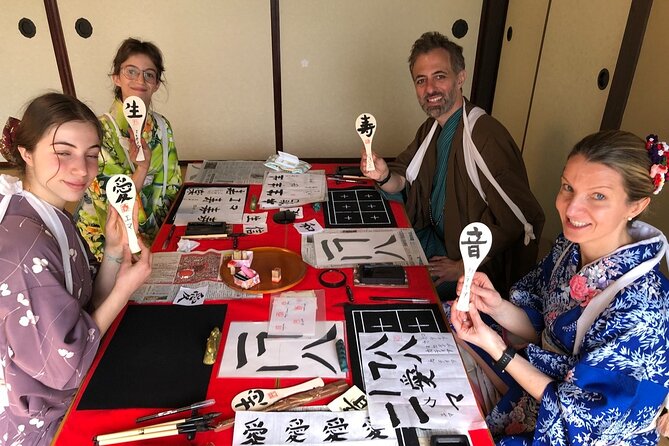
Many cultural activities ask you to choose one theme. This one gives you a sampler: calligraphy, tea, and amulet making. That makes it useful if your time on Miyajima is short or if different people in your group want different kinds of activities.
The session is built around participation, not just watching. You put on the clothing, hold the brush, prepare matcha, and work on the amulet. You should leave with a better sense of how much care goes into simple-looking Japanese customs.
The lessons take place at Okeiko Japan, at Tokuju-ji Temple. The temple was founded about 300 years ago and belongs to the Soto school, one of Japan’s major Zen Buddhist traditions. Its main Buddha is Kinseki Jizo, a protective figure associated especially with children and pregnancy.
That religious setting gives the class more weight than a studio activity in a shopping street. At the same time, you should understand what this is and is not. It is a practical cultural lesson held in a temple, not a formal religious service or an extended meditation retreat.
Other dressing and photo sessions in Hiroshima:
- Kimono and Tea Ceremony in Miyajima
★ 5.0 · 73 reviews - An Amazing set of Cultural experience: Kimono, Tea Ceremony and Calligraphy
★ 5.0 · 69 reviews - Kimono and Calligraphy Experience in Miyajima
★ 5.0 · 16 reviews
Putting on the kimono before class begins
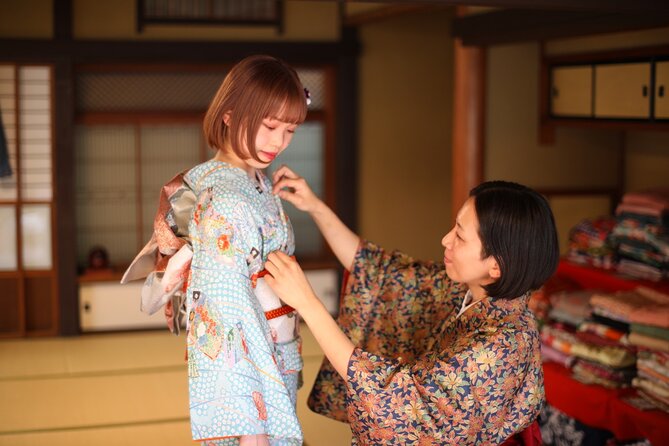
The kimono is not just a costume added for one photograph. You wear it during the activities, along with a traditional apron. That changes how the session feels, since each task takes place within a setting that looks and feels more ceremonial than ordinary clothing would allow.
The clothing can also be one of the most memorable parts for children and first-time visitors. The minimum age is 6, and children must be accompanied by an adult. Since the activities involve sitting, handling tea equipment, writing, and making an amulet, an adult should be ready to help a young child stay focused.
The exact dressing arrangements are not detailed, so you should not assume that the kimono fitting is a long standalone lesson. Think of it as preparation for the cultural session. You may arrive a little early if you want time to get settled, as one itinerary allowed for early arrival before the photo session.
The instructors take photographs during the activities and send them to you by email. This is a useful touch. You can pay attention to the lesson instead of asking a companion to document every step, and you receive a record of the kimono, garden, tea, and calligraphy portions afterward.
Calligraphy: more than writing your name
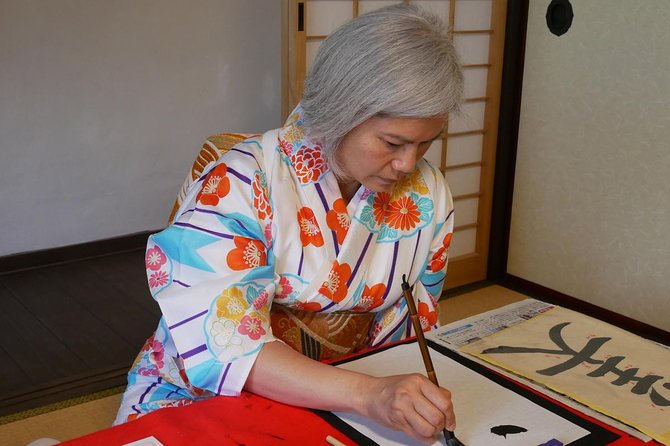
The calligraphy lesson teaches you how to write your name in Japanese. For most people, that means more than copying unfamiliar marks. You get a first look at how Japanese writing is formed, spaced, and presented on paper.
Calligraphy rewards patience. The brush is not used like a ballpoint pen, and the order and shape of strokes matter. A good instructor will help you slow down and treat each mark as part of the finished design. You should not expect to produce museum-quality work in half an hour, but you can create something personal and recognizable.
This part suits you if you enjoy making a souvenir rather than buying one. It also works well for families because the task has a clear result: your name in Japanese. If you have never held a calligraphy brush, expect a little fumbling at first. That is part of the lesson, not a problem.
The time limit keeps the activity approachable. You will not spend an entire morning repeating the same character, but you also will not receive a long technical lesson on Japanese scripts. The value comes from the direct experience and the chance to ask questions while you work.
The tea ceremony, prepared rather than performed
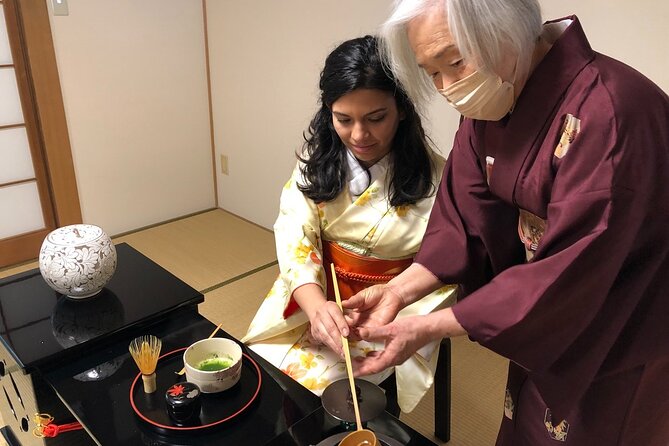
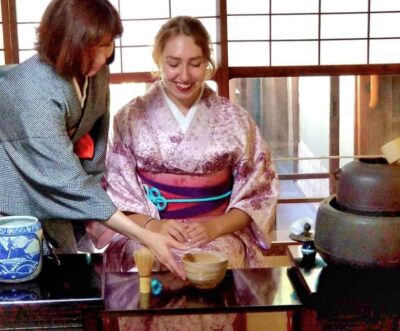
The tea ceremony is another hands-on lesson. You learn how to prepare matcha and take part in the ceremony instead of simply sitting in the audience. This gives you a practical sense of the deliberate movements and attention that shape Japanese tea culture.
The ceremony is often misunderstood as a quick cup of green tea. The important part is the process: preparation, posture, handling the utensils, and respect for the person sharing the tea. Even a short session can show you why the ritual has such a careful rhythm.
At roughly half an hour, this is an introduction. You will not study every school or rule of tea preparation, and the activity does not promise an advanced tea qualification. Still, it is long enough to make the customs feel real rather than decorative.
The kimono and temple setting help here. The clothing encourages you to move with care, while the temple gives the lesson a calm background. The instructors are described as personable and attentive, which matters because tea ceremony can feel stiff if instructions are rushed or overly formal.
Other tea rooms and ceremonies in Hiroshima:
- Hiroshima Local guided Hiking Tour&Open-air Tea Ceremony
★ 5.0 · 213 reviews - Hiroshima: Morning Hiking Tour with Open-air Tea Ceremony
★ 4.8 · 58 reviews - Kyoto: Tea Ceremony in a Traditional Tea House in Kiyomizu
★ 4.9 · 3,519 reviews - Kyoto: Tea Ceremony Ju-An at Jotokuji Temple
★ 4.9 · 3,207 reviews
Making an amulet at Tokuju-ji Temple
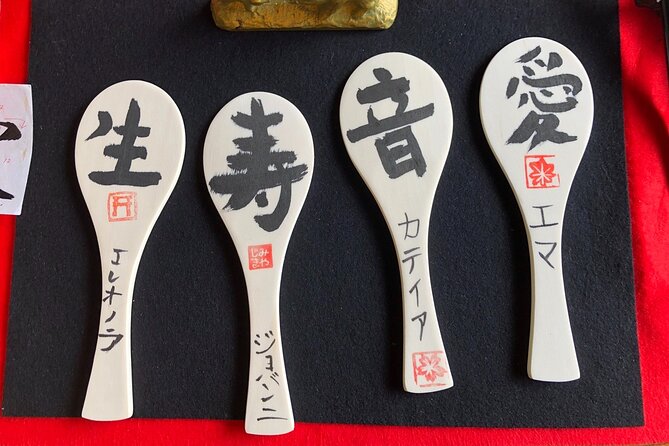
Amulet making is the most distinctive part of the program. Calligraphy and tea ceremonies are available in many Japanese destinations, but hands-on amulet making is less common. You create an item connected to the temple setting instead of purchasing a ready-made charm from a shop.
The activity also links directly to Tokuju-ji’s religious character. Kinseki Jizo is said to protect children and pregnancy. The temple’s story tells of an older couple who prayed to Jizo for a child, then had a healthy son and built the temple in thanks.
You should treat this story as part of the cultural context rather than as a guarantee of good fortune. The amulet is a personal souvenir with religious meaning, and the making process gives you a closer look at how protective objects fit into Japanese practice.
This section may be especially meaningful if you are interested in the everyday side of religion. Japanese temples and shrines are not only places for grand architecture or famous statues. They can also be places where people pray for health, children, safe journeys, and family well-being.
Why this temple setting adds value
Miyajima is strongly associated with Itsukushima Shrine and Shinto imagery. Tokuju-ji offers a chance to see another side of the island. The temple belongs to the Soto Zen school, yet the local religious setting reflects the way Buddhist and Shinto traditions have long existed alongside one another in Japan.
The activity information notes that some features at Miyajima’s temples may look like things you would expect at a Shinto shrine. That overlap is useful context for you. Japanese religious sites do not always fit neatly into Western categories, and a short lesson here can point out those connections without requiring a long lecture.
The temple was founded about three centuries ago, but the class is not presented as a full historical tour. You should book it for the activities first and regard the setting as an added benefit. If your priority is detailed temple architecture or a long guided history talk, this may feel too brief.
The gardens are another practical advantage. They provide a pleasant backdrop for photographs and a quieter atmosphere than a busy commercial venue. The setting helps make the visit feel tied to Miyajima rather than interchangeable with a workshop in another Japanese city.
Timing, group size, and the $171.73 price
The listed price is $171.73 per person for about two hours. That is not a low-cost craft class, but the fee covers several elements at once: kimono use, three activities, instruction, the temple setting, and photographs sent by email.
Value depends on how you would otherwise spend your time. If you planned to book separate kimono, tea, calligraphy, and craft activities, this combined format could save time and coordination. If you want only a quick kimono photograph or only a tea ceremony, you may pay for more than you need.
The compact schedule is a strength for a busy Miyajima visit. You can fit the session around other island sights, rather than giving up most of a day for one cultural lesson. The trade-off is depth. Each activity receives about half an hour, so the instructors need to keep the program moving.
The maximum group size is 10. That is small enough for questions and individual help, though it does not promise a private class. One booking became a private experience because of the day’s circumstances, but you should regard that as a possibility rather than something included in the price.
The activity has a mobile ticket and is near public transportation. Confirmation arrives at booking, and the meeting point is Okeiko Japan, 741-1 Miyamacho, Hatsukaichi, Hiroshima 739-0588. The session ends back at the same meeting point.
Who will get the most from this activity
I would recommend this experience to you if you want several cultural introductions in one sitting. It is particularly well suited to first-time visitors to Japan, families with children age 6 or older, couples, and anyone who wants a personal souvenir rather than another purchased object.
It also suits a cruise stop or a tightly planned Miyajima day. A short, fixed program is easier to fit around transport and sightseeing than a series of separate appointments. The emailed photos are helpful when you have limited time and want a record without arranging your own photo session.
You may want to skip it if you dislike dressing up, prefer unstructured temple visits, or want advanced instruction in one discipline. The program moves from one activity to the next, and the kimono and apron are central to the experience.
The session should be manageable for most people, since most participants can take part and it is near public transportation. Still, the provided information does not give detailed mobility guidance, seating arrangements, or clothing sizes. If you have specific needs, contact Okeiko Japan before booking rather than guessing.
Practical planning for your Miyajima day
Allow enough time to reach the meeting point. The address is in Miyajima, and the activity begins and ends there, so it is easy to connect with other plans on the island once you know your timing.
Arriving a little early can help you avoid starting the session in a rush. It may also give you time to settle into the kimono before the first lesson. Since the program includes photos, a calm arrival is better than racing in at the last minute.
Keep the cancellation rule in mind. You can cancel for a full refund up to 24 hours before the local start time. Cancellations or changes made less than 24 hours ahead are not refunded or accepted, so do not book this on a schedule that may change at short notice.
The activity is offered with a mobile ticket, and confirmation is provided at booking. Bring access to the booking details on your phone, and make sure you know the meeting address before setting out.
Is this two-hour Miyajima experience worth booking?
For the right person, yes. I like the way it combines a real temple setting, clothing, instruction, and a handmade souvenir rather than reducing Japanese culture to a quick photograph. The amulet class gives it a point of difference, while the calligraphy and tea ceremony make the program broad enough for a mixed-age group.
At $171.73, it is a considered purchase, not an impulse activity. Book it if you value structure, personal instruction, and several cultural experiences in one compact visit. Skip it if you want deep study of a single tradition or a simple low-cost workshop.
The strongest reason to choose it is efficiency without giving up participation. You get to wear the kimono, make the tea, write your name, create an amulet, and receive photographs afterward. For a short stay on Miyajima, that is a lot of cultural ground covered in two hours.
FAQ
Where does the cultural activity take place?
It takes place at Okeiko Japan, inside or at Tokuju-ji Temple in Miyajima. The meeting point is 741-1 Miyamacho, Hatsukaichi, Hiroshima 739-0588, Japan.
How long does the activity last?
The experience lasts approximately two hours. The three main lessons take roughly half an hour each, with time also used for changing and photos.
What activities are included?
You take part in Japanese calligraphy, a tea ceremony, and amulet making. You also wear a provided kimono and traditional apron.
Is the kimono included?
Yes. A kimono and traditional apron are provided for use during the activities.
Will photos be taken?
Yes. The teachers take photos during the lessons and send them to you by email.
What is the maximum group size?
The activity accepts a maximum of 10 participants. A private session may occur depending on the day’s bookings, but it is not guaranteed.
Can children participate?
Children age 6 and older can participate. Children must be accompanied by an adult.
Is the activity near public transportation?
Yes. The meeting point is near public transportation, according to the activity information.
Can I cancel for a refund?
You can receive a full refund if you cancel at least 24 hours before the experience start time. Cancellations and changes made less than 24 hours before the start time are not accepted or refunded.
More craft workshops in Hiroshima
- Calligraphy Workshop at Traditional Folk Craft Shop in Hiroshima
★ 5.0 · 26 reviews - Private Hiroshima Calligraphy: Create Your Own Kanji Art Souvenir
★ 5.0 · 12 reviews - Chopstick Making Workshop in Ginza
★ 4.8 · 1,366 reviews - Kyoto : Chopsticks Making Workshop in Gion with Engraving Option
★ 5.0 · 958 reviews
Just added in Hiroshima
- Iya Valley BROMPTON Slow Cycling Tour★ 5.0 · 28 reviews
- Iya Valley All Must-Sees Private Chauffeur Full-day Tour with a Driver★ 5.0 · 20 reviews
- Shore Excursion from Hiroshima Port : Private Tour in Hiroshima★ 5.0 · 17 reviews
- Hiroshima & Miyajima All-Inclusive Tour w/Licensed guide Pancho★ 5.0 · 54 reviews
- Okunoshima Rabbit Island Cycling Tour with Local Guide★ 4.5 · 17 reviews
- The Peace Memorial to Miyajima : Icons of Peace and Beauty★ 4.5 · 31 reviews
- Private Full Day Hiroshima Tour★ 4.5 · 29 reviews
- Hiroshima Saijo Sake Tasting Tour with visit to 7 Breweries★ 5.0 · 104 reviews
Tea Ceremony Experiences, compared.

Tea Ceremony in a Traditional Tea House in Kiyomizu
Read our review →

World Heritage Kyoto & Nara Uji Authentic Matcha Experience
Read our review →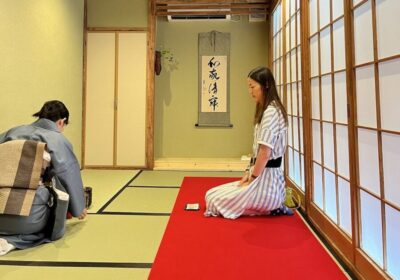
Arashiyama Bamboo Forest, Monkeys, Matcha & Temple Tour
Read our review →Browse the lists this tour appears in