
Reviewed · GEISHA & GION DISTRICT TOURS
Kyoto Geisha District Walking Tour in Gion
Gion is at its most atmospheric when the paper lanterns come on and the narrow lanes begin to quiet down. This two-hour walk takes you from Yasaka Shrine through old wooden streets, along the Shirakawa Canal, and past the tea houses where Kyoto’s geiko and maiko work.
I like the small group limit of 10, which makes it easier to ask questions and keep up in crowded lanes. I also like the guide-led explanation of geiko customs, since Gion can look like a pretty collection of old houses if you do not know what you are seeing.
The main caution is guide quality. Many guides, including Takuma, Yuko, Yoko, Tom, Yuji, Hide, and Eric, have earned strong praise for their warmth and clear explanations. A few tours have been less organized, with basic commentary, weak English, or too much attention given to group photos.
Key points before you book
- Two hours in central Gion: See several famous corners without spending a full day on a walking tour.
- A small group capped at 10: Easier to hear the guide and ask about geiko, maiko, shrines, and local customs.
- Yasaka Shrine begins the route: Get useful context about Shinto practice before entering Gion’s old streets.
- Gion Shirakawa and Tatsumi Bridge provide the best photos: Expect canals, wooden machiya houses, bridges, lanterns, and seasonal scenery.
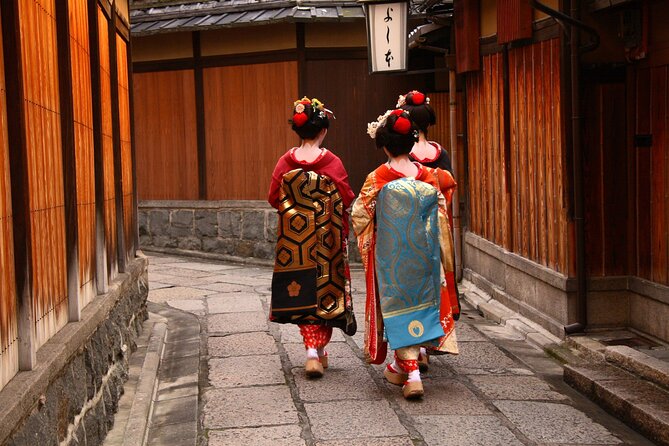
- Evening walks have the strongest atmosphere: You might see maiko or geiko heading to appointments, but sightings are never guaranteed.
- The tour returns to its starting point: Meet and finish at Gion Kōbu Kaburenjō, with no hotel transport or food included.
Why this Gion walk is worth your time
Gion is easy to admire and surprisingly easy to misunderstand. You see wooden facades, discreet entrances, lanterns, and people in kimono, but the district’s meaning is not always obvious from the street. A good guide connects those details to Kyoto’s geiko culture, Shinto traditions, and the working life of the entertainment quarter.
That is the real value here. You are not paying for admission to a monument. All the stops are free. You are paying for orientation, local context, and a route that brings together the most photogenic and culturally important parts of eastern Gion.
At $29.85 per person, the price is sensible for a two-hour guided walk, especially if you are visiting Kyoto for the first time. I would not book it simply to collect photographs of a shrine and a canal. You can do that alone. I would book it if you want someone to explain what geiko and maiko are, how Gion functions, and why the district looks the way it does.
The experience is mobile-ticket based, starts and ends at Gion Kōbu Kaburenjō, and runs in rain or shine. Wear shoes you can comfortably walk in. The route includes stairs, and the tour is not suitable for people who cannot manage going up and down them.
Other walking tours in Kyoto people book:
- Kyoto Geisha Walking Tour: Gion District & Hidden Gems
★ 4.7 · 3,273 reviews - Kyoto: Gion Magical Night Walking Tour with Geisha Trivia
★ 4.9 · 2,393 reviews - Kyoto: Gion Geisha District Walking Tour – Stories of Geisha
★ 4.7 · 2,187 reviews
Starting at Yasaka Shrine
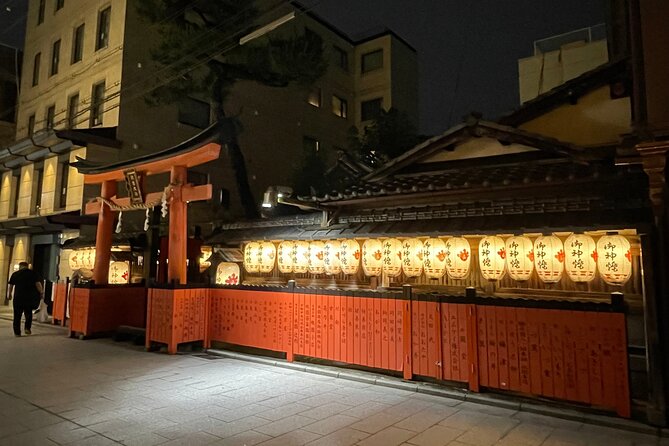
The walk begins at Yasaka Shrine, one of Kyoto’s best-known Shinto shrines. Its lanterns, gates, and bright architectural details offer a strong opening because the shrine is not just a pretty backdrop. It helps explain the religious setting around Gion.
Plan on about 40 minutes here. That is a generous portion of a two-hour tour, and it gives the guide time to discuss Shinto customs, the shrine’s role, and the connection between religious sites and everyday life in Kyoto.
I like starting here because it gives you something solid before the route moves into Gion’s more elusive geiko culture. You can look at the shrine’s buildings and lanterns on your own, but a guide can point out what deserves your attention and answer questions as they come up.
The stop is free, but it is not necessarily quiet. Yasaka Shrine is popular, and the atmosphere can change with the time of day. If you are hoping for a calm, empty photo, do not count on it. The value is the explanation and the setting, not guaranteed solitude.
Walking into Gion’s old lanes
From Yasaka Shrine, the route enters Gion. This first Gion section lasts roughly 20 minutes, though the precise pace depends on the group and the guide. Here, the main attraction is the change in atmosphere: broad shrine grounds give way to narrow lanes, wooden machiya houses, tea houses, restaurants, and discreet entrances.
This is where the guide’s skill matters most. Gion is not an open-air museum. It is a living neighborhood and a place where geiko and maiko work. You need context to understand that the people you might see are going to appointments, not posing for public entertainment.
Several highly praised guides, including Takuma, Yuko, Yoko, and Tom, have been singled out for making this part both friendly and informative. Takuma in particular has been praised for explaining customs with humor and energy. Yoko and Yuko have also been praised for making the walk comfortable while answering questions about the district and its traditions.
The less successful experiences point to an important risk: not every guide handles the route in the same way. Some commentary has been described as too basic, and one guide was criticized for focusing more on photographs than explanation. If you want serious cultural background, ask questions early and use the small group setting to steer the conversation.
Tatsumi Daimyojin and Tatsumi Bridge
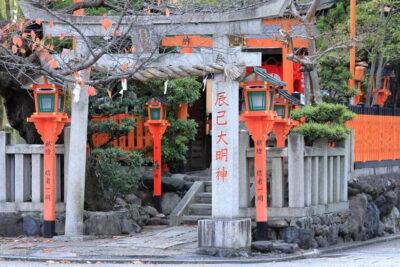
The short stop at Tatsumi Daimyojin Shrine lasts about five minutes. It is a small Shinto shrine associated with protection, good fortune, and safety. Its roots reach back to the Heian period, from 794 to 1185.
This is not a large sight that demands a long visit. Think of it as a pause that adds another layer to Gion. Yasaka Shrine introduces you to a major religious site. Tatsumi Daimyojin shows how smaller shrines fit into the daily life and beliefs of the neighborhood.
The next stop, Tatsumi Bridge, takes about 10 minutes. The bridge sits beside traditional wooden buildings and is one of the most recognizable corners of Gion. It has the sort of compact, carefully framed view that makes you understand why the district appears so often in photographs and films.
I would keep your camera ready here, but do not block the bridge or linger in the middle of the walkway. The charm comes from the combination of water, wood, and quiet scale. It is also a good place to ask the guide how this part of Gion differs from the larger streets nearby.
Other evenings in the old entertainment quarters of Kyoto:
- Best of Kyoto: Gion, Geisha, Pagodas & Cobblestones
★ 4.9 · 2,058 reviews - Night Walk in Gion: Kyoto’s Geisha District
★ 4.5 · 2,003 reviews - Kyoto Night Foodie Tour in Gion (9+ dishes + 6 Sake tastings)
★ 5.0 · 1,762 reviews - Kyoto Gion Geisha District Walking Tour – The Stories of Geisha
★ 5.0 · 1,441 reviews
Gion Shirakawa beside the canal
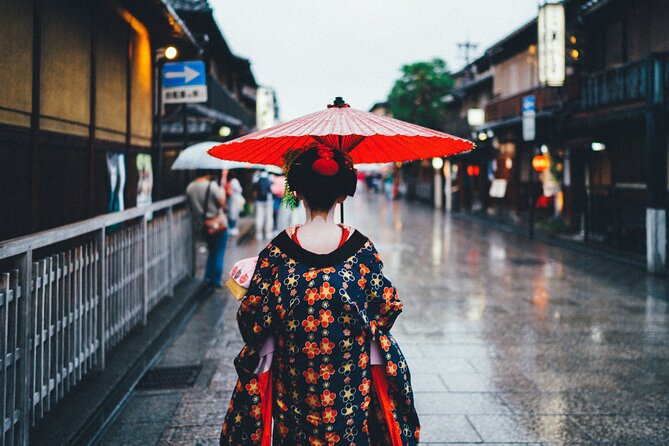
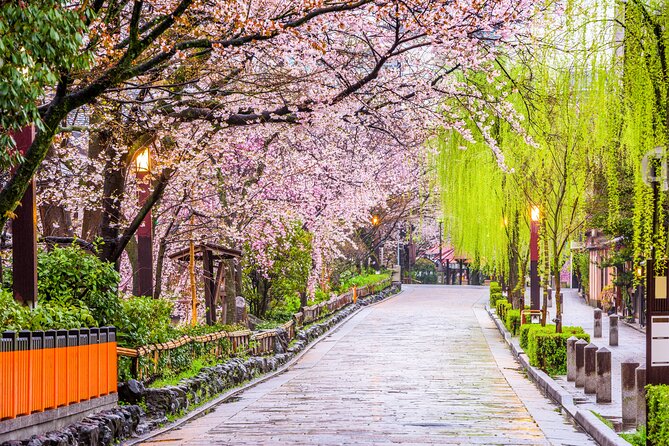
Gion Shirakawa, also called the Shirakawa Canal, is one of the prettiest sections of the walk. The waterway is lined with preserved wooden machiya houses and weeping cherry trees. In cherry blossom season, this can be especially attractive, but the canal remains a worthwhile stop outside spring because of its calm design and traditional buildings.
The itinerary gives no fixed duration for this stop, so your guide may fold it into the walk between Tatsumi Bridge and the next Gion area. That is useful to know. This is not a separate ticketed attraction or a formal visit with an entrance gate. It is a scenic stretch where the guide can help you notice details you might otherwise pass quickly.
This section also shows why an evening departure can work well. Lantern light and reflections along the canal can create a quieter mood than the busier streets. Still, do not assume the entire route will be peaceful. Gion remains a working district, and pedestrian traffic varies.
A second look at Gion
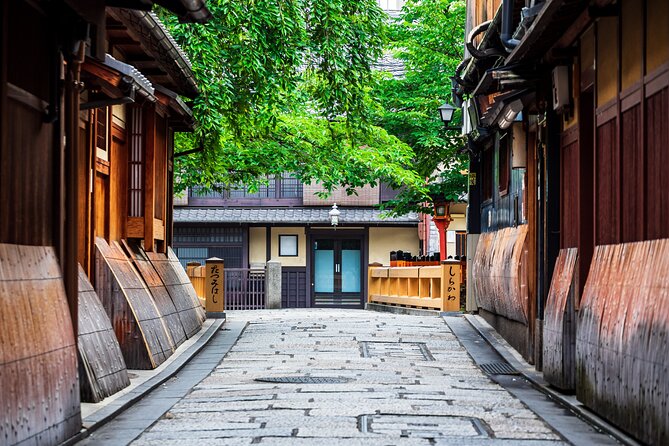
The tour then moves through another part of Gion for about 20 minutes. This second section matters because Gion is not one single street or viewpoint. It is a collection of lanes and pockets with different moods, from polished main roads to quieter back streets.
One especially useful element is the chance to walk away from the busiest city streets. Hide, one of the guides praised for his timing and area knowledge, led a group through quiet back lanes and happened to find a spot where geiko were leaving one engagement and heading to another. That kind of sighting can be memorable, but it depends entirely on chance and respectful timing.
Do not treat the possibility of seeing a geiko or maiko as the tour’s guarantee. The walk can be worthwhile even if you see none. The stronger reason to join is learning how the district operates and gaining a better sense of what you are looking at.
If you do see someone in traditional dress, follow the guide’s instructions. Do not chase, touch, block, or photograph people aggressively. Gion is a neighborhood, not a stage set, and good conduct matters more than getting one more picture.
Hanamikoji Street and Gion Corner
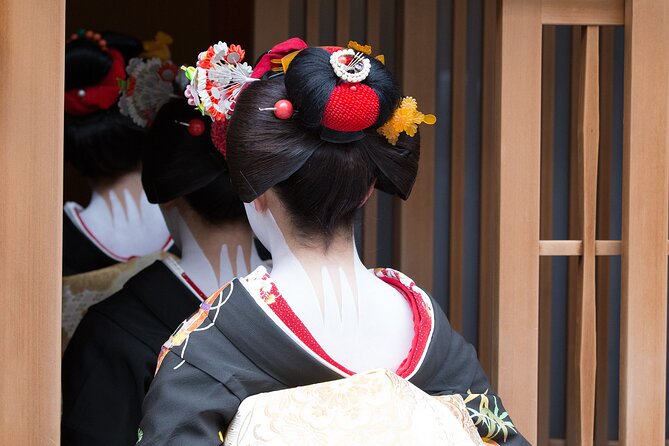
Hanamikoji Street is the main street in Gion and gets about 10 minutes on the route. Traditional machiya houses, tea houses, restaurants, and shops line the street, giving it the polished old-Kyoto appearance many people hope to find.
The stop is brief, so you will not have time to inspect every storefront. That is fine. The guide’s job here is to explain the role of Hanamikoji within Gion and help you understand what is behind the restrained facades.
Gion Corner is also included in the route description as a cultural venue presenting several traditional art forms. The information provided does not indicate that this walking tour includes an indoor performance or a ticket. Treat it as a point of interest rather than a guaranteed show.
That distinction matters. If you specifically want to watch traditional performances, confirm what is included when booking. This tour is designed as a walking introduction, not a full evening performance package.
What the two-hour timing feels like
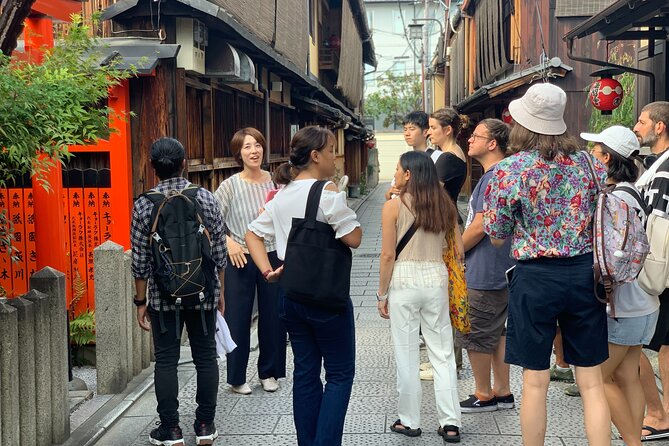
Two hours is enough to cover the main sights, but it is not enough for a leisurely exploration of every lane. You will move at a steady pace, stop for explanations, and take photographs along the way.
The compact schedule is useful if you are fitting Gion between other Kyoto plans. It also works well on your first day because the route gives you a basic map of the district. Afterward, you can return to the areas you liked best on your own.
The group size makes a real difference. With a maximum of 10 people, the guide can usually keep the walk personal, and you have a better chance of hearing explanations in narrow streets. Families have used the format successfully with children, including children aged 10, 11, and 13.
Heat is worth taking seriously. One guide described the experience as enjoyable despite very hot conditions, so bring water and dress for the forecast. Food, drinks, transportation to the meeting point, and hotel pickup are not included.
The meeting point is Gion Kōbu Kaburenjō, at 570-2 Gionmachi Minamigawa in Kyoto’s Higashiyama Ward. The tour returns there, and a guide can help you find your way afterward. It is near public transportation, but you are responsible for reaching the start.
The guide can make or break the experience
The most praised feature of this walk is not a particular building. It is the guide. Strong guides have made the district come alive with stories about geiko life, Shinto religion, the history of Gion, and the meaning of traditional customs.
Takuma has been praised for being friendly, funny, and passionate. He has also made an effort to communicate in Spanish. Yuko and Yoko have been praised for their pleasant manner and clear explanations. Yuji has been noted for his patience and warmth, while Tom has provided a useful introduction to shrines, religion, and geiko culture.
Eric has also been singled out for making geiko life interesting and showing how much more involved it is than many first-time visitors expect. These details suggest that the best version of the tour is conversational. You can ask questions instead of simply following a script.
But the mixed experiences deserve attention. One guide was described as disorganized, difficult to understand in English, and too focused on taking group photographs. Another tour was called fun but not very informative. If you prefer detailed history and polished delivery, there is some uncertainty because the guide may vary.
The tour provider is Japan Wonder Travel. The overall rating is 4.8 from 232 reviews, with 98 percent recommending it, which indicates a strong overall record but not a flawless one.
Who should book this Gion walk?
I would recommend it to first-time visitors who want a clear introduction to Gion without spending hours researching the district. It is also a good fit for families, couples, and solo visitors who like asking questions while walking.
You will get the most from it if you care about:
- Geiko and maiko customs
- Shinto shrines and local religious practice
- Traditional wooden architecture
- Evening atmosphere and photography
- A short route with several well-known sights
I would be more cautious if you want a private tour, a guaranteed geiko sighting, a formal performance, or a long historical lecture. This is a small-group walk, not a private deep-history seminar.
It can also suit repeat visitors. One person who had lived in Japan for years still learned new things about Gion and geiko life. That is a useful reminder that the district has more going on than its famous streets suggest.
Cancellation and practical details
You can cancel for a full refund up to 24 hours before the local start time. Cancellations or changes made within 24 hours are not refunded.
Children must be accompanied by an adult. The walk operates in all weather, so rain protection matters. If you select a kimono plan, you must walk from the kimono rental shop to the Japan Kanji Museum and Library, about five minutes away, and return the kimono by 5:30 p.m. The supplied details do not indicate that the kimono plan is part of every booking, so check your selected option carefully.
Should you book the Kyoto Geisha District Walking Tour?
Book it if you want a well-priced introduction to Gion with shrine visits, canal views, old streets, and an explanation of geiko culture. The two-hour format is efficient, and the small group keeps the experience more personal than a large coach tour.
Go with realistic expectations. You may see a maiko or geiko, but you may not. The route includes free public sights rather than paid attractions, and the quality depends heavily on the individual guide.
For the best chance of enjoying it, choose an evening departure if available, wear comfortable shoes, arrive ready to ask questions, and treat the people working in Gion with respect. At $29.85, I consider it a fair buy for first-time Kyoto visitors who want context rather than just a photo walk.
FAQ
How long does the Kyoto Geisha District Walking Tour last?
The tour lasts approximately two hours.
Where does the tour begin and end?
It begins and ends at Gion Kōbu Kaburenjō, 570-2 Gionmachi Minamigawa, Higashiyama Ward, Kyoto.
What places are included on the walking route?
The route includes Yasaka Shrine, several parts of Gion, Tatsumi Daimyojin Shrine, Tatsumi Bridge, Gion Shirakawa, Hanamikoji Street, and Gion Corner as a point of interest.
Is admission included?
The listed stops have no admission charge. Food, drinks, transportation to and from the meeting point, hotel pickup, and personal expenses are not included.
Can I see a geiko or maiko during the tour?
You might see a geiko or maiko, especially during an evening walk, but sightings are not guaranteed.
How many people can join the tour?
The tour has a maximum of 10 participants.
What happens if it rains?
The tour operates rain or shine, so you should dress for the weather and wear comfortable walking shoes.
More walking tours elsewhere in Japan
- Nishiki Market Brunch Walking Tour (7 Tastings + Brunch)
★ 5.0 · 1,355 reviews - Kyoto Arashiyama Walking Tour: Bamboo, Monkeys, Gardens & Secrets
★ 5.0 · 1,216 reviews - Kyoto Gion: 2-Hour Geisha Culture & History Walking Tour
★ 5.0 · 1,186 reviews - Kyoto: Izakaya Bars Guided Walking Tour
★ 4.9 · 815 reviews
Just added in Kyoto
- Kyoto: Private Photoshoot Service★ 5.0 · 158 reviews
- Kyoto Rickshaw Tour★ 5.0 · 210 reviews
- Izakaya Style Cooking Class★ 5.0 · 219 reviews
- Kyoto: Traditional Concert at Townhouse or Bathhouse★ 4.9 · 224 reviews
- Ninja 2-hour Hands-on Lesson by Japanese master in Kyoto -Medium★ 5.0 · 218 reviews
- Kyoto: Arashiyama Bamboo, Temple, Matcha, Monkeys & secret spots★ 5.0 · 219 reviews
- Kyoto: Gion & Pontocho Food Tour with 13 Dishes★ 4.9 · 235 reviews
- Kyoto: Afternoon Japanese Izakaya Cooking Class★ 4.9 · 241 reviews
Geisha & Gion District Tours, compared.
Kyoto Geisha Walking Tour: Gion District & Hidden Gems
Read our review →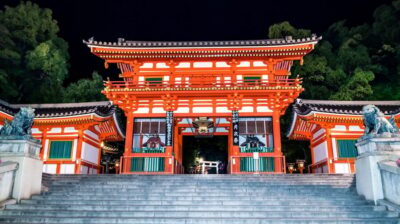
Gion Geisha District Walking Tour – Stories of Geisha
Read our review →
Best of Kyoto: Gion, Geisha, Pagodas & Cobblestones
Read our review →
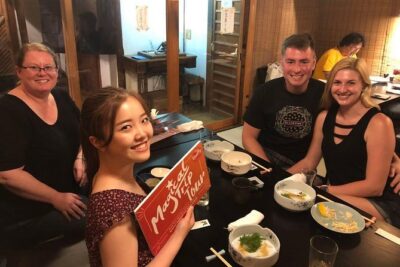
Kyoto Night Foodie Tour in Gion (9+ dishes + 6 Sake tastings)
Read our review →
Kyoto Gion: 2-Hour Geisha Culture & History Walking Tour
Read our review →
Chopsticks Making Workshop in Gion with Engraving Option
Read our review →
Browse the lists this tour appears in