
Reviewed · GEISHA & GION DISTRICT TOURS
Kyoto Geisha Show Cultural Hour with an apprentice geisha, Maiko
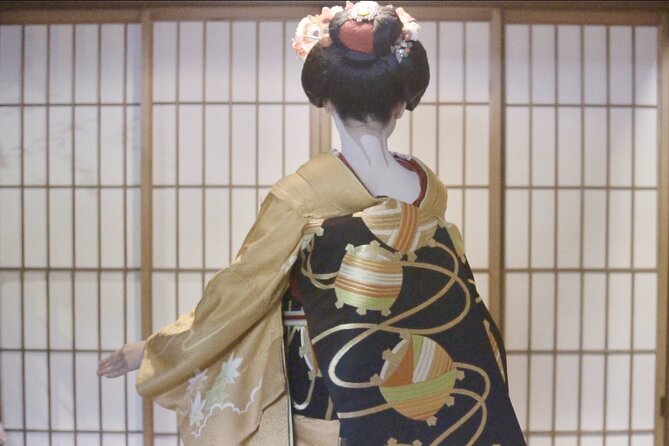
A maiko sighting in Kyoto is never guaranteed on the street, but this experience gives you a scheduled meeting with an apprentice geisha and a close look at her work. You’ll hear about training, customs, and daily routines, then watch one or two traditional dances in a small venue.
I like the direct question-and-answer time, which makes the culture easier to understand than a short stage show alone. I also like the English translation, especially with guides such as Ken and Saya, who help explain both the formal traditions and the small details of daily maiko life.
The main consideration is price: at $105.42 per person, this is not a casual add-on. Tea is not included, the booking is non-refundable, and the performance may be canceled if the weather is poor or the minimum group size is not reached.
Key points
- Meet a real maiko: You get a scheduled opportunity to speak with an apprentice geisha rather than hoping to spot one in Kyoto’s lanes.
- Ask questions through translation: An English-speaking guide explains the conversation and helps you ask about training, work, customs, and daily life.
- See traditional dancing up close: The maiko performs one or two songs and dances in an intimate setting.
- Small group size: The experience accepts no more than 14 people, keeping the meeting more personal than a large cultural show.
- Learn before the performance: The guide introduces geisha, geiko, and maiko traditions while walking through a geisha district.
- Allow about 90 minutes: The experience combines a district introduction, conversation, a game, dancing, and photographs.
Why this maiko meeting feels different from a standard Kyoto show
Kyoto offers plenty of ways to see traditional dance, but a stage performance alone can leave you wondering what happens before the curtain rises. This experience puts the conversation first. You meet an apprentice geisha, hear about her training and routine, and then see the artistic result in person.
That order matters. The dance becomes easier to read once you understand that a maiko is not simply a performer hired for an afternoon. She is an apprentice in a demanding traditional profession, with formal training in dance and other arts. The guide provides the context, while the maiko answers questions about her own life through translation.
You should also know the distinction between the terms. In Kyoto, geiko is the local term for a fully trained geisha, while maiko refers to an apprentice geiko. The meeting focuses on the maiko, so you are seeing someone still in training rather than a retired or costumed performer.
The experience is designed for people who want more than a photograph. You will have time to listen, ask questions, watch the performance, and take pictures at the end. That makes it a good choice if you value personal contact and explanation over a large-scale theater production.
Other evenings in the old entertainment quarters of Kyoto:
- Kyoto Geisha Walking Tour: Gion District & Hidden Gems
★ 4.7 · 3,273 reviews - Kyoto: Gion Magical Night Walking Tour with Geisha Trivia
★ 4.9 · 2,393 reviews - Kyoto: Gion Geisha District Walking Tour – Stories of Geisha
★ 4.7 · 2,187 reviews
Starting near Honmachi and the geisha districts
The listed meeting point is 5-chōme-182 Honmachi in Kyoto, near public transportation. The exact program begins at the front of a shrine, where the guide meets you and walks through part of the surrounding geisha district.
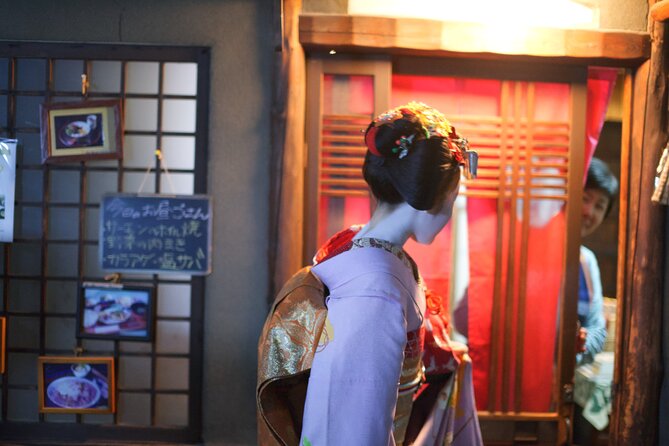
This short walk is useful because it gives the evening a sense of place. Guides have explained the difference between geisha, geiko, and maiko, along with the role of the theaters, agencies, and houses connected with the traditional entertainment districts. You may also pass the exteriors of places where entertainers work and meet clients.
Do not expect a long walking tour. The focus is the meeting and performance, not a full history walk through Kyoto. Still, the introduction helps you understand that these districts are working cultural areas, not open-air theme parks. The guide also gives basic information about how shows are arranged and how clients are traditionally introduced to entertainers.
Ken has been especially praised for making this background clear and approachable. Saya has also been noted for her gentle, careful translation and her ability to help families feel comfortable. The guide’s role is important here because the setting is formal, and the customs may not be obvious to someone seeing them for the first time.
You should arrive ready to follow the guide rather than treating the meeting point as the entire experience. Some people have had trouble finding the address, so keep your phone available and make sure you have the meeting instructions with you.
Inside the small tea house or performance room
After the district introduction, the group walks a short distance to a tea house or small theater. The room is described as cozy and pretty, which suits the scale of the experience. This is not a grand theater production with a large cast, orchestra, or elaborate stage effects.
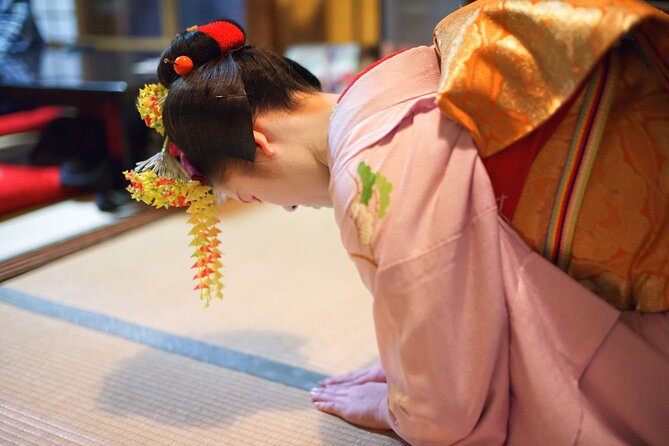
That smaller setting is one of the strongest reasons to book. With a maximum of 14 people, you are close enough to see the costume, movement, and facial expression without looking at a distant stage. You also have a better chance to ask a useful question and hear the answer clearly.
There is a trade-off. A small venue means the event depends heavily on the guide and the maiko on that particular date. The program is intimate rather than polished like a major public performance. If you want a large set, many performers, or a full evening of theater, this may feel modest.
Coffee and tea are not included, despite the tea-house setting. The room is part of the cultural environment, but you should not book this expecting a formal tea ceremony or a drinks service.
The question-and-answer session with the maiko
The conversation is the heart of the experience. Through the English-speaking guide, you can ask about the maiko’s training, working life, skills, schedule, and customs. The language barrier is handled by translation, so you are not left trying to communicate with gestures or a few memorized Japanese phrases.
This arrangement also keeps the conversation respectful. The guide explains the question, translates the response, and helps everyone follow along. The best questions are likely to be about daily routines, practice, professional expectations, and the path from apprentice to geiko.
The maiko has been described as charming and willing to answer questions. Some sessions have included a Japanese party game, which gives the meeting a lighter side and lets you interact without turning the event into a lecture. That detail is especially useful for families and small groups who want some participation rather than a strictly formal presentation.
You should keep in mind that the conversation is translated, so it moves more slowly than an ordinary chat. That is not a flaw, but it does shape the rhythm. You will hear a question, wait for the translation, listen to the answer, and then hear the English explanation. The payoff is access to a conversation that would otherwise be out of reach.
Photography takes place at the end, according to the experience details. Treat that as a closing opportunity rather than the main purpose of the meeting. The most meaningful part is the explanation and exchange before the camera comes out.
Same base, a different sort of day:
- PERFECT KYOTO 1-Day Bus Tour
★ 5.0 · 13,518 reviews - Kyoto: Fushimi Inari, Kinkakuji, Bamboo Grove 1 Day Bus Tour
★ 4.8 · 4,316 reviews - Kyoto: Tea Ceremony in a Traditional Tea House in Kiyomizu
★ 4.9 · 3,519 reviews - Kyoto: Tea Ceremony Ju-An at Jotokuji Temple
★ 4.9 · 3,207 reviews
One or two traditional dances, performed at close range

The maiko performs one or two songs and dances after the conversation. The dances are traditional, controlled, and precise, with the costume and gestures carrying much of the visual effect. In a small room, you can notice details that disappear in a large hall.
The dance portion is relatively short, but that is not unusual for an experience built around both discussion and performance. You are not buying a full evening show. You are paying for a compact introduction that combines personal contact with a live example of the art.
I would approach this part with patience. Traditional dance may look restrained if you expect fast movement or a dramatic stage routine. The appeal is in the measured gestures, posture, costume, and discipline. The guide’s earlier explanation helps you appreciate what you are seeing instead of waiting for a big theatrical climax.
The performance can be one of the most memorable parts of the hour and a half, especially because you have already spoken with the person performing. You are not watching an anonymous act. You have just learned about her training and work, so the dance carries more meaning.
What the $105.42 price buys you
At $105.42 per person, this is an expensive one-and-a-half-hour activity by ordinary sightseeing standards. You are not getting a meal, a long tour, or a full theater program. Tea is also excluded.
The value depends on what you want from Kyoto. If you only want to see traditional dance, a larger public show may offer more performance time for less money. If you want a personal meeting, translated conversation, a small group, and a guide who can explain the culture, the price becomes easier to defend.
You are paying for access as much as for the dance. A chance street sighting gives you a glimpse, but no conversation and no guarantee. Here, the maiko is scheduled to meet the group, answer questions, perform, and pose for photos. That combination is difficult to arrange on your own.
The group limit of 14 also affects the value. It is not a private booking, but it is far smaller than a major theater audience. A smaller group means less waiting for your question and a better view of the performance. Group discounts are available, so check the total price if you are booking for several people.
I would call it good value for a person who has a strong interest in Japanese arts and social customs. I would call it poor value for someone who mainly wants a quick photo or a long dance show.
Guides Ken and Saya make the translation matter
The guide is not just there to lead you from the shrine to the venue. The guide explains the setting, prepares you for the formal meeting, translates the conversation, and helps the group understand what is happening.
Ken has been specifically praised for his clear background explanations and friendly manner. He has also helped people find the meeting point when the address proved difficult, which is practical in a part of Kyoto where a small navigation mistake can cost you valuable time.
Saya has been described as warm, gentle, and supportive, with a good sense of how to keep the meeting respectful while helping people feel at ease. She has also helped families communicate with the maiko and offered broader Kyoto suggestions.
The guides are especially valuable if you have no Japanese. Without translation, the meeting would be mostly visual. With it, you can ask direct questions and learn details about training, customs, and everyday work that a performance alone cannot provide.
The exact guide may vary, so you should not book with the expectation that one named person is guaranteed. Ken and Saya are examples of the guide style available, not a promise of a particular assignment.
Who should book this Kyoto experience
I would recommend this for:
- First-time visitors who want a cultural activity beyond temples and gardens
- Couples looking for a memorable evening or honeymoon experience
- Families with older children who can listen respectfully and take part in questions
- People interested in traditional dance, costume, Japanese customs, and performing arts
- Anyone who wants a guaranteed maiko meeting rather than a chance encounter
- Small groups that can benefit from the available group discount
It may be less suitable if you dislike translated conversations, formal settings, or short performances. It is also not the best pick if your main goal is a tea ceremony, since tea and coffee are not included and the program is centered on the maiko meeting.
The event is listed as suitable for most people, and it is near public transportation. No special physical requirements are given, but the program does include a short walk from the meeting area to the venue.
Timing, booking, and the cancellation risk
The experience lasts about 90 minutes. That gives enough time for the district introduction, the meeting, questions, a game in some sessions, dancing, and photographs without taking over your entire day.
It is commonly booked about 44 days in advance, so I would not leave it until the last minute if the date matters to you. Kyoto schedules fill quickly, especially during popular travel periods.
The ticket is mobile, which is convenient. Confirmation arrives at booking, and the activity is available near public transportation.
The important catch is the cancellation policy. Your booking is non-refundable and cannot be changed for any reason. If poor weather causes cancellation, you can be offered another date or a full refund. If the minimum number of participants is not reached, you can also be offered another date or experience, or receive a full refund.
That policy makes the date choice important. Do not book this for the final few hours of your Kyoto stay if a change would ruin your plans. Leave some flexibility if possible.
Should you book the Kyoto maiko experience?
Book it if you want personal contact, careful translation, and a compact cultural program that explains the person behind the costume. The strongest parts are the question-and-answer session, the small group, and the chance to see one or two traditional dances after learning what maiko training involves.
Skip it if you want a large-scale show, a full tea ceremony, or the lowest-cost cultural activity in Kyoto. At $105.42, the price only makes sense when the meeting itself is the main attraction.
For the right audience, this is a memorable use of 90 minutes. You get a guaranteed meeting rather than a street sighting, a guide who can bridge the language gap, and a respectful introduction to a tradition that is difficult to understand from photographs alone.
FAQ
How long does the Kyoto Geisha Show Cultural Hour last?
The experience lasts approximately 1 hour and 30 minutes.
What is included in the experience?
The booking includes a one-hour geisha show and meeting with a question-and-answer session, a performance of one or two songs, and an English-speaking guide.
Is tea or coffee included?
No. Coffee and tea are not included.
How many people can join the group?
The experience has a maximum group size of 14 people.
Will an English-speaking guide be present?
Yes. An English-speaking guide provides translation and explains the maiko’s training, customs, and daily life.
Where does the experience meet?
The listed location is 5-chōme-182 Honmachi in Kyoto. The program begins near the front of a shrine before continuing to the performance venue.
Can I ask the maiko questions?
Yes. The program includes a question-and-answer session, with the guide translating between English and Japanese.
Is the booking refundable?
No. The experience is non-refundable and cannot normally be changed. If poor weather or an insufficient minimum group size causes cancellation, you may be offered another date or experience, or a full refund.
Is the experience suitable for most people?
Yes. The activity information says most people can participate, and the meeting point is near public transportation.
Just added in Kyoto
- Private Cooking Class Udon in Kyoto Japan★ 5.0 · 23 reviews
- Your Private Vacation Photography Session In Kyoto★ 5.0 · 110 reviews
- Kyoto: Zen Meditation at a Private Temple with a Monk★ 5.0 · 25 reviews
- Private Pewter Sake Cup Experience with a Kyoto Artisan★ 5.0 · 31 reviews
- Kyoto Wagashi(Japanese sweets) Cooking Class near Fushimiinari★ 5.0 · 60 reviews
- Kyoto:Family-Friendly Kimono & Yukata Experience at WARGO★ 5.0 · 147 reviews
- Private Guided Traditional Buddhist Cooking in Japan★ 5.0 · 16 reviews
- Kyoto: Gion Geisha District & Sake-in-Hand Walking Tour★ 5.0 · 37 reviews
Geisha & Gion District Tours, compared.

Kyoto Geisha Walking Tour: Gion District & Hidden Gems
Read our review →
Gion Geisha District Walking Tour – Stories of Geisha
Read our review →
Best of Kyoto: Gion, Geisha, Pagodas & Cobblestones
Read our review →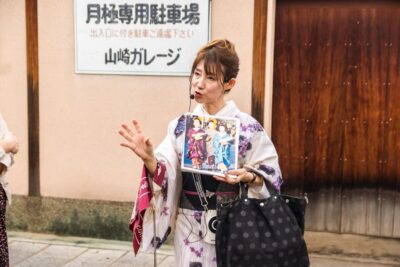
Kyoto Night Foodie Tour in Gion (9+ dishes + 6 Sake tastings)
Read our review →
Kyoto Gion: 2-Hour Geisha Culture & History Walking Tour
Read our review →
Chopsticks Making Workshop in Gion with Engraving Option
Read our review →
Browse the lists this tour appears in