
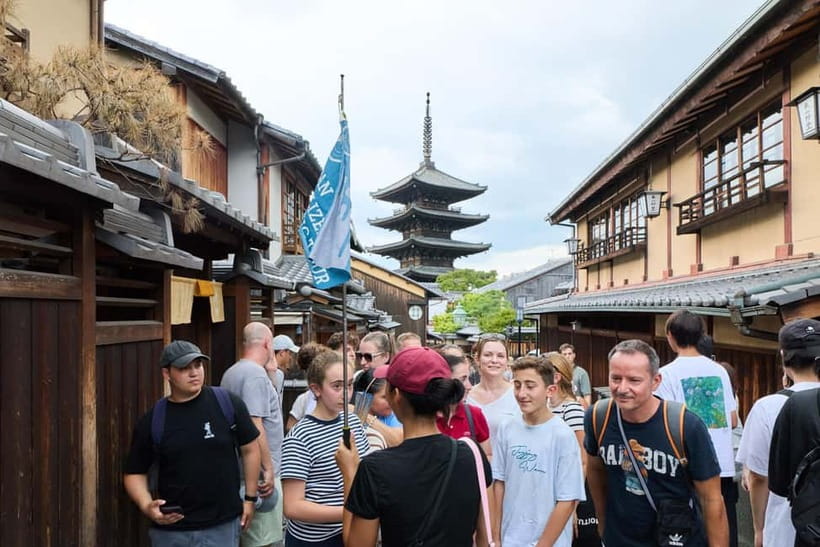
Reviewed · GEISHA & GION DISTRICT TOURS
Kyoto: Gion Geisha District Walking Tour and Hidden Gems
Gion is most rewarding when you look beyond the famous lanterns. This tour leads you from a cookie shop near Shijo into wooden townhouse lanes, quiet shrines, temple grounds, and the old streets climbing toward Kiyomizu-dera. I like the way it connects geisha customs with ordinary Kyoto life, and I like that guides such as Ben, J, and Jay bring in wider subjects, from samurai to the Shinkansen.
The route covers a lot in three hours, including Chion-in, Maruyama Park, Hōkan-ji, Ninen Zaka, and Sannenzaka. That reach is the main strength, but it is also the main drawback: there are many steps, and the pace may feel demanding if you have a low level of fitness.
Key points at a glance

- A route from Gion to Kiyomizu-dera: Begin near Shijo and finish at the Niomon Gate, so you cover a broad stretch of southern Kyoto without retracing your steps.
- Geisha culture explained with context: Learn about maiko and geisha training, work, and daily life rather than simply passing teahouses for photographs.
- Quiet corners between major sights: The walk includes small shrines, backstreets, and traditional wooden buildings that are easy to miss on a self-guided stroll.
- A strong history focus: Guides named Ben, J, and Jay have been praised for explaining Kyoto’s past and answering questions about modern Japanese life.
- A demanding but useful three hours: The route is efficient for first-time visitors, though stairs and uphill sections make water and sensible shoes important.
- Good value at $25: For a live English-speaking guide and several major cultural sights, the price is modest, especially if you want context rather than a quick photo stop.
Starting near Shijo and entering old Kyoto
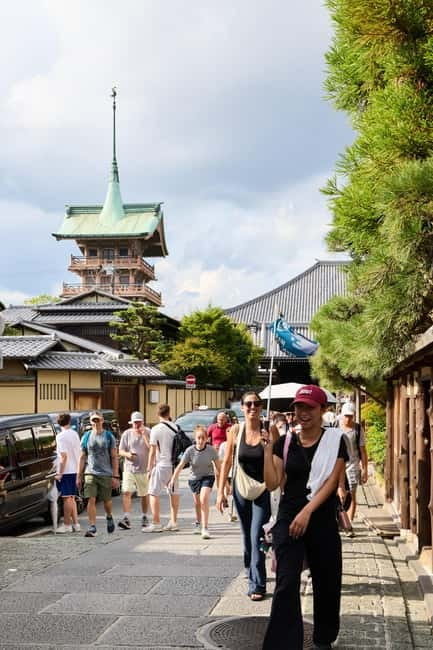
The meeting point is in front of Ben’s Cookies Kyoto Shijo. Your guide holds a sign, which keeps the start simple in a busy central area. From there, the first part of the walk sets the tone: you are moving away from modern shopping streets and toward the preserved lanes of Gion.
The starting location is practical rather than scenic. Do not expect the tour to begin at a grand temple gate. Its value is that you meet in an easy-to-find part of central Kyoto, then walk into the historic district instead of spending the first part of the tour arranging transport.
Your guide speaks English and leads the entire route on foot. Ben is named as one of the guides, while other experiences have been led by J or Jay. The strongest praise centers on their ability to explain difficult subjects clearly, answer questions, and connect what you see with wider Japanese history.
That matters in Kyoto. A wooden facade or stone lantern can look lovely without telling you much. A good explanation helps you understand why the street survived, how religious practice fits into daily life, and why Kyoto feels different from Japan’s larger modern cities.
Other walking tours in Kyoto people book:
- Kyoto Geisha Walking Tour: Gion District & Hidden Gems
★ 4.7 · 3,273 reviews - Kyoto: Gion Magical Night Walking Tour with Geisha Trivia
★ 4.9 · 2,393 reviews - Kyoto: Gion Geisha District Walking Tour – Stories of Geisha
★ 4.7 · 2,187 reviews
Gion Tatsumi Bridge and the world of geisha
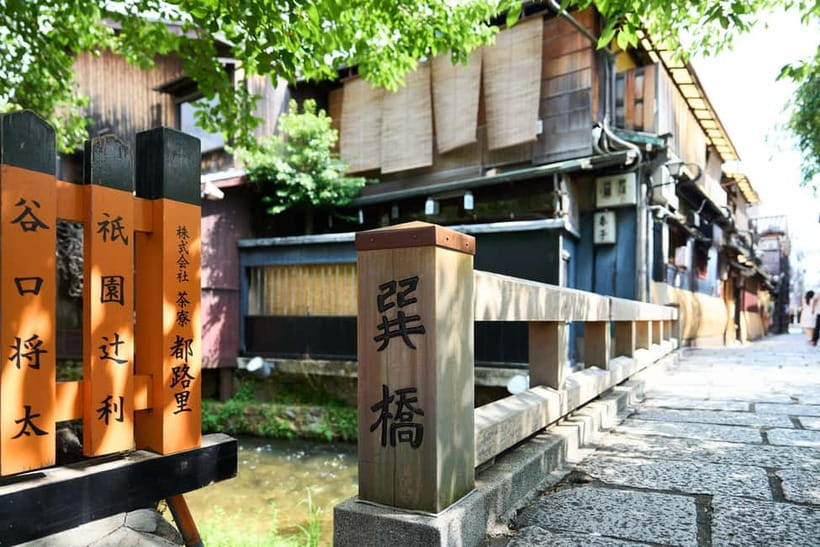
Gion Tatsumi Bridge is the first major scenic stop. It sits in one of Kyoto’s most recognizable traditional areas, with narrow lanes, old-style buildings, and a slower visual rhythm than the city’s main avenues. Your guide uses the setting to explain geisha culture, including the work and training of maiko and geisha.
This is the right place to get useful cultural context. The word geisha is often reduced to costumes and evening entertainment, but the tour aims to explain the discipline, customs, and professional life behind the image. You can ask questions about how the tradition fits into present-day Kyoto.
The bridge and surrounding lanes are also good for photographs, but remember that Gion is a lived-in and working neighborhood. The most respectful approach is to listen, keep moving when asked, and avoid treating people or private entrances as scenery.
The first stop receives about 20 minutes of guided attention. That is enough for a clear introduction without letting one famous corner swallow the whole morning or afternoon.
Chion-in, where scale changes the walk
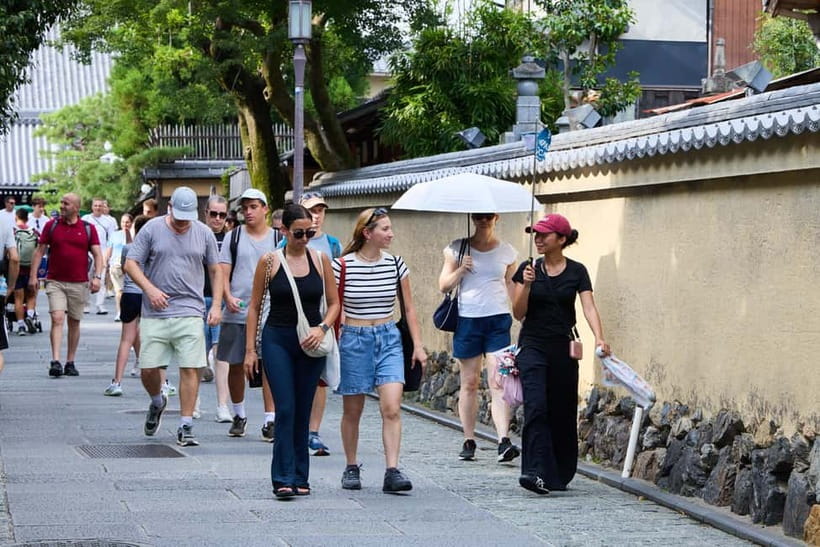
From Gion, the route continues to Chion-in, with about 30 minutes set aside for a visit. This is one of the larger and more imposing religious stops on the walk, and it gives the tour a change of scale after the tight lanes of Gion.
Here, your guide can place Kyoto’s religious traditions in a wider setting. The tour is not just a procession of photo spots. It explains how temples, shrines, rituals, and the old imperial capital shaped the city’s identity.
Chion-in also signals that this is a real walking tour, not a short neighborhood stroll. The route includes steps, uneven surfaces, and uphill walking. If you walk slowly or need frequent breaks, you should allow for the possibility that the three-hour schedule will feel full.
One useful feature is the guide’s flexibility with questions. Past tours have included discussion of everyday life in Japan alongside subjects such as samurai and the Shinkansen. That makes the stop more useful if you want to understand the country beyond the standard sightseeing script.
Maruyama Park and a slower pause
Maruyama Park receives roughly 20 minutes. The park gives you breathing room after the temple grounds and narrow streets, with space to pause while the guide continues the story of Kyoto.
I like this kind of stop on a walking tour. Three hours of continuous street movement can become tiring, especially in warm weather or during a busy sightseeing day. A park visit offers a natural point to rest, drink water, and absorb what you have seen.
The tour is designed to cover a lot of northern Higashiyama in one stretch. One guide has been praised for allowing rest when possible, which is useful because the route is long and includes several major areas. Still, you should not mistake a pause in a park for a full break. The tour continues on foot afterward.
Bring water. That is the only specific item listed, but it is an important one. Comfortable footwear is also a sensible choice because the route includes steps and traditional lanes.
Other evenings in the old entertainment quarters of Kyoto:
- Best of Kyoto: Gion, Geisha, Pagodas & Cobblestones
★ 4.9 · 2,058 reviews - Night Walk in Gion: Kyoto’s Geisha District
★ 4.5 · 2,003 reviews - Kyoto Night Foodie Tour in Gion (9+ dishes + 6 Sake tastings)
★ 5.0 · 1,762 reviews - Kyoto Gion Geisha District Walking Tour – The Stories of Geisha
★ 5.0 · 1,441 reviews
Hōkan-ji and the Yasaka-no-Tō view
The next stop is Hōkan-ji Temple, visited for about 10 minutes. The temple is especially associated with its tall Yasaka Pagoda, one of the most recognizable sights in the Higashiyama district.
This is a short stop, so expect an introduction and time to look around rather than a long temple visit. Its place in the route is smart: after the park, the walk returns to the compact old streets that make southern Higashiyama so photogenic.
You will likely notice how quickly Kyoto changes from open parkland to tightly packed traditional buildings. That contrast is one of the pleasures of the route. It also explains why a guide helps. The district can feel like a maze, and the story of the area is easier to follow when someone points out the connection between temples, shops, homes, and old travel routes.
The short timing is a limitation if Hōkan-ji is high on your personal list. You will not have the same amount of time here as at Chion-in. The tour is built for an overview of the area, not for extended visits inside every site.
Ninen Zaka and Sannenzaka: famous lanes with real foot traffic
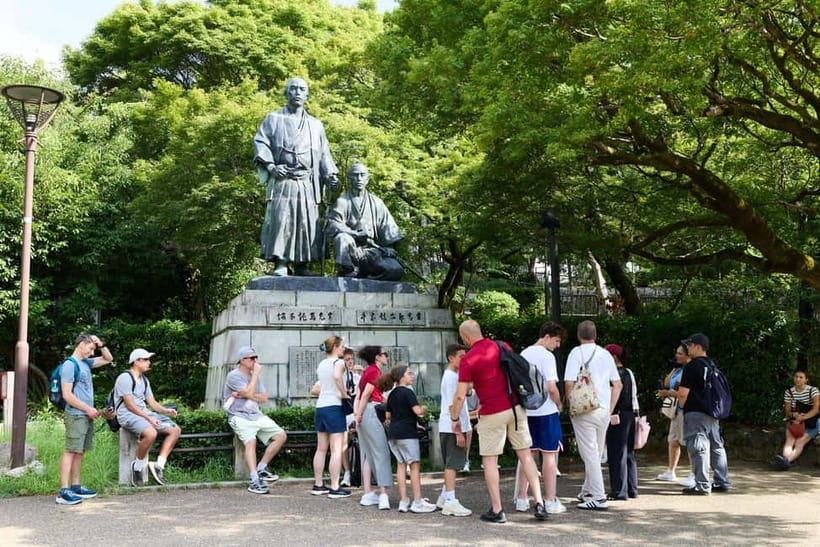
Ninen Zaka and Sannenzaka receive about five minutes each in the formal route. These sloping lanes are among Kyoto’s best-known traditional streets, lined with old-style buildings, shops, and places to stop for photos or snacks.
The short guided timing does not mean you are rushed through the entire area without value. Instead, the guide helps you understand the streets before you continue toward the finish. You can see how preserved townhouses and commercial life sit side by side.
These lanes are also where the tour may feel busiest. The route includes some of Kyoto’s most popular streets, so do not expect every moment to be quiet. The quieter experience comes from the side streets and smaller religious sites along the way, not from every section of Ninen Zaka and Sannenzaka.
The slopes and steps are worth taking seriously. They are manageable for many walkers, but the tour is specifically not suited to people with a low level of fitness. If you have knee trouble, balance concerns, or difficulty with hills, this is the point to think carefully before booking.
Finishing at Kiyomizu-dera’s Niomon Gate
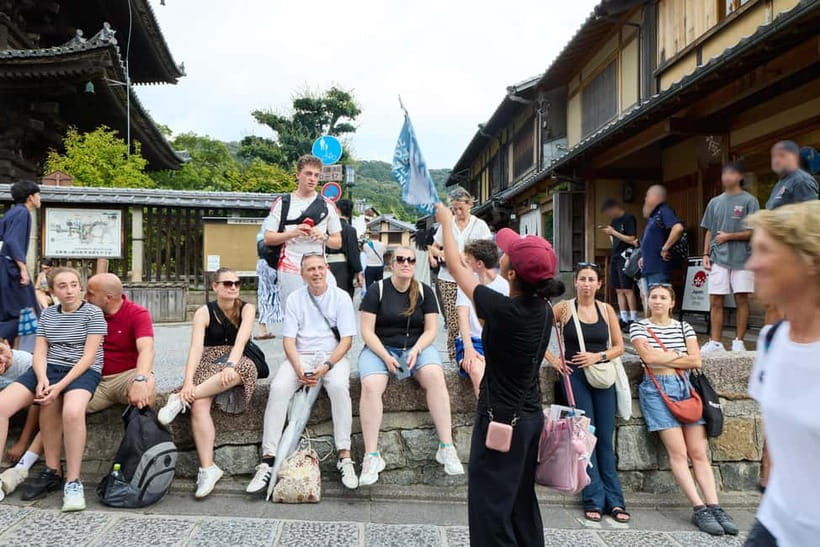
The tour ends at Kiyomizu-dera Niomon Gate rather than returning to the starting point. That is a useful design choice. You finish near one of Kyoto’s major attractions and can decide what to do next instead of walking back across the city.
The gate provides a memorable finale after the route through Gion and Higashiyama. One participant described the ending location as especially rewarding, and I can see why: the tour builds from neighborhood streets and cultural explanation toward one of Kyoto’s best-known temple areas.
The tour does not state that admission to Kiyomizu-dera is included. What is included is the guided walking tour, so check the temple’s own entry arrangements if you plan to continue inside after the tour.
Ending at the Niomon Gate also means you should plan your afternoon around that area. You can continue sightseeing, take photographs, or make your own way elsewhere, but transport back to the original meeting point is not part of the stated experience.
What the guides add to the experience
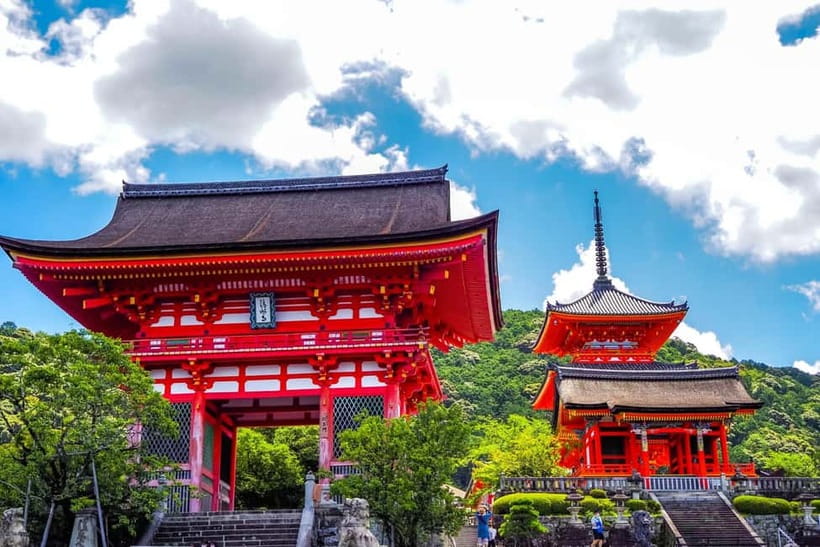
The guide is the main reason to choose this walk instead of following a map. Ben has been praised for explaining Kyoto at length and for sharing information on subjects ranging from samurai to tanuki. J has been described as having a university degree in history, with a clear and patient way of handling questions. Jay has also received praise for being friendly and informative.
The names may vary by departure, so you should not book on the assumption that one particular guide is guaranteed. What you can expect is an English-speaking live guide whose role is to explain the places, answer questions, and keep the group moving.
The guide style appears well suited to mixed groups. A family with children aged 11 and 15 and an older adult aged 79 found the material easy to follow and enjoyable. That suggests the tour can work for families, provided everyone is comfortable with the walking demands.
The conversations are not limited to ancient Kyoto. You can ask about daily life in Japan as well as historical subjects. That is a real advantage if you want practical cultural understanding rather than a string of dates and names.
Is $25 a fair price for three hours?
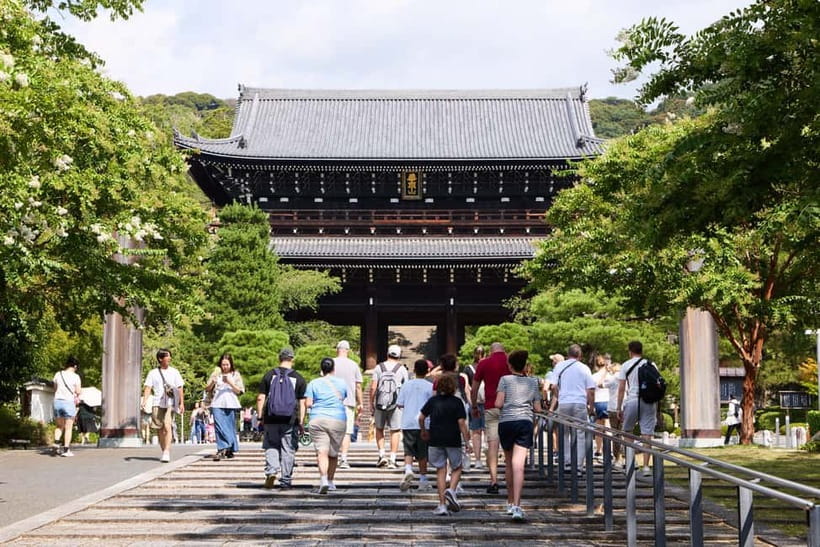
At $25 per person, this is a strong value for a three-hour guided walk through Gion and Higashiyama. You receive an English-speaking guide and a route linking several major places, including Chion-in, Maruyama Park, Hōkan-ji, Ninen Zaka, Sannenzaka, and the approach to Kiyomizu-dera.
The value is highest if you are new to Kyoto or want a clear orientation early in your visit. You cover a wide area and learn how the pieces fit together. Hiring a private guide would cost far more, while exploring alone would leave you to research the cultural background yourself.
The price does not make this a private experience. Group size can vary. One departure happened to be very small, almost one-to-one, but you should not count on that every time.
Entry fees, food, drinks, and transport are not listed as included. The main purchase is the guide’s time and interpretation. For many people, that is enough, especially when the route itself takes you through streets and grounds that are free to walk through.
Who should book this walk?
I would choose this tour if you want to see a lot of southern Kyoto in one organized outing. It is particularly useful on a first visit, when Gion’s lanes, Higashiyama’s temples, and the route to Kiyomizu-dera can blur into one large district.
It also suits you if you enjoy asking questions. The guides have been praised for handling topics beyond the fixed route, including modern Japanese life, the Shinkansen, samurai, and local customs.
Families can enjoy it, and the clear storytelling should keep older children interested. The main condition is stamina. You need to manage three hours on foot with plenty of steps.
I would skip it if you want a slow temple visit, lots of shopping time, or a tour focused only on photographs. The schedule gives several places a short introduction rather than allowing extended time at each one.
Booking is flexible: you can cancel up to 24 hours before departure for a full refund, and the reserve-now, pay-later option lets you hold a place without paying immediately. Starting times vary, so check availability when you choose a date.
Final call: a smart Kyoto orientation with stairs attached
Book this tour if you want strong cultural explanation for a modest price, a broad introduction to Gion and Higashiyama, and a finish near Kiyomizu-dera. The best parts are the guide’s stories, the connection between geisha culture and daily life, and the route through both famous streets and quieter corners.
Think twice if stairs are a serious problem or if you prefer to linger at one temple. This is an active, information-filled walk. For a fit visitor who wants to understand Kyoto while seeing many of its essential southern sights, it is a practical choice.
FAQ
Where does the Kyoto walking tour start?
The tour starts in front of Ben’s Cookies Kyoto Shijo. The guide holds a sign at the meeting point.
Where does the tour finish?
It finishes at Kiyomizu-dera Niomon Gate. The tour does not return to the starting point.
How long does the tour last?
The walking tour lasts three hours.
What language is the tour conducted in?
The tour is conducted in English with a live guide.
How much does the tour cost?
The price is $25 per person.
Which places does the tour visit?
The route includes Gion Tatsumi Bridge, Chion-in, Maruyama Park, Hōkan-ji Temple, Ninen Zaka, Sannenzaka, and Kiyomizu-dera Niomon Gate.
Does the tour include a guide?
Yes. A guided walking tour is included.
Are there many steps?
Yes. The tour includes many steps, and it is not suitable for people with a low level of fitness.
What should I bring?
Bring water. Comfortable footwear is also sensible for a walk with steps and sloping streets.
Can I cancel the booking?
Yes. You can cancel up to 24 hours in advance for a full refund. You can also reserve now and pay later.
More walking tours elsewhere in Japan
- Nishiki Market Brunch Walking Tour (7 Tastings + Brunch)
★ 5.0 · 1,355 reviews - Kyoto Arashiyama Walking Tour: Bamboo, Monkeys, Gardens & Secrets
★ 5.0 · 1,216 reviews - Kyoto Gion: 2-Hour Geisha Culture & History Walking Tour
★ 5.0 · 1,186 reviews - Kyoto: Izakaya Bars Guided Walking Tour
★ 4.9 · 815 reviews
More hidden-gem tours in Kyoto
- Private Kyoto Tour with a Local, Highlights & Hidden Gems, Personalised
★ 5.0 · 1,543 reviews - Arashiyama Bamboo Forest & Hidden Gems Bike Tour (Early Bird)
★ 5.0 · 613 reviews - Kyoto: Hidden Gems E-Bike Tour with Local Japanese Guide
★ 4.9 · 189 reviews - Kyoto: Gion Hidden Gems & Geisha Culture Tour
★ 4.9 · 126 reviews
Just added in Kyoto
- Private Cooking Class Udon in Kyoto Japan★ 5.0 · 23 reviews
- Your Private Vacation Photography Session In Kyoto★ 5.0 · 110 reviews
- Kyoto: Zen Meditation at a Private Temple with a Monk★ 5.0 · 25 reviews
- Private Pewter Sake Cup Experience with a Kyoto Artisan★ 5.0 · 31 reviews
- Kyoto Wagashi(Japanese sweets) Cooking Class near Fushimiinari★ 5.0 · 60 reviews
- Kyoto:Family-Friendly Kimono & Yukata Experience at WARGO★ 5.0 · 147 reviews
- Private Guided Traditional Buddhist Cooking in Japan★ 5.0 · 16 reviews
- Kyoto: Gion Geisha District & Sake-in-Hand Walking Tour★ 5.0 · 37 reviews
Geisha & Gion District Tours, compared.

Kyoto Geisha Walking Tour: Gion District & Hidden Gems
Read our review →
Gion Geisha District Walking Tour – Stories of Geisha
Read our review →
Best of Kyoto: Gion, Geisha, Pagodas & Cobblestones
Read our review →

Kyoto Night Foodie Tour in Gion (9+ dishes + 6 Sake tastings)
Read our review →
Kyoto Gion: 2-Hour Geisha Culture & History Walking Tour
Read our review →
Chopsticks Making Workshop in Gion with Engraving Option
Read our review →
Browse the lists this tour appears in