
Reviewed · GEISHA & GION DISTRICT TOURS
Kyoto Gion Walking Tour for First Time Visitors
Gion is best understood on foot, and this two-hour walk gets you beyond the obvious streets. You’ll move from wooden machiya houses and teahouses to Zen temple grounds, small shrines, Yasaka Pagoda, and the broad entrance of Yasaka Shrine. Guide Jay uses maps and pictures to make the stories easier to follow, which is useful on a first day in Kyoto.
I like the small group, capped at 15, and the route’s mix of famous sights and easy-to-miss corners. I also like the low $20 price, especially since admission fees and taxes are included. The main drawback is pace: six stops in about two hours means you’ll see each place briefly, not tour every temple in depth.
Key points to know before booking
- Gion and Higashiyama in one walk: The route links Gion with Kennin-ji, Yasui-Konpiragu, Yasaka Pagoda, Ninenzaka, and Yasaka Shrine.
- Guide Jay adds useful visual context: He uses maps and pictures while explaining Kyoto’s culture and history.
- Small groups keep the walk manageable: The maximum group size is 15 people.
- Good value at $20: Taxes, fees, and an in-person guide are included, with no separate admission charge for the listed stops.
- The route ends at Yasaka Shrine: You finish in a useful location for continuing around Gion on your own.
- Plan for outdoor walking: The tour requires good weather and includes traditional streets, temple areas, and sloping lanes.
Why this Gion walk works well on a first Kyoto day
Gion can look simple on a map, but its lanes do not always reveal what you are passing. A plain wooden facade may be a former teahouse, a narrow shrine entrance may lead to a place with a particular local purpose, and a busy street may be part of a carefully preserved historic district.
That is where a guide earns the $20. You are not paying only for directions. You are paying for the connections between the places. The tour gives you a basic framework for Gion, then sends you toward eastern Kyoto’s best-known sights without asking you to study a map first.
The route is also practical for first-time visitors because it combines major landmarks with smaller stops. You get the recognizable views of Yasaka Pagoda and Yasaka Shrine, but you also visit Yasui-Konpiragu and Kennin-ji, places that can be missed when you simply follow the busiest sightseeing street.
The tour lasts about two hours. The listed stops add up to roughly 80 minutes of planned time, leaving the rest for walking, explanations, questions, and transitions. That tells you what kind of outing this is: a guided orientation walk, not a slow temple visit.
Other walking tours in Kyoto people book:
- Kyoto Geisha Walking Tour: Gion District & Hidden Gems
★ 4.7 · 3,273 reviews - Kyoto: Gion Magical Night Walking Tour with Geisha Trivia
★ 4.9 · 2,393 reviews - Kyoto: Gion Geisha District Walking Tour – Stories of Geisha
★ 4.7 · 2,187 reviews
Starting near Gion’s traditional streets
The meeting point is Kyoto Tourist Lounge Gion, at Pare Gion near Komatsu Cho. You receive confirmation when you book, and the mobile ticket is convenient if you are already using your phone for transport and maps.
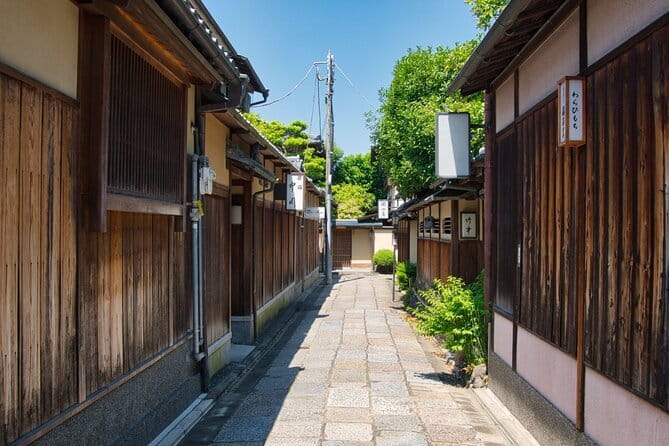
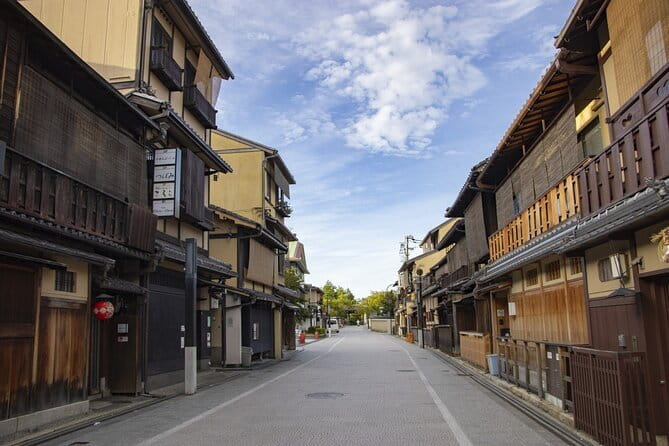
The first stop is Gion, where you spend about 20 minutes. This is the part of Kyoto most people picture when they hear the district’s name: wooden machiya townhouses, traditional teahouses, and narrow cobblestone streets near Yasaka Shrine.
A guide helps you read the setting with more care. Gion is not a stage set built only for photographs. It is a historic neighborhood with working businesses and residents, so your guide can help explain what you are seeing and how to behave respectfully around private spaces.
This is also where the tour’s navigation service matters. Gion’s appeal comes from its smaller lanes, but those same lanes can be confusing if you are trying to reach several different sights in a short time. You can put the map away and pay attention to the street details instead.
The 20-minute stop is not long enough for an extensive look at every lane. That is the tradeoff. You get a useful introduction, then continue before the walk becomes repetitive.
Kennin-ji and the quieter side of Gion
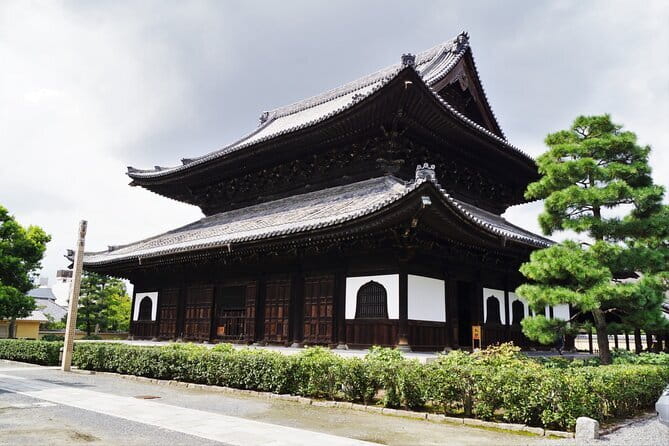
Kennin-ji Temple is scheduled for about 15 minutes. Founded in 1202 by the monk Eisai, it is one of Kyoto’s oldest Zen Buddhist temples. Eisai is also associated with the introduction of Zen Buddhism and tea culture to Japan, giving this stop a wider connection to Japanese religious and artistic life.
The temple provides a change of mood after Gion’s street scene. Instead of focusing only on storefronts and architecture, you begin to see how Zen institutions shaped Kyoto’s culture.
Fifteen minutes is a short visit, so you should not expect an unhurried temple experience. The value here is the guide’s explanation and the chance to place Kennin-ji on your Kyoto map. If you want a quiet, detailed temple visit, you may want to return later with more time.
I like this stop because it adds substance to the walk. A Gion tour made up only of photo spots would feel thin. Kennin-ji gives the route a religious and cultural center.
Yasui-Konpiragu, a small shrine with a clear purpose

Yasui-Konpiragu receives another 15-minute visit. This small Shinto shrine sits near Gion and is known for its enkiri and enmusubi stone.
The stone is associated with cutting unwanted ties and forming beneficial ones. That gives the shrine a distinct purpose, different from the larger ceremonial spaces on the route. Your guide can explain the meaning instead of leaving you to guess why the stone attracts attention.
This is one of the better reasons to take a guided walk rather than follow only the major sights. Yasui-Konpiragu is easy to overlook if you are focused on Yasaka Shrine, Ninenzaka, or the pagoda. The stop is short, but it adds a local detail that helps the neighborhood feel less like a checklist.
As with Kennin-ji, the timing limits how long you can linger. If the shrine has special meaning for you, note its location and return independently after the tour.
Other evenings in the old entertainment quarters of Kyoto:
- Best of Kyoto: Gion, Geisha, Pagodas & Cobblestones
★ 4.9 · 2,058 reviews - Night Walk in Gion: Kyoto’s Geisha District
★ 4.5 · 2,003 reviews - Kyoto Night Foodie Tour in Gion (9+ dishes + 6 Sake tastings)
★ 5.0 · 1,762 reviews - Kyoto Gion Geisha District Walking Tour – The Stories of Geisha
★ 5.0 · 1,441 reviews
Hōkan-ji and the view of Yasaka Pagoda
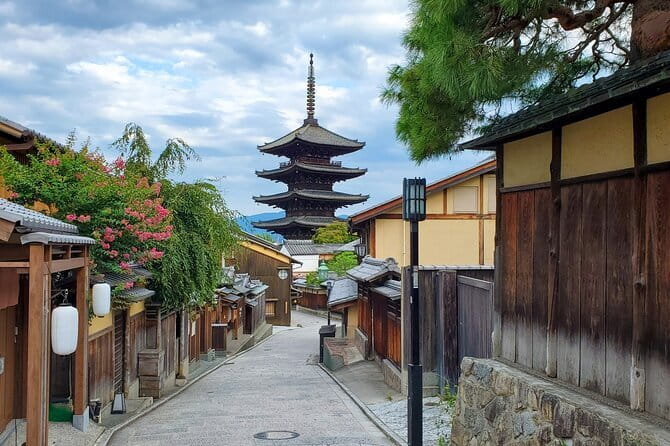
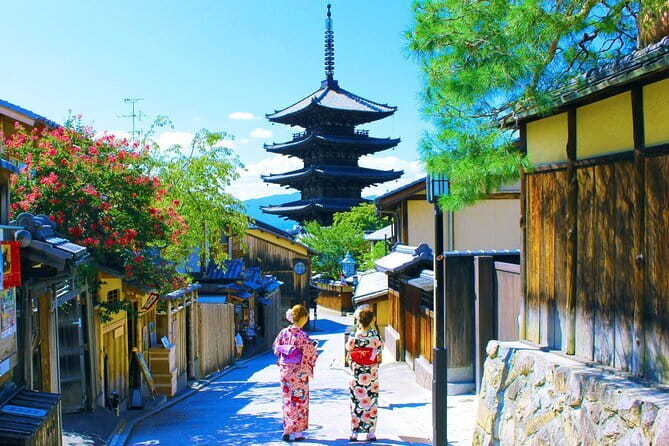
The route then reaches Hōkan-ji Temple, better known as Yasaka Pagoda, for about 10 minutes. Its five-story pagoda is one of the most recognizable sights in eastern Kyoto, rising above the traditional streets of Higashiyama.
This is likely to be one of the walk’s most photographed points. The surrounding streets help explain the pagoda’s appeal: the structure is not isolated in a large modern plaza. It appears above the older neighborhood, giving you a classic Kyoto view.
Ten minutes is enough for orientation and photographs, but not for a full temple visit. The itinerary does not promise extended access or a long architectural study, so keep your expectations sensible. You will see the landmark and hear about its place in the district, then move on.
The practical advantage is that the guide places the pagoda in sequence with Ninenzaka. You do not need to work out how these eastern Kyoto sights connect on your own.
Walking down Ninenzaka
Ninenzaka is another 10-minute stop. This traditional stone-paved slope runs through Higashiyama and is known for preserved architecture and a busy sightseeing atmosphere.
The slope is visually appealing, but it is also one of the places where a short guided visit can feel quick. You may want to pause for shops, food, or photographs, yet the group needs to keep moving to finish the route.
I would treat this section as an introduction rather than shopping time. Notice the buildings, the slope, and the way the street leads toward other Higashiyama sights. Then decide if you want to return later at your own pace.
Because the tour ends at Yasaka Shrine rather than returning to the starting point, you can also use the walk as a rough route planner. After the guide leaves, you already know where Ninenzaka sits in relation to Gion and Yasaka Shrine.
Finishing at Yasaka Shrine
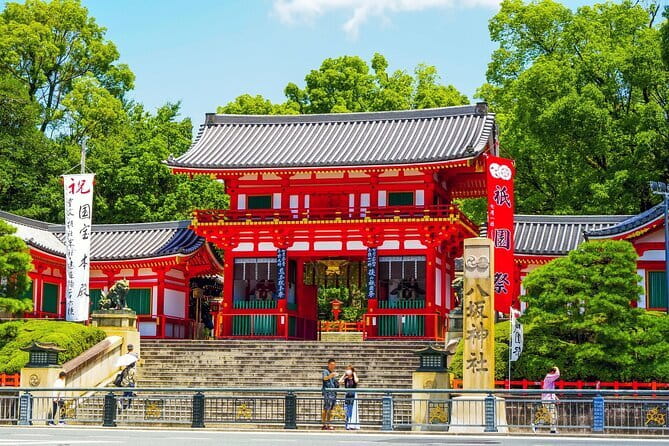
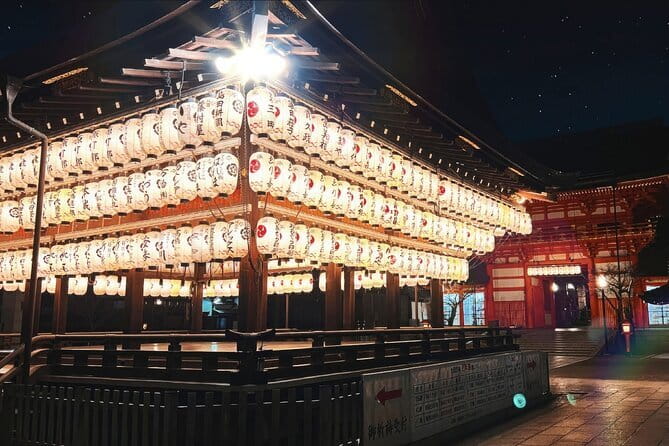
The final stop is Yasaka Shrine, also called Gion Shrine, for about 10 minutes. It is one of Kyoto’s major Shinto shrines, known for vermilion gates and lanterns, and it sits at the heart of the Gion area.
Ending here makes good sense. Yasaka Shrine is a clear landmark, easy to recognize, and well placed for continuing your own sightseeing. You can finish the tour with a broad sense of how Gion, the shrine, and Higashiyama connect.
Ten minutes will not cover the whole shrine complex. It is enough for a guided introduction, key points, and questions. If you want to explore the grounds carefully, plan to stay after the official walk ends.
The tour’s route is therefore slightly more useful than a simple loop. It begins near Gion and finishes at Yasaka Shrine, giving you a natural base for further exploration rather than sending you back to the starting point.
What the $20 price really buys you
At $20 per person, this is inexpensive for a two-hour guided walk in a major sightseeing district. All fees and taxes are included, and the listed stops do not require a separate admission charge as part of the tour.
The strongest value is the time saved on planning. You do not need to build a route between six places, work out which lanes connect, or research why Yasui-Konpiragu matters. A guide also gives you context at the places where a quick photograph would otherwise be the whole experience.
The price does not include snacks. That is not a serious concern, since the walk is only about two hours, but you should eat beforehand or plan a stop afterward if you want a full meal.
You should also understand what is not included in the price. This is not a private tour, and the group may include as many as 15 people. A small group is easier to manage than a large coach group, but it is still a group walk. If you want to set the pace or spend 30 minutes at one temple, a private guide or self-guided visit would suit you better.
Guide Jay and the value of good explanations
Guide Jay receives especially strong praise for clear English, useful pictures, and maps. One detail that comes through clearly is his enthusiasm for maps, which can be a real advantage in a district where the route matters as much as the individual sights.
He also leaves room for questions. That matters on a first day, when you may want to ask about a shrine custom, a temple’s purpose, or what to revisit later.
A guide’s style can shape a walking tour, so the available information points to Jay as a strong choice for visitors who want explanation rather than a silent escort. His use of visual material is particularly helpful if you find that names, dates, and religious terms blur together during a busy sightseeing day.
The tour provider is Localized Walking & Food Tours. The data supplied does not guarantee that Jay leads every departure, so check the booking details if having a particular guide is important to you.
Pace, group size, and practical comfort
The maximum group size is 15 people. That is small enough for a walking tour to remain reasonably personal, though the experience can still vary depending on the day’s attendance and how actively people ask questions.
Most people can participate, and service animals are allowed. The tour is near public transportation, which makes the Gion starting point practical for a first activity in Kyoto.
You should be ready for outdoor walking on cobblestones and sloping streets. The route includes Ninenzaka, and the tour requires good weather. If poor weather causes cancellation, you are offered another date or a full refund.
The cancellation policy is generous if your plans change early: cancel at least 24 hours before the start time for a full refund. Changes or cancellations made less than 24 hours before the start time are not refunded or accepted.
Wear comfortable shoes and keep your phone charged for the mobile ticket. Those are simple preparations, but they matter more on a walking tour than they do on a short taxi ride between sights.
Who should book this Gion experience?
I would choose this tour for a first visit to Kyoto, especially if Gion is on your must-see list but you do not yet understand how the district fits with Higashiyama.
It suits you if you want:
- A quick introduction before exploring on your own
- Help finding smaller shrines and traditional lanes
- Clear explanations of temples and shrine customs
- A short activity that fits into a busy Kyoto schedule
- A modest price with no separate listed admission fees
- A route that ends at Yasaka Shrine instead of returning to the meeting point
I would be more cautious if you already know Gion well or prefer long visits at individual temples. The six-stop route covers a lot of ground, and each place receives limited time.
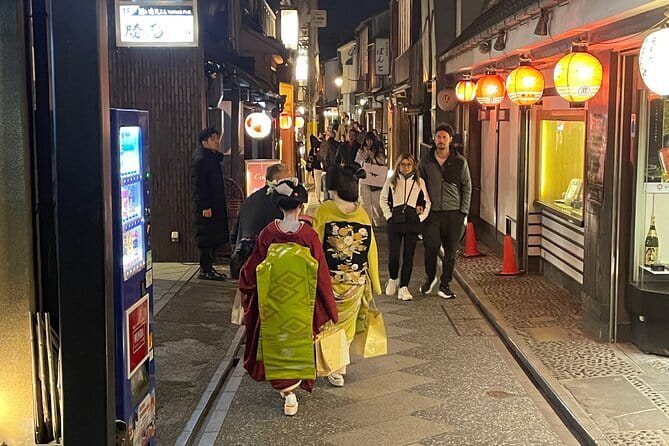
It may also disappoint you if you expect a dedicated geisha performance or guaranteed sightings of geisha. The experience is a walking tour of Gion and nearby landmarks, not a performance or private teahouse visit.
Should you book the Kyoto Gion Walking Tour?
Book it if you want a low-cost orientation to Gion with a guide who explains what you are seeing and keeps the route moving. The mix of Gion streets, Kennin-ji, Yasui-Konpiragu, Yasaka Pagoda, Ninenzaka, and Yasaka Shrine gives you a useful first look at Kyoto’s old center.
The best plan is to take it early in your Kyoto stay, then return to the places that deserve more time. At $20, the tour works especially well as a map in human form: you get the district’s basic shape, a handful of cultural details, and a clear idea of where to wander next.
Skip it if you want a slow, highly detailed temple tour or a private experience. For most first-time visitors who value context, a manageable group, and a practical route, it is a sound introduction to Gion.
FAQ
How long is the Kyoto Gion Walking Tour?
The tour lasts approximately two hours.
What is the price of the tour?
The price is $20 per person.
What sights are included on the route?
The route includes Gion, Kennin-ji Temple, Yasui-Konpiragu, Hōkan-ji Temple and Yasaka Pagoda, Ninenzaka, and Yasaka Shrine.
Where does the tour start?
The meeting point is Kyoto Tourist Lounge Gion at Pare Gion, 557-4 Komatsu Cho, Higashiyama Ward, Kyoto.
Where does the tour end?
The tour ends at Yasaka Shrine, at 625 Gionmachi Kitagawa, Higashiyama Ward, Kyoto.
What is included in the price?
All fees and taxes and an in-person guide are included. Snacks are not included.
How large is the group?
The tour has a maximum of 15 participants.
What happens if bad weather cancels the tour?
If poor weather causes cancellation, you are offered a different date or a full refund. You can also cancel at least 24 hours before the start time for a full refund.
More walking tours elsewhere in Japan
- Nishiki Market Brunch Walking Tour (7 Tastings + Brunch)
★ 5.0 · 1,355 reviews - Kyoto Arashiyama Walking Tour: Bamboo, Monkeys, Gardens & Secrets
★ 5.0 · 1,216 reviews - Kyoto Gion: 2-Hour Geisha Culture & History Walking Tour
★ 5.0 · 1,186 reviews - Kyoto: Izakaya Bars Guided Walking Tour
★ 4.9 · 815 reviews
Just added in Kyoto
- Private Cooking Class Udon in Kyoto Japan★ 5.0 · 23 reviews
- Your Private Vacation Photography Session In Kyoto★ 5.0 · 110 reviews
- Kyoto: Zen Meditation at a Private Temple with a Monk★ 5.0 · 25 reviews
- Private Pewter Sake Cup Experience with a Kyoto Artisan★ 5.0 · 31 reviews
- Kyoto Wagashi(Japanese sweets) Cooking Class near Fushimiinari★ 5.0 · 60 reviews
- Private Guided Traditional Buddhist Cooking in Japan★ 5.0 · 16 reviews
- Kyoto: Gion Geisha District & Sake-in-Hand Walking Tour★ 5.0 · 37 reviews
- Kyoto:Family-Friendly Kimono & Yukata Experience at WARGO★ 5.0 · 147 reviews
Geisha & Gion District Tours, compared.

Kyoto Geisha Walking Tour: Gion District & Hidden Gems
Read our review →
Gion Geisha District Walking Tour – Stories of Geisha
Read our review →
Best of Kyoto: Gion, Geisha, Pagodas & Cobblestones
Read our review →

Kyoto Night Foodie Tour in Gion (9+ dishes + 6 Sake tastings)
Read our review →
Kyoto Gion: 2-Hour Geisha Culture & History Walking Tour
Read our review →
Chopsticks Making Workshop in Gion with Engraving Option
Read our review →
Browse the lists this tour appears in