
Reviewed · GEISHA & GION DISTRICT TOURS
Kyoto: Lunch or Dinner with Maiko
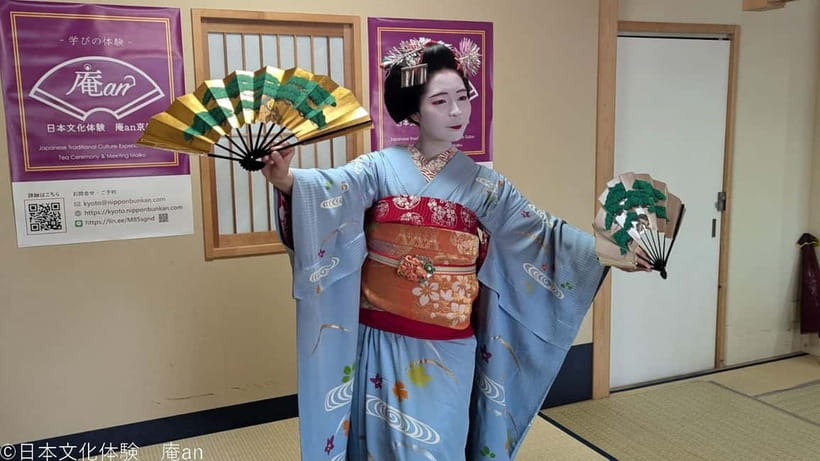
Kyoto’s Maiko are not museum pieces. They are young performers training in dance, music, etiquette, and hospitality, and this experience gives you a close look at that demanding world. You’ll watch a tea ceremony, see two dances, ask questions, play a game, and take a photo beside a Maiko.
I like the personal contact and the tight schedule. The Senjafuda lucky charm is a thoughtful keepsake, and the chance to meet a Geiko instead of a Maiko can be a special surprise. The main caution is the setting: this is in a plain building, not an atmospheric ochaya, and the meal may not impress diners looking for a polished restaurant experience.
Key points to know before booking
- Two traditional dances: You’ll see dances tied to seasons, love stories, or daily life, performed with the controlled movements Maiko are trained to master.
- Tea ceremony and optional tea making: A Maiko demonstrates the ritual, while making your own tea costs an additional 1,600 JPY.
- Direct questions and conversation: The Q&A gives you a chance to ask about daily routines and the Maiko profession.
- Photo and Senjafuda gift: You can pose beside the performer and receive a small lucky charm.
- Plain venue near Gojo Station: The room is relaxed and practical, but it is not a traditional Japanese house and has no elevator.
- Dinner included for $63: The price covers the meal and Maiko program, while preferred seating costs extra.
Meeting a Maiko without entering an ochaya
For many visitors, the hardest part of seeing Maiko culture is knowing where to look. Traditional ochaya, the exclusive entertainment houses where Geiko and Maiko perform, are not ordinary sightseeing stops. This program offers a simpler route into that world.
You meet at a building about one minute from Exit 1 of Gojo Station on the Subway Karasuma Line. The entrance faces Gojo-dori, so you do not need a long walk through unfamiliar lanes. Still, allow time to find the correct entrance and climb the stairs. There is no elevator.
The setting matters. This is not an old townhouse, tea house, or carefully staged historic room. It is a building with a casual event space, and the room may feel more like a functional hall than a Kyoto salon. Some people will find that disappointing, especially if they imagined screens, tatami, polished wood, and a more theatrical backdrop.
I see the plain room as a tradeoff. You give up atmosphere in exchange for an accessible program with a fixed price, a meal, a performance, and time to ask questions. If your priority is seeing the Maiko clearly and meeting her at close range, the setting may matter less. If your main goal is a picture-perfect Kyoto scene, you should adjust your expectations.
Other evenings in the old entertainment quarters of Kyoto:
- Kyoto Geisha Walking Tour: Gion District & Hidden Gems
★ 4.7 · 3,273 reviews - Kyoto: Gion Magical Night Walking Tour with Geisha Trivia
★ 4.9 · 2,393 reviews - Kyoto: Gion Geisha District Walking Tour – Stories of Geisha
★ 4.7 · 2,187 reviews
The first 15 minutes: tea, etiquette, and quiet movement
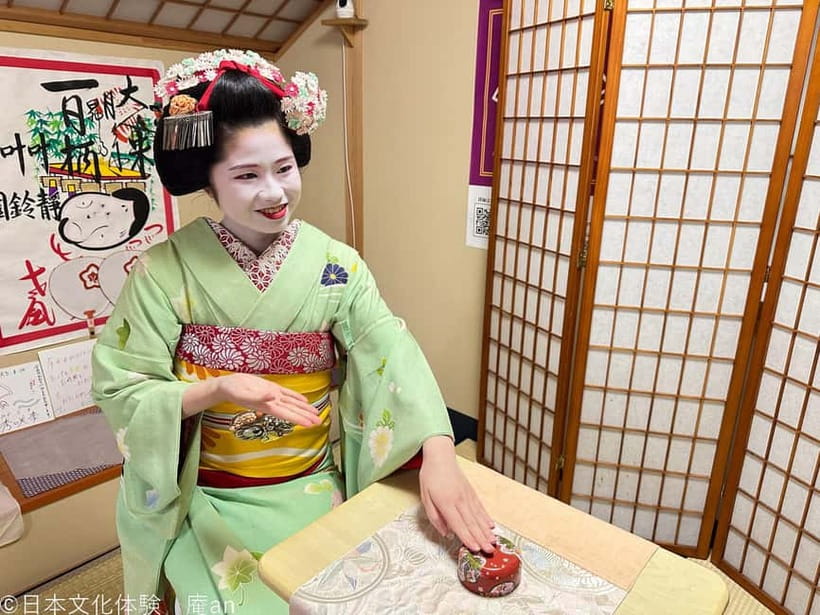
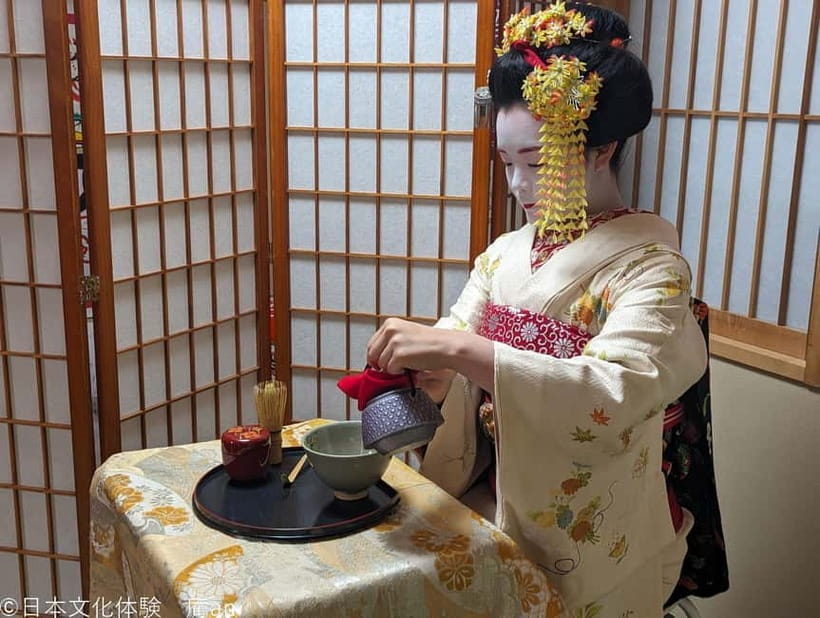
The program begins with a tea ceremony demonstration. Watch the Maiko handle the bowl, utensils, and movements with care. The point is not speed. It is the order of each action, the posture, and the attention given to the person receiving the tea.
This short demonstration helps explain why Maiko training takes years. The kimono and hairstyle catch your eye first, but the real skill is in the controlled gestures. Even a simple action becomes formal when every motion has meaning and timing.
You can add a tea-making option for 1,600 JPY. It is not included in the $63 base price, so select it when booking or contact the operator about adding it. The supplied information does not promise that every participant will make tea unless this option is arranged.
This is also the section most likely to feel different for people sharing the room. The schedule can include participants who have chosen the tea option while others are eating. That mixed format makes the event less uniform, but it allows the operator to combine several activities in one short session.
Kyoto cooking with dashi and shidashi service
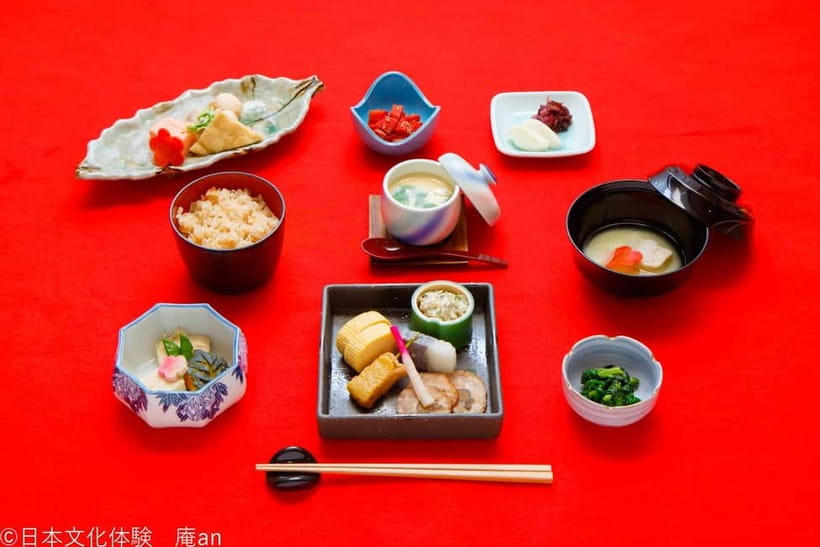
Dinner comes from a long-established Kyoto restaurant, and the meal is described as traditional Kyoto cuisine. Dashi, the stock made from ingredients such as fish and kelp, is important in Kyoto cooking, so expect delicate seasoning rather than bold spice.
The meal may arrive in a delivered traditional style called shidashi. That detail gives you a small window into Kyoto food customs, where prepared dishes are brought in for formal occasions and gatherings. It is not the same as sitting down in the restaurant that prepared the food.
I would keep the food expectations measured. Some diners found the meal mild and lacking in aroma, while others objected to the quality and said the tray seemed barely thawed. That is a serious concern if you are booking mainly for dinner. The cultural program is the stronger reason to come, with the meal serving as part of the package rather than the main culinary event.
The price is still reasonable when you add up what is included. At $63 per person, you receive dinner, the tea demonstration, two dances, a Q&A, a photo opportunity, a small gift, and a game. You are not paying only for a meal. You are paying for access to a live cultural presentation and a short personal meeting.
Children under two are free if they sit on a parent’s lap. If a child under two needs a separate seat or meal, the regular per-person fee applies. The information provided does not list a separate child price for older children, so check the booking terms before committing.
Asking questions about the Maiko profession
The Q&A is one of the most useful parts for anyone who wants more than a staged performance. You can ask directly about the Maiko’s daily life, training, clothing, hairstyles, and routines. Since the instructor language is Japanese, request English translation in advance if you need it.
English support is offered as much as possible, but it is not presented as a guaranteed full English-language tour. I would contact the operator before booking and clearly ask for English assistance. This matters most during the Q&A, when the value comes from understanding the answers rather than simply watching.
You should also keep questions polite and practical. Ask about the work, training, performance schedule, and customs. Avoid treating the Maiko as a costume character. The program works best when you approach her as a professional artist representing a living tradition.
The operator may invite a Geiko instead of a Maiko depending on the day. A Geiko is a senior traditional entertainer, so this change can offer a different perspective. You cannot count on which performer will appear, but the possibility is worth knowing before you book.
Same base, a different sort of day:
- PERFECT KYOTO 1-Day Bus Tour
★ 5.0 · 13,518 reviews - Kyoto: Fushimi Inari, Kinkakuji, Bamboo Grove 1 Day Bus Tour
★ 4.8 · 4,316 reviews - Kyoto: Tea Ceremony in a Traditional Tea House in Kiyomizu
★ 4.9 · 3,519 reviews - Kyoto: Tea Ceremony Ju-An at Jotokuji Temple
★ 4.9 · 3,207 reviews
Two dances that show the craft
The performance includes two traditional dances. They may express the seasons, a love story, or an everyday scene. Do not expect a large stage production. The appeal is the precision of a single performer working through small gestures, measured steps, and expressive pauses.
I like this part because it shows how much can be communicated without dramatic movement. A turn of the head, a fan, the angle of a sleeve, or a pause can carry the mood. Look beyond the kimono and notice the timing and restraint.
The quality of the performance depends partly on your seat. Standard admission includes dinner and the program, but preferred seating is extra:
- SS seat, first row: 3,300 JPY
- S2 seat, second row: 2,200 JPY
- S3 seat, third row: 1,100 JPY
If seeing the footwork and facial expressions matters to you, a front seat may be worth the surcharge. For a budget visit, the standard arrangement still gives you the performance, but the room layout and other participants may affect your view.
Some people especially enjoy the performance and game, while finding the meal less appealing. That matches my sense of the program’s balance: the Maiko’s presence is the main event, and the food and room are supporting elements.
Photos, a Senjafuda, and a friendly game
After the Q&A, you can take a commemorative photo beside the Maiko. This is a closer encounter than watching from a stage, but follow the staff’s instructions and keep the interaction respectful. The photo is a record of the meeting, not a substitute for the performance.
The Maiko also presents a Senjafuda. These small paper charms are associated with names and good fortune, and the program offers one as a special gift. It is a compact souvenir that connects the photo opportunity to a Japanese custom.
The final activity is a simple interactive game. Volunteers can take part, while everyone else watches, claps, and cheers. The games are meant to be light and social, not difficult contests. The Maiko are professionals at this kind of hospitality, so do not be surprised if they are hard to beat.
This part can help the room feel less formal. It gives you a chance to laugh and participate after the quiet concentration of the tea ceremony and dances. If you do not want to volunteer, watching is perfectly acceptable.
A 90-minute schedule with a small timing wrinkle
The program begins at the scheduled start time and runs through the tea demonstration, meal, Q&A, photo, gift, dances, and game. The active program ends around 75 minutes, followed by chatting time before you leave at about the 90-minute mark.
That timing makes this easy to fit into a Kyoto day. It is short enough to place between sightseeing stops, but you should not treat it as flexible. The staff cannot hold the event for late arrivals, regardless of the reason. Arrive early, especially if you need to locate the building, check in, and climb stairs.
The program may be held with people taking part in different meal or tea arrangements. You might not have the room entirely to yourself, and the order of activities can feel less intimate than a private meeting. The benefit is a lower price than a private cultural appointment.
Reservations are processed during operating hours from 10:00 to 17:00. Requests received after 17:00 are handled the next day. Cancellation is free up to eight days before the scheduled date, but later cancellations can incur a fee. If a fee has already applied and you then change the date or time, another specified charge may apply.
Who will get the most from this experience
I would recommend this to someone visiting Kyoto for the first time who wants a clear introduction to Maiko culture without arranging an expensive private evening. The compact format gives you several different elements: performance, conversation, food, a photo, and a game.
It also suits families with young children, provided they can manage the stairs and sit quietly during the tea and dance portions. The game adds a little energy, and children under two can attend free on a parent’s lap.
This is less suitable for someone seeking a refined dinner, an old Kyoto interior, or complete control over the language of the presentation. The venue is plain, English interpretation must be requested, and the meal may be the weakest part of the experience.
I would also think carefully if you have mobility concerns. There is no elevator, and the venue requires stairs. The operator asks people who are not participating not to enter, so a family member who only wants to accompany someone may not be able to wait inside.
Is the $63 price fair?
For a dinner alone, $63 would require a strong meal to feel like good value. Because the food quality can be uneven, I would not book this as a restaurant outing.
For the full package, the price is easier to justify. You receive a live Maiko program, two dances, a tea demonstration, a Q&A, a photo, a Senjafuda, a game, and a traditional meal in 90 minutes. Comparable access to a performer in a more private setting can cost much more, though this program does not offer that same sense of exclusivity.
The added options deserve a little thought. Tea making costs 1,600 JPY, and front seating ranges from 1,100 to 3,300 JPY. I would choose the tea option if you enjoy hands-on cultural activities. I would choose a better seat only if the performance is your main reason for coming.
Should you book Kyoto: Lunch or Dinner with Maiko?
Book it if you want a practical introduction to Maiko culture, value personal contact, and can accept a plain venue and a meal that may not be memorable. The strongest parts are the two dances, the direct questions, the close photo, and the chance of meeting a Geiko.
Skip it if you expect an elegant ochaya, a top-level Kyoto dinner, or a fully English-led experience. Go in for the performer and the cultural access, not for room decor or fine dining. Arrive early, ask for English help before the date, and consider a better seat if seeing the dances clearly matters to you.
FAQ
Where does the Maiko experience meet?
It meets about one minute from Exit 1 of Gojo Station on the Subway Karasuma Line. The entrance faces Gojo-dori, the main street.
How long does the program last?
The full experience lasts about 90 minutes. The main program finishes at around 75 minutes, followed by chatting time before room departure.
Is dinner included in the price?
Yes. The $63 price includes dinner with the Maiko. The meal is traditional Kyoto cuisine from a long-established restaurant.
Can I make tea myself?
Yes, but tea making is an optional add-on. It costs 1,600 JPY and must be selected when applying or arranged with the operator.
Is the venue a traditional ochaya?
No. The program takes place in a building rather than an ochaya or traditional Japanese house. The venue has a relaxed atmosphere, but it is a practical event space.
Is English available?
The instructor language is Japanese. English translation is provided as much as possible if requested, so contact the operator before the experience if you need English assistance.
Is there an elevator?
No. You need to use stairs to reach the venue.
Can I cancel for a full refund?
You can cancel up to eight days in advance for a full refund. Later cancellations may incur a fee, and the operator cannot compensate you for travel expenses if the reservation is canceled.
Just added in Kyoto
- Private Cooking Class Udon in Kyoto Japan★ 5.0 · 23 reviews
- Your Private Vacation Photography Session In Kyoto★ 5.0 · 110 reviews
- Kyoto: Zen Meditation at a Private Temple with a Monk★ 5.0 · 25 reviews
- Private Pewter Sake Cup Experience with a Kyoto Artisan★ 5.0 · 31 reviews
- Kyoto Wagashi(Japanese sweets) Cooking Class near Fushimiinari★ 5.0 · 60 reviews
- Kyoto:Family-Friendly Kimono & Yukata Experience at WARGO★ 5.0 · 147 reviews
- Private Guided Traditional Buddhist Cooking in Japan★ 5.0 · 16 reviews
- Kyoto: Gion Geisha District & Sake-in-Hand Walking Tour★ 5.0 · 37 reviews
Geisha & Gion District Tours, compared.

Kyoto Geisha Walking Tour: Gion District & Hidden Gems
Read our review →
Gion Geisha District Walking Tour – Stories of Geisha
Read our review →
Best of Kyoto: Gion, Geisha, Pagodas & Cobblestones
Read our review →
Kyoto Night Foodie Tour in Gion (9+ dishes + 6 Sake tastings)
Read our review →
Kyoto Gion: 2-Hour Geisha Culture & History Walking Tour
Read our review →
Chopsticks Making Workshop in Gion with Engraving Option
Read our review →
Browse the lists this tour appears in