
Reviewed · GEISHA & GION DISTRICT TOURS
Kyoto: Meet the Geisha Maiko with Gion Walking Tour
Kyoto’s Gion district is still a working neighborhood for maiko and geiko, not just a pretty backdrop for souvenir photos. This experience gives you a rare look inside a private ochaya, where you watch a maiko perform, meet a former geiko, and ask direct questions about training, work, and daily life.
I like the small-group feel when numbers are low, and I like that the walking tour gives the performance some context. You learn why the streets matter before stepping into the private venue. The main caution is timing: the advertised duration is three to five hours, and the tour can run longer than expected, so do not schedule a tight train connection afterward.
Key points to know before booking
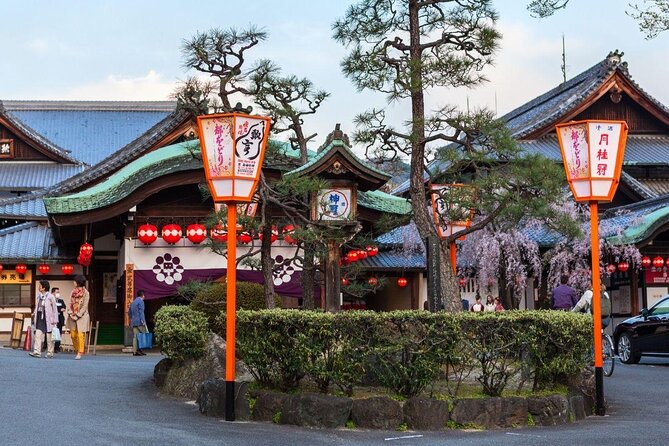
- Private ochaya visit: Enter a venue that most visitors cannot access without an introduction or membership.
- Live maiko performance: Expect one or two traditional dances, with the performance itself sometimes lasting only a few minutes.
- Former geiko conversation: Ask questions through your English-speaking guide and hear personal stories about the profession.
- Gion walking route: See Shirakawa Canal, Tatsumi-jinja Shrine, Hanamikoji Street, Gion Corner, Kenninji Temple, and Miyagawasuji.
- Photo rules matter: Photography and video are restricted, and you need permission before posting maiko photos online.
- Wear socks: The venue requires socks, and wet socks or clothes are not allowed inside on rainy days.
Why this Gion experience feels different
Many Kyoto visitors walk through Gion hoping to spot a maiko hurrying between appointments. That can be exciting, but it tells you little about the people behind the makeup, kimono, and elaborate hairstyles.
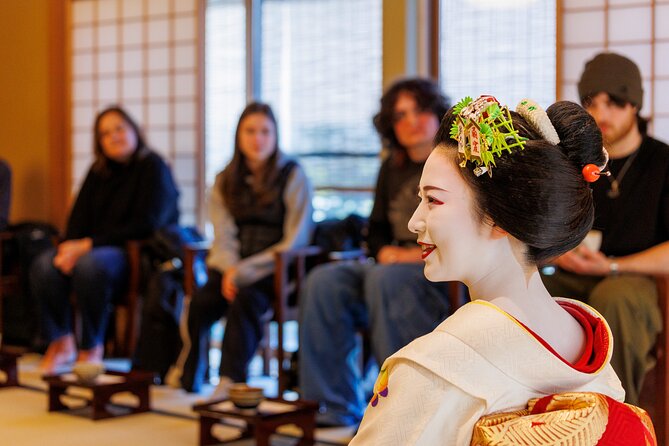
This tour gives you time with the tradition rather than a quick glimpse of it. The central visit takes place at an ochaya, a private teahouse-style venue on Miyagawasuji. There, a maiko performs one or two dances, and a former geiko and venue owner speak with the group. Your guide translates questions and explanations into English.
That conversation is the heart of the experience. The dance is short, graceful, and carefully staged, but the discussion helps you understand the discipline behind it. You can ask about training, the difference between a maiko and geiko, their working lives, and the customs that shape Kyoto’s flower districts.
The guide also makes a large difference. Past sessions have been led by guides including Mika, Naomi, Tom, Takuma, Ayako, Chiko, Yuko, Eric, and Ellie. The assigned guide changes, but the strongest reports consistently point to clear English, patience, and a good grasp of local history. Tom has also guided in German and Japanese, according to one account.
Other walking tours in Kyoto people book:
- Kyoto Geisha Walking Tour: Gion District & Hidden Gems
★ 4.7 · 3,273 reviews - Kyoto: Gion Magical Night Walking Tour with Geisha Trivia
★ 4.9 · 2,393 reviews - Kyoto: Gion Geisha District Walking Tour – Stories of Geisha
★ 4.7 · 2,187 reviews
Walking through Gion before the performance
The walking portion lasts about 70 to 80 minutes. It is not a long hike, but you are on your feet and outdoors, so hot summer weather or rain can affect your comfort.
You begin at one of two meeting points. One is the Izumo no Okuni statue, near the river. The other is the Wargo Kyoto Kimono Rental Gion Shijo store if you choose the kimono option. After changing, you walk to the statue yourself, a trip of about three minutes, where the guide meets you.
Starting beside the statue gives the guide a useful place to explain Kyoto’s performing arts and the role of Gion. From there, the route moves through several well-known spots.
Shirakawa Canal
The Shirakawa Canal is one of Gion’s most attractive stretches, with traditional buildings and a quieter feel than the larger roads nearby. It is a good place to learn how the district is arranged and why visitors are asked to behave carefully around working establishments.
This section lasts about 30 minutes, making it the longest single stop on the walking route. Your guide can point out photo angles and explain the difference between seeing Gion as a historic district and treating it as a stage set.
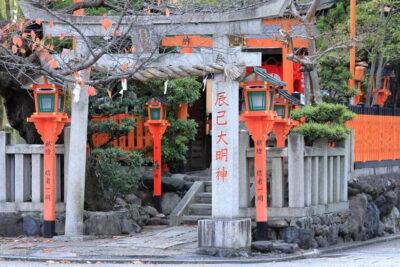
Tatsumi-jinja Shrine
The stop at Tatsumi-jinja Shrine is brief, about five minutes. Do not expect a long temple visit here. It works more as a short cultural marker within the walk than as a major sightseeing stop.
If you want a detailed look at every shrine and temple along the route, you will need to return independently. One visitor also felt the temple portion was only a quick glance, so keep your expectations modest.
Other evenings in the old entertainment quarters of Kyoto:
- Best of Kyoto: Gion, Geisha, Pagodas & Cobblestones
★ 4.9 · 2,058 reviews - Night Walk in Gion: Kyoto’s Geisha District
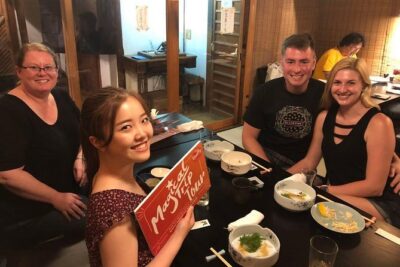
★ 4.5 · 2,003 reviews - Kyoto Night Foodie Tour in Gion (9+ dishes + 6 Sake tastings)
★ 5.0 · 1,762 reviews - Kyoto Gion Geisha District Walking Tour – The Stories of Geisha
★ 5.0 · 1,441 reviews
Hanamikoji Street
Hanamikoji is one of Gion’s best-known streets, lined with traditional facades and entrances to restaurants and teahouses. It is also where visitors most need to remember that people live and work here.
Your guide can help you read the street beyond its appearance. You may learn how the flower districts operate, where maiko and geiko practice, and why photography must be handled with care. The walking route is especially useful if this is your first visit to Gion and you want more than a self-guided stroll.
Gion Corner
Gion Corner helps place the maiko performance within Kyoto’s wider arts tradition. The stop is listed as a guided sightseeing point rather than a full show, so do not confuse it with the private performance later in the tour.
Some information may overlap with what you hear at the ochaya. That is not a major problem, but visitors who have already taken a Gion walking tour may find parts of the route familiar.
Kenninji Temple
Kenninji Temple is used mainly for sightseeing and photographs, with about 15 minutes set aside. It offers a change of pace from the narrow streets and gives you another setting in which to ask questions.
This is not a full temple tour. If you specifically want time inside the temple complex, plan a separate visit. The value here is the guide’s explanation and the chance to take photos, not an extended religious or architectural study.
Miyagawasuji
The walking portion ends at Miyagawasuji, the area connected with the private venue. This is an important transition. You leave the public streets and enter a setting where the customs are more formal.
The venue is on the second floor, and access is by stairs. That makes the experience unsuitable for wheelchair users and difficult for people with mobility impairments. The tour also does not suit children under 10.
Inside the private ochaya
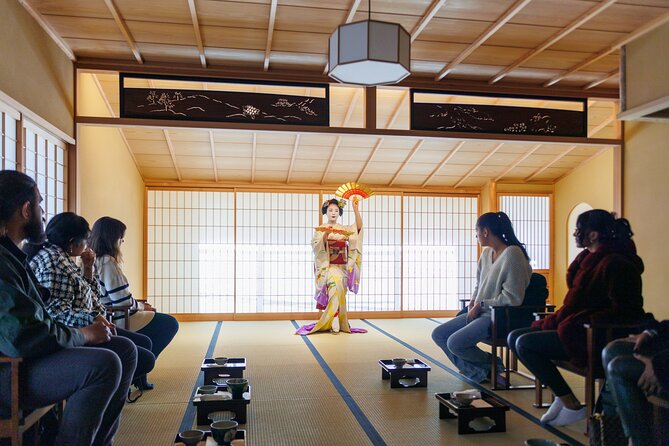
The venue visit lasts about 90 minutes, though the total day can stretch beyond the stated estimate. You enter a private house rather than a large theater, which changes the mood immediately. The setting is intimate, and the group may be small, sometimes around seven people.
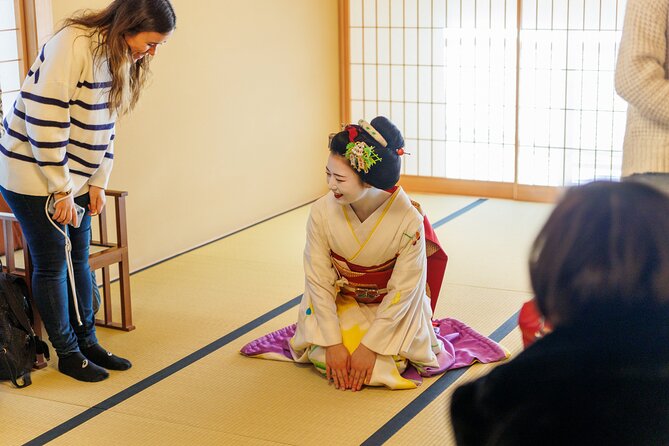
The program includes a live performance by a maiko and a former geiko. The dance may be accompanied by traditional music, and you can expect one or two dances depending on the session. It is worth knowing that the dancing is not a full evening performance. One detailed account put the actual dance time at under five minutes, with most of the visit devoted to conversation and questions.
That is not a weakness if you book this for cultural understanding rather than stage entertainment. The point is access and conversation. If you want a long concert, this is the wrong choice. If you want to see the details of the costume, movement, music, and formal presentation at close range, it offers something much harder to arrange independently.
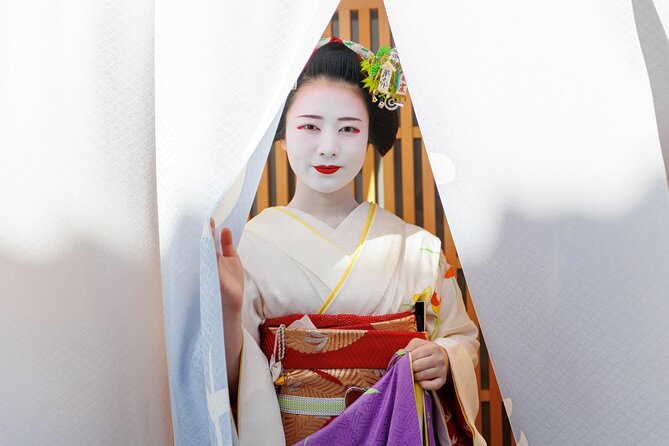
The maiko’s appearance is carefully prepared, from the colorful kimono to the makeup and hair ornaments. You are seeing a trained performer at work, but you are also seeing a young person still progressing through a demanding apprenticeship.
The conversation is the real value
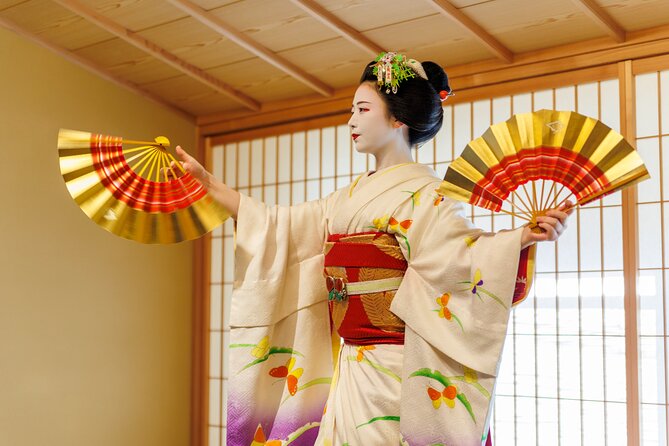
After the performance, you have a Q&A with the maiko and the former geiko or venue owner. The guide translates, allowing you to ask about their lives and the customs of the district.
This part has earned the strongest praise because it moves beyond a staged photo opportunity. You can hear candid stories about training, work, traditions, and the path from maiko to geiko. The former geiko adds an important point of comparison, giving you a sense of how the profession has changed and what it demands over time.
The venue owner also plays an important role. In some sessions, the owner has explained the teahouse and answered questions with warmth and humor. Accounts also describe traditional sweets and matcha service during the visit, though the central guaranteed elements are the performance, conversation, Q&A, and photo session.
Your guide’s translation skills matter here. English is not necessarily the first language of the performers, so a patient interpreter can make the difference between a polite presentation and a genuine exchange. Guides such as Naomi, Mika, Ayako, and Tom have been praised for explaining cultural details clearly and helping guests ask better questions.
Prepare a few questions before you arrive. Good topics include the stages of maiko training, the difference between maiko and geiko, the meaning of the dances, how appointments are arranged, and what daily life is like. Keep your questions respectful and avoid treating the performers as curiosities.
Photos, kimono rentals, and proper etiquette
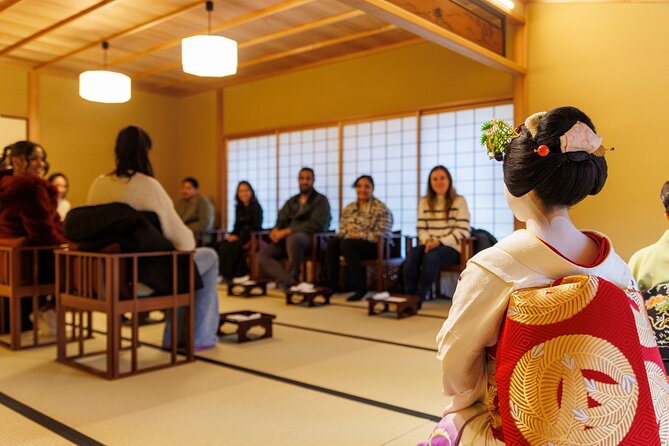
A photo session with the maiko is included. Photography and video are allowed only during the performance and the designated photo session. You cannot record freely throughout the visit.
If you plan to post a photo online, ask the maiko directly for permission first. Video cannot be uploaded to the internet. These rules are not minor details. This is a working cultural setting, and respecting the boundaries is part of receiving access to it.
You can also pair the tour with a kimono rental. This gives you the chance to walk through Gion in traditional dress and take photographs during the outdoor portion. Several people have found this especially enjoyable, but remember that the kimono option changes the meeting procedure. After dressing, you must walk to the Izumo no Okuni statue on your own.
The performance venue requires socks. On rainy days, you cannot enter with wet clothes or wet socks, so carry an umbrella and bring a dry pair of socks if rain is likely. Shoes are removed in many traditional settings, making this a simple but essential item to pack.
Is $106 a fair price?
At $106 per person, this costs more than a standard Gion stroll or a general cultural show. You are paying for a live guide, a 70 to 80 minute walking tour, access to a private venue, live performance, translation, conversation, and photos.
I consider that fair value if meeting a maiko is one of your main Kyoto goals. Foreign visitors normally cannot simply book a seat at a traditional ochaya, and independent access is difficult. The price reflects the private setting and the people required to make the visit possible.
The value is weaker if you mainly want to watch dancing. The performance is short, and much of the 90 minute venue session is conversation. It is also less appealing if you have already taken several Gion tours and do not need more background on the district.
Small groups improve the experience. When the group is around seven people, you have a better chance to hear the discussion and ask questions. Larger groups can make some walking stops feel crowded, and several people have noted repeated information between the street tour and the venue talk.
Timing, weather, and planning advice
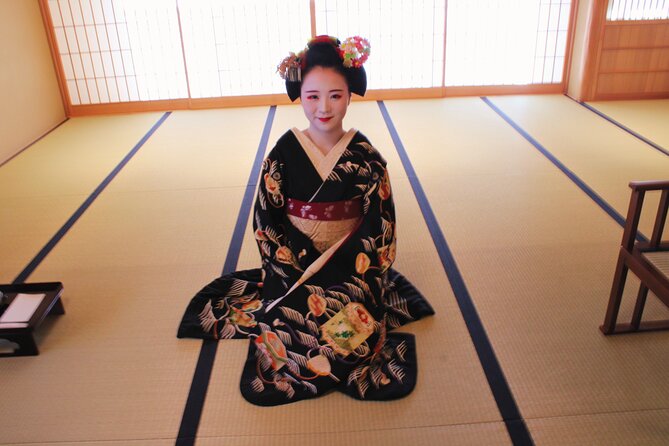
The activity is listed as lasting three to five hours. The exact length depends on the schedule, group, and pace of the day. Do not book a bullet train or other fixed connection immediately afterward. One person nearly lost the enjoyment of the final dance because of anxiety about catching a train.
The tour operates rain or shine. Summer heat can make the outdoor walk tiring, so wear comfortable shoes, carry water, and leave room for a slower pace. An umbrella is useful in wet weather, and dry socks are essential for the venue.
The tour begins at different points depending on the option you book. Check your meeting details carefully, especially if you are renting a kimono. The activity finishes at Miyagawasuji, so allow time to arrange your onward transport from there.
Cancellation is flexible up to 24 hours before the start for a full refund, and you can reserve now and pay later. If the organizer cancels, the activity is refundable, but related hotel or bullet train costs are not covered.
Who should book this experience?
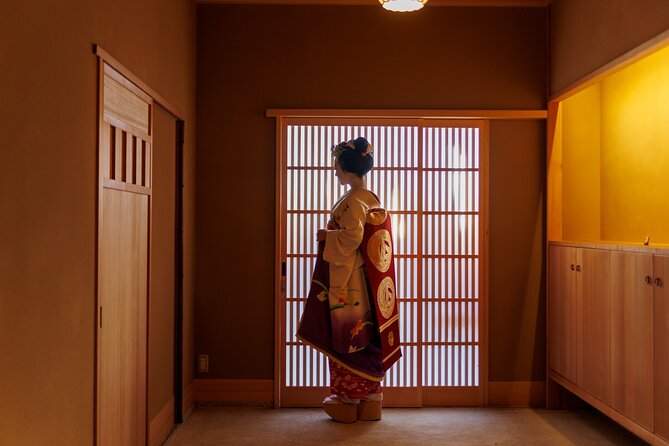
I would choose this tour if you want direct contact with Kyoto’s geiko and maiko tradition and you are willing to spend more for access that is hard to arrange alone. It suits adults and older children who enjoy asking questions, listening to personal stories, and learning how a living tradition works today.
It is also a good fit if you want both context and a special event. The Gion walk helps you understand the neighborhood, while the ochaya visit gives you a clear reason to remember it.
I would skip it if you need a short, tightly timed activity, want a long dance performance, or have difficulty with stairs and extended standing. You should also avoid booking it if your main goal is unrestricted photography. The rules are strict, and rightly so.
FAQ
How long does the Kyoto maiko and Gion tour last?
The activity is listed as lasting three to five hours. The walking tour takes about 70 to 80 minutes, and the meeting maiko portion takes about 90 minutes, but the day may run longer.
What does the tour include?
It includes an English-speaking local guide, the Gion walking tour, a visit to a private venue, one or two live dances, conversation with a maiko and venue owner, a Q&A session, and a photo session with a maiko.
Where does the tour meet?
The meeting point depends on the option you book. Choices include the Izumo no Okuni statue and the Wargo Kyoto Kimono Rental Gion Shijo store.
Can I combine the tour with kimono rental?
Yes. A kimono rental option is available. After changing, you must walk from the rental store to the Izumo no Okuni statue, which takes about three minutes.
Do I need to bring anything special?
Bring socks. You must wear socks inside the performance venue, and wet socks or wet clothing are not allowed there on rainy days.
Can I take photos and videos?
Photography and video are allowed only during the performance and the official photo session. You cannot upload video online, and you must ask the maiko directly before posting photos online.
Is the performance venue accessible by wheelchair?
No. The private house performance is on the second floor and can only be reached by stairs. The activity is not suitable for wheelchair users or people with mobility impairments.
Is the tour suitable for young children?
No. Children under 10 are not suitable for this activity.
Does the tour run in bad weather?
Yes. The tour operates rain or shine. Use an umbrella during the walk and keep your clothes and socks dry before entering the venue.
Can I cancel for a full refund?
You can cancel up to 24 hours in advance for a full refund. If the organizer cancels, the activity is refundable, but related hotel or bullet train costs are not covered.
Should you book it?
Book this experience if you want more than a quick Gion photo. The short dance is beautiful, but the real payoff is the private setting, the former geiko’s perspective, and the chance to ask respectful questions through a skilled guide.
Leave extra time in your schedule, wear socks, and treat the photo rules seriously. With those details handled, this is one of the stronger ways to connect a walk through Gion with the people who keep its traditional arts alive.
More walking tours elsewhere in Japan
- Nishiki Market Brunch Walking Tour (7 Tastings + Brunch)
★ 5.0 · 1,355 reviews - Kyoto Arashiyama Walking Tour: Bamboo, Monkeys, Gardens & Secrets
★ 5.0 · 1,216 reviews - Kyoto Gion: 2-Hour Geisha Culture & History Walking Tour
★ 5.0 · 1,186 reviews - Kyoto: Izakaya Bars Guided Walking Tour
★ 4.9 · 815 reviews
Just added in Kyoto
- Kyoto: Private Photoshoot Service★ 5.0 · 158 reviews
- Kyoto Rickshaw Tour★ 5.0 · 210 reviews
- Kyoto: Arashiyama Bamboo, Temple, Matcha, Monkeys & secret spots★ 5.0 · 219 reviews
- Izakaya Style Cooking Class★ 5.0 · 219 reviews
- Kyoto: Traditional Concert at Townhouse or Bathhouse★ 4.9 · 224 reviews
- Ninja 2-hour Hands-on Lesson by Japanese master in Kyoto -Medium★ 5.0 · 218 reviews
- Kyoto: Afternoon Japanese Izakaya Cooking Class★ 4.9 · 241 reviews
- Samurai Training with Modern day Musashi in Kyoto★ 5.0 · 256 reviews
Geisha & Gion District Tours, compared.
Kyoto Geisha Walking Tour: Gion District & Hidden Gems
Read our review →
Gion Geisha District Walking Tour – Stories of Geisha
Read our review →
Best of Kyoto: Gion, Geisha, Pagodas & Cobblestones
Read our review →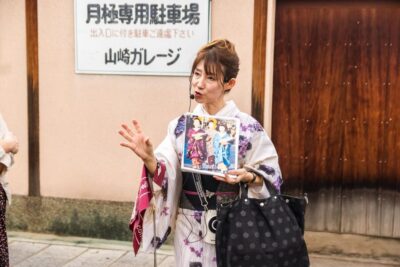
Kyoto Night Foodie Tour in Gion (9+ dishes + 6 Sake tastings)
Read our review →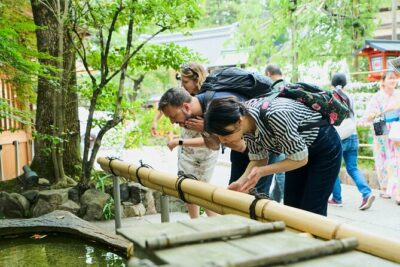
Kyoto Gion: 2-Hour Geisha Culture & History Walking Tour
Read our review →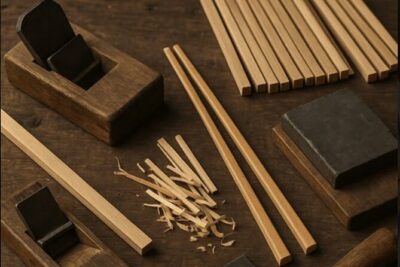
Chopsticks Making Workshop in Gion with Engraving Option
Read our review →
Browse the lists this tour appears in