
Reviewed · SUMO EXPERIENCES
Tokyo Sumo Morning Practice Tour at Stable
Sumo practice is not a polished stage show. Inside a working Tokyo sumo stable, you sit close to the ring and watch professional wrestlers repeat the hard, often punishing drills that prepare them for competition. The session can include bout after bout, with little ceremony to interrupt the action.
I like two things here: the close view of the wrestlers and the guide’s running explanation of what you’re seeing. Guides such as Seiji, Yumi, Cameo, and Noriko have helped visitors make sense of the rituals, rankings, and training. The main drawback is that seating and audio quality can vary, and you must remain quiet, still, and respectful throughout.
Key points to know before booking
- You watch real morning practice: This takes place inside a working stable, not at a dinner show or staged cultural performance.
- The viewing distance is excellent: You may sit only a short distance from the ring, though the best seats can be reserved for sponsors or stable supporters.
- The guide fills in the missing context: Expect explanations of Shinto customs, rankings, training methods, and the six annual grand tournaments.
- The morning starts early: Meet around 7:45am near Ryogoku Station, with the exact meeting point confirmed after booking.
- Silence is part of the experience: Phones must be silent, videos are not allowed, and flash photography and shutter sounds are prohibited.
- The stable can be hot: There is no air conditioning, especially important in Tokyo’s summer. Bring water, a cold towel, or an ice pack.
Why a practice session can beat a tournament
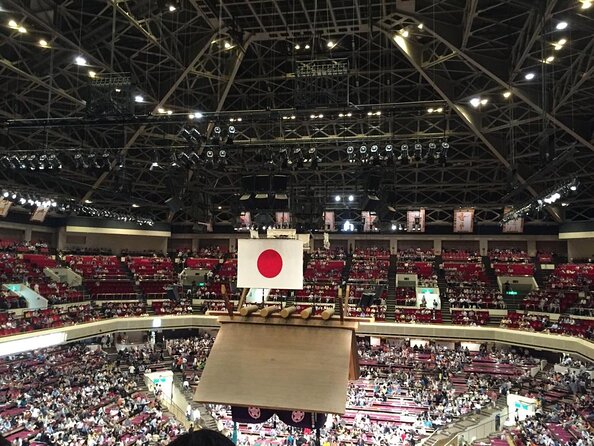
A formal sumo tournament is an important part of Japanese culture, but it also comes with ceremony, waiting, and long gaps between bouts. At morning practice, you see the athletes working repeatedly, often with far less downtime.
That gives you a sharper sense of the physical demands. Wrestlers stretch, train, grapple, and repeat movements until the session ends. You are not simply watching a match. You are seeing the daily work behind the public spectacle.
The action is also less polished. A practice session can feel rough, direct, and unfiltered. Some wrestlers may be developing their technique, while more seasoned athletes take part in harder exchanges. The precise content changes from day to day, so the length and intensity can vary.
That unpredictability is part of the appeal. It also means you should not book this expecting a fixed show with a guaranteed sequence of events.
Other ways to see sumo in Tokyo:
- Tokyo: Sumo Show Experience with Chicken Hot Pot and a Photo
★ 4.8 · 6,678 reviews - Tokyo: Sumo Show and Dining Experience
★ 4.8 · 2,742 reviews - the SUMO show
★ 5.0 · 1,960 reviews
Meeting at Ryogoku around 7:45am
The morning begins near Ryogoku Station, Tokyo’s traditional sumo district. The listed meeting point is Ryogoku Station Gallery at around 7:45am, but the exact location can vary by booking option. Check your confirmation carefully rather than relying only on a map application.
This is an early start, but it works well for a Tokyo sightseeing day. You finish after roughly two hours and still have most of the day available. The area is also near other sumo-related sights, though this activity itself returns you to the original departure area after practice.
After meeting your guide, you may take a train to the stable. The stable is not presented as a tourist attraction with a large entrance or a formal lobby. That is one reason the guide matters. You need someone to lead the group in, explain the rules, and help you understand how to behave in a private training space.
One practical point: use the restroom before meeting. The instructions specifically ask you to do so, and leaving halfway through practice is discouraged. Once you leave the stable, you cannot re-enter.
Entering a working sumo stable
A sumo stable, or heya, is where wrestlers live, train, and prepare for competition under the direction of their stable master. This visit gives you access to one of roughly a dozen or so stables used for regular training in the Tokyo area.
You are not entering a museum or a theater. The stable remains a working place for the wrestlers. That changes the tone of the morning. You are there to observe, not to interrupt, chat, or request a performance.
Before you sit down, the guide explains the basic setting and the larger traditions of sumo. The sport has long ties to Shinto, and its rituals preserve elements of that religious tradition. You will also hear about the sport’s long development, including its roots reaching back at least 1,500 years and its connection to Japanese culture.
The guide may also explain the six annual grand tournaments. These 15-day events are held three times in Tokyo, and once each in Osaka, Nagoya, and Fukuoka. That background helps you understand why a practice session matters. The wrestlers you see are training for a demanding professional competition system, not simply exercising for fitness.
Sitting close to the ring
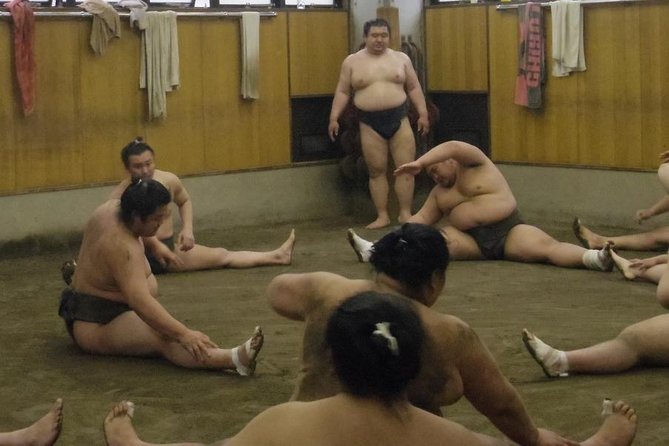
Seating is usually on low stools rather than mats, based on the arrangements described for this activity. You sit close to the training area, which makes the wrestlers’ size, speed, and impact much easier to appreciate than they would be from a distant arena seat.
The ring is sacred to the wrestlers. You must not step onto the ring or the sandy area around it. Do not stretch your legs toward the ring, since showing the soles of your feet is considered impolite in this setting.
Arrive ready to settle in. Front seating may be reserved for sponsors or people connected with the stable, and arriving early can improve your position among the public seats. Even so, the space is intimate, and several people have found the view close from most places.
There is one limitation to keep in mind. Depending on your seat, another person or a different angle may make certain exchanges harder to see. You cannot move around freely to chase a better view. You need to accept the seat you are given and watch without disturbing the training.
Same base, a different sort of day:
- Mt Fuji and Hakone 1-Day Bus Tour Return by Bullet Train
★ 5.0 · 26,383 reviews - 1-Day Tokyo Bus Tour
★ 5.0 · 14,250 reviews - Tokyo: TOKYO SKYTREE® Admission ticket
★ 4.5 · 11,192 reviews - Tokyo: teamLab Planets TOKYO Digital Art Museum Entry Ticket
★ 4.6 · 9,779 reviews
What the wrestlers actually do
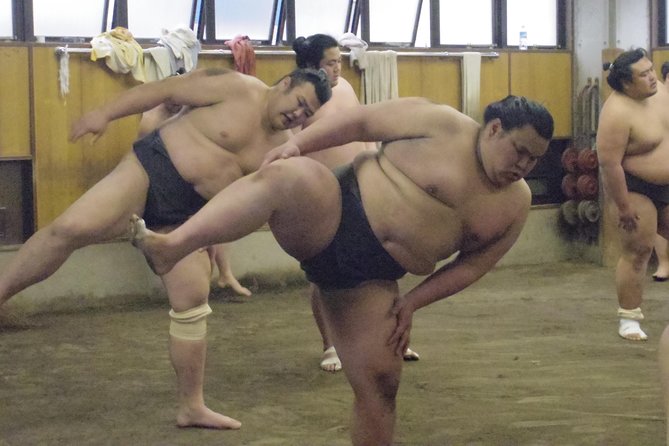
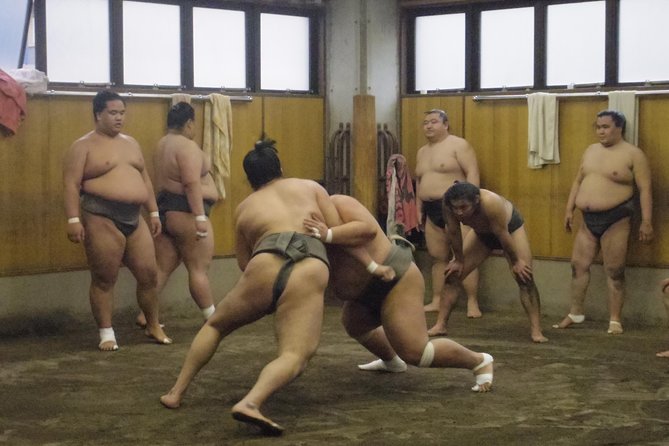
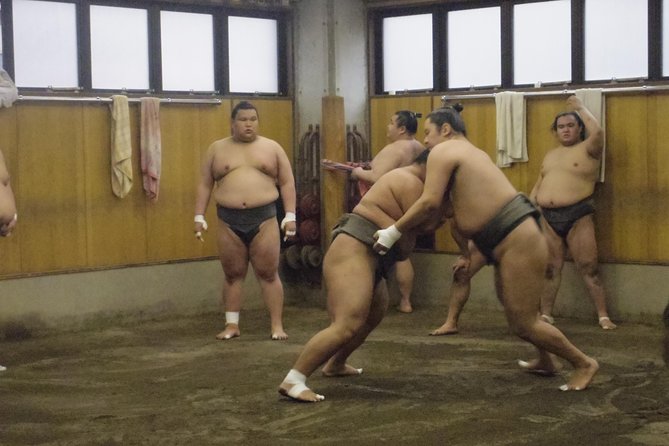
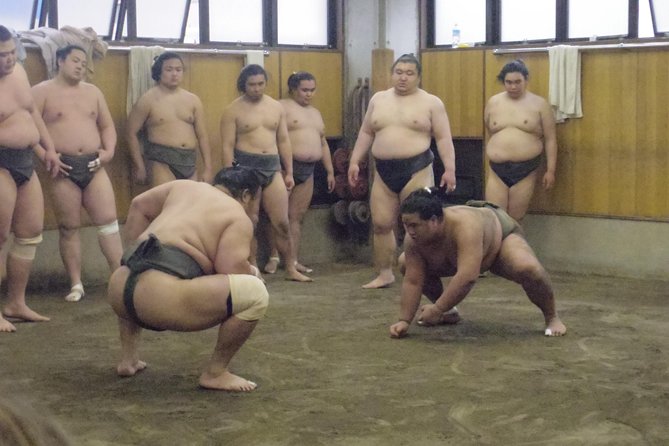
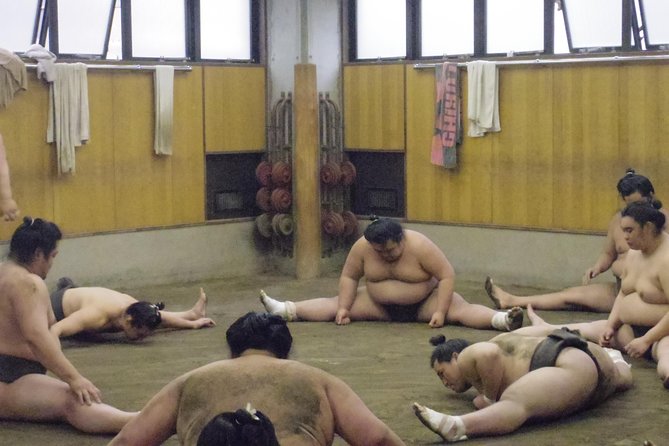
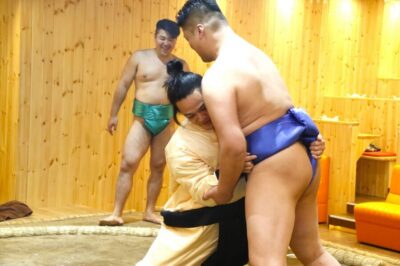
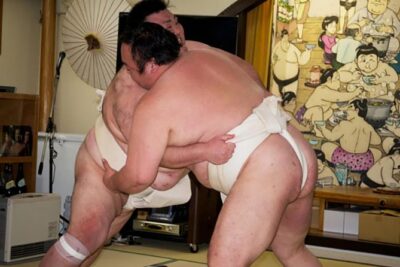
The practice is the heart of the morning. You watch wrestlers go through their daily routine, including warmups, exercises, and sparring. The most compelling moments are the direct exchanges, when two large athletes collide and try to force one another out of the ring.
The physical scale can surprise you. Sumo is not only about body weight. Balance, timing, footwork, leverage, and the ability to keep driving after contact all matter. A good guide can point out these details, helping you see more than two people pushing.
You may see many bouts during the session. That repeated action is one reason some people prefer practice to a formal tournament. At a tournament, ceremonial elements and scheduled bouts spread the action across the day. At the stable, you may watch wrestlers grapple again and again with little delay.
The practice may last a little less or a little longer than the advertised two hours. Its length depends on what the stable is doing that morning. A sponsor or important visitor can sometimes lead to a longer session and more intense wrestling, but that is not something you should count on.
The correct response is quiet attention. Cellphones must be silent. Videos are not allowed, and photos must be taken without flash or shutter sounds. Do not call out to wrestlers or interfere with their concentration. If you need to leave, try to do so only after practice ends.
The guide’s role and the headset issue
The guide is more than a person who leads you from the station. Before practice, you receive the basic story of sumo, the tournament calendar, the stable system, and the customs you need to follow. During practice, commentary may be delivered through an earpiece.
This is useful for a first visit. Sumo has its own vocabulary, ranks, rituals, and techniques. Without context, you might understand the force of the bouts but miss why certain exercises or gestures matter.
Several guides have been singled out for clear, friendly explanations. Seiji has been praised for breaking down the athletes’ routines and way of life. Yumi has provided discreet commentary as a serious sumo enthusiast. Cameo has been noted for a careful briefing and a question session afterward, while Noriko has helped explain the stable visit before seating. Nobu has also guided this experience.
The guide assigned to your date may be different. That means the tone and amount of commentary can vary. Some people enjoy having information throughout the practice. Others find it hard to listen and watch at the same time, especially if the headset has static or the commentary continues during an intense bout.
If you are sensitive to audio problems, this is worth considering. The most useful commentary should help you notice a specific move or explain the action without pulling your attention away from the ring. You may also have a chance to ask questions at the end, though the format is not guaranteed to include a long discussion.
Photos at the end
Photography is allowed under strict rules. No flash. No shutter sound. No video. You also must respect privacy and image rights, and unauthorized use of photographs is prohibited.
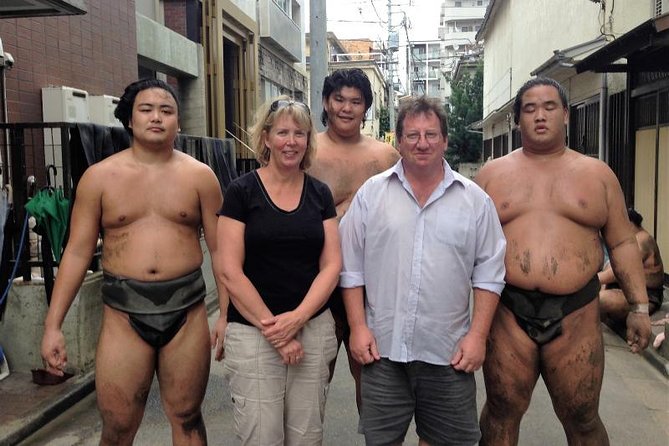
A short photo opportunity with wrestlers may take place after practice. Some sessions have allowed small groups to pose with athletes, which can be a memorable finish. Do not ask wrestlers to take photos with you while training is still under way.
Keep your expectations modest. The photo period may be brief, sometimes only a few minutes, and the stable may need to clear the space quickly. The practice itself is the main event. The photo, if offered, is an extra.
Heat, clothing, and stable manners
There is no air conditioning inside the stable. Tokyo summers can be very hot, and this matters because you remain seated and quiet for a sustained period. During summer, water and sports drinks are allowed inside, but eating is not.
Bring a small cooling aid such as an ice pack or cold towel. Wear clothing that will keep you comfortable without making noise as you shift. Hats and sunglasses are not allowed inside the stable, so be ready to remove them.
The etiquette is simple but important:
- Watch silently.
- Keep your phone on silent.
- Do not enter the ring or sandy area.
- Do not point your feet toward the ring.
- Do not leave during practice unless necessary.
- Do not distract the wrestlers.
- Do not use video, flash, or camera shutter sounds.
These rules are not needless fussiness. You are observing athletes at work in a place tied to their daily lives and religious customs. Your restraint helps preserve the experience for everyone in the room.
Is $83.57 good value?
At $83.57 per person, this is not a cheap morning activity. You are paying for access to a working stable, a guide, local coordination, and a rare chance to watch professional wrestlers from close range.
The value depends on what you want from sumo. If you only want to see a match, the price may feel high, especially if the practice is short or the audio is poor. You also do not control the exact training schedule, seating position, or amount of photo time.
I think the price makes more sense if you care about the setting and the explanation. A guide helps you understand the rankings, the tournament calendar, the Shinto customs, and the daily discipline behind the bouts. You also avoid the uncertainty of trying to locate a stable and gain access on your own.
The 96 percent recommendation rate and 4.8 rating from 298 ratings suggest strong satisfaction overall, but the lower scores point to real concerns: unclear audio, limited interaction, less-than-ideal sightlines, and a sense that the session can feel short for the price. Treat those as part of the decision, not as minor complaints.
Free cancellation is available up to 24 hours before the start time. Changes or cancellations inside that window are not accepted for a refund.
Who should book this morning
This is a strong choice for a first visit to Tokyo if you want an authentic cultural activity rather than a staged show. It suits people who enjoy watching process: training, repetition, discipline, and the small rituals around a sport.
It is also good for anyone who plans to watch a tournament on television later. Once you understand the ranking system and see how the wrestlers prepare, tournament bouts become easier to follow.
The minimum age is 12. Children 11 and under cannot enter the stable, and the quiet format may not suit anyone who needs to move around often. You should also skip the activity if you are unwell, particularly in hot weather.
I would be cautious if your main goal is personal interaction. This is observation first. You may have a short chance to take photos, but you should not expect a long conversation with the wrestlers or a guaranteed question-and-answer session.
Should you book the Tokyo sumo practice tour?
Book it if you want to see sumo where the work happens. The close seating, repeated sparring, and guide commentary can give you a clearer sense of the sport than a quick photo stop or themed dinner show.
Go in with the right expectations. You are entering a quiet working environment, not a performance built around your schedule. The session may vary in length, the commentary may not always be easy to hear, and the best seats may be reserved.
For most adults and older children with a genuine interest in Japanese culture, I think the access is worth the early start and the $83.57 price. Arrive on time, check the meeting point, bring something to cool yourself in summer, and prepare to watch quietly. If you can do that, this is one of Tokyo’s more memorable ways to understand what sumo demands.
FAQ
How long does the Tokyo sumo practice tour last?
The activity lasts about two hours, including the meeting, transfer, introduction, practice observation, and return to the original departure area. The practice itself is listed at about 90 minutes and may run shorter or longer.
Where do I meet the guide?
The listed meeting point is Ryogoku Station Gallery, near Ryogoku Station, at about 7:45am. The meeting point can vary by booking option, so check your confirmation email carefully.
Can I take photos inside the stable?
Yes, photos are allowed without flash or shutter sounds. Videos are not allowed, and you must follow privacy and image rights rules.
Can I take a photo with the wrestlers?
A short photo opportunity may be offered after practice. You cannot ask wrestlers to pose while practice is still taking place, and the photo period may be brief.
Are children allowed on the tour?
The minimum age is 12. Children 11 and under cannot enter the stable.
Is the stable air-conditioned?
No. There is no air conditioning inside the stable. In summer, bring an ice pack or cold towel. Water and sports drinks are allowed during the summer months, but eating is not allowed.
Can I leave the stable during practice?
You should make every effort to stay until practice ends. Once you leave, you cannot re-enter, and leaving during the session may distract the wrestlers.
What happens if I need to cancel?
You can cancel for a full refund up to 24 hours before the local start time. Cancellations or changes made less than 24 hours before the start time are not accepted for a refund.
Just added in Tokyo
- Nikko: Edo Wonderland Edomura Cultural Theme Park Ticket★ 4.3 · 205 reviews
- 《MEMBERS-ONLY-BAR-HOPPING》Discover Your Special Whiskey in Tokyo!★ 5.0 · 29 reviews
- Japanese Whisky Hunting《HIGH-QUALITY-ONLY》Rare Tasting Class★ 5.0 · 20 reviews
- Luxury Tokyo Sake, Cocktail, Whisky and Pairing Tour★ 5.0 · 18 reviews
- Wagyu & Sake Pairing in Shinjuku – Steak, Shabu-Shabu & More★ 5.0 · 112 reviews
- Small-Group Wagyu Beef and 7 Japanese Dishes Tokyo Cooking Class★ 5.0 · 190 reviews
- From Tokyo: Private Tour to Fuji/Hakone – Onsen, Art, Nature★ 5.0 · 116 reviews
- Tokyo: KABUKI Show at Kabukiza Theatre Admission Ticket★ 4.8 · 152 reviews
Sumo Experiences, compared.
Sumo Show Experience with Chicken Hot Pot and a Photo
Read our review →
Tokyo Shinjuku Sumo Show & Experience with Photo
Read our review →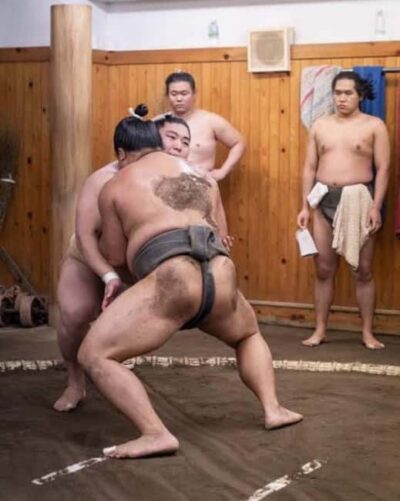
Sumo Show & Experience w/ Optional Kimono & Hot Pot
Read our review →
Authentic Sumo Experience in Tokyo: Enter the Sanctuary
Read our review →Browse the lists this tour appears in