
Reviewed · WALKING TOURS
Osaka Walking Tour
Osaka reveals itself quickly on this three-hour walk, from the polished maze of Osaka Station City to old-school Shinsekai and the neon signs of Dotonbori. I like the small group of up to 10 and the way the route uses the subway, letting you see how the city actually works. The included kushikatsu snack and drink add a useful taste of Osaka without turning the tour into a full food crawl.
I also like the local guides, especially the repeated praise for Hide, Harry, Kaori, Minako, Ichi, and Ichiro. They are known for clear English, helpful answers, and practical advice. The main drawback is value: at $53.06, you still pay your own subway fare, and the tour spends time walking through station and shopping areas rather than entering major paid sights.
Key things to know before booking
- Osaka Station City starts the story: You learn to read one of Japan’s busiest transport areas before heading south.
- Shinsekai brings the food stop: Expect kushikatsu, a deep-fried Osaka specialty, plus one non-alcoholic drink.
- The subway fare is extra: Budget 430 yen for an adult or youth fare, and 220 yen for a child.
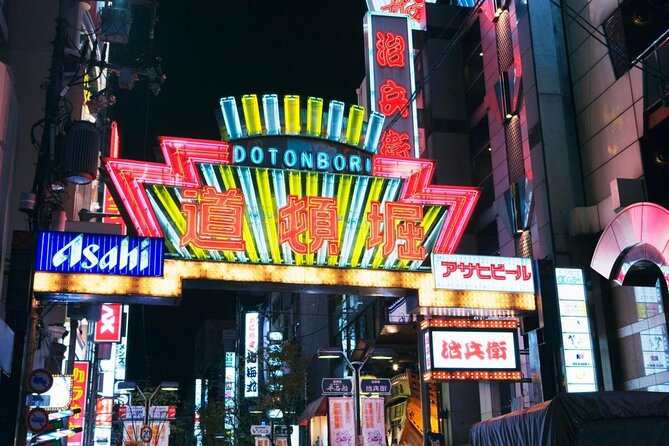
- The route ends in Dotonbori: You finish at Ebisu Bridge, a handy spot for more food, shops, and evening sightseeing.
- The guide makes the difference: Hide, Harry, Kaori, Minako, Ichi, and Ichiro are among the guides praised for clear English and local tips.
- Comfortable shoes matter: This is a real walking tour, with escalators, steps, station corridors, and outdoor streets.
A three-hour introduction to Osaka’s different sides
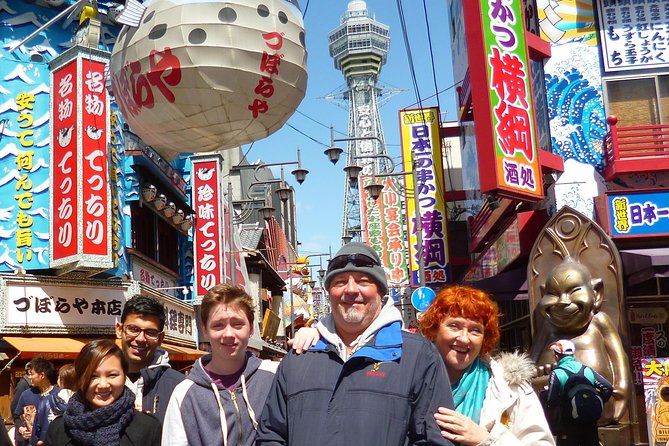
This tour works best as an orientation walk. In three hours, you move from north-central Osaka to the southern entertainment districts, seeing modern retail, traditional religious space, working-class streets, local food, and giant commercial signs along the way.
I would not book it expecting a museum tour or a long list of major landmarks. The route is about getting a feel for Osaka. You learn how the city is laid out, how people move around it, and how food and shopping shape daily life.
That makes the tour especially useful on your first day. A good guide can help you understand where Umeda, Shinsekai, Namba, and Dotonbori fit together. Several guides also offer practical advice for the rest of your Japan trip, which can be more useful than another quick photo stop.
The group limit of 10 is a real advantage. A small group allows you to hear the guide in crowded streets and ask questions without holding up a large crowd. In quieter periods, the group may be much smaller. One person even ended up on a private-feeling tour, which allowed the guide to keep moving at a comfortable pace.
Other walking tours in Osaka people book:
- Osaka: Hotspots & Hidden Gems Walking Tour Private or Group
★ 4.9 · 1,300 reviews - Osaka Local Foodie Walking Tour in Dotonbori and Shinsekai
★ 5.0 · 985 reviews - Osaka Bar Hopping Night Walking Tour in Namba (3 bars, 6 tastes)
★ 5.0 · 958 reviews
Meeting at Osaka Station City at 9:50
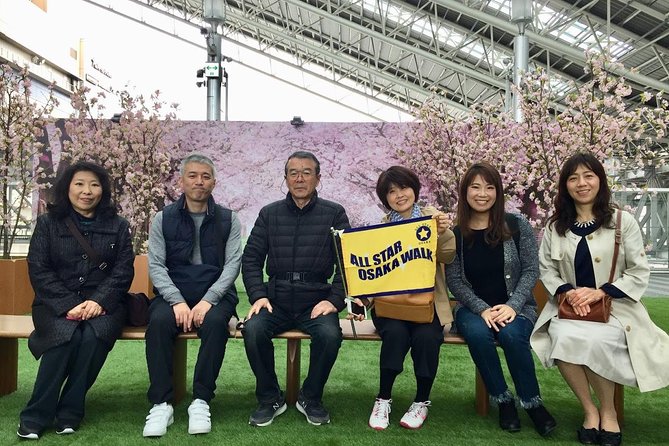
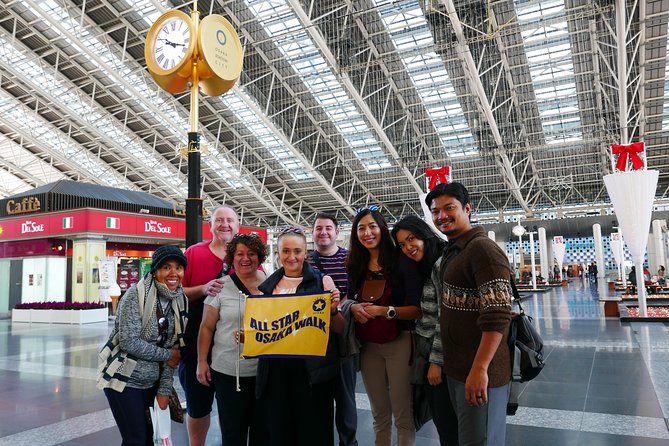
The tour meets at the Osaka Tourist Information Center on the ground level, in front of the central gate of JR Osaka Station. You meet at 9:50 a.m., and the walk begins exactly at 10 a.m. Look for the guide holding an All Star Osaka yellow flag.
Give yourself extra time to find the meeting point. Osaka Station is large, busy, and not always simple to navigate on a first visit. The meeting point is in front of the central gate, not just somewhere inside the station complex. If you arrive by train, follow signs for the central gate and the tourist information center.
This early portion takes place around Osaka Station City, a large modern facility in the north center of the city. The stop lasts about 45 minutes. That may sound less exciting than a temple or market, but it gives you something practical: a mental map of Osaka’s main northern transport and shopping area.
You will walk through a modern commercial setting rather than an old neighborhood. That is one reason the tour feels like an introduction to present-day Osaka instead of a checklist of historic sights. A guide can explain how Osaka Station City fits into the city and point out useful places for shopping, food, and transit.
The tradeoff is clear. If you want temples, castles, or long scenic walks, this first stop may feel too commercial. If you have trouble understanding Osaka Station, though, the orientation can save you time later.
Riding the subway to southern Osaka
The subway ride is part of the experience, not just a way to get from one attraction to another. You travel like a local between the different sections of the route. That helps you understand why Osaka can feel like several cities joined together by rail.
The subway fare is not included. The stated fare is 430 yen for an adult or youth and 220 yen for a child. Bring enough yen or be ready to use the payment method accepted for your journey. Since the fare is modest, it does not add much to the total cost, but you should know about it before booking.
This is also a useful part of the walk for first-time visitors who are still getting used to Japanese stations. Your guide handles the route and can help you follow the transfer process. You still need to keep up, especially if the station is crowded.
The route uses escalators and some steps. A stroller may be awkward, and the provider specifically advises families to take care around babies with strollers. Most people can take part, but this is not a step-free sightseeing route.
Shinsekai, kushikatsu, and Osaka’s old downtown mood
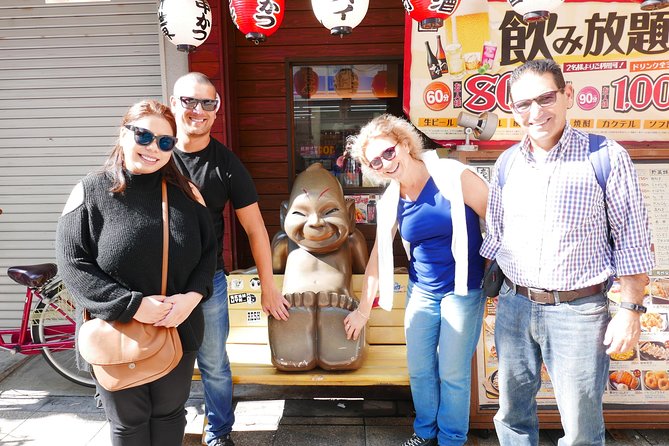
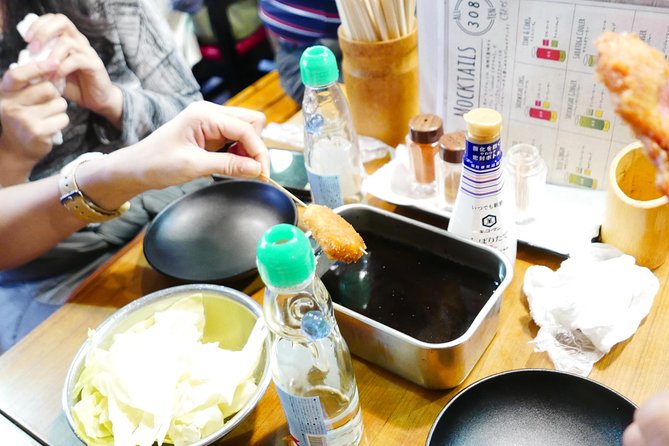
Shinsekai is the food-centered part of the tour and one of its most distinctive stops. The area is known for restaurants serving kushikatsu, Osaka’s famous deep-fried snack. Pieces of meat or vegetables are placed on skewers, coated, and fried, giving you a quick taste of the city’s casual food culture.
The tour stops at a restaurant for kushikatsu and includes one non-alcoholic drink. This is a tasting, not a full meal or a dedicated food tour. If you have a large appetite, plan to eat again after the walk.
The food stop is valuable because it gives context to Osaka’s reputation as a city that loves eating out. You are not simply handed a snack in an anonymous venue. The guide can explain what you are eating and how the neighborhood fits into Osaka’s character.
The exact setting may vary. Some people have described eating in an unusual space, including an old Volkswagen van at a restaurant. Treat that as a possible feature rather than a guaranteed part of every departure. The reliable promise is the kushikatsu stop and the drink.
Shinsekai also has a different feel from Osaka Station City. It is more informal, with restaurants, food signs, and older commercial streets. You get a useful contrast between the polished northern center and the southern neighborhoods that built Osaka’s popular image.
Still, do not expect a complete exploration of Shinsekai. The stop lasts about 50 minutes and includes the restaurant visit. You will have time to look around, but not enough for an extended meal or a slow wander through every side street.
Other guided walks in Osaka:
- Osaka: Deep Backstreets Walking Tour with Dinner Option
★ 4.9 · 902 reviews - Ultimate Osaka Walking Tour: Castle, Dotonbori & Hidden Gems
★ 5.0 · 862 reviews - Osaka: Main Sights and Hidden Spots Guided Walking Tour
★ 4.9 · 702 reviews - Private Osaka Walking Tour: Highlights & Hidden Gems
★ 5.0 · 569 reviews
Small alleys, shops, and everyday Osaka
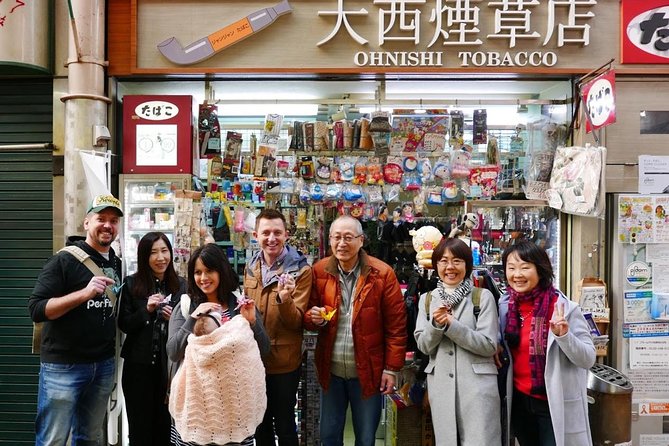
Between the major stops, the walk passes through an attractive alley lined with restaurants. These short passages are part of the tour’s appeal. They show the kind of narrow urban spaces you might miss if you moved only between large stations and famous landmarks.
The route also passes through a busy commercial district filled with restaurants, shops, theaters, and bright billboards. This is where Osaka’s playful, loud public face comes forward. The signs and storefronts are not just decoration. They show how food, entertainment, and shopping overlap in the city.
One limitation is that these sections are mostly viewed from the street. You are not promised shopping discounts, theater entry, or extended time inside individual businesses. I see the value in the walk as an introduction, not as a focused shopping excursion.
The guide is important here. A good guide can point out details you would pass without noticing and explain local customs without slowing the group too much. Guides such as Kaori have been praised for taking time with questions and checking answers when needed. Minako is also noted for offering practical advice about Osaka and Japan beyond the tour itself.
Hozenji Temple and the route toward Namba
Hozenji Temple adds a small, quiet religious stop to an otherwise commercial route. Its location near the entertainment districts makes it useful for showing how Osaka places old religious spaces beside restaurants, shopping arcades, and neon streets.
The temple visit is not a long formal sightseeing session. Think of it as a pause and a change of mood. After station corridors and food streets, Hozenji gives you a more traditional point of reference.
The walk then moves toward Namba and Dotonbori. Namba is one of the liveliest sections of the route, and it offers a strong contrast with Shinsekai. You see a dense mix of shops, restaurants, theaters, and people moving through the district.
Several people have found this part the most atmospheric. I can understand why. Namba and Dotonbori give you the classic Osaka first impression, but the guide has already shown you other sides of the city, so the bright signs mean more than they would at the start of the day.
Ending at Ebisu Bridge in Dotonbori
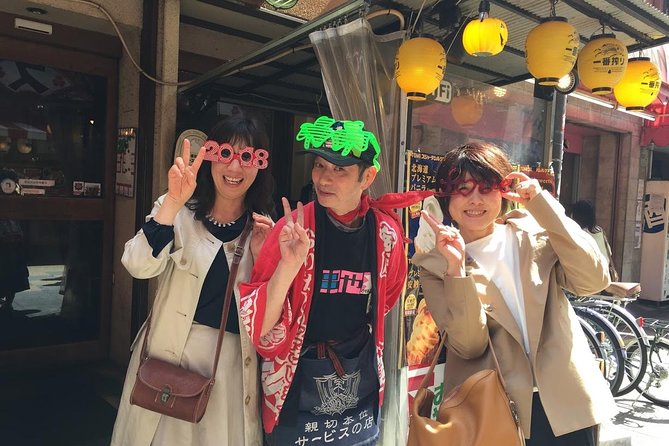
The tour finishes at Ebisu Bridge, at 1 Chome-6 Dotonbori, after about three hours. This is a practical ending point. You are already in one of Osaka’s main entertainment districts, with many choices for lunch, more snacks, shopping, and independent sightseeing.
The bridge sits in Osaka’s liveliest area, so do not expect a quiet finish. It can be crowded, especially later in the day. The guide does not provide hotel drop-off, and you are responsible for finding your next destination after the tour.
That is not a serious problem if you are comfortable continuing on your own. In fact, the location is useful because you can stay in Dotonbori or continue toward Namba. One guide even helped a participant work out the journey back to a cruise ship, though that kind of extra assistance depends on the guide and your circumstances.
The ending also makes the tour easy to combine with an afternoon plan. You could continue exploring Dotonbori, eat lunch, or use nearby transit. Just remember that the formal tour ends on the bridge, not at a restaurant or transport terminal.
What the $53.06 price really includes
At $53.06 per person, the price is reasonable if you value the guide and the city orientation. You receive about three hours with a local guide, a kushikatsu tasting, and one non-alcoholic drink. The small group can make the experience feel personal, especially when the guide is good at answering questions.
The price is less appealing if you mainly want admission to major attractions. No paid sightseeing attraction is included, and the subway fare is extra. Much of the tour takes place on public streets, in shopping areas, and around stations.
I would compare it with the cost of a private guide, which would normally be much higher. A group capped at 10 gives you some of the benefits of personal guidance without the full cost of a private tour. On the other hand, you should not expect a private itinerary or the freedom to skip sections you do not enjoy.
The food inclusion is modest but useful. You get a real local specialty without paying for a large meal. If you view the snack as part of the cultural explanation rather than the main value of the tour, the price makes more sense.
Guides who shape the experience
The strongest part of this tour is the guide. Names that receive particularly warm attention include Hide, also called Harry in some settings, along with Kaori, Minako, Ichi, Ichiro, Rika, Yahiro, and Keiko.
The most useful qualities are clear English, a relaxed walking pace, local pride, and a willingness to answer questions. Hide and Harry are praised for their history explanations and friendly manner. Kaori is noted for careful explanations and thoughtful answers. Minako is especially valued for practical tips and help beyond the basic route.
Guide quality can vary from one departure to another, as it does with any walking tour. The route itself is fairly straightforward, so the guide determines how much you learn and how connected the stops feel. A strong guide turns a station, alley, or restaurant street into a lesson about Osaka. A weaker one may leave you feeling that you simply walked between food districts.
One small issue deserves mention. A participant disliked repeated requests to pose for photos for the tour company’s social media. If you prefer not to be photographed, say so politely at the start. That concern appears to be about tour-company promotion, not the sightseeing route itself.
Weather, walking pace, and who should book
The tour operates in rain or shine, and the provider says it requires good weather. If poor weather causes cancellation, you are offered another date or a full refund. Bring suitable clothing for the forecast, since parts of the route are outdoors.
The walk is described as moderate, and several people found the pace relaxed, including in hot and humid weather. Even so, you will spend three hours moving through stations, streets, alleys, and shopping districts. Wear comfortable shoes and expect escalators and steps.
I would recommend this tour for:
- First-time visitors who want a quick orientation
- People with only one day or a short stay in Osaka
- Solo visitors who want local context without booking a private guide
- Anyone curious about Osaka food and everyday neighborhoods
- People who want to end near Dotonbori for independent sightseeing
I would look elsewhere if you want a deep food tour, major historic attractions, a castle visit, or a slow photography walk. Families should also consider the walking, station steps, and stroller issue. Children must be accompanied by an adult.
Should you book the All Star Osaka Walk?
Book it if you want a friendly introduction to Osaka that connects Umeda, Shinsekai, Namba, and Dotonbori in one morning. The combination of subway travel, kushikatsu, Hozenji Temple, station orientation, and local explanations gives you a useful first look at the city.
Skip it if you expect admission to famous attractions or a substantial food itinerary for the $53.06 price. The tour is strongest as a guided city sampler. For a first day in Osaka, especially with limited time, I think that is a worthwhile role.
FAQ
How long does the Osaka Walking Tour last?
The tour lasts approximately three hours.
Where does the tour start?
It starts at the Osaka Tourist Information Center on the ground level in front of the central gate of JR Osaka Station.
What time should I arrive?
Meet at 9:50 a.m. The tour begins exactly at 10 a.m.
How do I identify the guide?
The guide will hold an All Star Osaka yellow flag.
Where does the tour end?
The tour ends at Ebisu Bridge in Dotonbori, at 1 Chome-6 Dotonbori.
Is food included?
Yes. Kushikatsu and one non-alcoholic drink are included. Other food and drinks are not included.
Is the subway fare included?
No. The stated fare is 430 yen for an adult or youth and 220 yen for a child.
How large is the group?
The maximum group size is 10 people.
What happens if the tour is canceled because of bad weather?
You will be offered another date or a full refund. You can also cancel for a full refund up to 24 hours before the experience starts. Cancellations within 24 hours are not refunded.
Just added in Osaka
- Osaka Temple Cool Foot Bath & Matcha Experience〈45min〉★ 4.9 · 82 reviews
- Osaka: Mind & Spirit Balance Temple Reiki Healing★ 5.0 · 41 reviews
- Full Day Kyoto Tour : Bamboo Forest, Golden Temple, Fushimi Inari★ 5.0 · 84 reviews
- Osaka: Minoh, Katsuoji Temple, & Minoh Falls Full-day Tour★ 4.9 · 172 reviews
- Ramen and Gyoza Cooking Class in Osaka★ 5.0 · 202 reviews
- OSAKA NIGHT FUSION Japanese Taiko Kabuki Samurai Dance Show★ 4.8 · 155 reviews
- Osaka: A Modern Samurai, Kabuki, Taiko, & Dance Show★ 4.5 · 66 reviews
- Osaka: Samurai Training Experience KENDO in Osaka★ 5.0 · 111 reviews
Walking Tours, compared.
Kyoto Geisha Walking Tour: Gion District & Hidden Gems
Read our review →
Tokyo Tsukiji Fish Market Food and Culture Walking Tour
Read our review →
Imperial Palace and Shogun Historical Walking Tour
Read our review →
Gion Geisha District Walking Tour – Stories of Geisha
Read our review →
Shinjuku Local Bar and Izakaya Guided Walking Tour
Read our review →
Asakusa Walking Tour with Sensoji Temple Visit
Read our review →
Nishiki Market Brunch Walking Tour (7 Tastings + Brunch)
Read our review →Browse the lists this tour appears in