
Reviewed · TSUKIJI & TOYOSU FISH MARKET TOURS
Tsukiji Fish Market Small-Group Food Walking Tour
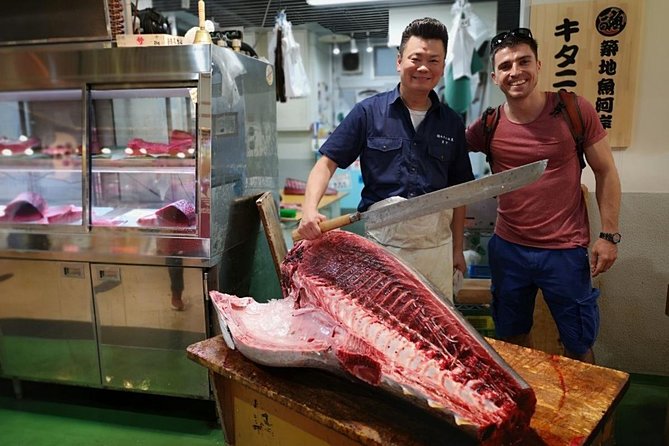
Tsukiji is best understood as a food neighborhood, not a single fish-trading floor. This three-hour walk takes you through narrow market lanes for seafood, tamagoyaki, sushi, eel, dried goods, and local snacks, then adds a Buddhist temple, a Shinto shrine, and a city view. The food is the main event, but the cultural stops give the morning some shape.
I like the small group, capped at seven, because a guide can steer you through tight lanes and explain unfamiliar foods without turning the walk into a slow parade. I also like that lunch is included, not just a few token bites. The main catch is important: the inner wholesale market moved to Toyosu in 2018, so this is an Outer Market food walk, not a visit to the former tuna auction area.
Key points at a glance
- Fresh seafood and local snacks: Sample foods such as sushi, tamagoyaki, eel, scallops, crab, and other market specialties, with exact stops subject to change.
- A real meal is included: You finish with a seafood lunch, often at a small local restaurant.
- More than food: The route includes a Buddhist temple, a Shinto shrine, and a view toward Tokyo Bay.
- Small groups help: The maximum group size is seven, useful in Tsukiji’s narrow lanes.
- Come prepared for heat: Tokyo summers are hot and humid, so bring water and wear a hat.
- Dietary limits matter: Vegan options are not available, and allergy-free food cannot be guaranteed.
What Tsukiji is today
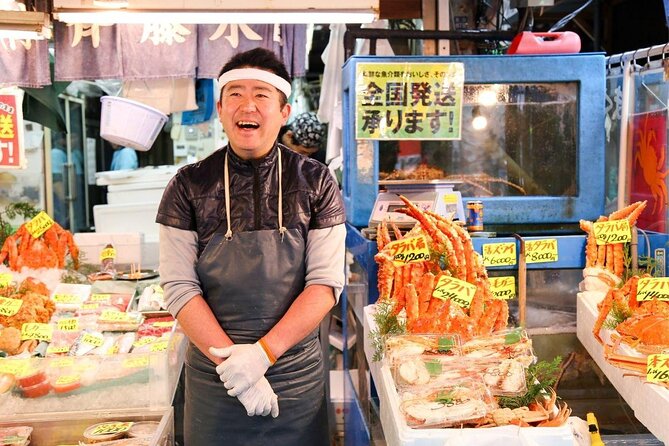
The name Tsukiji still carries the image of giant tuna, shouting wholesalers, and fish moving at speed through a wholesale market. That picture belongs mainly to the old inner market, which moved to Toyosu in 2018. The Tsukiji Outer Market remains open, active, and well worth visiting, but its character is different.
Here you find small shops selling seafood, fruit, vegetables, meat, dried fish, seasonings, knives, cooking tools, and tableware. Some shops serve businesses and restaurants, while others welcome home cooks and curious visitors. It feels like a working food district with plenty for the public to see and taste.
That distinction matters when you decide to book. If you want the famous tuna auction or the main wholesale hall, choose a Toyosu experience instead. If you want to eat your way through old Tsukiji, learn what the ingredients are, and have someone handle the choices for you, this tour makes more sense.
Other walking tours in Tokyo people book:
- Tokyo Tsukiji Fish Market Food and Culture Walking Tour
★ 5.0 · 3,184 reviews - Tokyo: Imperial Palace and Shogun Historical Walking Tour
★ 5.0 · 2,251 reviews - Tokyo: Shinjuku Local Bar and Izakaya Guided Walking Tour
★ 4.9 · 1,794 reviews
Meeting at Tsukiji Station
You meet at Tsukiji Station, Exit 1, near 3 Chome-9 Tsukiji. The meeting point is close to public transportation, and your guide will be waiting there. Arrive early enough to confirm you are in the right place, especially if the station area feels busy or several walking tours are gathering nearby.
The tour lasts about three hours. That is enough time for a proper introduction to the market, several tastings, lunch, and the religious and scenic stops without taking up your whole day. I would schedule it early in your Tokyo visit. You will learn names for foods and ingredients that can help you order with more confidence later.
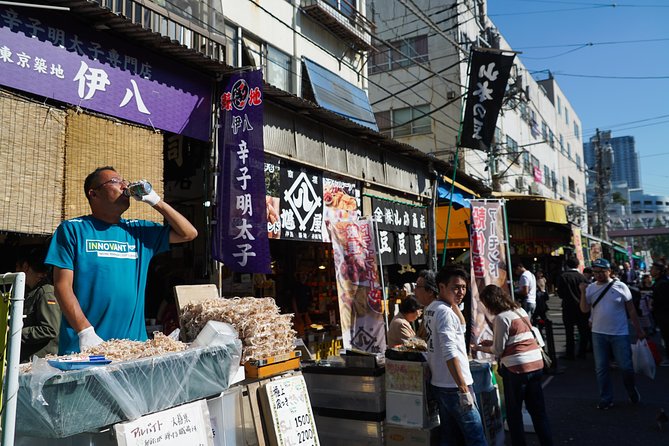
The group limit is seven people. That is a useful size for Tsukiji, where lanes can be tight and stopping in the wrong place can block shop entrances. One practical point from the route: there are signs asking people not to stop and eat in certain narrow areas. You may need to keep moving between stalls rather than linger over every bite.
Eating through the Outer Market
The food portion begins around Tsukiji Outer Market, a district of specialty shops rather than one enclosed hall. Your guide takes the lead on what to try and helps explain the unfamiliar items. This is where the experience earns its price, since you are not simply wandering past counters and guessing what everything means.
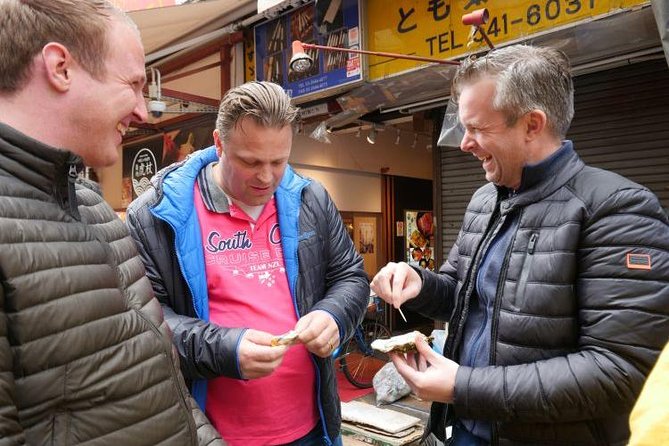
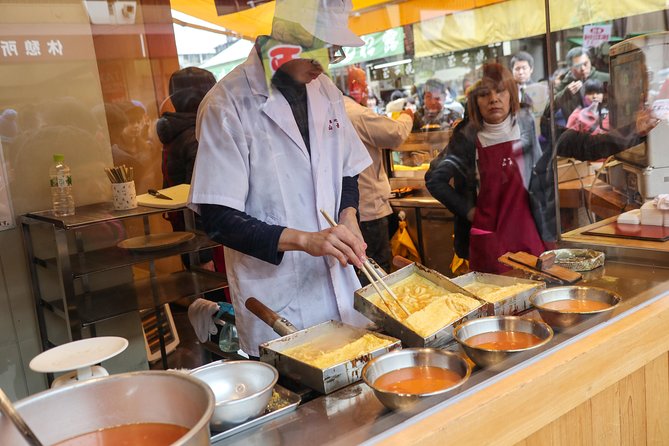
Past routes have included tuna nigiri, grilled eel, tamagoyaki, scallops on a stick, large crab legs, dried seafood, and small local snacks. You may also encounter foods such as takoyaki or grilled items, though individual stops can change. Some tastings are substantial, while others are one or two bites.
Tamagoyaki is a sweet Japanese omelet, often prepared in thick layers. It is a useful first taste because it shows you that market food is not only about raw fish. Eel brings a smoky, savory note, while dried seafood gives you a stronger idea of the preserved flavors used in Japanese cooking.
The guide also helps with the practical side of shopping. You can see cooking utensils, tableware, seasonings, and packaged foods alongside the seafood. If you want to buy something, there is time to look around, although the tour is built around tasting and learning rather than a dedicated shopping session.
The old market area and its 460 shops
One part of the walk focuses on the old Tsukiji market area, where roughly 460 shops sell fish, produce, meat, dried goods, seasonings, utensils, and tableware. The scale is easy to underestimate. Tsukiji is not simply a row of restaurants. It is a place where professionals, local residents, and visitors use the same food district for different purposes.
Your guide can point out the difference between a shop aimed at restaurant buyers and one that is easier for a casual shopper to browse. You will also learn how the market connects to Japanese food culture, including the importance of fresh ingredients and careful preparation.
The market can feel crowded, and the narrow lanes are not designed for long pauses. I like the human scale of this section, but you should not expect a quiet museum visit. Stay close to the guide, watch your footing, and give working shopkeepers room.
Other market mornings in Tokyo:
- Tokyo: Tsukiji Fish Market Food and Walking tour
★ 5.0 · 1,724 reviews - Tokyo: Tsukiji Fish Market Guided Walking Tour
★ 4.9 · 1,397 reviews - Tokyo Sushi Making Class in Tsukiji with Professional Chef
★ 5.0 · 1,177 reviews - Tsukiji Fish Market Guided Tour and Sushi Making with Pro Chef
★ 5.0 · 775 reviews
Seafood lunch in a local setting
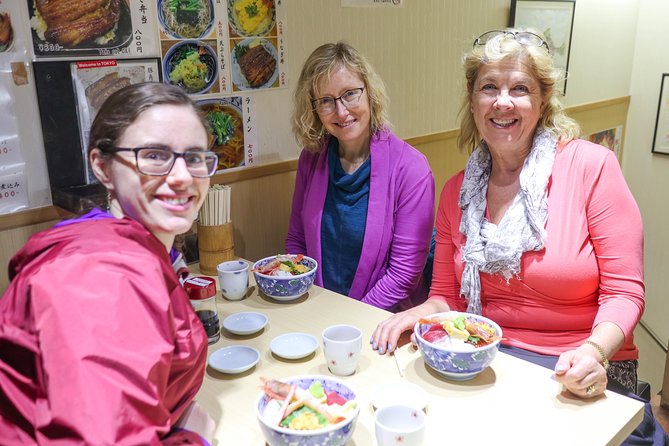
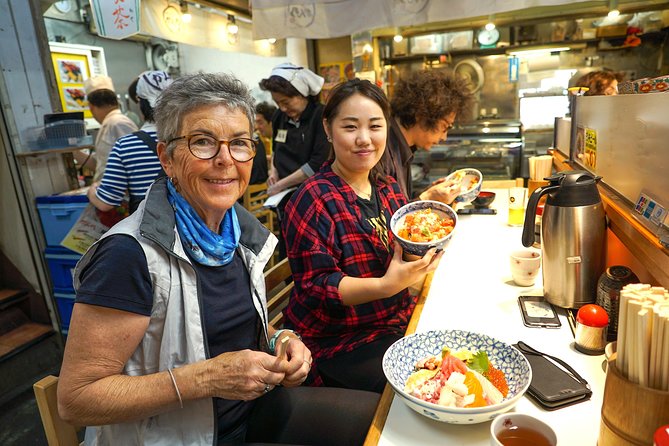
The included seafood lunch is a major reason to consider this tour instead of paying for a simple market orientation. After the snacks, you sit down for a fuller meal. Past meals have included sushi and other fresh fish, and one route ended in a small booth where the meal felt particularly local and informal.
You may be able to choose what you want for the sit-down meal, but do not treat a particular restaurant or menu as fixed. Market shops and food counters can change, and the guide may adjust the route based on opening hours, queues, or availability.
The lunch also changes the pace. Sampling at a stall is fun, but a seated meal gives you time to ask questions and decide which flavors you liked best. Come hungry. The combination of samples and lunch can be more filling than the basic three-hour length suggests.
Temple, shrine, and a different side of Tsukiji
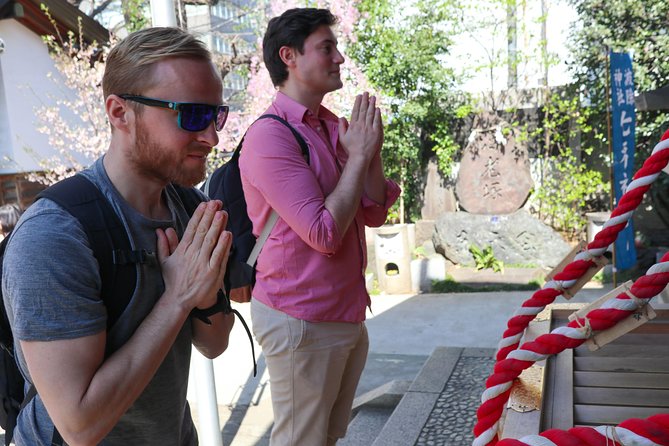
Tsukiji is not only a food stop. The route includes a Japanese Buddhist temple and a Shinto shrine, giving you a chance to see how religious sites sit alongside commercial streets in Tokyo.
The temple and shrine add useful context. At the Buddhist site, you can learn about the building and its place in Japanese religious life. At the Shinto shrine, the guide can help explain a different tradition and the customs associated with it. The stops are not presented as a long religious lecture, but they make the market feel like part of a lived-in neighborhood rather than a food attraction cut off from the city around it.
This part is valuable if you are new to Japan and want more than a list of dishes. You will see how food, work, faith, and daily life occupy the same few blocks. Wear respectful clothing and follow the guide’s instructions at each site.
A city view toward Tokyo Bay
The route also includes a viewpoint with a Tokyo city view, described as looking over Tokyo Bay. It gives you a short break from the close-packed market streets and lets you place Tsukiji within the wider city.
Do not book this as a dedicated observation-deck visit. The view is an added part of the walk, not the main attraction. Still, it is a welcome contrast after the market lanes and a good moment for photographs.
The tour ends at Shiodome Tower, at 1-chome-6-3 Higashishinbashi. That makes the experience useful for continuing into nearby parts of central Tokyo, though the tour itself does not include further sightseeing after the endpoint.
The guides make or break the morning
Food tours depend heavily on the person leading them. The strongest guiding style here combines clear explanations with a willingness to adjust the route. Guides named Kazu, Yuki, Hitomi, Mark, Tiger, Mia, and Mummy have led versions of this experience, and the most successful tours have included both food knowledge and a friendly manner.
A good guide does more than point at a fish. You want someone who can identify seafood, explain how it is eaten, give you a little market history, and tell you why one stall is worth your time. The best moments come when the guide turns an unfamiliar snack into something you can understand before you taste it.
There is some variation in how much explanation you receive. If you want a detailed lesson on every ingredient, tell your guide early. That simple request may help shape the experience toward history and food education rather than a faster tasting route.
Queues can also affect the plan. If a popular stall has a long wait, the group may move on and replace that item elsewhere. That is sensible in a three-hour tour, but it means you should not expect every advertised snack on every departure.
Is $87.37 good value?
At $87.37 per person, this is not the cheapest way to walk around Tsukiji. You could explore the market on your own and pay separately for a sushi meal. The price becomes easier to justify when you count the included lunch, several samples, guidance through a confusing food district, and the temple, shrine, and viewpoint.
I see the value in booking if you are visiting Tokyo for the first time, do not know which stalls are worth trying, or want to taste several foods without ordering full portions everywhere. The small group also adds practical value. Seven people or fewer means you can usually hear the guide and ask questions.
The price is less attractive if you already know Tsukiji well, prefer to choose every meal yourself, or mainly want to shop. It is also not the right match if you want the old wholesale market. For that, look toward Toyosu.
The tour is often booked about 40 days ahead, so planning early is sensible if your Tokyo dates are fixed. Confirmation arrives when you book, and the ticket is mobile.
Food restrictions and summer heat
The food policy deserves careful attention. Vegan options are not available. Allergy-free meals cannot be guaranteed because the food is prepared in kitchens that do not belong to the tour company, and substitutions may not be possible at every stop.
If you have a serious allergy or dietary restriction, contact the operator before booking and explain your needs clearly. The guide may try to provide alternatives at other stops, but you should not assume that every tasting or the included lunch can be changed.
Summer in Japan is hot and humid. Bring water and wear a hat to reduce the risk of heat exhaustion. Comfortable shoes are also a sensible choice because you will be walking and standing in crowded market lanes for much of the morning.
Who should book this Tsukiji walk?
I would choose this tour for someone who wants an easy introduction to Japanese seafood and does not want to make every market decision alone. It suits couples, families with older children, solo visitors who like small groups, and anyone who enjoys tasting foods with a guide nearby.
It is especially useful early in a Tokyo stay. After three hours, you will have a better sense of sushi, grilled seafood, Japanese snacks, market etiquette, and the difference between Tsukiji and Toyosu.
I would skip it if your main goal is the former inner market, the tuna auction, a vegan food experience, or a long, quiet meal. I would also think twice if you dislike crowded lanes or want complete control over the menu.
Cancellation is flexible up to 24 hours before the start time for a full refund. Changes or cancellations made within 24 hours are not accepted for a refund.
Should you book it?
Book this Tsukiji walk if you want fresh seafood, a seated lunch, and cultural context in one compact morning. The food sampling is generous enough to make the tour feel like more than a guided stroll, and the small group keeps the experience manageable in a tight market.
Just set your expectations correctly. You are visiting Tsukiji Outer Market, not the former wholesale floor. If that distinction works for you, the combination of market food, religious sites, and a Tokyo view offers good value at $87.37, especially for a first visit.
FAQ
How long does the Tsukiji Fish Market food tour last?
The tour lasts approximately three hours.
What is included in the price?
The experience includes food samples at several market shops and stalls, plus a fresh seafood lunch. The tour also includes visits to a Buddhist temple, a Shinto shrine, and a Tokyo city viewpoint.
Where does the tour start?
You meet your guide at Tsukiji Station, Exit 1, at 3 Chome-9 Tsukiji, Chuo City, Tokyo.
Where does the tour end?
The tour ends at Shiodome Tower, 1-chome-6-3 Higashishinbashi, Minato City, Tokyo.
How large is the group?
The maximum group size is seven people.
Is the former Tsukiji wholesale market included?
No. The inner wholesale market moved to Toyosu in 2018. This experience focuses on Tsukiji Outer Market and nearby areas.
Is lunch included?
Yes. A fresh seafood lunch at the market is included.
Are vegan options available?
No. Vegan options are not available on this tour.
Can the tour accommodate food allergies?
Allergy-free food cannot be guaranteed. Substitutions may not be possible at every stop, though alternatives may be attempted at other locations.
Can I cancel for a full refund?
Yes. You can cancel at least 24 hours before the start time for a full refund. Cancellations or changes made less than 24 hours before the start time are not accepted for a refund.
More walking tours elsewhere in Japan
- Tokyo: Asakusa Walking Tour with Sensoji Temple Visit
★ 4.8 · 1,583 reviews - Tokyo Castle & Imperial PalaceーShogun Walking Tour
★ 4.7 · 1,068 reviews - Tokyo: Imperial Palace Japanese History Walking Tour
★ 4.9 · 987 reviews - Tokyo: Imperial Palace and Shogun Walking Tour
★ 4.9 · 935 reviews
Just added in Tokyo
- Wagyu & Sake Pairing in Shinjuku – Steak, Shabu-Shabu & More★ 5.0 · 112 reviews
- Small-Group Wagyu Beef and 7 Japanese Dishes Tokyo Cooking Class★ 5.0 · 190 reviews
- Nikko: Edo Wonderland Edomura Cultural Theme Park Ticket★ 4.3 · 205 reviews
- 《MEMBERS-ONLY-BAR-HOPPING》Discover Your Special Whiskey in Tokyo!★ 5.0 · 29 reviews
- Japanese Whisky Hunting《HIGH-QUALITY-ONLY》Rare Tasting Class★ 5.0 · 20 reviews
- Luxury Tokyo Sake, Cocktail, Whisky and Pairing Tour★ 5.0 · 18 reviews
- From Tokyo: Private Tour to Fuji/Hakone – Onsen, Art, Nature★ 5.0 · 116 reviews
- Tokyo: KABUKI Show at Kabukiza Theatre Admission Ticket★ 4.8 · 152 reviews
Tsukiji & Toyosu Fish Market Tours, compared.
Tokyo Tsukiji Fish Market Food and Culture Walking Tour
Read our review →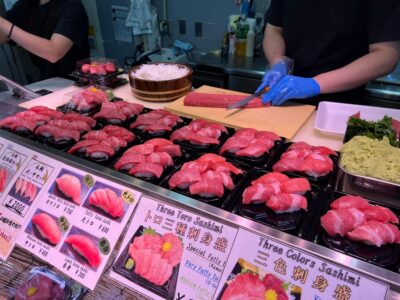
Tokyo Sushi Making Class in Tsukiji with Professional Chef
Read our review →
Tsukiji Fish Market Guided Tour and Sushi Making with Pro Chef
Read our review →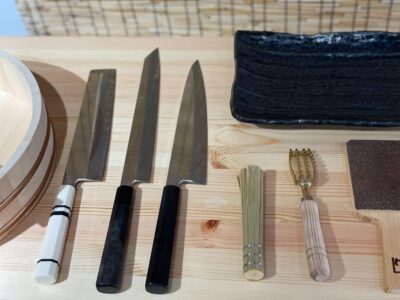
Tsukiji Fish Market Sushi Making Class with Pro Chef
Read our review →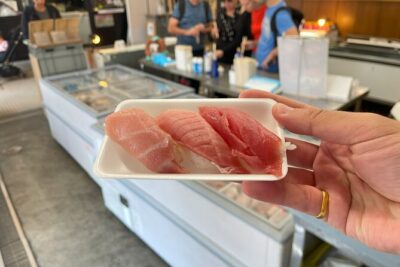
Tokyo Food Tour Taste Fresh Delights at Tsukiji Market
Read our review →
Tokyo Tsukiji Fish Market Tour and Sushi Making Lesson
Read our review →Browse the lists this tour appears in