
Reviewed · GEISHA & GION DISTRICT TOURS
Kyoto: Tea Ceremony with Maiko
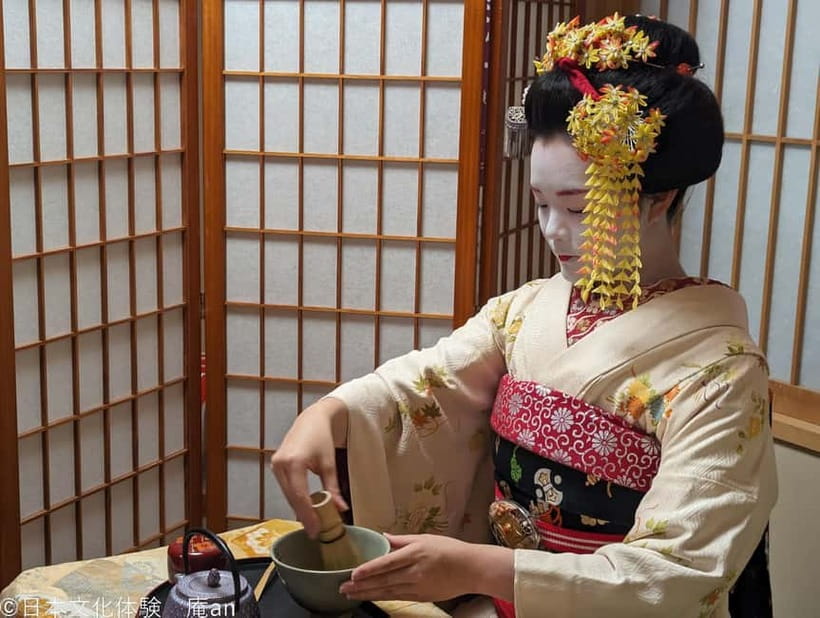
Kyoto’s maiko tradition can be hard to encounter respectfully, which makes this short program a practical way to meet one in a proper setting. You watch the tea ritual, make your own matcha, ask direct questions about her life, and finish with a photo and Senjafuda lucky charm.
I like the central Gojo location, only about a minute from Subway Gojo Station, and the honest 45-minute format. I also like that the Q&A is a real part of the program, not an afterthought. The main drawback is that this takes place in a building rather than a traditional ochaya or Japanese house, and English help may depend on the available interpreter.
Key points to know before booking
- Meet a maiko up close: You sit near the performer for the tea demonstration, questions, and a commemorative photo.
- Make your own matcha: The maiko shows you the method before you whisk your own tea.
- Try two ohigashi sweets: These small dried Japanese sweets balance the bitter matcha.
- Ask about maiko life: The Q&A offers a direct look at training, daily routines, and the path toward becoming a geiko.
- Plan for stairs: The building has no elevator, and the venue is reached by stairs.
- Allow extra time to find the entrance: It faces Gojo-dori, above the Carnival supermarket, near Subway Gojo Station Exit 1.
A direct introduction to Kyoto’s maiko tradition
This is a compact cultural program built around two symbols of Kyoto: the maiko and matcha. You do not simply watch a performer from across a room. You see the tea preparation close up, try it yourself, ask questions, and pose for a photo beside her.
The format is useful if your Kyoto schedule is tight. The activity lasts about 45 minutes, with the main ceremony and Q&A finishing around the 30-minute mark. The last portion allows time for your photo and the presentation of the Senjafuda charm before the maiko leaves.
The setting is practical rather than theatrical. The venue is in a building and is not an ochaya, the traditional establishment associated with geiko and maiko entertainment. That may disappoint anyone expecting tatami rooms, old wooden architecture, or a formal tea house atmosphere. In return, you get a relaxed space that is easy to reach and suited to a short visit.
Other tea ceremonies in Kyoto people book:
- Kyoto: Tea Ceremony in a Traditional Tea House in Kiyomizu
★ 4.9 · 3,519 reviews - Kyoto: Tea Ceremony Ju-An at Jotokuji Temple
★ 4.9 · 3,207 reviews - Kyoto: 45-Minute Tea Ceremony Lesson Experience
★ 4.3 · 2,378 reviews
Finding the venue near Gojo Station
The meeting point is about one minute from Exit 1 of the Subway Karasuma Line’s Gojo Station. The entrance faces the main road, Gojo-dori, but the location can still be easy to miss if you are moving quickly through the area.
A useful way to orient yourself is to leave by Exit 1, walk straight, cross a small street, and continue ahead. The venue is above the Carnival supermarket and before the next small street. You then take the stairs up to the room.
I would not cut this close to the start time. Late arrivals cannot be accommodated, and missing the session does not bring a refund. The activity will not wait for delayed trains, slow navigation, or a long search for the entrance.
The building has no elevator. You need to use stairs to reach the venue, so this is worth considering if stairs are difficult for you or someone in your group. Children who sit on a parent’s lap and are under two years old can attend free. A child who needs their own seat pays the same fee as one adult.
The opening greeting and tea demonstration
The program begins with a greeting from the maiko. Depending on the date, the performer may instead be a geiko. In Kyoto, a maiko is generally a young apprentice in the traditional performing arts, while a geiko is an established professional. The distinction matters, but both offer a chance to learn about a cultural world most people will not encounter casually.
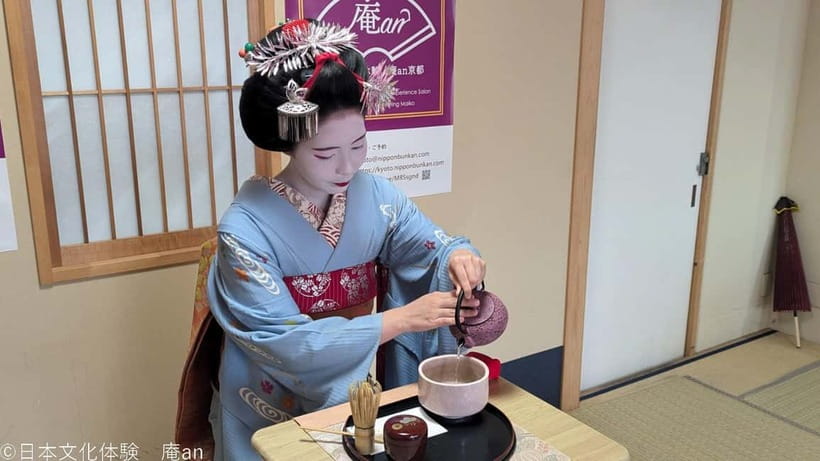
The tea portion follows. You first watch the maiko demonstrate how to prepare and drink matcha. The value here is not just the finished cup. You see the order of the actions and the care given to a drink that can look simple when prepared by someone practiced.
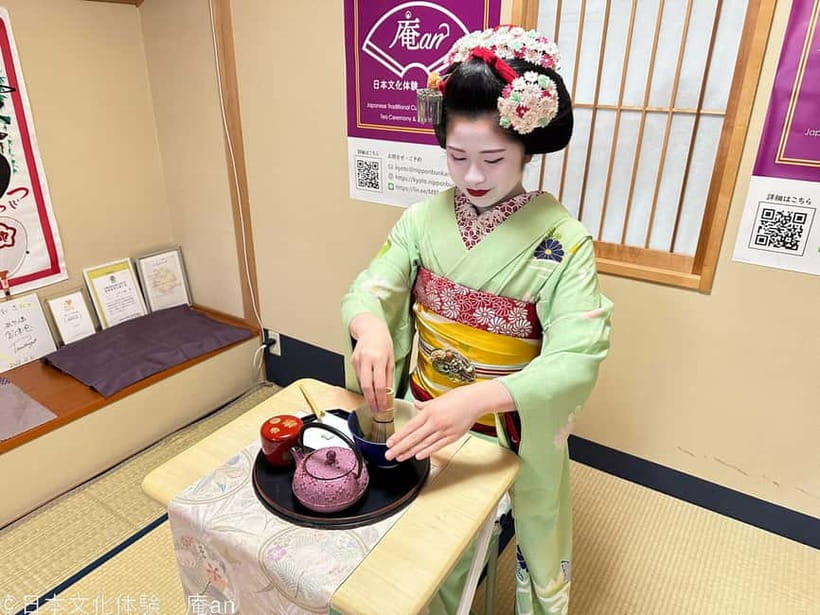
You then make your own bowl. This hands-on step makes the program more useful than a performance alone. You get a basic sense of the tools, the whisking, and the balance between the powdered tea and water. Do not expect a full formal tea ceremony course in half an hour. Think of it as a clear introduction that lets you take part without special preparation.
The tea is served with two pieces of ohigashi, a dried Japanese sweet. The sweets are small and deliberately restrained, offering a little sweetness alongside matcha’s sharp, grassy taste. If you have never tried matcha in a traditional setting, this pairing gives you the basic flavor pattern without turning the food into a separate meal.
Why the Q&A is the best part for many people
The question period is where this activity moves beyond a photo opportunity. You can ask about the maiko’s daily life, training, work, and eventual path toward becoming a geiko. The supplied information does not promise a fixed list of questions or a set lecture length, so your experience will depend partly on the questions asked and on the translation available that day.
The maiko speaks Japanese. English translation is provided as much as possible if requested, and an interpreter helped explain the session in one reported visit. That support can make a large difference, especially during the Q&A, where a short language gap can turn a thoughtful answer into a nod and a smile.
I would prepare a few questions before arriving. Ask about her training, how she became a maiko, what a normal workday involves, or how the move toward geiko status works. Specific questions usually produce a better exchange than relying on the host to fill every minute.
One session featured a maiko named Masaya-san, who answered questions in Japanese while an interpreter helped the group follow along. The performer changes, so you should not book this expecting a particular individual. Still, the program’s strongest feature is the chance to hear about the person’s own life rather than receiving only a rehearsed display.
Other evenings in the old entertainment quarters of Kyoto:
- Kyoto Geisha Walking Tour: Gion District & Hidden Gems
★ 4.7 · 3,273 reviews - Kyoto: Gion Magical Night Walking Tour with Geisha Trivia
★ 4.9 · 2,393 reviews - Kyoto: Gion Geisha District Walking Tour – Stories of Geisha
★ 4.7 · 2,187 reviews - Best of Kyoto: Gion, Geisha, Pagodas & Cobblestones
★ 4.9 · 2,058 reviews
The photo and Senjafuda presentation
After the main program, you can take a commemorative photo beside the maiko. This is a close-up photo opportunity, not a distant view from the back of a hall. Staff help the event move along, which matters when several people need a turn before the performer leaves.
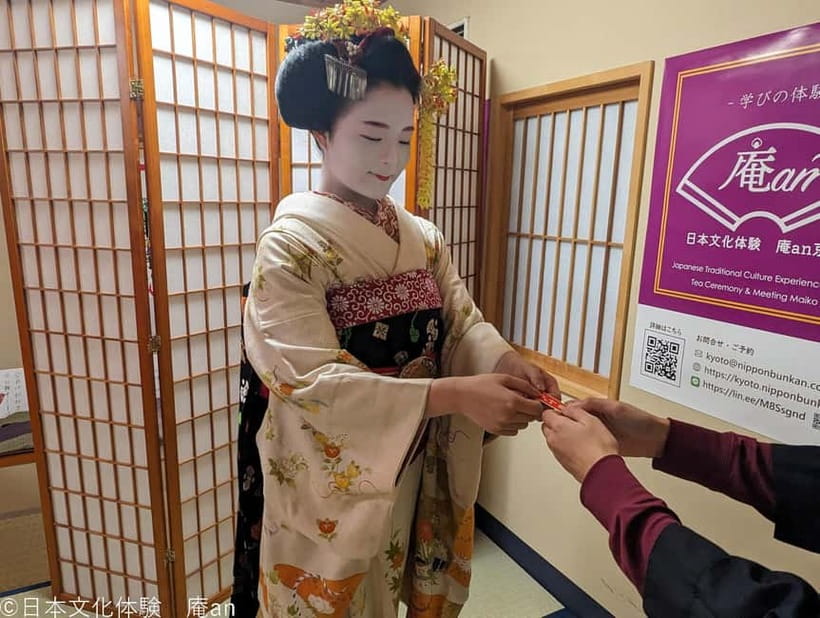
The photo gives the visit a clear keepsake, but the Senjafuda is the more distinctive souvenir. The maiko presents this small lucky charm at the end. It is a simple gesture, yet it connects the visit to the old custom of exchanging or collecting name slips associated with performers and temples.
You should treat the photo as part of a respectful cultural meeting, not as a chance to handle the costume, hair, or accessories. The setting is designed for a polite encounter, and the short format keeps the interaction orderly.
Some sessions may include extra elements such as a dance performance, sake, or a game, but these are not guaranteed in the standard details provided for this program. I would book for the tea, Q&A, photo, and Senjafuda, then regard anything else as an unexpected addition.
What the $28 price really buys you
At $28 per person, this is priced as a short introduction rather than a full evening of geiko entertainment. The fee includes the tea ceremony with the maiko, two dried sweets, matcha, the photo opportunity, and the Senjafuda gift.
I consider that fair value if you want several distinct elements in one compact stop. A basic cultural demonstration alone could feel thin, but here you also make tea and have time for questions. The central location adds value because you can fit the program between sights without committing half a day.
The price is less compelling if you are seeking a grand traditional setting or a long formal tea ceremony. You are paying for access to a personal encounter and a guided introduction, not an elaborate historic venue. The room is in a modern building, and the program can sometimes be held alongside people having lunch or dinner. That may make the atmosphere feel less private than a dedicated tea house visit.
A rating around the mid-three range overall suggests that expectations matter. People who want direct contact, simple explanations, and a short activity tend to find the format satisfying. Someone imagining an old Kyoto house, a silent ceremonial setting, or extensive English interpretation may find the experience more limited.
Language, group atmosphere, and changing performers
The official activity language is Japanese. English translation is available as much as possible when requested, but it is not presented as a fully English-led program. If every detail matters to you, contact the organizer in advance to ask for English support.
The event may be held with people having lunch or dinner, so do not assume you are booking a private session. A shared room can make the meeting more social, though it also means the amount of time available for each person’s questions and photos may vary.
The host may be a maiko or a geiko, depending on the event date. Both are part of Kyoto’s traditional entertainment world, but they are not interchangeable labels. If meeting a maiko specifically is essential, confirm the scheduled performer before booking.
The staff help explain how the program works, and the event is organized around a clear sequence. That structure is useful for first-time visitors because you know when to watch, when to make tea, when to ask questions, and when to take photos.
Who should book this short Kyoto activity
I would recommend it most strongly to you if:
- You have limited time in Kyoto.
- You want a respectful, guided introduction to maiko culture.
- You would rather participate than only watch.
- You enjoy asking questions about daily life and training.
- You want a photo and a small souvenir without paying for a long evening program.
- You are staying or sightseeing near Gojo, Kyoto Station, or the Karasuma Line.
Families can also use the short format well, especially with older children who can sit through a demonstration and take part in making matcha. Remember that children needing their own seats pay the regular per-person price.
I would hesitate if stairs are a serious problem, if you need guaranteed English throughout, or if the physical setting is central to your idea of a tea ceremony. The activity offers access and conversation, but not the architecture of a traditional Kyoto house.
Booking advice and cancellation details
The activity runs between 10:00 AM and 5:00 PM, with starting times based on availability. Reservations received after 5:00 PM are processed the next day.
You can cancel up to eight days in advance for a full refund. Changes to the date or time within seven days of booking incur a fee, and cancellation charges may apply depending on the policy. The organizer does not cover your transportation costs if you cancel.
I would book only after checking your route to Gojo Station and confirming that everyone can manage the stairs. Arrive early enough to identify the supermarket and entrance, since the program cannot pause for late arrivals.
Should you book the maiko tea ceremony?
Book it if you want a short, affordable Kyoto encounter that combines a real activity with personal conversation. The matcha-making gives you something to do, the Q&A adds context, and the photo and Senjafuda give you lasting reminders of the visit.
Skip it if you want a formal tea house, a private room, a guaranteed maiko rather than geiko, or extensive English instruction. For the right expectations, $28 buys a thoughtful introduction to a rare tradition without taking over your day. For many visitors, the direct questions and close photo opportunity will be more memorable than the tea itself.
FAQ
How long does the tea ceremony with a maiko last?
The full activity lasts about 45 minutes. The tea ceremony and Q&A finish at about the 30-minute point, followed by photos, the Senjafuda presentation, and room departure.
Where is the meeting point?
The venue is about a one-minute walk from Exit 1 of Subway Karasuma Line Gojo Station. The entrance faces Gojo-dori and is located above the Carnival supermarket.
Is the activity held in a traditional Japanese house?
No. The venue is in a building and is not an ochaya or traditional Japanese house. It offers a relaxed setting with friendly staff.
Will the host always be a maiko?
Not necessarily. Depending on the date, the program may be hosted by a maiko or a geiko.
Is English available?
The official language is Japanese. English translation is provided as much as possible if you request it, so contact the organizer if English support is important to you.
What is included in the price?
The fee includes the tea ceremony with the maiko, matcha, two dried Japanese sweets called ohigashi, a photo opportunity, and a Senjafuda gift.
Are children charged?
Children under two who sit on a parent’s lap are free. A child who needs their own seat pays the same fee as one person.
Can I cancel for a full refund?
You can cancel up to eight days in advance for a full refund. Cancellation fees may apply at other times, and changes made within seven days of booking may also incur a fee.
More tea ceremonies elsewhere in Japan
- Kyoto: Table-Style Tea Ceremony at a Kyo-Machiya
★ 4.9 · 1,211 reviews - Kimono Tea Ceremony at Kyoto Maikoya, NISHIKI
★ 5.0 · 911 reviews - Kyoto: Arashiyama Bamboo Forest, Monkeys, Matcha & Temple Tour
★ 5.0 · 759 reviews - Kyoto: Tea Museum Tickets and Matcha Grinding Experience
★ 4.9 · 739 reviews
Just added in Kyoto
- Kyoto: Zen Meditation at a Private Temple with a Monk★ 5.0 · 25 reviews
- Private Cooking Class Udon in Kyoto Japan★ 5.0 · 23 reviews
- Your Private Vacation Photography Session In Kyoto★ 5.0 · 110 reviews
- Private Pewter Sake Cup Experience with a Kyoto Artisan★ 5.0 · 31 reviews
- Kyoto Wagashi(Japanese sweets) Cooking Class near Fushimiinari★ 5.0 · 60 reviews
- Kyoto:Family-Friendly Kimono & Yukata Experience at WARGO★ 5.0 · 147 reviews
- Private Guided Traditional Buddhist Cooking in Japan★ 5.0 · 16 reviews
- Kyoto: Gion Geisha District & Sake-in-Hand Walking Tour★ 5.0 · 37 reviews
Geisha & Gion District Tours, compared.

Kyoto Geisha Walking Tour: Gion District & Hidden Gems
Read our review →
Gion Geisha District Walking Tour – Stories of Geisha
Read our review →
Best of Kyoto: Gion, Geisha, Pagodas & Cobblestones
Read our review →
Kyoto Night Foodie Tour in Gion (9+ dishes + 6 Sake tastings)
Read our review →
Kyoto Gion: 2-Hour Geisha Culture & History Walking Tour
Read our review →
Chopsticks Making Workshop in Gion with Engraving Option
Read our review →
Browse the lists this tour appears in