
Reviewed · GEISHA & GION DISTRICT TOURS
Kyoto: Tea Ceremony with Maiko Premium
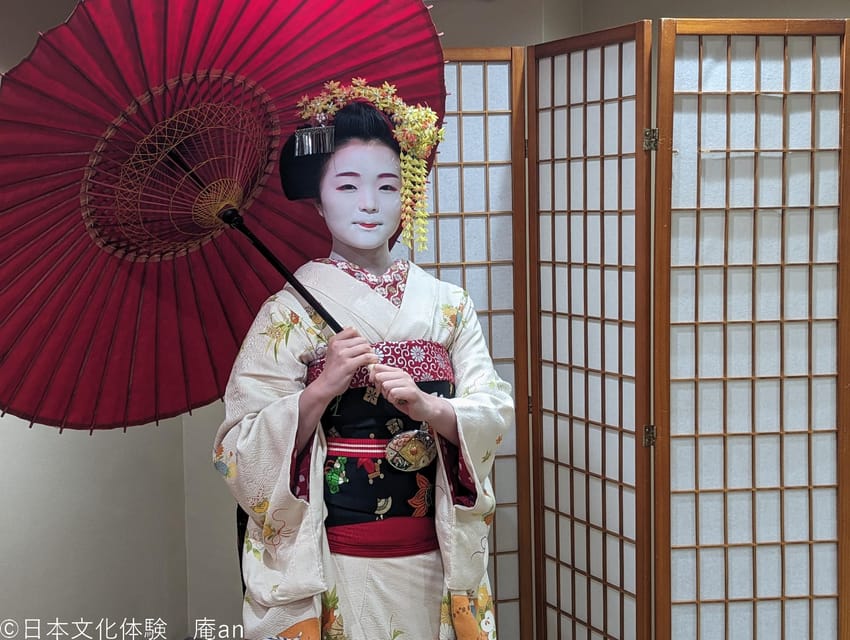
Kyoto’s Maiko culture is usually seen from a distance, perhaps in a quick glimpse on a Gion street. Here, you sit close enough to ask questions, watch two elegant dances, prepare matcha, and take a photo beside a Maiko. That direct contact is the real draw.
I like the open question-and-answer session, which turns a polished performance into a useful look at training, clothing, work, and daily life. I also like the traditional games, since they bring children and adults into the program instead of leaving everyone quietly watching.
The main compromise is the setting. This is held in a modern building near Gojo Station, not an ochaya or old Japanese house. Tables, stools, and company advertising can appear in the background of photos, so book it for the Maiko contact and cultural explanation rather than an atmospheric tea-house setting.
Key points to know before booking
- Two cultural experiences in one: You make matcha with a Maiko, then watch traditional dance and join a game.
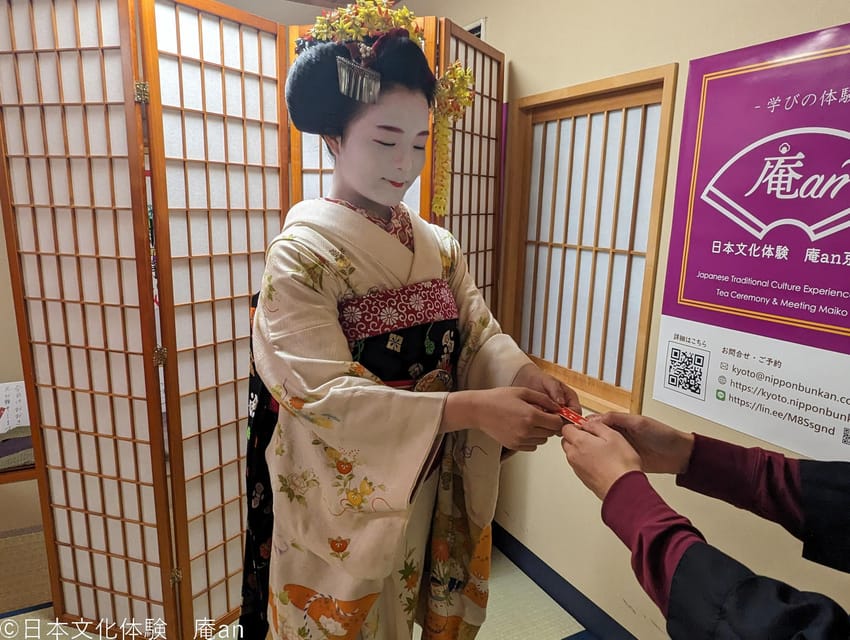
- Close photo opportunity: You can take a commemorative photo beside the Maiko and receive a Senjafuda lucky charm.
- Useful for families: Children can enjoy the games, sweets, and direct interaction, and the program does not require formal preparation.
- Modern venue near Gojo Station: The entrance is one minute from Exit 1, but the room is not a traditional tatami setting.
- Maiko or Geiko may appear: The program normally features a Maiko, but a Geiko may be invited instead.
- Premium pricing matters: The base cost is about $50 per person, with extra charges for front-row seating.
Why meeting a Maiko changes the usual Kyoto visit
A Maiko is not simply a performer in a beautiful kimono. She is part of a living Kyoto tradition built around music, dance, hospitality, formal dress, and years of training. This program gives you a short, structured way to learn about that world without trying to spot someone on the street.
The appeal is the personal exchange. You are not only watching a dance from across a stage. You can ask questions, listen to explanations about Maiko life, and take part in a few activities. The format is friendly and social, though it remains a group event rather than a private meeting.
The program has a current rating of 4.3 out of 5 from 280 ratings, which fits the overall picture: the Maiko contact, explanations, dances, and games are the strongest parts. The venue and photo backdrop are the main weak points.
Other tea ceremonies in Kyoto people book:
- Kyoto: Tea Ceremony in a Traditional Tea House in Kiyomizu
★ 4.9 · 3,519 reviews - Kyoto: Tea Ceremony Ju-An at Jotokuji Temple
★ 4.9 · 3,207 reviews - Kyoto: 45-Minute Tea Ceremony Lesson Experience
★ 4.3 · 2,378 reviews
Arriving near Gojo Station
The meeting point is easy to reach. Walk about one minute from Exit 1 of Gojo Station on the Subway Karasuma Line. The entrance faces Gojo-dori, so you should not need to search through small side streets.
Plan to arrive early. The organizers cannot hold the program for late arrivals, even if your train, taxi, or previous activity runs behind. One useful tip is to arrive about 15 minutes before the start. The Maiko may arrive by taxi around that time, though this is not guaranteed.
The building has no elevator. You need to use stairs to reach the venue, so allow extra time if someone in your party has difficulty with stairs. The activity is not suitable for people who cannot manage the building access unless the provider confirms another arrangement in advance.
The venue itself is relaxed and staffed by friendly people, but do not picture an old Kyoto townhouse. You will be in a room inside a modern building, with tables and stools rather than a formal tatami arrangement. That makes the program less ceremonial, but it also makes it easier for many first-time visitors to follow.
Making matcha with a Maiko
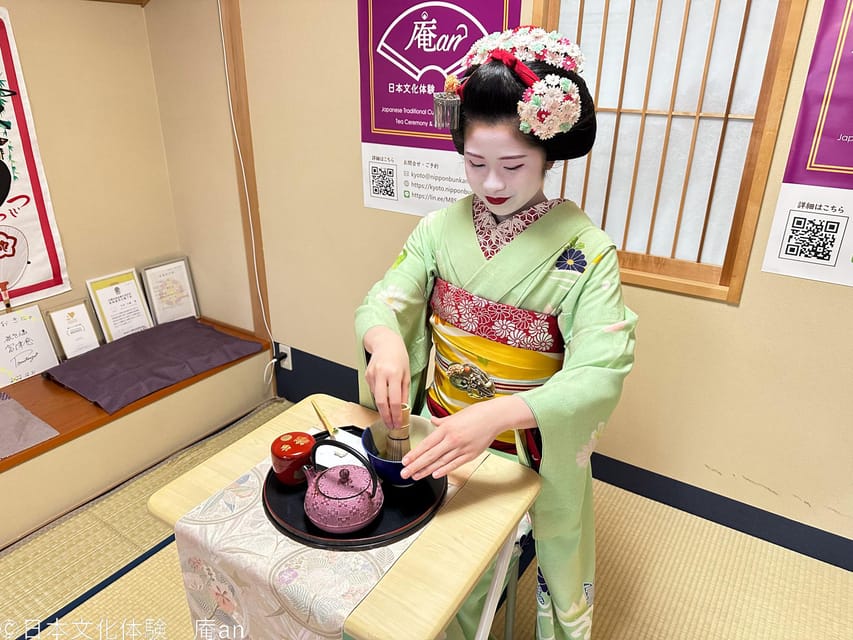
The tea portion begins with an explanation from the Maiko. She shows you the basic steps for preparing matcha, then gives you a chance to make your own bowl. You receive matcha and two dried Japanese sweets.
This is a hands-on introduction, not a full formal tea ceremony with every traditional rule and movement. That distinction matters. If you want a highly formal tea-school lesson in a historic tea room, this may feel too simple. If you want to understand the basic process and try it yourself, the format works well.
The sweets help balance matcha’s bitter taste. They also give the tea segment a clear Japanese context rather than treating matcha as just another drink. Children can take part, although very young children may find the tea preparation less interesting than the later games.
The host or interpreter may provide English help when requested. The instructor language is Japanese, and the amount of translation can depend on the session. If English support is important to you, contact the provider before booking and request it rather than assuming every comment will be translated in full.
Asking direct questions about Maiko life
The question-and-answer period is where the program gains much of its value. You can ask about training, daily routines, clothing, hairstyles, performances, and the path from Maiko to Geiko. Past sessions have included explanations that Maiko training can take several years, with one discussion referring to five years.
Ask clear, practical questions. The Maiko may receive familiar questions often, but the format still gives you a rare chance to hear answers directly rather than reading a short museum label. You can learn how the role fits into modern Kyoto and why the tradition continues.
Translation can shape the pace. A question may pass through a host or interpreter, so the exchange is not as quick as a casual conversation in English. Still, the format gives you time to ask several questions, and the Maiko usually remains available and engaged.
I would prepare two or three questions before arriving. Good subjects include the most difficult part of training, how the kimono is worn, what a typical working day involves, and how a Maiko’s life differs from that of a Geiko. Avoid treating the session like a photo-only encounter. The conversation is one of the best reasons to choose the Premium option.
Other evenings in the old entertainment quarters of Kyoto:
- Kyoto Geisha Walking Tour: Gion District & Hidden Gems
★ 4.7 · 3,273 reviews - Kyoto: Gion Magical Night Walking Tour with Geisha Trivia
★ 4.9 · 2,393 reviews - Kyoto: Gion Geisha District Walking Tour – Stories of Geisha
★ 4.7 · 2,187 reviews - Best of Kyoto: Gion, Geisha, Pagodas & Cobblestones
★ 4.9 · 2,058 reviews
Watching two traditional dances
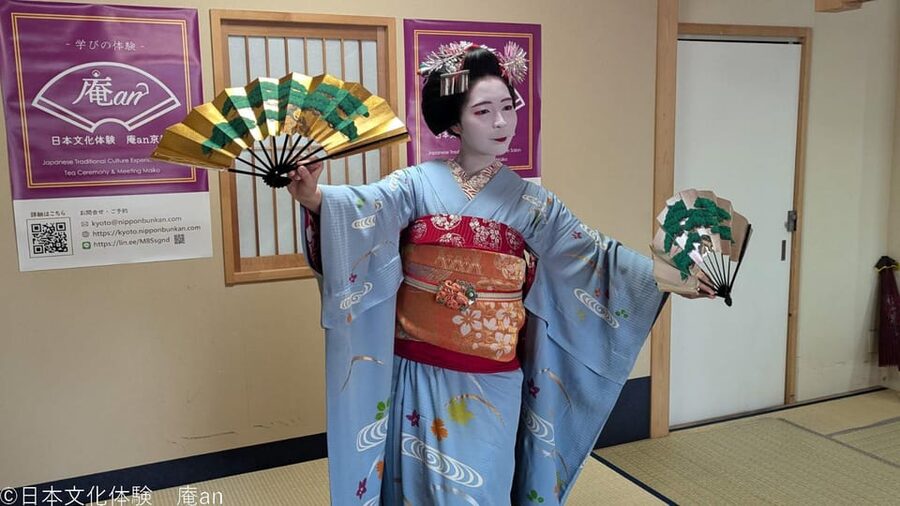
The Maiko performs two dances. Their themes can express the seasons, love stories, or everyday life, and the slow, controlled movements give you a better sense of the discipline behind the role.
This is not a large theater production. The close room works in your favor because you can see the details of posture, hand movements, kimono, hairstyle, and fan work. It also means the presentation is more intimate than a stage show, though your view depends on your seat.
The dance is frequently the emotional high point of the program. It offers a quiet contrast to the lively question period and game. Take photographs respectfully, and keep your phone from blocking the view of people behind you.
The backdrop is less successful. Several people have found that vendor advertisements, a company name, or a QR code can appear behind the Maiko in photographs. You can still take good photos, but the images may look more like a commercial event than a traditional Kyoto scene.
Playing a traditional game with the Maiko
After the formal elements, the mood becomes playful. The Maiko invites volunteers to join a simple traditional game, while the rest of the room claps and cheers. You do not need to volunteer to enjoy this part, but outgoing children and adults may have the most fun here.
The game gives the Maiko a chance to show a lighter side of her hospitality. It also keeps the program from feeling like a lecture followed by a performance. Families tend to benefit from this balance, since younger children may lose interest during a long explanation but become involved once the game begins.
Do not expect a serious contest. The point is participation and laughter, not a complicated lesson in Japanese rules. You may even find that the Maiko is difficult to beat.
Photos and the Senjafuda keepsake
You receive time to take a commemorative photo beside the Maiko. This is closer and more organized than trying to photograph a Maiko on a public street, where privacy and local etiquette matter.
The program also gives you a Senjafuda, a small lucky charm associated with a performer’s name. It is an appealing keepsake because it connects the photograph to the individual Maiko who hosted your session.
You can take photos and videos during parts of the presentation, but follow the staff’s instructions. Since the room is shared, be mindful of other people’s sightlines. If the background matters to you, ask where the cleanest angle is before the photo session begins. The advertising backdrop is a repeated complaint, so it is worth planning around.
How the 90 minutes usually unfold
The advertised duration is 90 minutes, although the active program may feel shorter in some sessions. The general order is:
- Greeting from the Maiko
- Matcha demonstration and your own tea preparation
- Two dried Japanese sweets with matcha
- Question-and-answer session
- Photo opportunity
- Senjafuda presentation
- Two traditional dances
- Interactive game
- Departure of the Maiko
- Informal chat time before leaving
The Maiko is scheduled to leave at about the 75-minute mark, followed by chatting time and room departure at around 90 minutes. Timing can vary, so do not arrange a tight connection immediately afterward.
The program has enough variety to hold attention. You move from watching, to making, to asking, to photographing, to cheering. That change of pace is one reason the experience works for families and mixed-age groups.
The advertised schedule is not a guarantee that every section will occupy the same amount of time. One session felt closer to 70 minutes to a participant, while others found there was plenty of time and no rushed feeling. Arrive with a flexible attitude.
Is $50 good value?
At about $50 per person, this is not the cheapest way to drink matcha in Kyoto. You can find simpler tea experiences for less. The value here comes from combining several elements that are difficult to arrange independently: a Maiko meeting, direct questions, two dances, a game, photos, sweets, and a keepsake.
I think the Premium price makes sense if the dance and game are important to you. Those are the parts that turn a basic tea demonstration into a fuller cultural program. If you only want to learn how to whisk matcha, a simpler tea class may be better value.
Seat upgrades cost extra: 3,300 yen for the first row, 2,200 yen for the second row, and 1,100 yen for the third row. The upgrade matters most if you care about seeing the dance clearly or getting a closer photo. A standard seat may be adequate for people who mainly want the overall experience.
Free snacks and a drink are included. The information also describes the two Japanese sweets served with matcha. Other drinks may be available for purchase inside at a moderate price, but do not assume a full meal is part of the ticket.
Maiko or Geiko: what you may see
The program is designed around a Maiko, but the provider may invite a Geiko instead, depending on the day. That is not a downgrade. A Geiko is a more senior performer, and seeing one can make the session feel especially distinctive.
You should book with an open mind about which performer appears. The clothing, dance, answers, and personal style will vary by person. The program’s core structure remains the same, but the conversation and performance will not be identical every time.
That flexibility is useful for repeat visitors. Even if you have already seen a Maiko event, a Geiko appearance can give the program a different tone. It also means you should not treat a particular performer’s name as guaranteed.
Who will enjoy this most
I would recommend this to first-time Kyoto visitors who want a clear introduction to Maiko culture without spending an entire evening at a formal dinner. It suits couples, families, and small groups who like a mix of explanation and entertainment.
It is especially good for:
- Families with children who enjoy games and photos
- Visitors with only 90 minutes for a cultural activity
- Anyone curious about Maiko training and daily life
- People who want a direct encounter rather than a street sighting
- Visitors who want a keepsake and organized photo opportunity
It may not suit you if your main goal is a historic room, quiet ceremony, or highly formal tea-school instruction. The modern venue and group format are central to the experience. You also need to accept stairs, fixed start times, and some translation through a host.
Practical booking advice for Gojo
The operating hours are 10:00 to 17:00, and reservations received after 17:00 are processed the next day. Cancellation is free up to eight days before the activity, but charges apply after that point. If you change the date or time after a fee has begun, another specified fee may apply.
Do not book for someone who plans to wait outside. Only participants may enter the experience. Children under two can attend free when sitting on a parent’s lap, but a paid seat or meal is charged at the regular per-person rate.
The program may take place alongside people having lunch or dinner. That can make the room feel more like a hosted cultural event than a private ceremony. It is another reason to expect friendly group energy rather than silence.
Should you book the Maiko Premium experience?
Book it if you want the fullest version of this program: tea preparation, direct questions, two dances, a game, close photos, sweets, and a Senjafuda charm. At about $50, the package offers solid value for a short Kyoto activity, especially if you are traveling with children or have limited time.
Skip it if the room itself matters as much as the performer. The modern building, stools, plain walls, and advertising backdrop can disappoint anyone expecting an old tea house. For most people, though, the chance to speak with a Maiko and watch her dance up close is worth more than the missing tatami and painted screen.
My practical choice would be the Premium version, a standard seat unless you care strongly about photography, and an arrival 15 minutes early. Come with a few thoughtful questions, leave room in your schedule, and treat the setting as a simple stage for the person and traditions at its center.
FAQ
How long does the Kyoto Maiko Premium experience last?
The scheduled duration is 90 minutes. The Maiko’s main program generally ends around 75 minutes, followed by chatting time before you leave the room.
Where does the experience take place?
It takes place one minute from Exit 1 of Gojo Station on the Subway Karasuma Line. The entrance faces Gojo-dori, inside a modern building rather than an ochaya or traditional Japanese house.
Is the experience conducted in English?
The instructor language is Japanese. English translation is provided as much as possible when requested, so contact the provider before the activity if you need English support.
Will I definitely meet a Maiko?
The program is planned around a Maiko, but a Geiko may be invited instead depending on the situation.
What is included in the ticket?
The ticket includes the Maiko Premium program, matcha, two dried Japanese sweets, snacks and a drink, the photo opportunity, and the Senjafuda gift.
Can children join the activity?
Children under two can attend free when sitting on a parent’s lap. If a child under two needs a separate seat or meal, the regular per-person fee applies. The activity also includes games that can appeal to older children.
More tea ceremonies elsewhere in Japan
- Kyoto: Table-Style Tea Ceremony at a Kyo-Machiya
★ 4.9 · 1,211 reviews - Kimono Tea Ceremony at Kyoto Maikoya, NISHIKI
★ 5.0 · 911 reviews - Kyoto: Arashiyama Bamboo Forest, Monkeys, Matcha & Temple Tour
★ 5.0 · 759 reviews - Kyoto: Tea Museum Tickets and Matcha Grinding Experience
★ 4.9 · 739 reviews
Just added in Kyoto
- Kyoto: Private Photoshoot Service★ 5.0 · 158 reviews
- Kyoto Rickshaw Tour★ 5.0 · 210 reviews
- Izakaya Style Cooking Class★ 5.0 · 219 reviews
- Kyoto: Traditional Concert at Townhouse or Bathhouse★ 4.9 · 224 reviews
- Ninja 2-hour Hands-on Lesson by Japanese master in Kyoto -Medium★ 5.0 · 218 reviews
- Kyoto: Arashiyama Bamboo, Temple, Matcha, Monkeys & secret spots★ 5.0 · 219 reviews
- Kyoto: Gion & Pontocho Food Tour with 13 Dishes★ 4.9 · 235 reviews
- Kyoto: Afternoon Japanese Izakaya Cooking Class★ 4.9 · 241 reviews
Geisha & Gion District Tours, compared.
Kyoto Geisha Walking Tour: Gion District & Hidden Gems
Read our review →
Gion Geisha District Walking Tour – Stories of Geisha
Read our review →
Best of Kyoto: Gion, Geisha, Pagodas & Cobblestones
Read our review →
Kyoto Night Foodie Tour in Gion (9+ dishes + 6 Sake tastings)
Read our review →
Kyoto Gion: 2-Hour Geisha Culture & History Walking Tour
Read our review →
Chopsticks Making Workshop in Gion with Engraving Option
Read our review →
Browse the lists this tour appears in