
Reviewed · WALKING TOURS
The Old Quarter of Tokyo – Yanaka Walking Tour
Yanaka gives you a Tokyo of wooden houses, temple bells, small lanes, and neighborhood shops. Parts of this old district survived the World War II bombings, and the walk shows you a side of the city that is easy to miss between major sights. I like the calm pace and the way religious customs connect with daily life here. I also like ending at Yanaka Ginza, where you can browse local food and sweets.
The small group, capped at 10 people, makes it easier to ask questions and keep up with the guide. Guides including Aya, Junko, Mei, Polina, Rei, and Kiyo have been praised for clear English and warm explanations. The main drawback is that this is a three-hour walk with little sitting time, so hot weather, sun, and comfortable shoes matter.
Key points to know before booking
- See a quieter Tokyo: Walk through Yanaka’s temples, residential lanes, wooden homes, and small shopping streets.
- Learn how Buddhism and Shinto fit together: The guide explains customs at Tennoji Temple, Enju-ji Temple, and Nezu Shrine.
- Visit Nezu Shrine’s red torii gates: You get a Tokyo photo stop with a feel reminiscent of Kyoto’s Fushimi Inari.
- Finish at Yanaka Ginza: The tour ends beside a local shopping street where you can buy food and sweets at your own cost.
- Expect a small group: The maximum is 10 people, with an English-speaking local guide.
- Plan for the weather: The experience requires good weather, and much of the walk is outdoors.
Why Yanaka feels unlike central Tokyo
Tokyo can feel polished, crowded, and relentlessly modern. Yanaka offers a gentler change of pace without requiring a long trip from the city center. The district has temples, shrines, old houses, back streets, and small businesses woven into ordinary residential life.
That mix is the real reason to book this walk. You are not simply moving from one famous monument to another. You are seeing how sacred places, homes, cafés, bakeries, and neighborhood shops share the same streets.
I especially like the contrast with areas such as Ginza and Omotesando. Those districts show Tokyo’s grand, high-energy side. Yanaka feels closer to a small Japanese town, with a slower rhythm and fewer large attractions competing for your attention.
The tour is also useful if you want context. A guide can explain why a cemetery sits beside homes, how people behave at a shrine, and how Buddhist and Shinto traditions appear in the same neighborhood. Those details are easy to miss if you simply walk through Yanaka alone.
Other walking tours in Tokyo people book:
- Tokyo Tsukiji Fish Market Food and Culture Walking Tour
★ 5.0 · 3,184 reviews - Tokyo: Imperial Palace and Shogun Historical Walking Tour
★ 5.0 · 2,251 reviews - Tokyo: Shinjuku Local Bar and Izakaya Guided Walking Tour
★ 4.9 · 1,794 reviews
Starting at Nippori Station and meeting the old quarter
The meeting point is outside Nippori Station at 2 Chome-19 Nishinishi-Nippori, Arakawa City. This is a practical starting point because the tour moves into Yanaka on foot from a major transport stop rather than asking you to find an obscure alley.
From there, expect a guided walk rather than a bus tour or a series of long transfers. The route includes several short stops, but the three-hour length allows time for explanations, questions, photographs, and walking between sites.
The group limit of 10 is one of the strongest features. You are not likely to be standing at the back of a large crowd while a guide speaks to the first few people. Small groups also work well in Yanaka, where narrow lanes and modest temple grounds do not suit a large procession.
The end point is near Yanaka Ginza at 3 Chome-13-1 Yanaka. That makes the tour easy to combine with your own lunch, snack, or shopping time afterward. Since the start and finish are different, you should think of this as a one-way neighborhood walk, not a loop back to Nippori Station.
Tennoji Temple and the Yanaka Buddha
The first major stop is Tennoji Temple, home to the Yanaka Buddha, created in 1690. You receive an introduction to the temple’s past and to aspects of Japanese religion before the walk moves farther into the district.
This is a useful opening because it gives the rest of the tour a framework. Instead of treating every temple or shrine as another attractive building, you begin to learn why these places matter and how people approach them.
The stop is listed at about 15 minutes, with no admission charge. That is enough time to see the main feature and hear the explanation without turning the visit into a long temple tour.
If you are hoping to spend a great deal of time inside religious buildings, adjust your expectations. This is a neighborhood overview, not a specialist religious tour. Its value comes from the guide’s interpretation and the connections between the stops.
Yanaka Cemetery and local customs
The walk continues into Yanaka Cemetery, another 15-minute stop. Here, the guide explains what a Japanese cemetery is like and discusses customs followed by local people.
This part can be especially helpful if you have noticed cemeteries near temples during your time in Japan but were unsure how to understand them. The setting also shows how closely religious spaces and residential life sit together in Yanaka.
The cemetery is not presented as a spooky attraction. It is part of the neighborhood, and the emphasis is on culture, behavior, and local practice. You should be prepared to walk respectfully and listen to the guide’s instructions.
For many people, this is where the tour becomes more than a pleasant stroll. The explanation gives you a better sense of how religion appears in everyday Japanese life, rather than only in grand festival settings or famous historic sites.
Other guided walks in Tokyo:
- Tokyo: Tsukiji Fish Market Food and Walking tour
★ 5.0 · 1,724 reviews - Tokyo: Asakusa Walking Tour with Sensoji Temple Visit
★ 4.8 · 1,583 reviews - Tokyo: Tsukiji Fish Market Guided Walking Tour
★ 4.9 · 1,397 reviews - Tokyo Castle & Imperial PalaceーShogun Walking Tour
★ 4.7 · 1,068 reviews
Ueno Sakuragi Atari’s old wooden houses
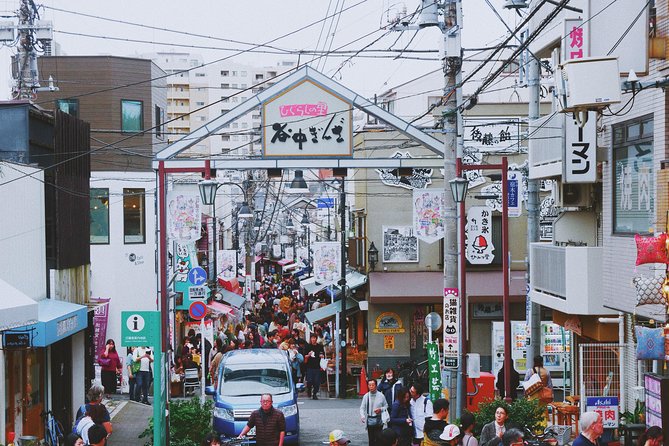
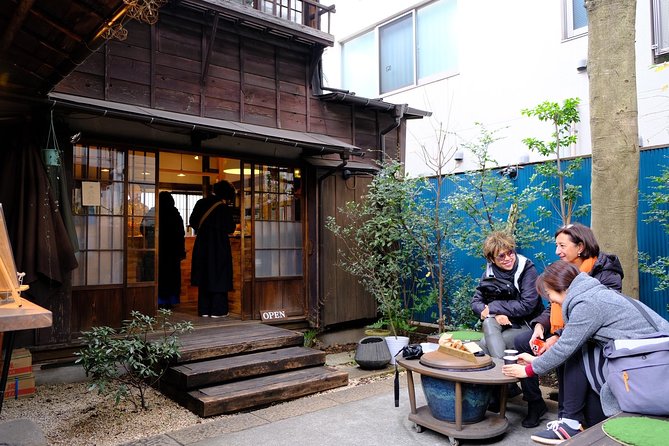
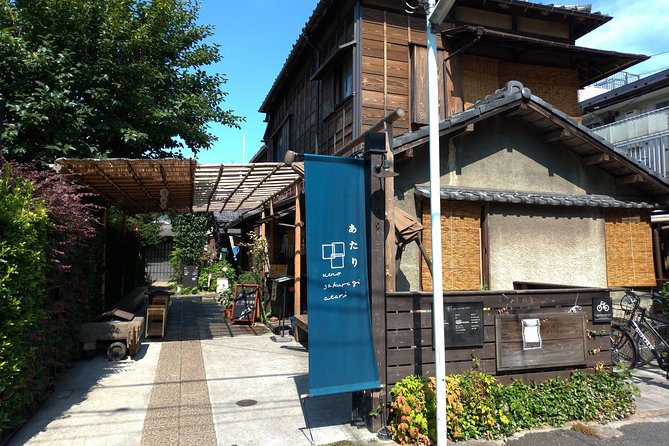
At Ueno Sakuragi Atari, you get a break in a group of roughly 80-year-old wooden houses. These buildings were renovated into a café, bakery, and beer hall, creating a community space for local residents.
I like this stop because it shows preservation in practical use. The houses are not simply kept as museum pieces. They now support eating, meeting, and neighborhood activity while retaining their older character.
The visit lasts around 15 minutes. Admission is not included, and food and drinks are also your responsibility. The tour description includes time for a break, but you should not assume that a meal or a café purchase is part of the $40 price.
You will also see a 100-year-old cider tree described as a symbol of Yanaka. The combination of old homes and a long-lived tree helps explain the area’s appeal without relying on a single famous landmark.
This is one place where the tour’s short format is both useful and limiting. You get a quick introduction and a chance to look around, but you will need to return on your own if you want to sit down for a longer drink or explore the food options in detail.
Enju-ji Temple and the god of strong legs
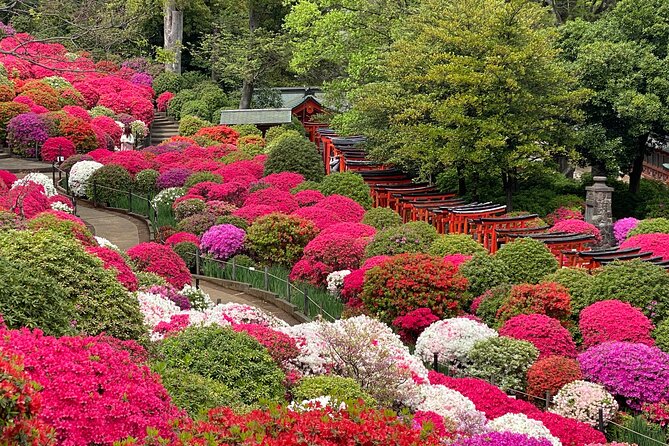
The brief stop at Enju-ji Temple lasts about five minutes, but it has an unusual focus. Instead of a typical Buddhist figure, the temple enshrines a god associated with strong legs.
Wooden boards carry the wishes of people dealing with foot problems. The stop offers a memorable reminder that religious sites often address very practical concerns, not only large spiritual questions.
Because the visit is short, this is more of a quick cultural note than a full temple visit. It works well as part of the walking route, especially for anyone interested in the small customs and local beliefs that rarely appear in a standard Tokyo sightseeing schedule.
Nezu Shrine and its red torii gates
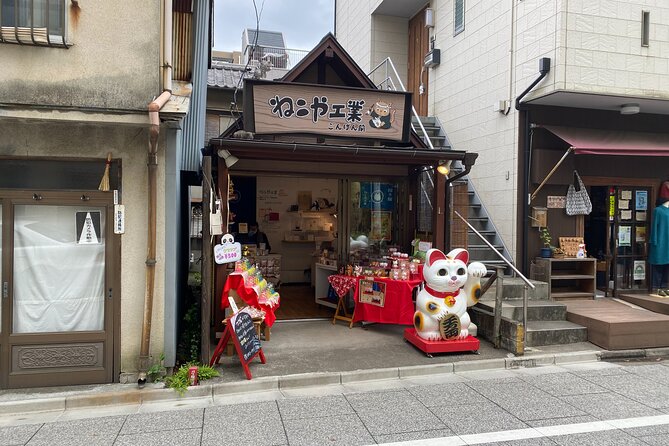
Nezu Shrine is one of the main visual highlights. You can photograph rows of red torii gates, similar in appearance to the famous gates at Fushimi Inari Shrine in Kyoto, while learning basic shrine etiquette.
The stop lasts about 20 minutes and admission is free. For many people, this will be the most immediately photogenic part of the route. The red gates give you a strong image of traditional Japan without leaving Tokyo.
The etiquette lesson matters. At a shrine, small actions have meaning, and a guide can explain how to behave respectfully. You do not need prior knowledge of Shinto customs, and the tour is designed for ordinary sightseers rather than religious specialists.
Nezu Shrine can also be one of the more popular points on the route. The advantage of visiting with a guide is not only finding the gates, but understanding what you are seeing and how the shrine fits into the neighborhood.
Hebimichi and the everyday side of Yanaka
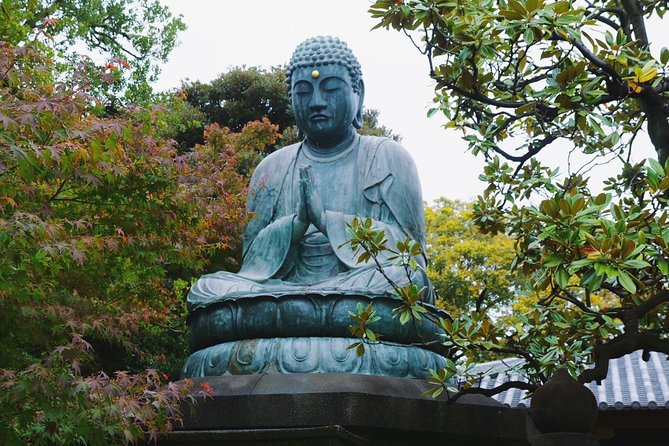
The route then turns into Hebimichi, a back street in a residential area. This is not a grand attraction. That is exactly the point.
You see Japanese daily life close up, with the guide helping you notice the character of a residential lane. The walk is a reminder that Yanaka’s appeal lies as much in its ordinary streets as in its temples.
Please keep your voice low and follow the guide’s lead in residential areas. The route passes through places where people live, not just places arranged for sightseeing. That makes the experience feel more authentic, but it also calls for courtesy.
This section will suit you if you prefer local atmosphere to a checklist of major monuments. If you want constant photo stops and dramatic architecture, the quieter pace may feel modest.
Yanaka Ginza and the final food stop
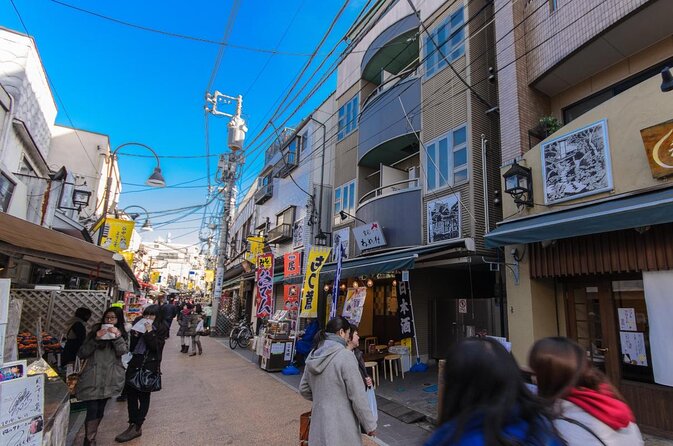
The tour ends at Yanaka Ginza Shopping Street, where your guide explains the shops and points out ways to experience everyday Japanese food culture. You can try local foods and sweets, but purchases are not included.
Ending here is smart. You finish with a chance to eat, browse, and continue exploring on your own instead of being dropped at a station with no idea where to go next.
The street also provides a useful counterpoint to the temples and cemetery. You move from religious sites and quiet lanes into a working shopping area where people buy food and daily goods. That change helps you see Yanaka as a living neighborhood rather than a preserved historic district.
Bring some cash or a payment method you normally use in Japan if you want to sample items, but the supplied tour details do not promise any specific dish or tasting. Food fees and personal expenses are separate from the tour price.
What the guides add to the walk
The guide can make or break a neighborhood tour, and this experience places a lot of weight on personal explanation. Guides named in the tour feedback include Aya, Junko, Polina, Rei, Mei, Kiyo, Mami, and others, so your exact guide will vary by date.
The strongest pattern is clear English, patience with questions, and attention to the group. Aya is noted for using laminated photos to explain points from the past, while Junko has been described as familiar with the neighborhood and its local details. Mei is associated with food suggestions, and Rei with careful explanations of cultural and religious customs.
That variety is useful because the route has many small stories rather than one large spectacle. A good guide can explain an old house, a cemetery custom, a shrine gesture, or a local snack in a way that gives the detail meaning.
The group size helps here. With no more than 10 people, you can ask about Japanese houses, religion, food, or the modern life of the district without needing to shout across a crowd.
Is $40 a fair price?
At $40 per person, this is not a bargain-priced self-guided stroll. You could walk through Yanaka without paying for admission to the temples and shrine, and the route itself uses public streets.
The value comes from the interpretation, organization, and small-group setting. You are paying to understand what you see, move efficiently between places, and get practical suggestions at Yanaka Ginza. If you already know Japanese religious customs and have researched Yanaka carefully, the price may feel less necessary.
For a first visit to Tokyo, I think the cost is reasonable if you want more than photographs. The tour lasts about three hours, includes an English-speaking local guide, and covers several types of place: temples, a cemetery, old wooden buildings, a shrine, a residential lane, and a shopping street.
Food, drinks, admission charges where applicable, and gratuities are not included. The main stops listed are free, but you should budget extra if you want to eat or drink at Ueno Sakuragi Atari or Yanaka Ginza.
Walking comfort, weather, and practical details
Wear comfortable shoes. The route is on foot, and one person described walking in 35-degree heat and humidity, with a hat and sun protection proving important. Tokyo weather can make a moderate walk feel much harder than expected.
The tour requires good weather. If poor weather causes cancellation, you are offered another date or a full refund. You can cancel for a full refund up to 24 hours before the start time, but changes or cancellations inside that period are not accepted.
Mobile tickets are provided, and the meeting point is near public transportation. Service animals are allowed, and most people can participate, though the tour is still best suited to anyone comfortable walking for several hours.
The end point is not the same as the start. Plan your next stop from Yanaka Ginza rather than assuming you will return to Nippori Station with the group.
Who should book this Yanaka walk?
I would choose this tour if you have already seen some of Tokyo’s major districts and want a quieter contrast. It also suits first-time visitors who want a guided introduction to temples, shrines, local customs, and everyday streets without spending half a day on trains.
It is a good fit for people who enjoy asking questions, taking photographs, and learning the meaning behind small details. The tour also works well for anyone who wants local food suggestions at the end but prefers to decide and pay for snacks independently.
I would hesitate if you dislike walking, need a highly structured food tour, or want long visits inside each temple. The stops are brief, and the experience depends on moving through the neighborhood rather than settling in one place.
Should you book it?
Book the Yanaka Walking Tour if you want Tokyo to feel less like a collection of famous districts and more like a lived-in city. The best parts are the small group, the strong cultural explanations, the red torii gates at Nezu Shrine, and the final arrival at Yanaka Ginza.
Skip it if you only have a few hours in Tokyo and need to prioritize major landmarks, or if hot weather makes a three-hour walk unpleasant. For everyone else, $40 buys a useful introduction to a quiet, traditional side of the city, with enough free time at the end to keep exploring on your own.
FAQ
How long does the Yanaka Walking Tour last?
The tour lasts approximately three hours.
Where does the tour begin?
The meeting point is at Nippori Station, at 2 Chome-19 Nishinishi-Nippori, Arakawa City, Tokyo 116-0013, Japan.
Where does the tour finish?
The tour ends near Yanaka Ginza at 3 Chome-13-1 Yanaka, Taito City, Tokyo 110-0001, Japan.
What language is the tour conducted in?
The tour includes an English-speaking local guide.
What is the maximum group size?
The maximum group size is 10 people.
Is food included in the tour price?
No. Food, drinks, and personal expenses are not included. You can buy local foods and sweets at Yanaka Ginza if you wish.
Are admission tickets included?
The listed admission tickets for Tennoji Temple, Yanaka Cemetery, and Nezu Shrine are free. Admission is not included for stops where a fee may apply.
Can I cancel for a full refund?
Yes. You can cancel at least 24 hours before the start time for a full refund. If poor weather causes the tour to be canceled, you will be offered another date or a full refund.
Just added in Tokyo
- Small-Group Wagyu Beef and 7 Japanese Dishes Tokyo Cooking Class★ 5.0 · 190 reviews
- Nikko: Edo Wonderland Edomura Cultural Theme Park Ticket★ 4.3 · 205 reviews
- 《MEMBERS-ONLY-BAR-HOPPING》Discover Your Special Whiskey in Tokyo!★ 5.0 · 29 reviews
- Japanese Whisky Hunting《HIGH-QUALITY-ONLY》Rare Tasting Class★ 5.0 · 20 reviews
- Luxury Tokyo Sake, Cocktail, Whisky and Pairing Tour★ 5.0 · 18 reviews
- Wagyu & Sake Pairing in Shinjuku – Steak, Shabu-Shabu & More★ 5.0 · 112 reviews
- From Tokyo: Private Tour to Fuji/Hakone – Onsen, Art, Nature★ 5.0 · 116 reviews
- Tokyo: KABUKI Show at Kabukiza Theatre Admission Ticket★ 4.8 · 152 reviews
Walking Tours, compared.
Kyoto Geisha Walking Tour: Gion District & Hidden Gems
Read our review →
Tokyo Tsukiji Fish Market Food and Culture Walking Tour
Read our review →
Imperial Palace and Shogun Historical Walking Tour
Read our review →
Gion Geisha District Walking Tour – Stories of Geisha
Read our review →
Shinjuku Local Bar and Izakaya Guided Walking Tour
Read our review →
Asakusa Walking Tour with Sensoji Temple Visit
Read our review →
Nishiki Market Brunch Walking Tour (7 Tastings + Brunch)
Read our review →Browse the lists this tour appears in