
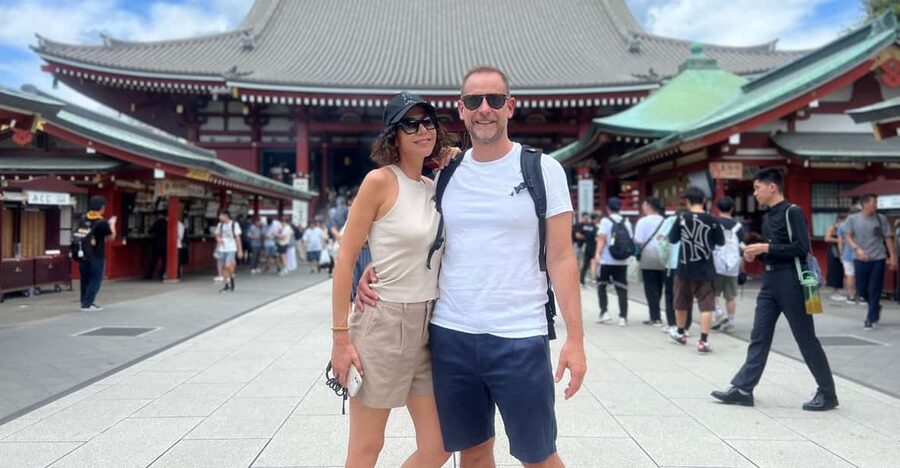
Reviewed · TEMPLE & SHRINE TOURS
Tokyo: Meiji Jingu Shrine and Shinto Culture Walking Tour
Meiji Shrine feels far removed from Tokyo’s neon streets, even though Harajuku is just outside the gate. This two-hour walk through a forest of 100,000 trees gives you the setting, history, and simple rituals that are easy to miss on your own.
I especially like the small-group format and the way the guides explain what to do, from cleansing your hands to praying at the shrine. The included photos are another nice touch, and guides such as Maya, Yota, Andres, Ryota, Minori, and Sara have been praised for answering questions and offering useful Tokyo tips.
The main consideration is time. Two hours is enough for a thoughtful introduction, but not for a slow, detailed study of every corner of the grounds. The walk is also outdoors, so rain and heat can affect your comfort.
Key points to know before you book
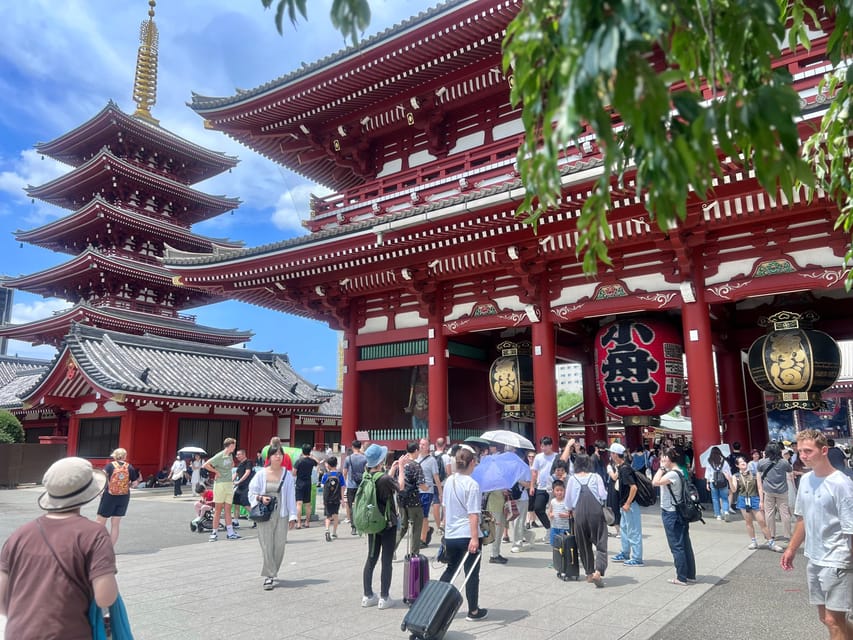
- A calm forest walk in central Tokyo: The approach to Meiji Shrine passes through a broad wooded area that feels surprisingly quiet for such a busy part of the city.
- Practical Shinto instruction: You learn shrine etiquette and how to pray, rather than simply hearing dates and names.
- Small groups make questions easy: Groups can be as large as 12, but many departures are smaller, and some have become private tours.
- Useful first-day orientation: Guides can explain Japanese customs, the Meiji period, metro use, food spots, and other Tokyo sights.
- Photos are included: Your guide can take pictures during the walk, handy if you are traveling without a companion.
- Good value at $19: Admission to Meiji Shrine and the Imperial Garden is included, along with an English-speaking guide, for a modest price.
Why Meiji Shrine is worth two hours
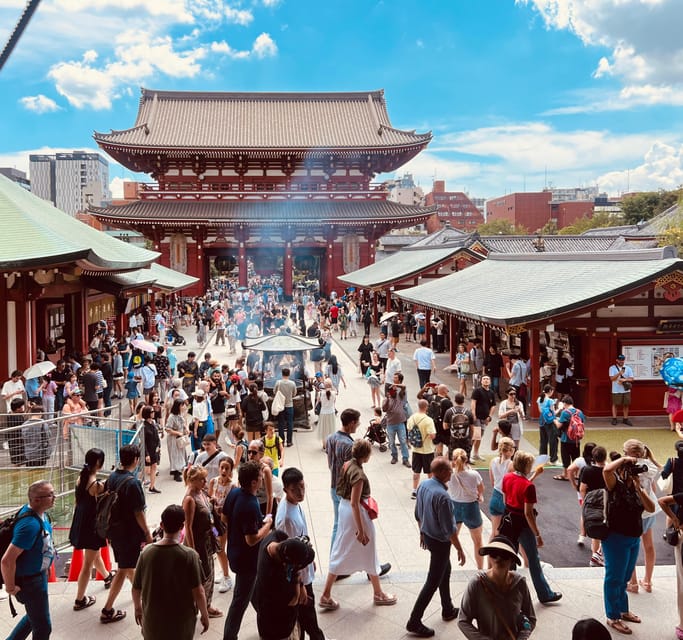
Tokyo has no shortage of famous sights, but Meiji Jingu offers something different from the city’s shopping streets and observation decks. You enter a large sacred precinct surrounded by trees, gravel paths, wooden gates, and quiet corners. The change is immediate.
The shrine honors Emperor Meiji and Empress Shoken, whose era brought major changes to Japan. Your guide puts that period into plain language and connects the site to modern Japanese culture. That context helps you see Meiji Shrine as more than a photogenic building.
You also learn how Shinto works in daily practice. The emphasis is on respect, cleanliness, nature, and the presence of kami, or sacred spirits. A good guide will not treat the subject like a museum lecture. Instead, you learn through the actions you take along the way.
This is especially useful if you are new to Japan. Several guides have been praised for explaining the difference between Shinto and Buddhism, two traditions that have shaped Japanese life in different but sometimes overlapping ways. You do not need prior knowledge, and you can ask basic questions without feeling out of place.
Other temples and shrines in Tokyo people book:
- Tokyo: Meiji Shrine, Asakusa, Skytree Bus Tour and Cruise
★ 4.7 · 1,986 reviews - Tokyo: Asakusa Walking Tour with Sensoji Temple Visit
★ 4.8 · 1,583 reviews - Nikko: Kegon Falls, Lake Chuzenji & Toshogu Temple
★ 4.6 · 1,577 reviews
Meeting in Harajuku and entering Meiji Jingu Gyoen
The meeting point is in front of the Starbucks closest to Meiji Shrine, near coordinates 35.6705208, 139.7031067. That detail matters because there are many Starbucks locations in Harajuku and Omotesando. Check the exact location before setting out.
From there, the group enters Meiji Jingu Gyoen, the garden and wooded grounds surrounding the shrine. The first section includes a photo stop and about 30 minutes of guided walking. This is where you begin to notice the contrast between Harajuku and the shrine grounds.
The forest is not a decorative park added as an afterthought. The grounds contain about 100,000 trees, planted from across Japan. The result is a broad green corridor that muffles much of the city noise. Depending on the season, you might see different colors and light among the trees, but the main pleasure is the sense of space.
This part of the visit benefits from a guide because the forest can seem simple at first glance. Your guide explains why nature matters in Shinto and points out features that you could easily walk past. The walk is gentle enough for most people, and the activity is listed as wheelchair accessible, though you should still contact the provider if you need details about the exact route and surfaces.
Passing through the Big Torii
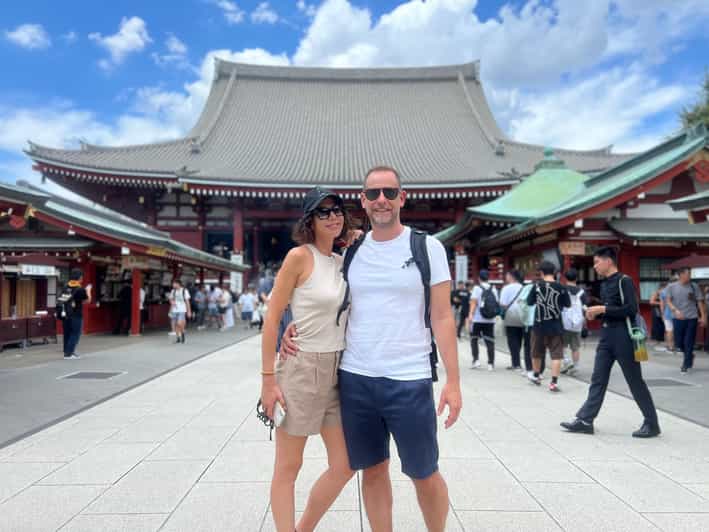
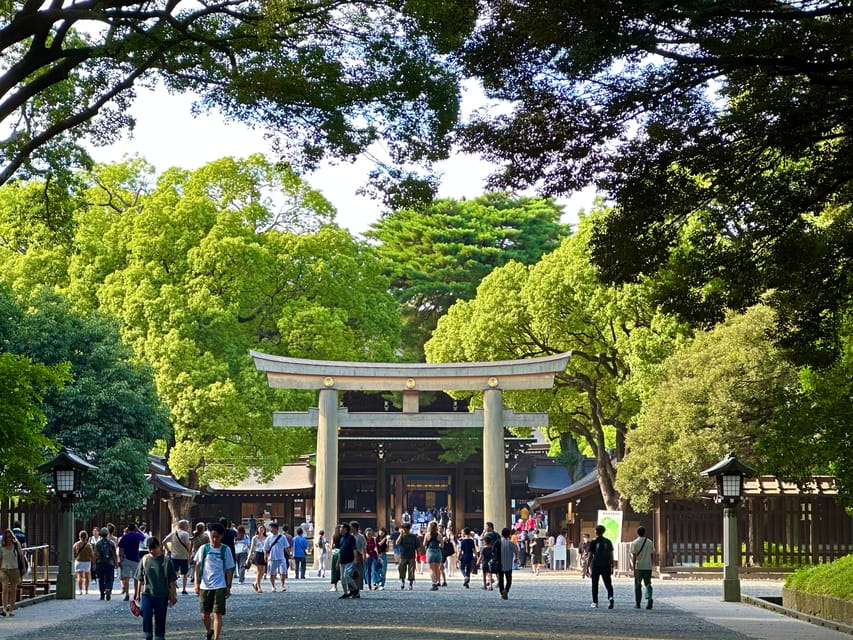
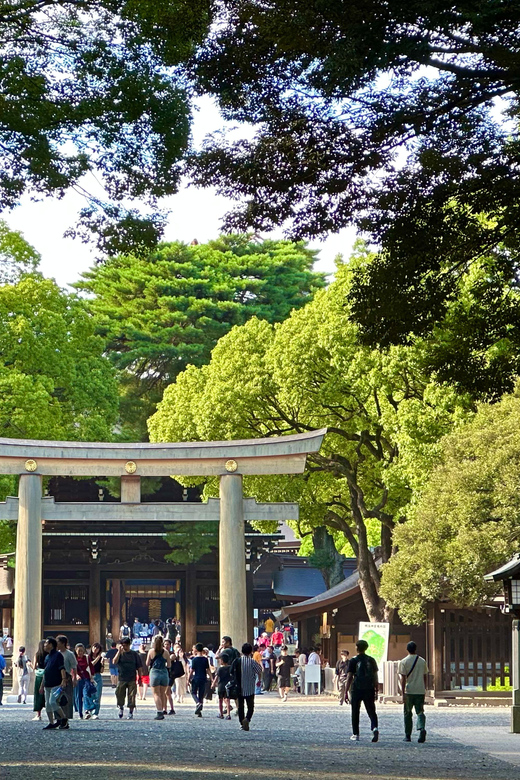
The Big Torii receives about 10 minutes of explanation, but it marks an important shift in the experience. This large wooden gate signals the entrance to sacred ground. Your guide explains the respectful way to approach and pass through it.
The lesson is small but useful. You learn that a shrine visit is not simply a matter of reaching the main building, taking a photograph, and leaving. There is a sequence and a manner to the visit. Small customs like these help you feel less like an observer and more like someone taking part appropriately.
This is also a good place for photos. The scale of the gate makes it one of the clearest visual markers on the walk. Your guide can take pictures for you, a benefit that matters if you are traveling alone or want a group photograph.
Sake barrels, wine barrels, and the mix of old and new
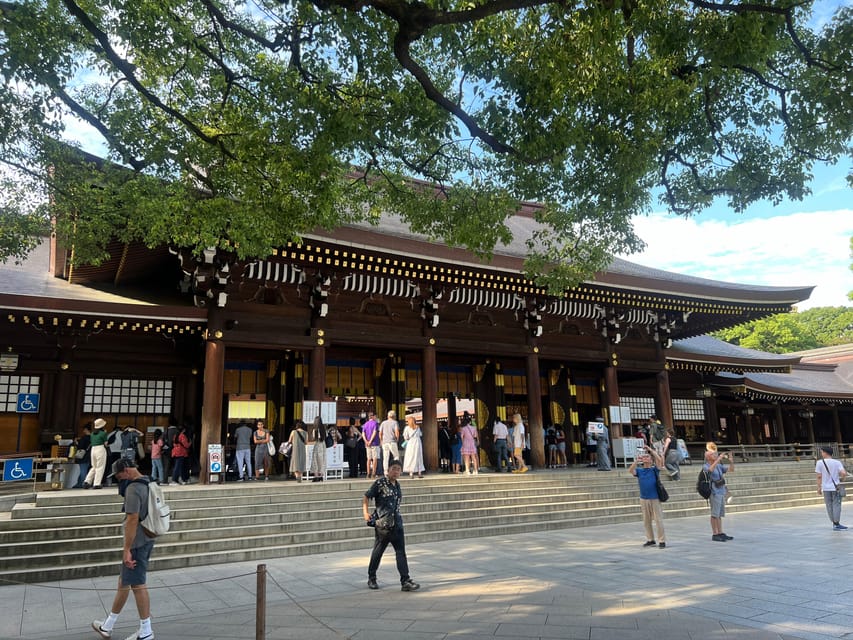
The next stops are the consecrated sake barrels and Meiji Jingu’s consecrated wine barrels. Each receives about 10 minutes of explanation.
The sake barrels show the connection between shrines, local communities, and offerings. The wine barrels add an unexpected detail. They reflect the Meiji era’s interest in contact with the wider world and the changes taking place in Japan at that time.
Together, the two displays give you a quick lesson in how Japanese tradition can include both long-standing customs and newer influences. They are also a reminder that religious sites are not frozen in the past. A guide can explain the symbolism and historical setting without turning the stop into a long academic talk.
These barrels are easy to pass without understanding. That is one of the strongest reasons to take this walk with someone who knows what you are seeing. The objects are not the biggest attractions on the grounds, but they add texture to the story of Meiji Shrine.
Other walking tours in Tokyo people book:
- Tokyo Tsukiji Fish Market Food and Culture Walking Tour
★ 5.0 · 3,184 reviews - Tokyo: Imperial Palace and Shogun Historical Walking Tour
★ 5.0 · 2,251 reviews - Tokyo: Shinjuku Local Bar and Izakaya Guided Walking Tour
★ 4.9 · 1,794 reviews - Tokyo: Tsukiji Fish Market Food and Walking tour
★ 5.0 · 1,724 reviews
The main shrine and the rituals you can follow
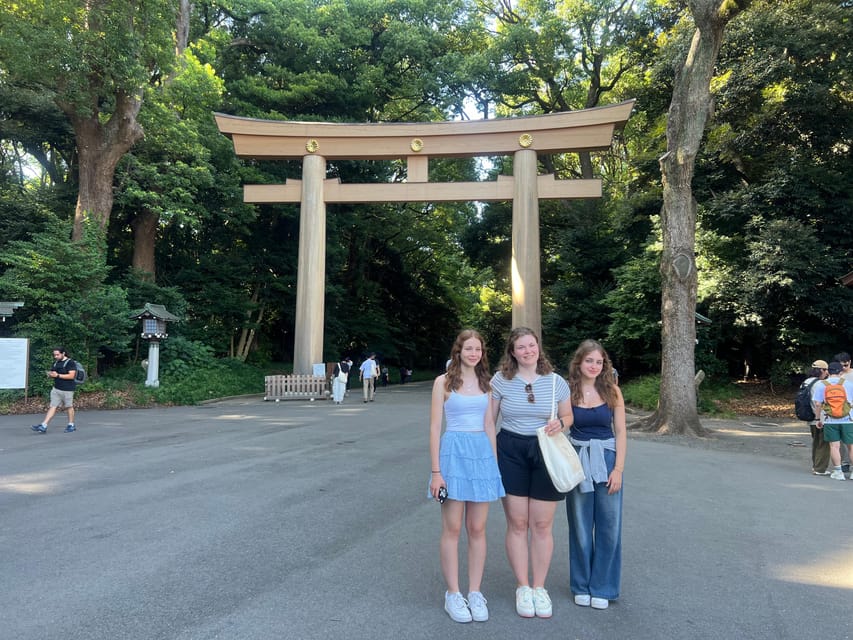
The main visit to Meiji Shrine lasts about an hour. Here, the guide explains the shrine’s origin, the Meiji period, and the customs connected with worship.
You will be shown how to behave at the purification fountain and how to approach the main hall. The guide also explains the steps for praying. This practical instruction is one of the best parts of the tour because it removes the guesswork. You can take part respectfully instead of copying the nearest person and hoping you got it right.
The experience is not built around a long religious sermon. It is a guided look at how Shinto appears in ordinary acts: washing, bowing, offering, and making a prayer. You can ask about the meaning of what you see, including the relationship between Shinto practice and Buddhist traditions in Japan.
There may be other people visiting the shrine, especially at popular times, so do not expect complete silence at the main hall. The forest approach usually provides the calmer part of the visit. Guides have often recommended going early in the morning when possible, since the grounds can feel more peaceful before the day grows busy.
The main shrine is also where weather matters most. Rain does not cancel the cultural value of the visit, and guides have led enjoyable walks in heavy rain, but comfortable shoes and suitable clothing will make the experience much better.
The guide makes the difference
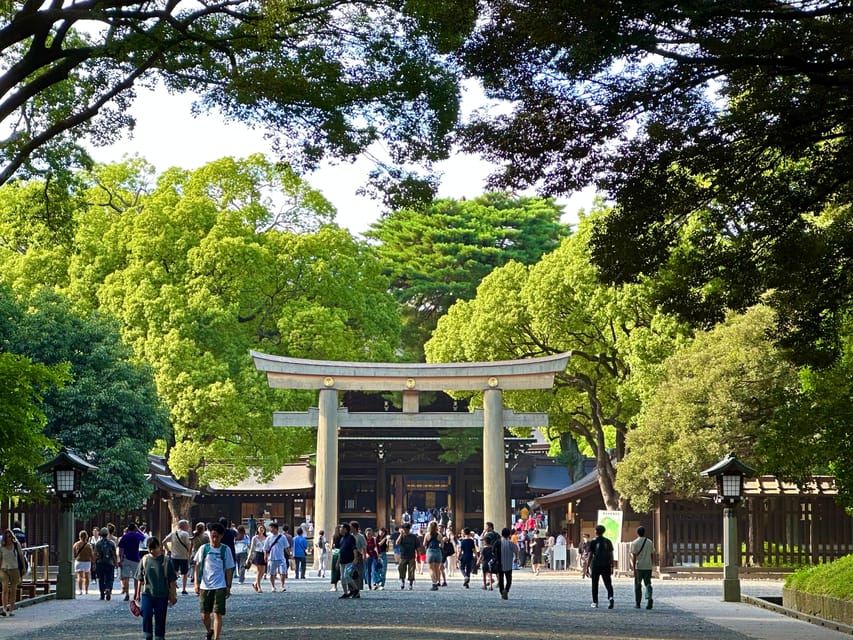
At $19, this is an inexpensive way to add structure to a major Tokyo sight. The admission to Meiji Shrine and the Imperial Garden is included, as are guide-taken photos and two hours of English instruction. On your own, you can enter the grounds for a walk, but you may miss the meaning behind the rituals, barrels, gates, and forest.
The quality of the experience depends heavily on the individual guide. The guide team includes Maya, Minori, Nicholas, Hoshi, Naruto, Matt, Yumi, Haydn, Sara, Andres, Yota, Ryota, and others. The strongest praise has focused on friendly personalities, clear English, local knowledge, and a willingness to answer questions.
That variety means the tone may differ from one departure to another. One guide may focus more on history, another on customs, and another on food and neighborhood suggestions. That is not necessarily a weakness, but you should expect a personal walking tour rather than a fixed audio script.
Some guides have helped visitors understand Tokyo beyond the shrine. Andres, Yota, Ryota, and others have offered suggestions for sushi, ramen, wagyu, snacks, and other places to eat. Several guides have also shared ideas for nearby sights and later stops in the city. These tips can be especially useful at the beginning of a Japan trip, when you are still learning how to use the metro and how to behave at religious sites.
The groups can reach about 12 people, but many departures are smaller. Small groups make it easier to hear the guide and stop for questions. On unusually quiet dates, the experience has become a private tour when other participants did not appear. You should not book on the assumption that this will happen, but the possibility adds flexibility.
What the two-hour timing means
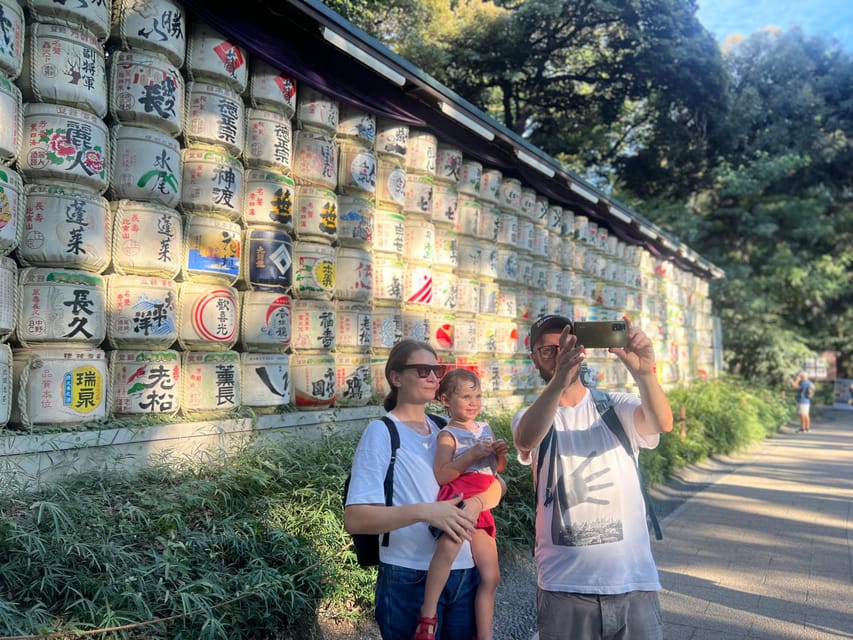
The tour returns to the Starbucks meeting point after about two hours. That makes it easy to fit into a morning or afternoon in Harajuku.
I would place it early in your Tokyo stay. You get an introduction to shrine manners, Japanese religious traditions, and the Meiji period before you encounter other temples and shrines. The food and neighborhood advice can also help you plan the rest of your visit.
The short length is both an advantage and a limit. You will not spend an entire day on one site, and you can combine the walk with Harajuku shopping, Omotesando, or another nearby activity. On the other hand, you will not have time for an unhurried personal wander through every path.
The tour is more about understanding than checking off sights. If you want only a quick photograph at the main shrine, you can visit independently. If you want to know why the rituals matter and how the site fits into Japanese culture, the guide adds real value.
Who should book this Meiji Shrine walk
This experience suits first-time visitors particularly well. The explanations are clear enough for beginners, but guides can also go further when someone asks more detailed questions. Families may appreciate the manageable length and the practical activities, including shrine etiquette and the chance to write an ema prayer plaque independently if you choose to do so, though the tour information does not promise that this activity is included.
It also works for solo visitors. The guide-taken photos solve one small but common problem, and a small group gives you company without requiring a full-day commitment.
You should also consider it if you have visited Tokyo before but rushed through Meiji Shrine on an earlier trip. The forest, wine barrels, and rituals offer more than a quick stop at the main building. A returning visitor can ask more specific questions and use the walk as a cultural refresher.
People with limited time should note that the tour stays focused on Meiji Shrine. Some individual comments describe other Tokyo sights, markets, meals, or temples, but this experience itself is built around Meiji Jingu and its grounds. Do not book it expecting a full-day city tour.
Cancellation is free up to 24 hours before the start, and you can reserve now and pay later. English is the tour language. The activity is listed as wheelchair accessible, and the provider includes entry to both Meiji Shrine and the Imperial Garden.
Is the $19 price good value?
Yes, especially if this is your first visit to a Japanese shrine. For $19, you receive two hours with an English-speaking guide, admission to the stated sites, cultural explanation, and photos. Even if you already know the basic prayer sequence, the historical context and opportunity to ask questions can justify the modest cost.
The value is less clear for someone who prefers to wander silently or already has a strong understanding of Shinto customs. In that case, the guided pace may feel unnecessary. You are paying mainly for interpretation and conversation, not for access to a restricted area.
For most people, the price is low enough that the risk is limited. The biggest benefit is not a rare view or special ticket. It is the chance to understand what you are seeing and to begin your Tokyo visit with better manners and a clearer sense of place.
Should you book it?
Book this walk if you want a friendly, practical introduction to Shinto, Meiji Shrine, and Japanese shrine etiquette. It is particularly useful on your first or second day in Tokyo, when advice about food, transport, and nearby sights can shape the rest of your trip.
Skip it if you want a completely self-guided visit or a longer, slower exploration. For everyone else, the combination of the sacred forest, the Big Torii, the unusual barrel displays, and an approachable English-speaking guide makes this a strong $19 choice.
FAQ
How long does the Meiji Shrine walking tour last?
The tour lasts two hours and returns to the Starbucks meeting point near Meiji Shrine.
Where does the tour meet?
You meet in front of the Starbucks closest to Meiji Shrine. The listed coordinates are 35.6705208, 139.7031067.
What language is the tour conducted in?
The tour is conducted in English with a live English-speaking guide.
Is admission to Meiji Shrine included?
Yes. Entry to Meiji Shrine and the Meiji Shrine Imperial Garden is included.
Is the activity wheelchair accessible?
Yes, the activity is listed as wheelchair accessible. Contact the provider if you need specific details about the route and surfaces.
How large is the tour group?
Groups can include as many as 12 people, though many departures are smaller. Some departures have operated as private tours when no other participants attended.
What does the tour cover?
The walk includes Meiji Jingu Gyoen, the Big Torii, the consecrated sake barrels, the consecrated wine barrels, and Meiji Shrine.
Can I cancel for a full refund?
Yes. You can cancel up to 24 hours in advance for a full refund. You can also reserve now and pay later.
More walking tours elsewhere in Japan
- Tokyo: Tsukiji Fish Market Guided Walking Tour
★ 4.9 · 1,397 reviews - Tokyo Castle & Imperial PalaceーShogun Walking Tour
★ 4.7 · 1,068 reviews - Tokyo: Imperial Palace Japanese History Walking Tour
★ 4.9 · 987 reviews - Tokyo: Imperial Palace and Shogun Walking Tour
★ 4.9 · 935 reviews
More temples and shrines elsewhere in Japan
- Tokyo: Nikko Toshogu Shrine and Kegon Waterfall Tour
★ 4.5 · 1,266 reviews - Tokyo Panoramic 1 Day: Meiji Shrine, Asakusa, Odaiba and SKYTREE®
★ 4.5 · 1,222 reviews - Tokyo: Zen Meditation at a Private Temple with a Monk
★ 5.0 · 510 reviews - Mt. Fuji Heritage Tour: Traditional Villages, Lakes & Shrine
★ 4.5 · 509 reviews
Just added in Tokyo
- 《MEMBERS-ONLY-BAR-HOPPING》Discover Your Special Whiskey in Tokyo!★ 5.0 · 29 reviews
- Japanese Whisky Hunting《HIGH-QUALITY-ONLY》Rare Tasting Class★ 5.0 · 20 reviews
- Luxury Tokyo Sake, Cocktail, Whisky and Pairing Tour★ 5.0 · 18 reviews
- Wagyu & Sake Pairing in Shinjuku – Steak, Shabu-Shabu & More★ 5.0 · 112 reviews
- Small-Group Wagyu Beef and 7 Japanese Dishes Tokyo Cooking Class★ 5.0 · 190 reviews
- Nikko: Edo Wonderland Edomura Cultural Theme Park Ticket★ 4.3 · 205 reviews
- From Tokyo: Private Tour to Fuji/Hakone – Onsen, Art, Nature★ 5.0 · 116 reviews
- Tokyo: KABUKI Show at Kabukiza Theatre Admission Ticket★ 4.8 · 152 reviews
Temple & Shrine Tours, compared.

Meiji Shrine, Asakusa, Skytree Bus Tour and Cruise
Read our review →
Asakusa Walking Tour with Sensoji Temple Visit
Read our review →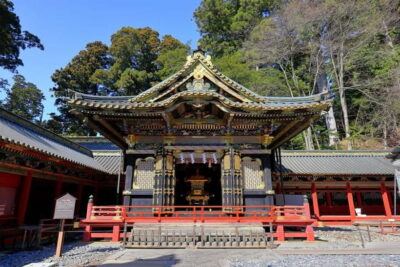
Kamakura & Enoshima Day Trip including Temple Tickets
Read our review →
Nikko Toshogu Shrine and Kegon Waterfall Tour
Read our review →
Tokyo Panoramic 1 Day: Meiji Shrine, Asakusa, Odaiba and SKYTREE®
Read our review →
1-Day Snow Monkeys, Zenko-ji Temple & Sake in Nagano
Read our review →Browse the lists this tour appears in